


Smitten means being completely overwhelmed by romantic attraction to someone so captivated that you can’t stop thinking about them. It describes that giddy, heart‑racing feeling of being “struck” by another person, typically in the early stages of falling for them.
Let’s be honest. You’ve probably used the word smitten before. Maybe you’ve called a friend smitten over their new partner. Perhaps you’ve described yourself that way after a particularly amazing first date.
But here’s the thing. Most people don’t actually understand the full smitten meaning. They know it means “really likes someone,” but they miss the rich history, the specific intensity, and the crucial differences between being smitten and being in love.
The smitten definition is deceptively simple. Smitten is an adjective describing someone who feels overwhelming affection, attraction, or romantic interest toward another person. When you’re smitten, you’re completely captivated. Your thoughts drift toward that person constantly. Seeing them makes your heart race. Hearing their name brings an involuntary smile.
But there’s so much more to it.
The meaning of smitten carries weight. It suggests a feeling so powerful it practically overwhelms you. You don’t get mildly smitten. You are smitten. It’s an all-or-nothing emotional state that changes how you think, act, and feel.
The Surprising Origin | Why “Smitten” Means “Struck”
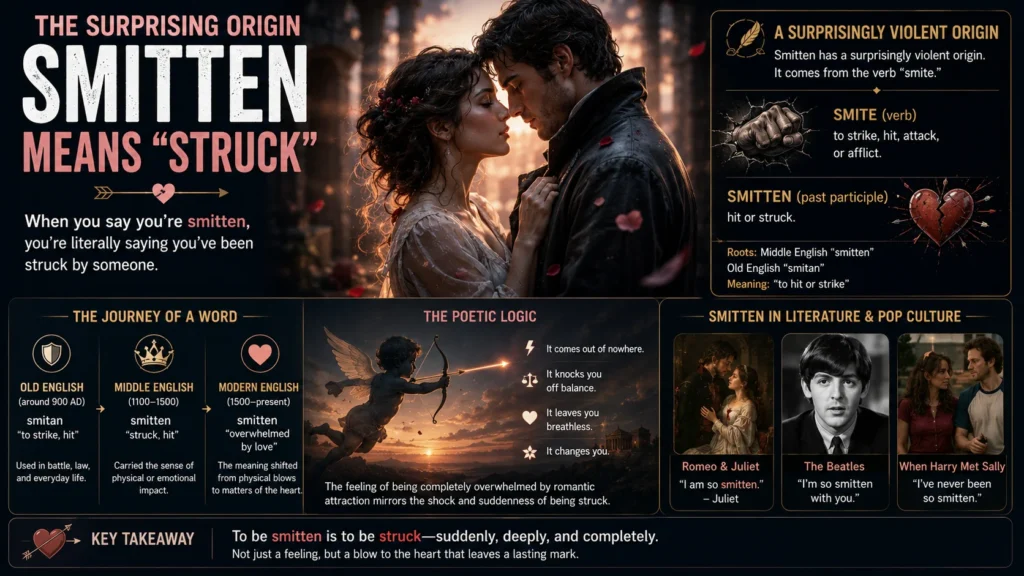
Here’s where the smitten meaning gets genuinely fascinating. Most people assume smitten is just a fluffy romantic term invented by poets or romance novelists. That’s not even close to the truth.
Smitten has a surprisingly violent origin.
The word smitten is actually the past participle of the verb “smite.” Yes, that smite. The word that means to strike, hit, attack, or afflict. Its roots trace back to Middle English “smitten” and Old English “smitan,” both meaning “to hit or strike.”
Think about that for a moment. When you say you’re smitten with someone, you’re literally saying you’ve been struck by them. Like a blow. Like lightning. And like Cupid’s arrow piercing straight through you.
There’s a poetic logic here. The feeling of being completely overwhelmed by romantic attraction often mirrors the shock and suddenness of being physically hit. It comes out of nowhere. It knocks you off balance. And it leaves you breathless and changed.
The Unfortunate Literal Definitions
Because it comes from “smite,” smitten also technically means:
- Struck with a hard blow
- Grievously or disastrously stricken or afflicted
- Overwhelmed by something powerful
Obviously you’re not using it that way in modern conversation. Nobody says “I was smitten by a falling branch” when they mean they got hit by one. But this background adds texture. The romantic smitten meaning feels more dramatic and intense when you understand its roots in sudden, overwhelming impact.
The Evolution of the Word
Language evolves in fascinating ways. The journey of smitten from “physically struck” to “romantically captivated” shows how humans have always connected love to powerful, overwhelming forces.
Here’s the timeline:
- Old English (450-1150 AD): “Smitan” meant to strike or hit in a physical sense
- Middle English (1150-1500 AD): “Smitten” still referred to physical blows but started appearing in religious texts describing being “struck by God’s wrath”
- Early Modern English (1500-1700 AD): The metaphorical meaning began emerging. People used smitten to describe being “struck” by emotions, ideas, or beauty
- Modern English (1700-present): The romantic smitten meaning became dominant. Today, most people don’t even realize the word’s violent origins
This evolution mirrors how we describe love itself. We say we “fell” in love, as if it were an accident. We’re “struck” by someone’s beauty. We “lose our hearts” as if hearts could be misplaced. The language of love has always borrowed from the language of sudden, overwhelming forces.
Smitten Meaning in Love vs. Smitten Meaning in a Relationship
Context matters enormously when understanding the smitten meaning. The word describes slightly different experiences depending on where you are in your romantic journey.
Smitten Meaning in Love
In the context of love, being smitten describes that initial rush of attraction. It’s the beginning, not the destination. You’re still getting to know the person. Everything about them seems perfect and magical.
What smitten in love looks like:
- You think about them constantly, even when you’re busy
- You replay your interactions in your head, analyzing every word and gesture
- You feel nervous and excited before seeing them
- Their text messages make you smile like an idiot
- You want to know everything about them but you’re still learning
- Your friends tease you about how obvious your feelings are
- Everything they do seems cute or interesting
Smitten in love is intoxicating. It’s the phase where you stay up too late talking, where you can’t focus on work because they’re in your head, where the world seems brighter and more colorful. It’s like dipping a toe into the pool of what it feels like to truly fall for someone.
Smitten Meaning in a Relationship
Once you’re in an established relationship, the smitten meaning shifts slightly. You’re no longer in the giddy discovery phase. You know this person. You’ve seen their flaws. You’ve had disagreements.
But you’re still smitten.
What smitten in a relationship looks like:
- You still get excited to see them after a long day
- You find them attractive even when they’re in sweatpants
- You remember the small things that made you fall for them
- You actively choose them every day
- You feel proud to be with them
- Their happiness genuinely matters to you
- You look at them sometimes and think “I can’t believe I get to be with this person”
The key difference: In love, smitten is about discovery and excitement. In a relationship, smitten is about appreciation and continued attraction. It’s the feeling that even though you know this person well, they still manage to captivate you.
Smitten From a Girl vs. Smitten From a Guy
Does the smitten meaning change based on gender?
The short answer is no. The actual emotion is identical. Both men and women experience the same overwhelming attraction, the same giddiness, the same inability to stop thinking about someone.
However, cultural expectations can influence how people express being smitten.
How smitten might look from a guy:
- He might go out of his way to help you or do favors for you
- He might be more protective or attentive
- He might joke around more to make you laugh
- He might get noticeably nervous or awkward around you
How smitten might look from a girl:
- She might play with her hair or smile more when you’re around
- She might remember small details you mentioned
- She might introduce you to her friends earlier than usual
- She might text you more frequently or send you things that remind her of you
The important thing: These are generalizations, not rules. People express smitten feelings in countless ways. The core experience remains the same regardless of gender.
Smitten vs. In Love vs. Obsessed
This is where people get genuinely confused. Smitten, in love, and obsessed describe different emotional states, but they overlap in confusing ways.
Smitten vs. In Love: The Essential Difference
Love runs deep. It takes time, trust, and genuine knowing. You can’t truly love someone you just met, no matter how intense the chemistry feels.
Smitten happens quickly. It’s more about the excitement of discovery and the thrill of new attraction. It’s “like dipping a toe into a pool of what it is like to fall for someone.”
The feeling of being smitten is real. It’s not fake or invalid. But it’s still in its early stages.
| Aspect | Smitten | In Love |
|---|---|---|
| Timeline | Immediate, intense | Develops over time |
| Depth | Surface to moderate | Deep, comprehensive |
| Knowledge | Limited about the person | Complete, flawed knowledge |
| Duration | Can fade or grow | Endures through challenges |
| Commitment | Tentative | Strong, intentional |
| Feeling | Giddy, excited, nervous | Secure, comfortable, trusting |
Here’s a helpful analogy. Being smitten is like seeing a beautiful landscape for the first time. You’re overwhelmed by its beauty. You can’t stop looking at it. Being in love is like living in that landscape. You know its seasons, its storms, its hidden corners. You love it even when it’s not beautiful.
Smitten vs. Infatuated
Infatuated carries a slightly negative or irrational connotation. It suggests an attraction that might be shallow, obsessive, or disconnected from reality.
Smitten feels more positive and charming. It’s the giddy, happy stage before things get complicated.
Key differences:
- Smitten is fun, exciting, and generally healthy. You’re enjoying the feeling.
- Infatuated often involves idealization. You might not really see the person clearly.
- Smitten is usually short-term. It either grows into love or fades.
- Infatuated can last longer but often stays shallow.
Smitten vs. Obsessed
Obsessed sounds unhealthy and consuming. It suggests a loss of control, fixation, and potentially harmful behavior.
Smitten is different. You’re captivated, not controlled. You think about the person often, but you can still function. You want them, but you don’t need them desperately in an unhealthy way.
The spectrum looks like this:
Crush → Smitten → Infatuation → Obsession
Each step involves more intensity and less control. Smitten sits in the sweet spot where the feeling is powerful but still healthy.
How to Use Smitten in a Sentence
Using the word correctly is simple once you understand the grammar.
The Correct Grammar
Smitten is almost always followed by one of two prepositions:
- Smitten with (someone or something)
- Smitten by (someone)
Both are acceptable. “Smitten with” is slightly more common in modern usage.
Real-World Examples
Here are real-world examples to help you nail the usage:
“He was completely smitten with her from the moment they met.”
“The CEO was so smitten with the candidate’s presentation that he offered her the job on the spot.”
“She’s been smitten with the new guy in accounting ever since he helped her fix the printer.”
“I can’t help noticing how smitten my brother is with his new girlfriend. He’s always smiling at his phone.”
“The puppy seemed smitten with its new owner, following her everywhere from the first day.”
Common Mistakes to Avoid
Incorrect: “I am smitten to her.”
Correct: “I am smitten with her.”
Incorrect: “She feels smitten about him.”
Correct: “She feels smitten by him.”
Incorrect: “They are smitten for each other.”
Correct: “They are smitten with each other.”
When Not to Use Smitten
The word works best for romantic attraction. Using it for non-romantic situations feels forced or joking.
Works well:
- Smitten with my new partner
- Smitten by your charm
- Smitten with our new puppy
Doesn’t work well:
- Smitten with my breakfast
- Smitten by the weather
- Smitten with this spreadsheet
You could use it humorously for non-romantic things. “I’m absolutely smitten with this pizza” is obviously a joke. But the core smitten meaning remains romantic.
Synonyms for Smitten and Their Nuances
Expanding your vocabulary helps you express yourself more precisely. Here are the best alternatives to smitten.
High Intensity Synonyms
| Word | Meaning | Best Used For |
|---|---|---|
| Captivated | Held in thrall by someone’s charm | Strong, focused attraction |
| Enchanted | Like under a magical spell | A sense of wonder and delight |
| Mesmerized | Hypnotized by their presence | Being utterly fascinated |
| Bewitched | Cast under their spell | Feeling magically drawn to someone |
| Lovestruck | Struck by love | Very close to smitten in meaning |
Medium-High Intensity Synonyms
| Word | Meaning | Best Used For |
|---|---|---|
| Infatuated | Intense but short-lived attraction | Early-stage intense feelings |
| Head over heels | Classic idiom for deep attraction | Being completely swept away |
| Taken with | Attracted to or charmed by | More formal, slightly restrained |
| Enamored | Filled with love or admiration | A mix of love and respect |
More Playful Synonyms
- Gaga – “He’s gone gaga over her” (very informal)
- Stuck on – “She’s really stuck on that guy” (casual)
- Nuts about – “I’m nuts about my new girlfriend” (friendly)
- Gone on – “He’s really gone on her” (British, informal)
Choosing the Right Word
Smitten is the best choice when:
- You want to sound charming and slightly romantic
- The feeling is strong but not yet love
- You’re describing an early-stage attraction
- You want to avoid sounding too serious
Use another word when:
- You need to be more formal (use “enamored” or “taken with”)
- You want to emphasize the magical quality (use “enchanted”)
- You want to sound casual and playful (use “stuck on” or “nuts about”)
- You’re describing a long-term, deep love (use “in love” or “devoted”)
The Opposite of Smitten | What to Use Instead
When you want to describe the exact opposite of being smitten, here are your options.
The Best Antonyms
Indifferent – Having no particular interest or opinion. You’re not attracted, but you’re not actively repulsed either.
Uninterested – Not engaged or curious. You simply don’t care.
Unaffected – Not moved or impacted. Their presence or absence makes no difference to you.
Detached – Emotionally disconnected. You might notice them, but you don’t feel anything.
Unmoved – Not feeling anything. Their charm doesn’t work on you.
Put off – Actively turned away or repelled. You’re not just not attracted; you’re actively not interested.
The Spectrum of Attraction
Understanding where smitten sits on the spectrum of attraction helps clarify its opposite.
| Level | Description | Example |
|---|---|---|
| Obsessed | Consumed, unhealthy fixation | “I can’t stop thinking about them” |
| Smitten | Overwhelming attraction | “I’m completely captivated” |
| Attracted | Interested and drawn | “They seem interesting” |
| Neutral | No particular feeling | “They’re fine, I guess” |
| Uninterested | No engagement | “I don’t care either way” |
| Repulsed | Actively turned off | “I want to avoid them” |
Is Being Smitten a Good Thing?
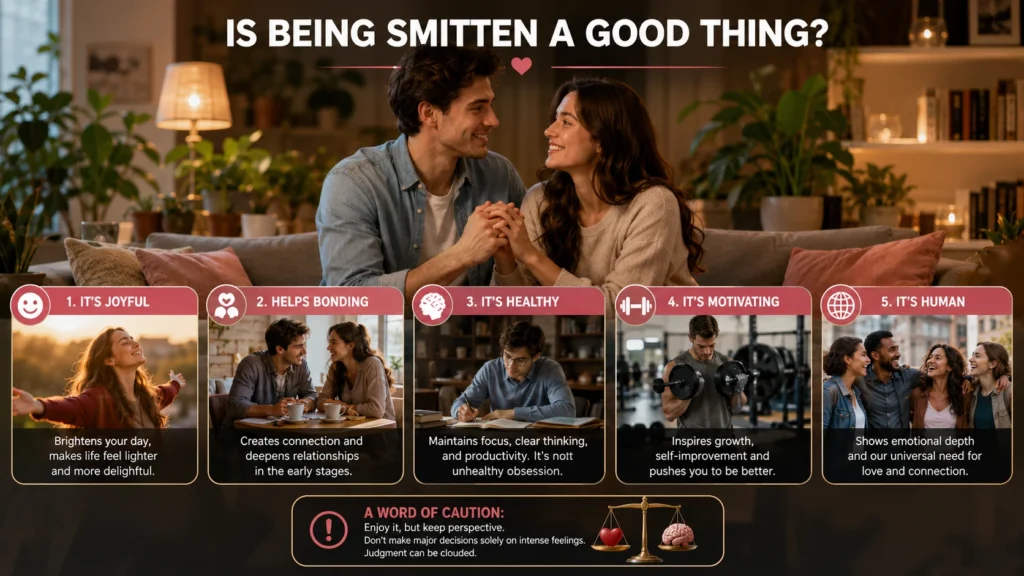
Yes, absolutely. Being smitten is a positive, warm, delightful feeling.
Here’s why:
It’s joyful. The smitten feeling is genuinely pleasant. It brightens your day, gives you something to look forward to, and makes the world feel more colorful.
It helps bonding. Smitten is the earliest stage of falling in love. And it helps couples bond during the initial romantic phase. Without that spark and excitement, many relationships wouldn’t develop.
It’s healthy. Unlike obsession or infatuation, being smitten doesn’t involve losing yourself. You can still think clearly. You’re not sacrificing your wellbeing.
It’s motivating. Feeling smitten can inspire you to be your best self. You want to impress them. You want to grow and improve.
It’s human. The capacity to be smitten shows emotional depth. It connects you to the universal experience of romantic attraction.
A word of caution: Being smitten is wonderful, but don’t make major life decisions based only on feeling smitten. The feeling can cloud your judgment. Enjoy it, but keep some perspective.
The Psychology of Being Smitten
Why does being smitten feel so powerful? The answer lies in your brain chemistry.
What Happens in Your Brain
When you’re smitten, several powerful neurochemicals flood your system:
Dopamine – The reward chemical. It makes you feel pleasure and motivation. When you see or think about the person you’re smitten with, your brain releases dopamine. That’s why they feel addictive.
Norepinephrine – The adrenaline-like chemical. It increases alertness and focus. It also causes physical symptoms like a racing heart and sweaty palms.
Serotonin – This one’s interesting. Early attraction can actually lower your serotonin levels, similar to what happens in obsessive-compulsive disorder. That explains why you can’t stop thinking about them.
Oxytocin – The bonding hormone. It increases with physical touch and emotional closeness. It makes you feel connected and trusting.
The Physical Symptoms of Being Smitten
These chemicals cause real physical effects:
- Racing heart when you see them
- Butterflies in your stomach
- Sweaty palms or nervous energy
- Difficulty sleeping or eating normally
- Loss of appetite (or wanting to eat everything)
- Feeling jittery or excited
- Smiling involuntarily when you think about them
- Inability to concentrate on other things
The High and the Crash
Here’s the thing about these chemicals. They don’t stay at peak levels forever.
The smitten feeling usually peaks within 6-12 months. After that, the brain’s chemical profile changes. The intensity fades. This doesn’t mean the attraction dies. It just means the intense smitten phase naturally evolves.
This is a crucial insight. Many people mistake the fading of smitten feelings for falling out of love. But that’s not what’s happening. You’re just moving from the excitement of discovery to something deeper and more sustainable. Smitten by you meaning. Absolutely smitten meaning.
Signs Someone Is Smitten With You
How can you tell if someone is truly smitten?
The Obvious Signs
They light up when they see you. No matter how tired or stressed they are, their face changes when you walk in. You can see genuine joy.
They remember small details. You mentioned your favorite ice cream once. They show up with it a month later. You mentioned you were nervous about a presentation.
They go out of their way. They take the long route to see you. And they offer to help with things.
The Subtle Signs
They mirror your body language. When you lean in, they lean in. When you smile, they smile.
They remember dates and details. Anniversaries. Important events. Things you never expected anyone to remember.
They talk about you to others. Their friends know a lot about you. You keep meeting people who “already know all about you.”
They treat you differently than others. You get more attention, more care, more consideration.
They’re protective. Not in a controlling way. In a caring way. They want you to be safe and happy.
What It Means When Someone Says They’re Smitten
When someone says “I’m smitten with you,” they’re making a relatively serious declaration.
- It’s more than “I like you.” It’s a confession of significant attraction.
- It’s less than “I love you.” They’re not committing to forever yet.
- It’s vulnerable. They’re exposing genuine feelings.
- It’s charming. The word itself carries a pleasant, romantic tone.
What to say back: If you feel the same way, say so. “I think I’m smitten with you too” works perfectly. If you’re unsure, be honest but kind. “That means so much to me. I really care about you too.”
Smitten Meaning in Texting and Social Media
The smitten meaning stays the same in digital communication, but context matters.
What “Smitten” Means in a Text
If someone texts you “I’m smitten”:
- They’re making a deliberate, somewhat cute declaration
- They chose the word purposefully
- They’re expressing meaningful attraction
- They want you to know how they feel
The response matters. This isn’t a casual comment. It’s a confession.
How to Respond
| If You Feel Similarly | If You’re Not Sure | If You Don’t Feel The Same |
|---|---|---|
| “I’m smitten with you too!” | “That’s so sweet. I really care about you.” | “I’m flattered, but I see you as a friend.” |
| “Reading that made my day.” | “You’re wonderful. I’m just not ready for that yet.” | “I appreciate you telling me, but I don’t feel the same way.” |
| “Me too. I was just nervous to say it.” | “I need time to figure out how I feel.” | “I don’t want to lead you on. I’m sorry.” |
Emojis That Complement “Smitten”
When you’re texting about being smitten, emojis can help convey the right tone:
- 😍 – Smitten face with heart eyes
- ❤️ – Simple heart
- 🥰 – Smiling face with hearts
- 💕 – Two hearts
- 😊 – Warm smile
- 🙈 – Shy, feeling exposed
How to Handle Being Smitten
The smitten feeling can be overwhelming. Here’s how to handle it healthily.
Enjoy It
Being smitten is genuinely joyful. Let yourself feel it. Don’t try to suppress or analyze everything. Sometimes the best thing is simply to enjoy the ride.
Maintain Perspective
Remember the smitten meaning includes temporary intensity. The feeling won’t last forever in its current form. That’s okay. Enjoy it while it’s here.
Don’t Make Major Decisions
Getting a tattoo of their name while smitten is a famously bad idea. So is moving in together in the first week. Let the smitten feeling settle before making big commitments.
Stay Connected to Reality
When you’re smitten, you’re seeing the person through rose-colored glasses. That’s fine. But remember they’re human. They have flaws. No one is perfect.
Let It Grow or Let It Go
Smitten is a starting point. It either grows into something deeper or fades away. Both outcomes are okay. Not every smitten moment needs to become a lifelong love story.
How to Tell If You’re Smitten
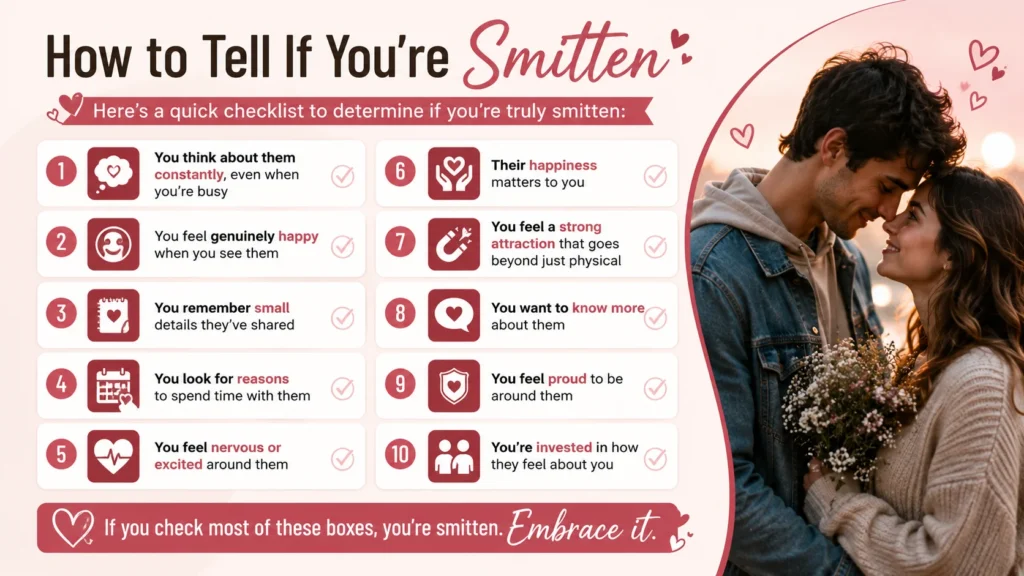
Here’s a quick checklist to determine if you’re truly smitten:
- You think about them constantly, even when you’re busy
- You feel genuinely happy when you see them
- You remember small details they’ve shared
- You look for reasons to spend time with them
- You feel nervous or excited around them
- Their happiness matters to you
- You feel a strong attraction that goes beyond just physical
- You want to know more about them
- You feel proud to be around them
- You’re invested in how they feel about you
If you check most of these boxes, you’re smitten. Embrace it.
FAQs
Is smitten a good thing?
Yes, absolutely. Being smitten is a positive, warm, delightful feeling. It’s usually the earliest stage of falling in love. It’s good because it helps couples bond during the initial romantic phase.
Does smitten mean you are in love?
Not exactly. It’s close but different. Smitten describes the exciting rush of new attraction. Love involves deep commitment, trust, and time. You can be smitten without being in love yet.
What does smitten mean in a relationship?
In a relationship, smitten means you’re still captivated by your partner. Even after the initial excitement fades, you remain attracted and appreciative. The feeling is less intense but more stable.
Is smitten a crush?
Yes, effectively. The smitten feeling is basically an intense crush. “Crush” can feel casual or teenage-like. Smitten feels more mature and romantic, but they describe similar emotions.
How long does being smitten last?
The intense smitten phase typically peaks within 6-12 months. After that, the feeling naturally fades into something deeper or disappears entirely. This doesn’t mean something’s wrong. It’s a normal progression.
Can you be smitten with someone you’re not dating?
Absolutely. Being smitten describes how you feel, not your relationship status. You can be smitten with a friend, a coworker, or someone you just met. The feeling doesn’t require reciprocity.
What’s the difference between smitten and attracted?
Attracted is broader. You can be attracted to someone’s appearance, personality, or energy. Smitten is more specific. It means you’re completely captivated, not just casually interested.
What’s the right way to use smitten in a sentence?
Use “smitten with” or “smitten by.” For example: “I’m smitten with my new boyfriend” or “She was smitten by his charm.”
What’s the past tense of smitten?
This is a common confusion point. Smitten is already the past participle of smite. You can’t be “smittened.” You simply “are smitten.” For past tense, you’d say “was smitten” or “were smitten.”
Can you be smitten with yourself?
Not really. The smitten meaning specifically describes attraction toward someone else. Being confident and self-loving is wonderful, but it’s not smitten.
What does “I’m smitten with you” mean?
“I’m smitten with you” means I am deeply attracted to you or have strong romantic feelings for you. It usually suggests affection, admiration, or being happily infatuated with someone, especially in the early stages of a crush or romance.
What is smitten mean?
Smitten means being strongly attracted to or deeply affectionate toward someone. It is often used to describe the feeling of having a crush or being romantically captivated by a person.
Conclusion
The smitten meaning captures something uniquely human. It describes that magical moment when someone walks into your life and leaves you feeling absolutely, wonderfully struck.
Here’s what to remember:
The word comes from “smite,” meaning “to strike.” You’re literally struck by attraction. It’s not the same as love. It’s the exciting beginning. And it’s a positive, healthy, joyful feeling. Use it with “with” or “by.”
You’re using the smitten definition to understand your own feelings or to describe someone else’s, you’re tapping into one of the most charming words in the English language. It captures that giddy, heart-racing moment when love first starts to bloom.
Being smitten is a gift. It reminds us we’re capable of deep feeling. It connects us to others. And it makes life feel exciting and new. i’m smitten with you meaning.
So next time you feel that rush of attraction, own it. You’re not just interested. You’re not just curious. You’re smitten. And that’s a beautiful thing.
Discover More Related Articles:
- “A Burger and a Grape Snow Cone” Mean: in Social Media Slang Guide In 2026
- “Diddy” Meaning in Texting: When & How It’s Used In 2026
- “SMH” Mean in Text: Don’t Misuse This Acronym In 2026