
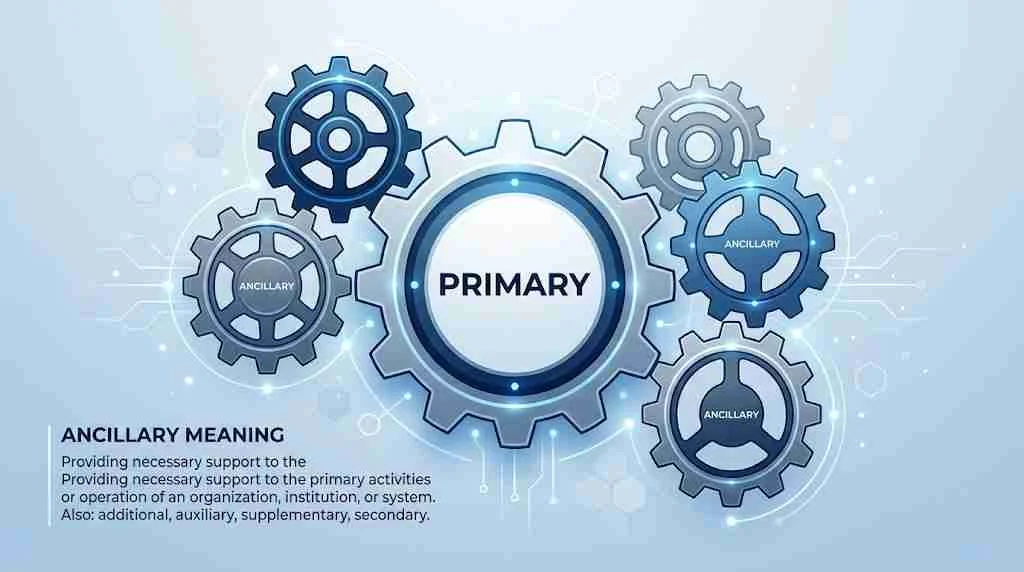

Ancillary describes something that provides support or assistance to a main activity, person, or operation. It is secondary in importance but often essential for the primary thing to function smoothly or successfully.
Let’s get straight to the point. You want to know what ancillary means. We will break this down so thoroughly that you will never confuse this word again.
The ancillary meaning refers to something that provides support or additional help to a main activity or purpose. Think of it as the backbone that holds up the primary function. It is not the star of the show, but the show cannot go on without it.
This word comes from the Latin word ancilla, which means maidservant or handmaiden. A maidservant supports the household. She does not run it, but the household would struggle without her. This perfectly captures the ancillary meaning.
The ancillary definition has two main uses. As an adjective, it describes something that provides necessary support to primary operations. As a noun, it refers to a person or thing that provides this support.
Understanding this concept matters because you encounter ancillary elements constantly. Your morning coffee comes with ancillary products like pastries or milk alternatives. Your hospital visit includes ancillary services like lab work or X-rays. And your job likely involves ancillary tasks that support your main responsibilities.
When you grasp the ancillary meaning, you start seeing support structures everywhere. You notice how systems depend on these secondary but essential components. This awareness helps you make better decisions in business, healthcare, education, and daily life.
The Core Definition | What Does Ancillary Mean?
Let’s establish a rock-solid understanding of what does ancillary mean in practical terms.
Ancillary (adjective):
- Providing necessary support to the primary activities or operation of an organization, system, or process
- Existing as a subordinate or secondary part of something larger
- Supplementary or additional in nature
Ancillary (noun):
- A person whose work provides support to others
- Something that is subordinate or supplementary to something else
The ancillary word meaning always implies a relationship. You cannot have ancillary without something primary. It exists in connection to something more important.
This relationship creates three key characteristics:
- Subordination – Ancillary elements rank below primary elements in importance
- Support – Ancillary elements exist to help primary elements succeed
- Dependency – Ancillary elements derive their purpose from primary elements
When you understand these characteristics, you can identify ancillary elements in any system. Look for what supports the main function. Look for what would lose its purpose without the primary activity. That is the ancillary meaning in action.
Ancillary Meaning in English | Pronunciation and Usage
The ancillary meaning in English comes with specific pronunciation rules. Say it as AN-suh-lair-ee. The stress falls on the first syllable.
Common pronunciation mistakes include:
- an-SIL-uh-ree – Wrong stress pattern
- AN-sill-airy – Incorrect vowel sounds
- an-sill-AR-ee – Misplaced emphasis
Using this word correctly requires understanding its grammatical role.
As an adjective:
- “The company offers ancillary services to its clients.”
- “Her ancillary duties include managing the office supplies.”
As a noun:
- “The ancillaries in this department keep everything running smoothly.”
- “We need more ancillaries to support our expanding operations.”
Many people confuse ancillary with similar words. Do not make these mistakes.
Ancillary vs Auxiliary
Auxiliary implies a backup or reserve function. It steps in when needed. Ancillary implies ongoing support that depends on the primary function. Auxiliary police officers supplement the main force during emergencies.
Ancillary vs Supplementary
Supplementary adds something that completes or extends the main thing. Ancillary subordinates itself to the primary function. A supplementary textbook adds material to a course. And ancillary tutors help students understand the main material.
Ancillary vs Secondary
Secondary simply means second in order or importance. And ancillary means supportive and connected to something primary. Secondary issues may have no connection to each other. Ancillary elements always connect to the main activity.
Ancillary Services Meaning | The Business Perspective
The ancillary services meaning drives significant value in modern business. These services complement primary offerings and often generate substantial revenue.
Ancillary services are extra services that support or enhance a main service. They are not the core product, but they make the core product more valuable or usable.
Consider how airlines operate. The primary service is transporting passengers from point A to point B. Ancillary services include:
- Baggage fees
- Seat selection fees
- Priority boarding
- In-flight meals and beverages
- Wi-Fi access
- Travel insurance
These ancillary services generated over $100 billion in global airline revenue. That massive figure shows how supporting services can become profit centers.
The ancillary services meaning matters because these extras often have higher profit margins than core services. The airline already flies the plane. Selling you a seat upgrade costs almost nothing but brings in pure profit.
Why businesses love ancillary services:
| Benefit | Explanation |
|---|---|
| Higher margins | Ancillary services often cost less to deliver than primary services |
| Customer retention | Good ancillary services improve the overall experience |
| Competitive advantage | Unique ancillary offerings set businesses apart |
| Revenue diversification | Dependence on a single revenue stream becomes less risky |
| Low acquisition costs | Existing customers are cheaper to sell to than new ones |
However, ancillary services come with risks. Poorly designed ancillary offerings damage trust. Hidden fees anger customers. Low-quality extras reflect poorly on the main product.
Best practices for ancillary services:
- Keep them genuinely useful
- Make pricing transparent
- Connect them clearly to the main offering
- Deliver quality that matches the primary product
- Avoid excessive upsells that annoy customers
The ancillary services meaning extends beyond business. You find these services in healthcare, education, technology, and government. Anywhere a primary service exists, ancillary services follow.
Ancillary Support Meaning | The Operational View
The ancillary support meaning focuses on help that is additional or supplementary to primary operations. This support exists because the main activity exists. Remove the main activity, and the support disappears.
Ancillary support comes in many forms.
In information technology:
- Help desk services that assist users
- Backup systems that protect data
- Network monitoring that prevents outages
- Security protocols that guard against threats
In education:
- Tutoring centers that help struggling students
- Counseling services that support mental health
- Writing labs that improve assignments
- Career services that prepare students for employment
And in corporate settings:
- Human resources that manage employee needs
- Facilities management that maintains workspaces
- Training departments that develop skills
- Research teams that inform decisions
The ancillary support meaning emphasizes that this help enables primary functions. A help desk does not create the software product. But without help desk support, users would struggle and abandon the product.
Quality ancillary support creates competitive advantages. Companies with excellent support retain customers longer. Schools with strong support services graduate more students. Organizations with robust support systems operate more smoothly.
The cost of poor ancillary support:
- Customer churn increases
- Employee frustration grows
- Productivity declines
- Reputation suffers
- Revenue drops
Investing in ancillary support pays dividends. The returns come from improved satisfaction, better retention, and smoother operations.
Ancillary Role Meaning | Understanding Support Positions
The ancillary role meaning describes positions that assist or support primary functions. These roles are not the main attraction, but they make the main attraction possible.
Consider a law firm. The partners bring in business and win cases. But they depend on associates, paralegals, administrative assistants, and support staff. These ancillary roles handle research, documentation, scheduling, and client communication.
Without these roles, the partners could not function effectively. They would spend hours on administrative work instead of practicing law.
Common ancillary roles across industries:
| Industry | Primary Roles | Ancillary Roles |
|---|---|---|
| Healthcare | Doctors, Surgeons | Nurses, Technicians, Administrators |
| Education | Teachers, Professors | Teaching Assistants, Counselors, Librarians |
| Technology | Developers, Engineers | QA Testers, Technical Writers, Support Staff |
| Finance | Traders, Analysts | Operations Staff, Compliance Officers, Clerks |
| Manufacturing | Production Workers | Quality Control Inspectors, Maintenance Staff |
The ancillary role meaning highlights that these positions are essential. They may not have primary authority or decision-making power. But they create the conditions for success.
People in ancillary roles often develop deep expertise. They know systems inside and out. They understand how things work in practice. Their knowledge becomes invaluable for problem-solving and innovation.
Advancing from ancillary to primary roles:
- Build expertise in your support function
- Learn how your work impacts primary operations
- Develop complementary skills
- Take on additional responsibilities
- Seek mentorship from primary role holders
- Demonstrate your value consistently
Many leaders started in ancillary roles. They learned the business from the ground up. They understood how everything connected. This foundation made them better leaders later.
Ancillary Work Meaning | Tasks That Support the Main Job
The ancillary work meaning covers tasks that support the main job without being the main job itself.
For a teacher, ancillary work includes:
- Grading papers and exams
- Preparing lesson materials
- Communicating with parents
- Attending faculty meetings
- Updating grade books
- Planning field trips
- Managing classroom behavior
Teaching is the primary work. But teachers spend significant time on ancillary work. This supporting work makes effective teaching possible.
For a sales professional, ancillary work includes:
- Updating customer relationship management systems
- Preparing presentations
- Researching prospects
- Following up on leads
- Completing paperwork
- Coordinating with other departments
Selling is the primary work. But ancillary work consumes considerable time. Ignoring this supporting work hurts sales performance.
The 80/20 rule often applies to ancillary work. About 80% of results come from 20% of efforts. The core activities drive most outcomes. Ancillary work supports those core activities.
However, some ancillary work creates leverage. A few hours of preparation saves days of execution. A little research prevents major mistakes. Smart professionals optimize their ancillary work for maximum impact.
Optimizing ancillary work:
- Identify your most valuable ancillary tasks
- Automate repetitive ancillary work
- Delegate low-value ancillary tasks
- Schedule ancillary work for low-energy times
- Connect ancillary work to primary outcomes
- Measure how ancillary work affects primary results
The ancillary work meaning teaches us that support tasks matter. They may not be glamorous, but they enable success.
Ancillary Function Meaning | Supporting System Operations
The ancillary function meaning describes specific supporting activities within a larger system. These functions serve the primary purpose but are not the primary purpose themselves.
In manufacturing, quality control is an ancillary function. The main function is production. But without quality control, you would ship defective products and ruin your reputation.
In healthcare, medical records management is an ancillary function. The main function is patient care. But without accurate records, care becomes dangerous and inefficient.
In software development, testing is an ancillary function. The main function is coding. But without testing, bugs escape and users suffer.
Key characteristics of ancillary functions:
- They support primary operations
- They are not the main activity
- They are necessary for success
- They often involve specialized skills
- They interact with primary functions
The ancillary function meaning reveals the interconnected nature of systems. Every function depends on others. Ancillary functions enable primary functions to operate effectively.
Examples of ancillary functions:
| System | Primary Function | Ancillary Functions |
|---|---|---|
| Restaurant | Food Preparation | Inventory Management, Cleaning, Scheduling |
| Hospital | Patient Treatment | Billing, Sanitation, Medical Records |
| School | Education | Registration, Grading, Counseling |
| Bank | Financial Services | Compliance, Auditing, Customer Service |
| Factory | Production | Maintenance, Quality Control, Logistics |
Ancillary functions often become specialized areas of expertise. People dedicate entire careers to these supporting functions. Their work enables the primary functions to succeed.
Innovation often happens in ancillary functions. Someone finds a better way to maintain equipment. Quality control improves through new techniques. Customer service becomes more efficient. These improvements cascade into better primary operations.
Ancillary Staff Meaning | The People Behind the Scenes
The ancillary staff meaning refers to employees who provide support services without being directly involved in core operations.
In a hospital, ancillary staff includes:
- Medical technicians
- Lab workers
- Administrative personnel
- Housekeeping staff
- Dietary workers
- Maintenance workers
- Security guards
These people are not doctors or nurses. But patients could not receive proper care without them. Lab workers process tests that guide treatment. Housekeeping staff prevent infections. Dietary workers ensure patients receive proper nutrition.
The value of ancillary staff:
- They handle essential support functions
- They free primary staff to focus on core work
- They maintain the environment for success
- They provide specialized expertise
- They ensure smooth daily operations
Ancillary staff often go unnoticed. Their work happens behind the scenes. But when they stop doing their jobs, everything falls apart.
Respecting ancillary staff:
- Acknowledge their contributions
- Include them in team communications
- Provide proper training and resources
- Offer career development opportunities
- Recognize their achievements
- Pay them fairly for their work
Organizations that treat ancillary staff well benefit immensely. Staff turnover decreases. Morale improves. Service quality increases. The entire organization runs more smoothly.
The ancillary staff meaning reminds us that every role matters. Support positions are not less important. They are differently important. They make the core work possible.
Ancillary Products Meaning | Add-Ons That Enhance Value
The ancillary products meaning covers supplementary items sold alongside the main product. These products add value and often generate significant revenue.
At a coffee shop, ancillary products include:
- Pastries and baked goods
- Bottled drinks
- Merchandise like mugs or bags of coffee
- Gift cards
- Coffee-making equipment
Coffee is the primary product. But those pastries boost revenue and enhance the customer experience. Many customers buy a pastry with their coffee. The combination feels like a complete experience.
In technology, ancillary products include:
- Accessories like cases or chargers
- Extended warranties
- Premium features or subscriptions
- Training materials
- Consulting services
Why ancillary products matter:
- They increase average transaction value
- They improve customer satisfaction
- They differentiate the brand
- They create recurring revenue streams
- They build customer loyalty
The ancillary products meaning connects to cross-selling strategies. When customers buy one thing, offer them something complementary. This approach increases revenue and improves the customer experience.
Effective ancillary product strategies:
- Understand what complements your main product
- Price ancillary products competitively
- Make ancillary products easy to add
- Highlight the value of the combination
- Train staff to suggest appropriate add-ons
- Avoid pushing irrelevant ancillary products
Customers appreciate helpful add-ons. They resent unnecessary upsells. The distinction lies in the ancillary product genuinely adds value.
Ancillary Business Meaning | Supporting Commercial Activities
The ancillary business meaning refers to commercial activities that support a primary business. These activities often generate significant revenue while enhancing the core offering.
A car dealership with a repair shop runs an ancillary business. The repair shop supports the main business of selling cars. But it also operates as its own profit center. Customers who buy cars return for service. Customers who need service might buy cars.
A gym with a smoothie bar runs an ancillary business. The smoothie bar supports the main business of fitness. But it generates additional revenue and enhances the member experience. People who work out want refreshments. People who want refreshments might join the gym.
Types of ancillary businesses:
- Service-based – Providing services that complement products
- Product-based – Selling products that complement services
- Information-based – Offering guidance that supports primary offerings
- Event-based – Hosting events that enhance the main business
The ancillary business meaning reveals important opportunities. Many successful companies have built significant revenue streams from ancillary activities. These businesses create synergy between primary and supporting offerings.
Benefits of ancillary businesses:
- Diversified revenue streams
- Enhanced customer relationships
- Increased customer loyalty
- Competitive differentiation
- Efficient use of existing resources
- Improved brand perception
Risks of ancillary businesses:
- Distraction from core operations
- Dilution of brand focus
- Additional operational complexity
- Potential customer confusion
- Increased costs and overhead
Successful ancillary businesses require careful planning. They must align with the primary business. They must add value for customers. And they must operate profitably on their own terms.
Ancillary Activities Meaning | Supporting Endeavors
The ancillary activities meaning covers supporting actions within a larger endeavor. These activities are not the main goal, but they help achieve the main goal.
For an event planner, ancillary activities include:
- Managing RSVPs
- Coordinating vendors
- Handling logistics
- Creating timelines
- Managing budgets
- Communicating with attendees
- Handling unexpected issues
These activities all support the primary goal of throwing a successful event. The event planner could not focus on the main event without managing these supporting details.
For a project manager, ancillary activities include:
- Tracking progress
- Managing risks
- Communicating with stakeholders
- Updating documentation
- Coordinating team members
- Resolving conflicts
- Managing resources
The importance of ancillary activities:
- They enable primary activities
- They prevent problems
- They ensure smooth operations
- They provide necessary support
- They create the conditions for success
Ancillary activities often seem tedious. They lack the excitement of primary activities. But ignoring them leads to failure. Major projects fail because ancillary activities were neglected.
Managing ancillary activities effectively:
- Identify all supporting activities
- Allocate appropriate resources
- Assign clear responsibilities
- Track progress regularly
- Address issues promptly
- Recognize the value of supporting work
Ancillary Charges Meaning| The Hidden Fees
The ancillary charges meaning refers to fees for additional services not included in the base price. These charges often surprise customers and generate significant revenue for businesses.
Airlines pioneered ancillary charges. The base ticket price covers transportation. But you pay extra for:
- Checked baggage
- Seat selection
- Priority boarding
- In-flight meals
- Wi-Fi access
- Travel insurance
These ancillary charges transform airline economics. Base ticket prices have fallen. Ancillary charges have risen. Airlines now generate substantial revenue from these extras.
Common ancillary charges across industries:
| Industry | Base Service | Ancillary Charges |
|---|---|---|
| Hospitality | Hotel Room | Resort Fees, Parking, Wi-Fi, Minibar |
| Banking | Account | ATM Fees, Overdraft Charges, Wire Fees |
| Telecom | Phone Plan | Data Overages, Roaming, Device Insurance |
| Entertainment | Event Ticket | Service Fees, Processing Fees, Delivery Fees |
| Travel | Flight | Baggage, Seat Selection, Meals |
Consumer perspectives on ancillary charges:
- They feel like hidden fees
- They undermine trust in the business
- They complicate price comparisons
- They create negative experiences
- They damage brand reputation
Business perspectives on ancillary charges:
- They enable lower base prices
- They allow customers to pay only for what they use
- They generate needed revenue
- They provide competitive flexibility
- They increase profitability
The ancillary charges meaning creates tension between businesses and consumers. Businesses see value in optional extras. Consumers see hidden fees. Finding balance matters.
Best practices for ancillary charges:
- Make charges transparent upfront
- Explain what customers get for the charge
- Offer value that justifies the cost
- Avoid excessive or predatory charges
- Allow easy comparison of options
- Provide alternatives when possible
Ancillary Costs Meaning | Supporting Expenses
The ancillary costs meaning covers expenses that support primary work but are not part of main costs. These costs often add up significantly.
In construction, ancillary costs include:
- Delivery fees for materials
- Permits from local authorities
- Cleanup services after completion
- Insurance during construction
- Temporary utilities
- Storage for materials
These costs support the primary construction work. They are not part of the main materials or labor costs. But they add significantly to the total project expense.
Types of ancillary costs:
- Transportation costs – Moving materials or people
- Administrative costs – Paperwork, permits, fees
- Facilities costs – Space, utilities, maintenance
- Support costs – Training, consulting, testing
- Compliance costs – Regulations, certifications, inspections
Managing ancillary costs:
- Identify all supporting expenses
- Budget appropriately
- Track actual spending
- Look for cost-saving opportunities
- Negotiate with suppliers
- Consolidate where possible
Businesses often overlook ancillary costs. They focus on major expense categories. But ancillary costs can represent 20-30% of total expenses. Managing them effectively improves profitability.
Common mistakes with ancillary costs:
- Underestimating their magnitude
- Failing to budget for them
- Lacking visibility into their drivers
- Accepting them as fixed costs
- Missing opportunities to reduce them
Ancillary costs are not optional. They come with the primary work. But they can be managed and reduced. Regular review of ancillary costs reveals opportunities for savings.
Ancillary Explained | Understanding the Concept
Ancillary explained simply means understanding support structures. Every system has primary elements and supporting elements. The supporting elements are ancillary.
Think of a tree. The trunk and branches are primary. The leaves and roots are ancillary. The tree needs all parts to survive. But the trunk provides the main structure. The leaves and roots support that structure.
Think of a play. The main actors are primary. The stage crew, lighting technicians, and costume designers are ancillary. The audience comes to see the actors. But without the ancillary support, the actors could not perform.
Key insights about the ancillary concept:
- Ancillary elements depend on primary elements
- Ancillary elements support primary elements
- Ancillary elements are essential despite being secondary
- Ancillary elements often work behind the scenes
- Ancillary elements create the conditions for success
Understanding ancillaries helps you see systems clearly. You notice what supports the main function. You appreciate the supporting players. And you understand how everything connects.
Why the ancillary concept matters:
- It helps you allocate resources effectively
- It reveals dependencies you might miss
- It shows you where to invest for maximum impact
- It helps you design better systems
- It improves your strategic thinking
The ancillary meaning in English connects to this broader concept. It helps you understand how things work together. It reveals the structure underlying complex systems.
Ancillary Meaning with Examples Across Contexts
Let’s explore the ancillary meaning with examples from different contexts. These examples show how the concept applies in real situations.
Example 1: Healthcare
“The hospital invested $5 million in ancillary services including diagnostic imaging, laboratory testing, and rehabilitation therapy. These services support the core medical care provided by physicians and nurses. Patient satisfaction scores increased by 20% after the expansion.”
Example 2: Business
“The consulting firm offered ancillary services like market research and competitor analysis. These services complemented their primary strategy consulting. Revenue from ancillary services grew to 35% of total revenue within two years.”
Example 3: Education
“The university expanded ancillary support for students. They added tutoring centers, writing labs, and mental health services. Graduation rates improved by 15% as a result. These ancillary services made the difference for struggling students.”
Example 4: Technology
“The software company added ancillary features like automated backups and data recovery. These features weren’t the main reason people bought the software. But they made the product much more valuable. Customer retention increased by 25%.”
Example 5: Hospitality
“The hotel offered ancillary services including spa treatments, restaurant reservations, and tour bookings. These services enhanced the guest experience. Revenue per guest increased by 40% compared to room bookings alone.”
Example 6: Manufacturing
“The factory implemented ancillary functions like predictive maintenance and quality control automation. These functions supported primary production operations. Defect rates fell by 60%. Production efficiency improved by 30%.”
Example 7: Finance
“The investment firm provided ancillary services like financial planning, tax preparation, and estate planning. These services complemented their primary investment management. Client retention rates exceeded 95% over five years.”
Example 8: Retail
“The online store offered ancillary products like accessories, extended warranties, and gift wrapping. These products enhanced the main purchase. Average order value increased by 25% when customers added ancillary items.”
Example 9: Government
“The municipal government provided ancillary services like recycling, parks maintenance, and community programs. These services supported the primary functions of public safety, infrastructure, and administration. Quality of life ratings improved significantly.”
Example 10: Technology
“The cloud provider offered ancillary features like security monitoring, compliance reporting, and technical support. These features supported the primary cloud infrastructure service. Customer acquisition increased by 30% due to the comprehensive offering.”
The Strategic Importance of Ancillary Elements
Understanding the ancillary meaning gives you strategic advantages. You see how support structures create value. You recognize opportunities others miss.
Ancillary elements create competitive advantages:
- They differentiate your offering
- They increase customer stickiness
- They generate additional revenue
- They improve customer satisfaction
- They create barriers to competition
Companies that excel at ancillary services dominate their markets. Amazon offers ancillary services like Prime shipping, streaming, and cloud storage. These support the primary retail business. They also generate massive revenue and customer loyalty.
Apple offers ancillary products like cases, headphones, and services. These support the primary device sales. They also create an ecosystem that locks in customers. Switching becomes harder when you own multiple Apple products.
Strategic questions to consider:
- What ancillary elements support your primary offering?
- How can you improve these supporting elements?
- What new ancillary offerings would your customers value?
- How can you monetize ancillary services effectively?
- What ancillary investments would generate the highest returns?
Answering these questions unlocks opportunities. Many businesses focus entirely on their core offering. They ignore the ancillary elements that create true differentiation. You can outperform them by investing in support.
Ancillary and Business Growth
The ancillary meaning connects directly to business growth. Supporting services and products drive expansion and profitability.
Growth pathways through ancillary elements:
- Upselling – Offering better versions of ancillary products
- Cross-selling – Introducing new ancillary categories
- Bundling – Combining ancillaries with primary offerings
- Subscription – Converting ancillaries to recurring revenue
- Ecosystem – Building connected ancillary offerings
Revenue impact of ancillaries:
| Business Type | Primary Revenue | Ancillary Revenue Share |
|---|---|---|
| Airlines | Ticket Sales | 15-35% |
| Hotels | Room Bookings | 20-40% |
| Software | Licenses | 25-50% |
| E-commerce | Product Sales | 10-30% |
| Financial Services | Core Products | 15-25% |
Ancillary revenue represents a significant opportunity. Many businesses derive substantial income from supporting offerings. Ignoring this potential leaves money on the table.
Growth strategy considerations:
- Identify your highest-potential ancillary offerings
- Invest in quality for these offerings
- Market them effectively to existing customers
- Develop new ancillaries based on customer feedback
- Measure and optimize ancillary performance
The businesses that master ancillary offerings grow faster. They capture more value from each customer. They build stronger relationships. And they create more resilient business models.
Ancillary in Healthcare | A Deep Dive
Healthcare provides the clearest examples of ancillary meaning. The healthcare system depends on ancillary services constantly.
Primary healthcare services:
- Medical diagnosis
- Surgical procedures
- Medication prescription
- Emergency treatment
- Preventive care
Ancillary healthcare services:
- Diagnostic imaging (X-rays, MRIs, CT scans)
- Laboratory testing (blood work, urinalysis)
- Physical therapy and rehabilitation
- Pharmacy services
- Medical records management
- Billing and coding
- Home health services
- Hospice care
The ancillary services meaning in healthcare is clear. These services support primary medical care. They enable accurate diagnoses. And they support treatment plans. They improve patient outcomes.
Financial significance of healthcare ancillaries:
- Ancillary services represent 30-50% of healthcare revenue
- Diagnostic imaging generates substantial profits
- Laboratory testing provides reliable income streams
- Physical therapy offers growing demand
- Pharmacy services capture recurring revenue
Healthcare organizations invest heavily in ancillary services. They build imaging centers. They expand laboratory capabilities. And they acquire physical therapy practices. These investments drive growth and profitability.
Quality considerations for healthcare ancillaries:
- Diagnostic accuracy affects treatment decisions
- Timely results improve patient outcomes
- Coordinated care requires integrated ancillaries
- Patient experience depends on ancillary quality
- Regulatory compliance creates additional requirements
Patients expect comprehensive ancillary services. They want tests done quickly. They want results explained clearly. And they want convenient locations. Healthcare organizations that deliver this win patient loyalty.
Ancillary in Education | Supporting Learning
Education systems rely heavily on ancillary support. The ancillary meaning applies throughout the learning process.
Primary educational services:
- Classroom instruction
- Curriculum delivery
- Assessment and grading
- Academic advising
Ancillary educational services:
- Tutoring and academic support
- Counseling and mental health services
- Career guidance and placement
- Library and research resources
- Technology support
- Extracurricular activities
- Student housing and dining
- Health services
- Disability accommodations
These ancillary services support the primary educational mission. They help students succeed in their studies. They address barriers to learning. And they enhance the overall educational experience.
Impact of educational ancillaries:
- Tutoring improves academic performance
- Counseling reduces dropout rates
- Career services improve employment outcomes
- Libraries support research and learning
- Technology access enables modern education
Schools with strong ancillary support outperform those without. Students achieve more. They stay enrolled longer. They graduate at higher rates. And they succeed in their careers.
Investing in educational ancillaries:
- Identify student needs beyond classroom instruction
- Allocate resources to support those needs
- Measure the impact of ancillary programs
- Adjust based on results
- Communicate the value to stakeholders
The ancillary meaning in education matters because learning happens in context. Students need more than lectures and textbooks. They need support that addresses their whole experience.
Ancillary in Technology | Enhancing Digital Products
Technology companies excel at ancillary offerings. The ancillary products meaning takes on new dimensions in digital contexts.
Primary technology products:
- Software applications
- Hardware devices
- Digital platforms
- Cloud infrastructure
Ancillary technology offerings:
- Customer support and training
- Security and compliance services
- Data analytics and reporting
- Integration and customization
- Consulting and implementation
- Extended warranties and insurance
- Premium features and subscriptions
- Accessories and add-ons
These ancillary offerings support the primary technology products. They help customers get more value. They generate additional revenue. And they create customer loyalty.
Tech ancillary revenue models:
- Freemium – Free core product, paid ancillaries
- Subscription – Ongoing payments for ancillary services
- Pay-per-use – Ancillary charges based on usage
- Tiered pricing – Different ancillary packages for different needs
- Ecosystem bundling – Ancillaries integrated across products
Technology companies increasingly rely on ancillary revenue. Software companies generate significant income from support and consulting. Hardware companies profit from accessories and warranties. Platform companies monetize through premium features.
Customer value of tech ancillaries:
- Better support improves user experience
- Security services protect against threats
- Analytics provide actionable insights
- Integration simplifies operations
- Customization addresses specific needs
Customers appreciate valuable ancillary offerings. They willingly pay for services that address their needs. Technology companies that provide great ancillary support win long-term loyalty.
Ancillary in Finance | Supporting Financial Services
Financial services depend heavily on ancillary offerings. The ancillary charges meaning and ancillary services meaning both apply in finance.
Primary financial services:
- Banking accounts
- Investment management
- Insurance policies
- Lending products
Ancillary financial services:
- Financial planning and advice
- Tax preparation and planning
- Estate planning and trusts
- Retirement planning
- Education savings planning
- Insurance products
- Credit monitoring
- Identity theft protection
- Mobile banking apps
These ancillary services support primary financial products. They help customers make better decisions. They address related financial needs. And they deepen customer relationships.
Value of financial ancillaries:
- Financial planning improves outcomes
- Tax planning reduces liabilities
- Estate planning protects assets
- Retirement planning builds security
- Credit monitoring prevents fraud
Financial institutions use ancillaries to retain customers. A customer with multiple products is stickier. They are less likely to switch providers. They generate more revenue over time.
Challenges in financial ancillaries:
- Regulatory compliance adds complexity
- Integration across products requires coordination
- Customer understanding affects adoption
- Competition intensifies for ancillary services
- Technology enables new entrants
Successful financial institutions master ancillary offerings. They provide comprehensive solutions. They address customer needs holistically. And they build relationships that last decades.
Ancillary in Operations | Supporting Core Functions
Operations management depends on ancillary functions. The ancillary function meaning applies throughout operational systems.
Primary operational functions:
- Production
- Distribution
- Customer service
- Sales
Ancillary operational functions:
- Quality control and assurance
- Maintenance and reliability
- Inventory management
- Supply chain coordination
- Logistics and transportation
- Facilities management
- Safety and compliance
- Training and development
These ancillary functions support primary operations. They ensure quality. They prevent failures. And they enable growth.
Operational importance of ancillaries:
- Quality control reduces defects
- Maintenance prevents breakdowns
- Inventory management optimizes availability
- Supply chain coordination ensures flow
- Logistics enable delivery
Operations without effective ancillary functions struggle. Quality suffers. Breakdowns occur. Stockouts happen. Customer satisfaction declines.
Optimizing operational ancillaries:
- Identify critical support functions
- Allocate appropriate resources
- Measure performance regularly
- Invest in continuous improvement
- Integrate ancillaries with primary operations
The ancillary meaning in operations is practical. These functions keep things running. They prevent problems. They enable success.
Ancillary in Project Management | Enabling Success
Project management relies on ancillary activities. The ancillary activities meaning applies throughout project execution.
Primary project activities:
- Task execution
- Deliverable creation
- Milestone achievement
- Goal accomplishment
Ancillary project activities:
- Planning and scheduling
- Resource allocation
- Risk management
- Communication coordination
- Documentation and reporting
- Quality assurance
- Stakeholder management
- Change control
- Meeting facilitation
These ancillary activities support primary project work. They keep projects on track. They prevent issues. And they enable success.
Project management ancillaries in action:
- Planning establishes direction
- Risk management prevents disasters
- Communication aligns stakeholders
- Documentation preserves knowledge
- Reporting provides visibility
- Quality assurance ensures standards
Projects without effective ancillaries fail. Scope creep occurs. Delays accumulate. Quality suffers. Stakeholders become dissatisfied.
Managing project ancillaries effectively:
- Allocate time for planning
- Monitor risks continuously
- Communicate proactively
- Document decisions and changes
- Track progress transparently
- Engage stakeholders throughout
Successful project managers master ancillary activities. They plan thoroughly. They communicate constantly. And they manage risks proactively. These supporting activities make the primary work possible.
Ancillary and Customer Experience
The ancillary meaning connects directly to customer experience. Supporting elements often determine customer satisfaction.
Primary customer experience elements:
- Product quality
- Service delivery
- Value proposition
- Brand reputation
Ancillary customer experience elements:
- Ease of purchase
- Customer support
- Returns and exchanges
- Loyalty programs
- Communication frequency
- Personalization
- Convenience features
- Community engagement
These ancillary elements support the primary customer experience. They make interactions smoother. They address customer needs. And they build relationships.
Impact of ancillary experience elements:
- Easy purchase increases conversion
- Good support improves retention
- Simple returns build trust
- Loyalty programs encourage repeat business
- Personalization enhances satisfaction
- Convenience reduces friction
- Community creates belonging
Customers remember ancillary experiences. They remember how you treated them when things went wrong. They remember how easy it was to do business with you. And they remember the little extras that made them feel valued.
Improving ancillary customer experience:
- Map the entire customer journey
- Identify touchpoints beyond the core interaction
- Invest in support infrastructure
- Simplify processes and policies
- Train staff on customer experience
- Measure satisfaction at every touchpoint
- Act on feedback promptly
The ancillary meaning in customer experience is profound. Supporting elements often determine loyalty. They are the difference between a one-time buyer and a lifelong customer.
Common Ancillary Mistakes to Avoid
Understanding the ancillary meaning helps you avoid common errors. These mistakes undermine the value of supporting elements.
Mistake 1: Ignoring Ancillaries
Many businesses focus entirely on primary offerings. They neglect supporting services and products. This creates a weak customer experience. Competitors who offer better ancillaries win.
Mistake 2: Overpricing Ancillaries
Some businesses charge excessive fees for ancillary services. This creates customer resentment. It undermines trust in the brand. It invites regulatory scrutiny.
Mistake 3: Underinvesting in Ancillaries
Supporting services need investment. Skimping on quality damages the customer experience. Poor ancillaries reflect poorly on the primary offering.
Mistake 4: Poor Integration
Ancillaries must connect to primary offerings. Disconnected ancillaries confuse customers. They feel like unrelated add-ons. They fail to create value.
Mistake 5: Ignoring Ancillary Feedback
Customers provide feedback about ancillary experiences. Ignoring this feedback perpetuates problems. It misses opportunities for improvement.
Mistake 6: Hiding Ancillary Costs
Hidden charges damage trust. Customers feel deceived. They share negative experiences. They avoid the business in the future.
Mistake 7: Forgetting Ancillary Staff
Support staff are essential. Forgetting them reduces morale. It increases turnover. It degrades service quality.
FAQs
1. What does ancillary mean in simple words?
Ancillary means providing support or help to something more important. It’s like a backup singer who supports the lead vocalist. The backup singer isn’t the star, but the performance wouldn’t be as good without them.
2. Is ancillary the same as secondary?
No, they are different. “Secondary” simply means second in order or importance, but it doesn’t imply a connection to something else. “Ancillary” specifically means supporting or subordinate to a primary function. Ancillary elements depend on the main activity for their purpose. Secondary elements might have no relationship to each other.
3. What are some common examples of ancillary services?
Common examples include baggage fees and seat selection on airlines, diagnostic imaging and lab testing in healthcare, tutoring centers and counseling in education, and customer support and training in technology. These services all support a primary offering without being the main product themselves.
4. How do you pronounce ancillary?
You pronounce it as AN-suh-lair-ee. The stress falls on the first syllable. Avoid saying “an-SIL-uh-ree” because that’s incorrect.
5. What is the difference between ancillary and auxiliary?
“Auxiliary” implies a backup or reserve function that steps in when needed. “Ancillary” implies ongoing support that depends on the primary function. Auxiliary police officers supplement the main force during emergencies. Ancillary staff support main operations every single day.
6. Can ancillary be used as a noun?
Yes, ancillary works as both an adjective and a noun. As an adjective, it describes supporting things, like “ancillary services.” As a noun, it refers to a person or thing that provides support, like “The ancillaries in this department keep everything running smoothly.”
7. Why do businesses focus on ancillary revenue?
Ancillary revenue often provides higher profit margins and lower customer acquisition costs than primary revenue. Businesses can sell ancillaries to existing customers without spending heavily on marketing. Airlines generated over $100 billion from ancillary services like baggage fees and seat upgrades.
Conclusion
Understanding the ancillary meaning isn’t just about adding a new word to your vocabulary. It’s about recognizing the invisible machinery that makes everything work. You’re running a business or just trying to get through your daily tasks, those supporting elements often determine success or failure. The main act gets the applause, but the ancillaries ensure the show goes on without a hitch.
So next time you spot an ancillary service, role, or product, give it a little appreciation. These secondary pieces create real value and often drive the outcomes you care about most. Mastering this concept helps you see the bigger picture, build better systems, and make smarter decisions in every area of life.
Discover More Related Articles:
- “A Burger and a Grape Snow Cone” Mean: in Social Media Slang Guide In 2026
- “Diddy” Meaning in Texting: When & How It’s Used In 2026
- “SMH” Mean in Text: Don’t Misuse This Acronym In 2026