
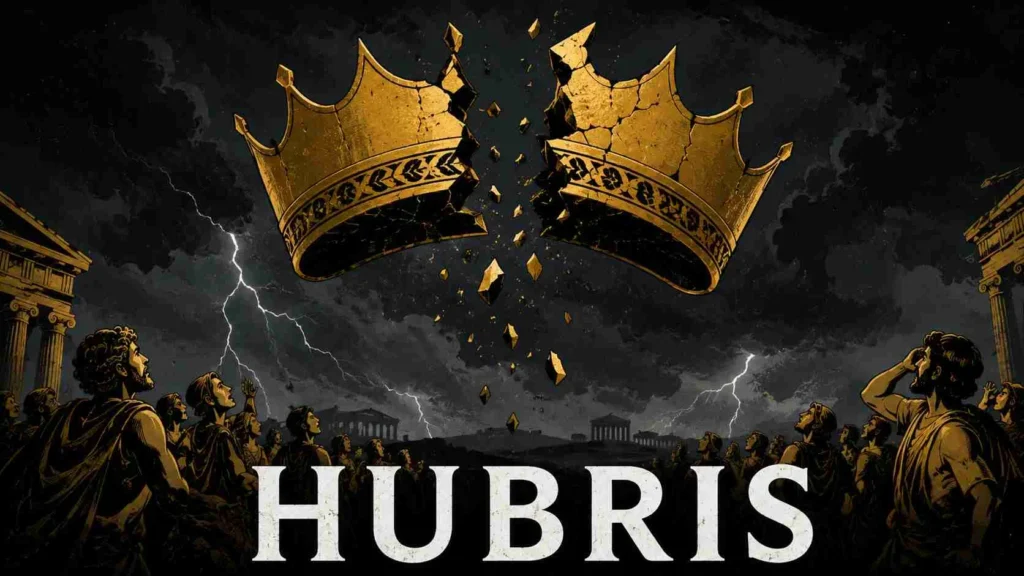

Hubris means excessive pride or self‑confidence that blinds you to your own limits. It always leads to a downfall sometimes slow, often sudden, but always because you believed the rules didn’t apply to you.
You’ve watched someone crash because they thought they couldn’t fail.
Maybe it was a boss who ignored every warning sign. A politician who promised victory right before a landslide loss. Or an athlete who mocked their opponent then choked in the final minute.
That’s not bad luck and that’s not simple overconfidence.
That’s hubris.
The hubris meaning cuts deeper than everyday arrogance. It carries a specific promise: excessive pride followed by a public, humiliating fall. The Greeks built entire tragedies around this one word. Shakespeare used it to kill kings. Modern boardrooms bleed billions from it. hubris def
So what does hubris mean exactly? Where did it come from? And how do you spot it before it burns down your own plans? hubris meaning in english. hybris meaning.
Let’s get into it. No fluff. Just the real definition, real examples, and real ways to recognize this ancient flaw in modern life. hubris meaning in farsi.
Hubris Definition | What Does “Hubris” Mean?

Hubris is a noun that refers to excessive pride, arrogance, or overconfidence, especially when someone believes they are better, smarter, or more powerful than others.
Simple Definition
Hubris: Extreme self-confidence or arrogance that often leads to poor decisions, mistakes, or downfall.
Pronunciation
Hubris: HYOO-bris (/ˈhjuː.brɪs/)
Examples in Sentences
- His hubris made him believe he could never fail.
- The company’s downfall was caused by the CEO’s hubris.
- In many stories, a hero’s hubris eventually leads to tragedy.
Origin of the Word
The term comes from Ancient Greek, where hubris referred to excessive pride or behavior that defied the gods. In Greek mythology and literature, hubris was often punished and led to a character’s downfall.
Synonyms
- Arrogance
- Pride
- Conceit
- Vanity
- Overconfidence
- Self-importance
Antonyms
- Humility
- Modesty
- Humbleness
- Meekness
Hubris vs. Confidence
| Confidence | Hubris |
|---|---|
| Believing in your abilities | Believing you are superior to others |
| Healthy self-esteem | Excessive pride and arrogance |
| Encourages growth | Often leads to mistakes and failure |
In Everyday Language
When someone says a person has hubris, they usually mean that the person is so confident and proud that they ignore risks, advice, or limitations.
In short: Hubris means excessive pride or arrogance, often leading someone to make poor decisions or experience a downfall. 📚✨
The Core Hubris Meaning in Plain English
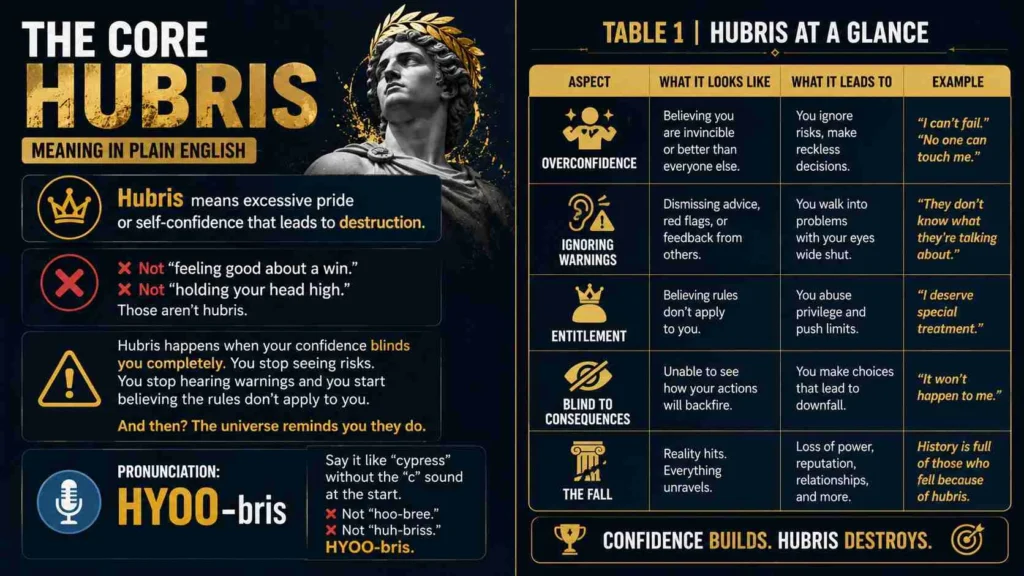
Hubris means excessive pride or self-confidence that leads to destruction.
Not “feeling good about a win.” Not “holding your head high.” Those aren’t hubris.
Hubris happens when your confidence blinds you completely. You stop seeing risks. You stop hearing warnings and you start believing the rules don’t apply to you.
And then? The universe reminds you they do.
Here’s the pronunciation so you never stumble: HYOO-bris. Say it like “cypress” without the “c” sound at the start. Not “hoo-bree.” Not “huh-briss.” HYOO-bris.
Table 1 | Hubris at a Glance
| Aspect | Quick Answer |
|---|---|
| Hubris meaning | Excessive pride that guarantees a downfall |
| Part of speech | Noun |
| Origin | Ancient Greek (ὕβρις hybris) |
| Common in | Literature, business, politics, sports, your own life |
| Opposite | Humility, self-awareness, prudent caution |
| One-word synonym | Overconfidence (but only if a fall follows) |
The keyword here is destruction. Without a fall, you’re just dealing with arrogance or vanity. Hubris always includes the crash.
Hubris vs Arrogance vs Narcissism Stop Confusing Them
People throw these words around like they’re interchangeable. They’re not.
Arrogance makes you unlikeable. You act superior. You talk down to people. But arrogance alone won’t necessarily ruin your life. Plenty of arrogant people succeed every day. They’re just jerks.
Narcissism is a personality pattern. Deep need for admiration. Low empathy. Chronic selfishness. It damages relationships over years, but it doesn’t require a single dramatic collapse.
Hubris is different. Hubris specifically means your pride blinds you to reality. You don’t just think you’re better than others. You think you’re above consequences.
That belief? That’s the trap door.
“Hubris is the pride that comes before a fall not a moral failing you confess, but a structural flaw that guarantees collapse.”
Table 2 | Hubris vs Other “Pride” Words
| Term | Core Meaning | Requires a Fall? | Time Frame |
|---|---|---|---|
| Hubris | Blind excessive pride | Yes always part of the definition | Dramatic and sudden |
| Arrogance | Superior attitude toward others | No | Persistent |
| Narcissism | Need for admiration + lack of empathy | Not necessarily | Long-term pattern |
| Overconfidence | Overestimating your abilities | Sometimes | Varies |
| Vanity | Obsession with appearance or status | Rarely | Ongoing |
| Conceit | Excessive pride in yourself | No | Stable trait |
So when someone says “that was hubris” after a failure, they’re not just calling the person proud. They’re saying the pride caused the failure. Cause and effect. No accident.
The Ancient Greek Origin | Where Hubris First Meant Blood
You can’t understand hubris meaning without going to Athens around 500 BCE. Because back then, hubris wasn’t just a character flaw. It was a crime.
In ancient Greek law, hybris meant violent, shaming acts meant to humiliate another person. Think public beatings. Sexual assault. Stealing a free citizen’s dignity. If you committed hybris, you could be sued and if you lost, the punishment was severe.
But the word evolved.
The playwrights Aeschylus, Sophocles, Euripides turned hybris into a psychological force. In their tragedies, hubris wasn’t just a crime against another person. It was a crime against the gods. You acted like you were above divine law. You refused to know your place as a mortal.
And the gods always struck back.
Aristotle later formalized this in his Poetics. He called hubris a type of hamartia a tragic mistake. But not just any mistake. Hubris was the mistake that came from greatness turning poisonous. The hero’s strength, skill, or brilliance makes them feel invincible. Then that feeling destroys them.
Key fact: Aristotle never said hubris was the only tragic flaw. But every major Greek tragedy includes it. Every single one.
Three Greek Myths That Define Hubris Forever
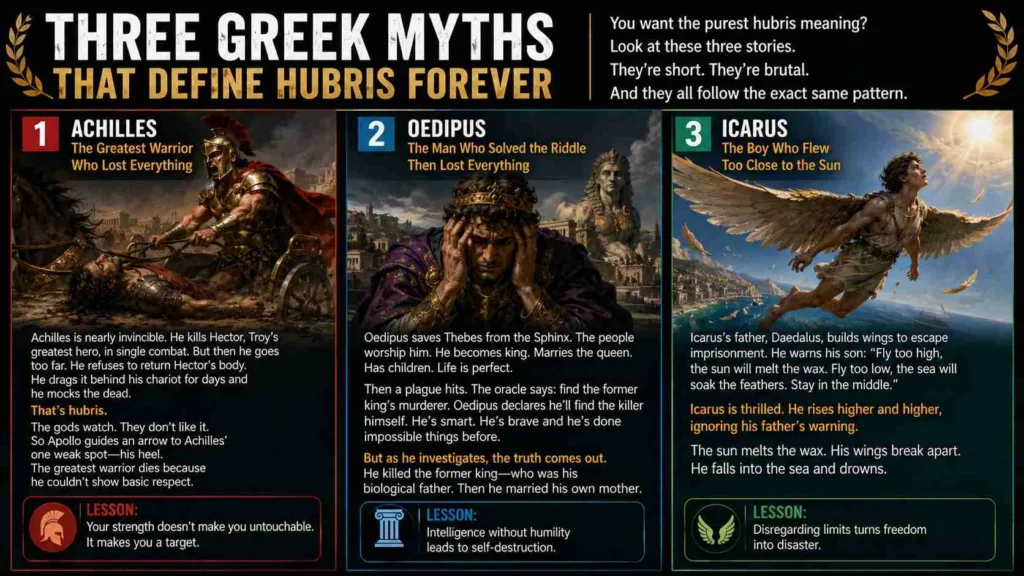
You want the purest hubris meaning? Look at these three stories. They’re short. They’re brutal. And they all follow the exact same pattern.
Achilles | The Greatest Warrior Who Lost Everything
Achilles is nearly invincible. He kills Hector, Troy’s greatest hero, in single combat. But then he goes too far. He refuses to return Hector’s body. He drags it behind his chariot for days and he mocks the dead.
That’s hubris.
The gods watch. They don’t like it. So Apollo guides an arrow to Achilles’ one weak spot his heel. The greatest warrior dies because he couldn’t show basic respect.
Lesson: Your strength doesn’t make you untouchable. It makes you a target.
Oedipus | The Man Who Solved the Riddle Then Lost Everything
Oedipus saves Thebes from the Sphinx. The people worship him. He becomes king. Marries the queen. Has children. Life is perfect.
Then a plague hits. The oracle says: find the former king’s murderer. Oedipus declares he’ll find the killer himself. He’s smart. He’s brave and he’s done impossible things before.
But as he investigates, the truth comes out. He killed the former king who was his biological father. Then he married his own mother.
Jocasta, his wife and mother, hangs herself. Oedipus stabs his own eyes out. He’s exiled. Blind. Broken.
What was his hubris? Not solving the riddle. That was smart. His hubris was believing his intelligence made him immune to fate. He kept pushing for truth without ever asking: should I?
Niobe | The Mother Who Boasted One Time Too Many
Niobe had fourteen children seven sons, seven daughters. She was proud of them. That’s fine.
But then she stood in front of a temple and said: “I am more fortunate than the goddess Leto. Leto only had two children. I have fourteen. I am better.”
Leto’s children were Apollo and Artemis. Twin gods. Armed with bows.
Apollo killed all seven of Niobe’s sons. Artemis killed all seven daughters. Niobe’s husband killed himself. Niobe turned to stone from grief. But even as stone, she wept forever.
Lesson: Don’t compare your blessings to a god’s. Actually, just don’t compare your blessings to anyone’s. It never ends well.
Table 3 | Hubris in Classic Stories (Cheat Sheet)
| Character | Hubristic Act | The Exact Moment of Pride | The Fall |
|---|---|---|---|
| Achilles | Defiles Hector’s body | “I am Achilles. No one will mourn my enemies.” | Apollo kills him with an arrow to the heel |
| Oedipus | Declares he’ll find the killer | “I, Oedipus, whom all men call great, will solve this.” | Blinds himself; loses family and throne |
| Niobe | Compares herself to Leto | “I am more fortunate than a goddess.” | Apollo and Artemis kill all fourteen children |
| Prometheus | Steals fire and mocks Zeus | “Let Zeus throw his lightning. I won’t bow.” | Chained to a rock; eagle eats his liver daily |
Hubris in Shakespeare | The English Version of the Same Trap
Shakespeare never used the word “hubris” much. But he wrote the concept into almost every tragedy. He just called it “pride” or “vaulting ambition.”
Macbeth | The Thane Who Believed He Was Charmed
After witches tell Macbeth he’ll be king, he murders the current king. Then he murders his best friend. Then he murders a nobleman’s entire family.
By the end, Macbeth believes his own hype. The witches told him: “No man born of a woman can harm you.” So Macbeth declares:
“I bear a charmed life, which must not yield to one of woman born.”
That’s pure hubris. He thinks he’s invincible. He stops plannin and he stops worrying.
Then Macduff shows up. Macduff was ripped from his mother’s womb a C-section before C-sections had a name. Technically, he wasn’t “born of a woman.” He kills Macbeth in one fight.
The hubris lesson: Don’t trust prophecies that flatter you.
Oedipus Rex (Shakespeare didn’t write it, but let’s clarify)
Actually, Shakespeare didn’t write Oedipus. Sophocles did. But students often ask about Shakespeare and hubris together, so here’s the truth: Shakespeare’s Lear is the closest. King Lear divides his kingdom based on flattery. He believes his daughters love him more than they do. That pride leaves him homeless, mad, and holding his dead daughter in his arms.
Table 4 | Hubris in Famous Plays
| Play | Character | Hubris Moment | Body Count |
|---|---|---|---|
| Macbeth | Macbeth | “I bear a charmed life” | 8+ (including himself) |
| King Lear | Lear | “Which of you shall we say doth love us most?” | 6 (including Cordelia and Lear) |
| Julius Caesar | Caesar | “I am constant as the northern star” | Stabbed 23 times in the Senate |
| Oedipus Rex | Oedipus | “I, Oedipus, will find the murderer” | 2 (Jocasta and himself, metaphorically) |
Modern Hubris | Real Examples You’ll Recognize Immediately
Ancient myths are useful. But hubris meaning gets real when you see it in boardrooms, stadiums, and news headlines.
Enron | “We’re the Smartest Guys in the Room”
In the late 1990s, Enron was America’s seventh-largest company. Executives created fake profits. They hid billions in debt. Auditors asked questions. Lawyers raised concerns.
Enron’s leaders laughed. They called themselves “the smartest guys in the room.” One executive, Jeffrey Skilling, told a reporter: “We are the only energy company that really understands how to manage risk.”
Hubris.
In 2001, the whole thing collapsed. Stock price dropped from $90 to $0.67. Employees lost their life savings. Skilling went to prison for 24 years. Ken Lay, the chairman, died before sentencing.
The cost: $74 billion in market value. Gone.
Nokia | “The iPhone Is a Niche Product”
In 2007, Apple released the first iPhone. Nokia dominated the mobile phone market 50% market share globally. Their executives looked at the iPhone and saw a toy.
“No one wants a touchscreen. People want a physical keyboard. The iPhone won’t last.”
That wasn’t strategy. That was hubris.
By 2013, Nokia’s phone division sold to Microsoft for $7.2 billion a fraction of its former value. Today, Nokia doesn’t make phones at all.
The irony: Nokia had a working touchscreen prototype in 2004. Three years before the iPhone. They killed it because leadership “didn’t see the point.”
Blockbuster | “We Don’t Need Netflix”
In 2000, Netflix was a small DVD-by-mail startup. They approached Blockbuster the king of video rental with a proposal: Buy us for $50 million, and we’ll run your online business.
Blockbuster’s CEO laughed. He said: “The DVD business is mature. Streaming is a fad.”
Hubris.
By 2010, Blockbuster declared bankruptcy. Netflix today is worth over $200 billion.
The actual number: Blockbuster’s CEO turned down a $50 million deal that would have made him a legend. Instead, he’s a case study in business schools on “what not to do.”
Elizabeth Holmes | “One Drop of Blood Changes Everything”
Elizabeth Holmes founded Theranos. She promised a machine that could run 200 medical tests from a single drop of blood. No needles. No labs. Instant results.
She raised $700 million. She appeared on magazine covers and she was “the next Steve Jobs.”
But the machine never worked. It failed every real test. Holmes knew it. She faked results anyway. She lied to investors, doctors, and patients.
That’s not just fraud. That’s hubris of the highest order. She believed her vision was so important that the rules didn’t apply.
In 2022, a jury convicted her on four counts of fraud. She got 11 years in prison.
Table 5 Modern Hubris in Business & Culture
| Example | Hubristic Statement | Year of Hubris | Consequence |
|---|---|---|---|
| Enron | “We can hide billions in debt” | 2000 | Bankruptcy; executives jailed |
| Nokia | “iPhone is a niche product” | 2007 | 90% market share → 3% |
| Blockbuster | “Streaming is a fad” | 2000 | Liquidated by 2010 |
| Theranos | “This device does 200 tests from one drop” | 2015 | Holmes convicted; company dissolved |
| WeWork | “We’re not a real estate company. We’re a tech company.” | 2019 | Valuation $47B → $8B; CEO ousted |
How to Spot Hubris in Real Time

You don’t need a psychology degree to catch hubris. Just listen for these three patterns.
Red Flag 1 | Absolute Language
Hubristic people stop using words like “maybe,” “possibly,” or “we’ll see.” Instead, they say:
- “I alone can fix this.”
- “We never lose.”
- “That’s impossible for anyone except me.”
- “Rules don’t apply here.”
Test: If someone says “never” or “always” about their own success, watch closely.
Red Flag 2 | Dismissal of Warnings
Before every hubris-driven collapse, someone raised a hand and said: “This might be a problem.”
The hubristic person’s response is always the same: dismiss, mock, or ignore.
- “What do they know?”
- “They’re just jealous.”
- “That’s the old way of thinking.”
- “I don’t have time for negativity.”
Test: Ask yourself: when was the last time this person changed course because of criticism? If the answer is “never,” you’re looking at hubris.
Red Flag 3 | Public Shaming of Others
Hubris doesn’t just lift you up. It pushes others down. The hubristic person needs to prove their superiority by humiliating someone else.
- “Everyone else is an amateur.”
- “They couldn’t do my job in a million years.”
- “Look at how stupid that competitor is.”
Test: Notice how they talk about people who aren’t in the room. That’s how they’ll talk about you eventually.
“The man who tells you he has never made a mistake is either a liar or about to make a very big one.”
The Psychology of Hubris | Why Smart People Fall Hardest
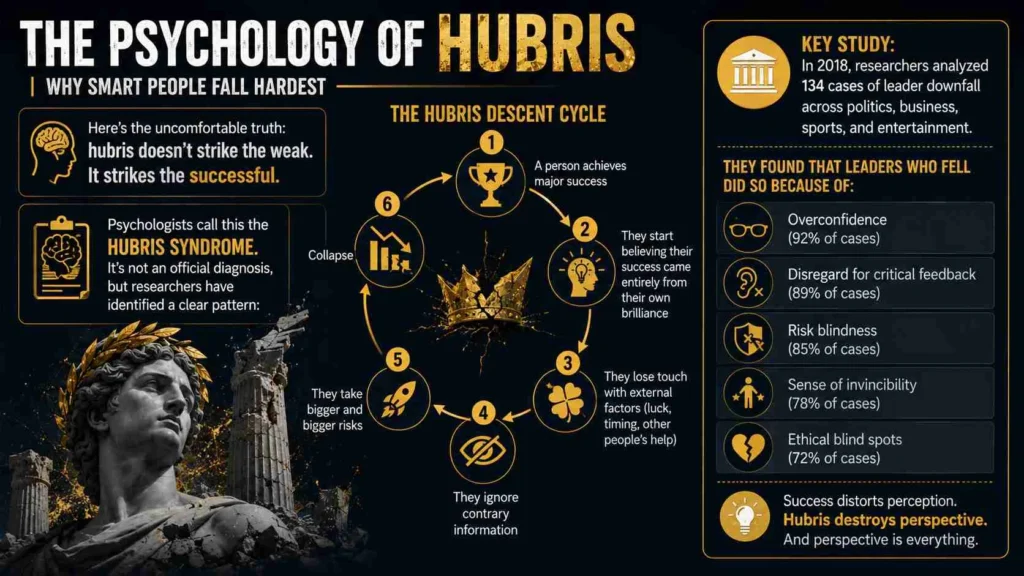
Here’s the uncomfortable truth: hubris doesn’t strike the weak. It strikes the successful.
Psychologists call this the hubris syndrome. It’s not an official diagnosis, but researchers have identified a clear pattern:
- A person achieves major success
- They start believing their success came entirely from their own brilliance
- They lose touch with external factors (luck, timing, other people’s help)
- They ignore contrary information
- They take bigger and bigger risks
- Collapse
Key study: In 2018, researchers analyzed CEO behavior over 20 years. They found that CEOs who appeared on magazine covers were 40% more likely to make catastrophic errors within three years. The fame itself bred the blindness.
The Neuroscience Piece
Your brain has a built-in reward system. Dopamine floods your system when you succeed. But repeated success changes your brain chemistry. You literally become less sensitive to risk.
That’s not a moral failing. That’s biology.
But here’s the catch: successful people who actively practice humility seeking criticism, thanking others, admitting small mistakes early keep their risk detection systems online. They don’t lose the ability to say “I might be wrong.”
Hubris in Politics | When Leaders Forget They Can Lose
Politics might be the purest modern hubris laboratory. The stakes are high. The egos are bigger. And the falls are public.
Napoleon’s Russian Winter
By 1812, Napoleon controlled most of Europe. He’d never lost a major war. His generals warned him: invading Russia in June is fine, but winter comes fast. Supply lines stretch thin. The Russians won’t fight a single decisive battle they’ll just retreat and burn everything behind them.
Napoleon dismissed every warning.
“The Russian winter will not stop me. I am Napoleon.”
Hubris.
He marched 600,000 soldiers into Russia. Fewer than 100,000 returned. The Russian winter, combined with scorched-earth tactics, destroyed the Grand Army. Napoleon’s empire never recovered.
The number: 500,000 dead or missing. For one campaign. Because one man believed he couldn’t fail.
The 2016 US Election | A More Recent Example
Without picking sides, let’s look at the pattern. Multiple political analysts and campaigns have shown the classic hubris curve:
- Polls show you ahead
- You start believing the polls
- You stop visiting certain states because “we have those in the bag”
- You focus on celebrating instead of executing
- Election night surprises everyone
That’s hubris. Not the losing the blindness to the possibility of losing.
How to Use “Hubris” Correctly in a Sentence
You’ve got the definition. Now let’s use it.
Correct uses:
- “His hubris cost him the election when he refused to debate.”
- “The company’s hubris was obvious the day they fired every engineer who asked questions.”
- “I showed hubris by skipping the rehearsal. Then I forgot my lines on stage.”
Incorrect uses:
- “She had a little hubris about her cooking.” (No hubris isn’t small. It’s excessive.)
- “His hubris made him a great leader.” (No hubris destroys. You mean confidence.)
- “The team showed hubris by celebrating after the first game.” (Depends. Did they then lose the championship because they stopped practicing? If yes, correct. If they won anyway, it wasn’t hubris just enthusiasm.)
Quick test: If the person didn’t fall, don’t call it hubris. Call it arrogance or confidence instead.
Synonyms and Antonyms | Build Your Vocabulary Fast
You don’t need fifteen synonyms. You need the right ones.
Best synonyms for hubris:
- Arrogance (closest, but missing the fall)
- Conceit
- Pomposity
- Overweening pride (old but powerful)
- Presumption (when someone oversteps their place)
Closest match in tone: Overweening pride. It sounds old-fashioned, but it carries the same “too much” energy.
Antonyms (opposites):
- Humility
- Modesty
- Self-doubt (healthy amounts only)
- Diffidence (shyness not weak, just cautious)
One weird trick: If you want to sound like a literature professor, use “hamartia” when discussing Greek tragedy. But hamartia means any tragic mistake. Hubris is a specific type of hamartia. Don’t use them interchangeably.
The Memory Trick That Actually Works
Forget flashcards. Use this:
“Huge Brashness Brings Ruin In Seconds”
First letters: H B B R I S
That’s not exactly “hubris,” but it’s close enough that your brain will connect them. Every time you see “huge brashness” in your head, you’ll think: that’s hubris.
Alternatively: “Hubris = Huge ego. Utter Blindness. Real Immediate Suffering.”
Say that three times. You’ll never forget.
Common Mistakes Even Smart People Make
Mistake 1: Calling every failure hubris
Not every loss comes from pride. Sometimes you just make an honest mistake. Sometimes luck turns bad. Hubris requires excessive pride as the direct cause.
Example: You invest in a stock and lose money. That’s not hubris unless you ignored every warning because you thought you were a genius.
Mistake 2: Using hubris as a compliment
“His hubris is what makes him great.”
No. Hubris is always, always negative. You can say “his confidence made him great.” You can say “his audacity won the day.” But hubris specifically includes the destruction. It’s like saying “his cancer is what made him strong.”
Mistake 3: Mispronouncing it
The most common error: “hoo-bree” (like a French fashion house). Or “huh-briss” (like a medical procedure).
It’s HYOO-bris. Rhymes with “cypress” without the C. Say it out loud right now: HYOO-bris.
FAQs
What does hubris mean in one word?
Overconfidence. But only if the fall is included. Without the fall, it’s just arrogance.
Is hubris always bad?
Yes. By definition. If it doesn’t cause harm, it’s not hubris. It’s just regular pride.
Can hubris ever be positive?
No. That’s like asking for “healthy poison.” The word itself carries destruction.
What’s the difference between hubris and hamartia?
Hamartia is any tragic mistake. Hubris is a specific type of hamartia caused by excessive pride. All hubris is hamartia, but not all hamartia is hubris.
How do you use hubris in a sentence for an essay?
“In Sophocles’ Oedipus Rex, the protagonist’s hubris manifests when he ignores Tiresias’s warnings, believing his past success at solving the Sphinx’s riddle makes him immune to error.”
What’s a real-life example of hubris today?
A startup founder who raises millions, ignores customer complaints, fires everyone who disagrees, and then watches the company fold in 18 months. That story repeats weekly in Silicon Valley.
Is hubris a sin?
In Christianity, pride is one of the seven deadly sins. Hubris is pride cranked to self-destructive levels. So yes but the Greeks defined it as a crime against the gods before Christianity existed.
What is hubris?
Hubris is excessive pride, arrogance, or overconfidence, especially when someone believes they are superior to others or immune to failure. It often causes people to ignore advice, underestimate risks, and make poor decisions that can lead to their downfall.
Conclusion
Hubris isn’t a sin you commit once. It’s a pattern you fall into when success feels permanent and warnings sound like whispers.
Here’s what you actually need to remember: confidence keeps you safe. Hubris destroys you. The difference is simple. Confidence asks “what could go wrong?” Hubris answers “nothing.”
Every example we covered Achilles, Oedipus, Enron, Nokia, Napoleon follows the same arc. Greatness. Blindness. Collapse. Not because they were bad people. Because they stopped doubting themselves.
So check your own blind spots today. Find one person who will tell you the truth. Ask them: “Where am I overconfident?” Then shut up and listen.
Discover More Related Articles:
- “OBO” Meaning Explained: How to Use It in Sales & Negotiations In 2026
- “DTF” Meaning in Chat: What It Really Means & How It’s Used In 2026
- “White Heart” Meaning: Pure Love, Friendship & Peace Symbol In 2026