
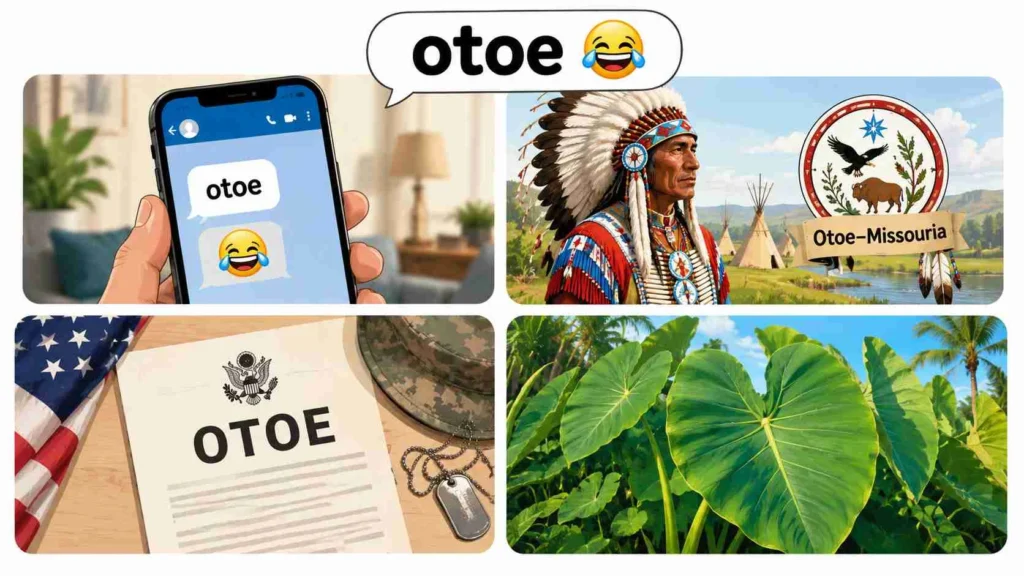

the Otoe–Missouria Native American tribe from Oklahoma, a military acronym for Objective Table of Organization and Equipment and an edible Panamanian plant similar to taro. Context and capitalization (otoe vs. Otoe vs. OTOE) tell you which one someone means.
You’re scrolling through a group chat. Someone just types “otoe” and nothing else. No period. No follow-up. Just four little letters. Do you laugh? Ignore it? Or spend ten minutes searching the internet like a detective?
Most people do the third one.
The truth is, otoe meaning changes completely depending on where you see it. A TikTok comment uses it one way. A history book uses it another. A military document uses it as a capital-letter monster.
So let’s fix the confusion. No fluff. No filler. Just the real meanings, side by side, with examples you can actually use.
Table 1: The Four Meanings of Otoe at a Glance
Before we dive deep, here’s your cheat sheet.
| Meaning | Context | Example sentence | Capitalization |
|---|---|---|---|
| Playful “okay” slang | TikTok, text, Discord, memes | “Otoe, I’ll be there in five.” | Lowercase or any |
| Otoe–Missouria Tribe | U.S. history, Oklahoma, Nebraska | “The Otoe signed a treaty in 1854.” | Capital O |
| OTOE (acronym) | Military documents, defense planning | “The unit’s OTOE lists 40 personnel.” | All caps |
| Edible plant | Panamanian cooking, rural gardening | “Boil otoe leaves twice before eating.” | Lowercase |
Keep this table handy. You’ll thank yourself later.
What Is the Slang Meaning of Otoe?
Let’s start with the one you probably saw first. On TikTok, Twitter, Discord, and even in casual text messages, “otoe” works as a playful, ironic version of “okay.”
Think of it like “otay” from old cartoons but with a little more vowel stretch. It sounds softer, sillier, and less serious than a plain “OK.”
How do people actually use it?
Here’s the breakdown. People drop “otoe” in three main situations:
- Skeptical agreement: You don’t really agree, but you don’t want to argue.
“You think pineapple belongs on pizza? Otoe, sure.” - Lighthearted acknowledgment: You heard the person, but you’re not fully excited.
“I’ll be there in an hour.” / “Otoe. Just don’t forget the chips.” - Meme-style reply: A short, funny reaction to something mildly annoying.
When your boss adds a meeting at 5 PM on Friday.
Caption: “Otoe 😩”
No one uses “otoe” in formal writing. No one uses it in an email to their boss. But among friends or online communities, it works perfectly.
Where did this slang come from?
Good question and the answer isn’t one single moment. “Otoe” as slang emerged organically from a few places:
- Voice-to-text errors that people found funny and kept using
- Meme pages on Instagram and Twitter looking for fresh reactions
- Discord servers where inside jokes become daily vocabulary
- TikTok comment sections where short, weird words get repeated until they stick
No dictionary has officially added it yet. Urban Dictionary, however, has multiple user-submitted entries. Most define it as a goofy “okay” or a sarcastic acknowledgment.
Example table for slang scenarios
| Scenario | What someone says | Your “otoe” reply | Tone |
|---|---|---|---|
| Friend makes a bad joke | “Get it? Get it?” | “Otoe. I guess.” | Skeptical |
| Partner changes dinner plans | “No tacos tonight.” | “Otoe. Pizza then.” | Accepting but flat |
| Meme about slow WiFi | video of loading spinner | “Otoe 🐌” | Humorous |
| Real argument | “You never listen.” | (Don’t use otoe here) | N/A |
So if you see “otoe” in a chat or a meme, you’re looking at modern internet slang. Nothing more. Nothing less.
But if you’re reading something older or something about Native American history then the meaning shifts completely.
Otoe as a Native American Tribe
Before TikTok, before memes, before the internet even existed, the word “Otoe” referred to a living, breathing nation of people.
The Otoe (sometimes spelled Oto) are a Native American tribe. Their original name, in their own language, is Jiwere. They belong to the Siouan language family, which includes other tribes like the Iowa, Missouri, and Ho-Chunk.
Who are the Otoe people today?
The Otoe share a federally recognized nation called the Otoe–Missouria Tribe of Indians. Their headquarters sit in Red Rock, Oklahoma. As of 2011, enrollment records counted roughly 3,049 citizens. That number has likely grown, but tribal updates come out slowly.
Land holdings include:
- Tribal trust land in Noble County and Kay County, Oklahoma
- A smaller reservation area in Nebraska (historic, not current)
A short history that matters
Let’s hit the important dates. No boring timeline. Just what you need to know.
Early 1600s: Otoe ancestors lived around the Great Lakes region, near present-day Wisconsin and Minnesota.
Late 1600s – early 1700s: Pressure from other tribes and European settlers pushed them southwest toward the Missouri River.
1804: Lewis and Clark met the Otoe tribe at a place now called Council Bluffs, Iowa. In fact, the Otoe were the first tribe Lewis and Clark officially met after the Louisiana Purchase.
1854: The Otoe and Missouria tribes signed a treaty with the United States. They gave up most of their land in Nebraska, about 160,000 acres, and moved to a smaller reservation.
1880s: The federal government pushed them again this time to Indian Territory, which later became Oklahoma.
Today: The Otoe–Missouria Tribe runs its own government, courts, and social services. They also operate the 7 Clans Casino in Newkirk, Oklahoma.
Table 2: Key Facts About the Otoe Missouria Tribe
| Fact | Detail |
|---|---|
| Official name | Otoe–Missouria Tribe of Indians |
| Headquarters | Red Rock, Oklahoma |
| Enrollment (2011) | 3,049 citizens |
| Original language | Chiwere (Jiwere) |
| Language family | Siouan |
| Historic location | Great Lakes region (Wisconsin/Minnesota) |
| Modern location | North-central Oklahoma |
| Tribal enterprise | 7 Clans Casino, Newkirk, OK |
| First contact with US explorers | Lewis and Clark, 1804, Council Bluffs |
| Major land cession treaty | 1854 (Nebraska territory) |
What about their language?
The Otoe traditionally spoke Chiwere, a Siouan language. But like many Native languages, Chiwere became endangered due to forced assimilation, boarding schools, and government policies.
As of the early 2000s, only a handful of fluent elders remained. The tribe has worked hard to preserve and revive the language through:
- Audio recordings of fluent speakers
- Language classes for children and adults
- Written dictionaries and learning materials
You won’t hear Chiwere spoken casually on the street today. But you will find dedicated people keeping it alive.
One important note on spelling
You’ll sometimes see “Oto” without the final E. That’s not a typo. Both “Otoe” and “Oto” appear in historical records. The tribe itself uses Otoe–Missouria officially. Stick with that spelling for respect.
So if you’re reading about the Louisiana Purchase, the Great Plains, or modern tribal governments, “Otoe” means the tribe. Full stop.
But wait. There’s another meaning hiding in military paperwork.
OTOE as a Military and Business Acronym
Here’s where things get technical. In all-caps, OTOE stands for Objective Table of Organization and Equipment.
That mouthful of words basically means: a document that lists exactly what a military unit should have personnel, vehicles, weapons, radios, even uniforms.
Where do you find OTOE in real life?
- U.S. Army and Marine Corps planning documents
- Defense contractor bids and proposals
- Government budget reports
- Military readiness assessments
Why should you care?
Honestly? You probably shouldn’t unless you work in defense, logistics, or military planning.
But if you’re researching acronyms or reading old military records, OTOE will pop up. And now you won’t panic.
OTOE versus MTOE
You might also see MTOE, which means Modified Table of Organization and Equipment. The difference is small but real.
| Acronym | Full form | What it means |
|---|---|---|
| OTOE | Objective Table of Organization and Equipment | The ideal, goal-state structure |
| MTOE | Modified Table of Organization and Equipment | The actual, current structure (with changes) |
Think of OTOE as the blueprint and MTOE as the real house with a few walls moved.
So if you’re reading a PDF filled with acronyms and see “OTOE” in bold, you’re looking at military planning. Not slang. Not a tribe. Just paperwork.
But paperwork isn’t the only oddball meaning.
Otoe as a Plant in Panama
This one surprises almost everyone. In parts of Panama, especially among older generations and rural communities, “otoe” refers to a specific plant.
The plant is similar to cassava (yuca) or taro (malanga). It has large, dark green leaves shaped like a mix between a heart and an arrowhead. The root is edible, but the leaves are the real prize if you prepare them correctly.
Can you eat it?
Yes. But you have to cook it the right way.
Raw otoe leaves contain calcium oxalate crystals. Those tiny needle-like crystals irritate your mouth and throat. Eat them raw, and you’ll regret it fast.
Proper preparation:
- Boil the leaves twice
- Change the water between boils
- Discard the first water completely
After that, the leaves become safe and nutritious. They’re rich in:
- Vitamin A
- Vitamin C
- Iron
- Dietary fiber
Table 3: Otoe Plant vs. Similar Crops
| Crop | Scientific name | Edible part | Preparation needed | Region |
|---|---|---|---|---|
| Otoe (Panama) | Likely Xanthosoma or Colocasia variety | Leaves and root | Boil leaves twice | Panama |
| Taro | Colocasia esculenta | Root and leaves | Boil leaves (oxalates present) | Worldwide tropics |
| Cassava | Manihot esculenta | Root only | Never eat raw; must cook | South America, Africa, Asia |
| Malanga | Xanthosoma sagittifolium | Root and leaves | Cook thoroughly | Caribbean, Central America |
Do people still use this meaning?
Less than before. Younger Panamanians often don’t recognize the word “otoe” for the plant. They use “malanga” or “taro” instead. But in older cookbooks, rural markets, and oral history, “otoe” still shows up.
So if you’re reading a Central American gardening blog or a Panamanian recipe, that’s your context.
Otoe as a Common Typo or Misspelling
Sometimes the simplest answer is the right one. A lot of people search for “otoe meaning” because they misspelled another word.
WordReference and other dictionary sites don’t list “otoe” as a standard English word. Instead, they suggest similar words.
Most likely typos
| What you typed | What you probably meant |
|---|---|
| otoe | note |
| otoe | onto |
| otoe | otay |
| otoe | outdo |
| otoe | toed |
Example:
“Can you take a otoe of this?” → Should be “Can you take a note of this?”
Another:
“Step otoe the platform” → Should be “Step onto the platform”
Voice-to-text makes this error constantly. So does fast typing with no proofreading.
Before you go down a rabbit hole, ask yourself: did the writer probably mean “note” or “onto”? If yes, then there’s no mystery. Just a typo.
Table 4: Quick Decision Guide | Which Meaning Fits?
Use this table like a flowchart. Match what you’re seeing to the most likely meaning.
| Where you saw “otoe” | Capitalization? | Most likely meaning | Next step |
|---|---|---|---|
| TikTok, Twitter, Discord, text message | lowercase or any | Slang for “okay” | Reply casually |
| History book, tribal website, Oklahoma news | Capital O (Otoe) | Otoe–Missouria Tribe | Read with respect |
| Military PDF, defense document, government report | All caps (OTOE) | Acronym (Objective Table) | Skip unless relevant |
| Panamanian recipe, rural gardening blog | lowercase | Edible plant | Follow cooking instructions |
| Any other context, especially handwritten | lowercase | Possible typo for “note” or “onto” | Reread the sentence |
Bookmark this table. It’ll save you time and confusion.
Real Examples of Otoe in the Wild
Let’s walk through actual (or totally realistic) examples so you can hear the difference.
Slang example
Friend: “I’ll be 20 minutes late. Traffic’s a nightmare.”
You: “Otoe. Just bring the chips.”
That’s friendly, low-stakes, and a little silly.
Tribal example
“The Otoe–Missouria Tribe hosts an annual powwow at their cultural center in Red Rock, Oklahoma. Dancers from across the region attend.”
That’s factual, respectful, and rooted in real history.
Acronym example
“According to the unit’s OTOE, we should have twelve Humvees and forty personnel. Right now, we have nine and thirty-two.”
That’s dry military speak. Perfect for a briefing. Terrible for a text message.
Typo example
“Hey, can you take a otoe of the whiteboard before you erase it?”
That’s a simple misspelling of “note.” No hidden meaning. Just a quick fix.
Why This Matters
Here’s the bigger picture.
Words don’t sit still. They move between communities, shift over time, and pick up new jobs. “Otoe” started as a tribal name. Then it became an acronym. Then a plant and then a silly text reply.
That’s not confusing that’s language working exactly the way it should.
Understanding otoe meaning across different contexts makes you a better reader, a sharper communicator, and a lot less likely to misunderstand a DM or a history passage.
Think of it like this:
- Slang keeps you connected to online culture.
- Tribal knowledge keeps you grounded in real history.
- Acronyms help you navigate niche professional worlds.
- Plant names remind you that language carries food, memory, and place.
One word. Four lives. All worth knowing.
FAQs
Is “otoe” in the dictionary?
No official English dictionary includes “otoe” as a standard word. Urban Dictionary does have user-submitted entries, mostly describing the slang “okay” meaning. Formal dictionaries like Merriam-Webster or Oxford do not list it.
How do you pronounce Otoe (the tribe)?
OH-toe. Two syllables. Stress the first one.
Is Otoe the same as Otoe–Missouria?
Yes. “Otoe” is the shorter name. “Otoe–Missouria” is the full official name of the federally recognized tribe. The Missouria people merged with the Otoe in the late 1700s due to population decline from disease and war.
Can I use “otoe” in a work email?
Only as a joke with close coworkers who would understand it. Otherwise, no. Stick to “OK,” “got it,” or “acknowledged.”
What does “otoe” mean in Spanish?
Nothing. It’s not a Spanish word. The plant meaning exists only in Panamanian regional Spanish, not standard Spanish.
Is “otoe” offensive?
The slang meaning? No. It’s just silly.
The tribal reference? Always capitalize “Otoe” when referring to the tribe. Lowercase “otoe” for slang is fine. Never use the tribe’s name as a joke.
How do I know which meaning someone intended?
Three questions:
- Where did you see it? (social media, history book, military doc, recipe)
- Was it capitalized? (OTOE = acronym; Otoe = tribe; otoe = slang or typo)
- Does “note” or “onto” make more sense? (if yes, typo)
Answer those, and you’re 95% of the way there.
Conclusion
One word. Four completely different lives. That’s the real story behind otoe meaning. Someone uses it as silly slang, a tribal name, a military acronym, or a leafy plant in Panama, context does all the heavy lifting. You don’t need to memorize a dictionary. You just need to look at where the word showed up and how someone wrote it lowercase, capital O, or all caps
Language moves fast, especially online. But understanding a word like otoe across slang, history, military speak, and even regional cooking makes you a sharper reader and a better communicator. So go ahead use “otoe” in a group chat if it feels right. Or just file this knowledge away for later. Either way, you’ve got the full picture now. No fluff. Just the real meaning.
Discover More Related Articles:
- “OBO” Meaning Explained: How to Use It in Sales & Negotiations In 2026
- “DTF” Meaning in Chat: What It Really Means & How It’s Used In 2026
- “White Heart” Meaning: Pure Love, Friendship & Peace Symbol In 2026