
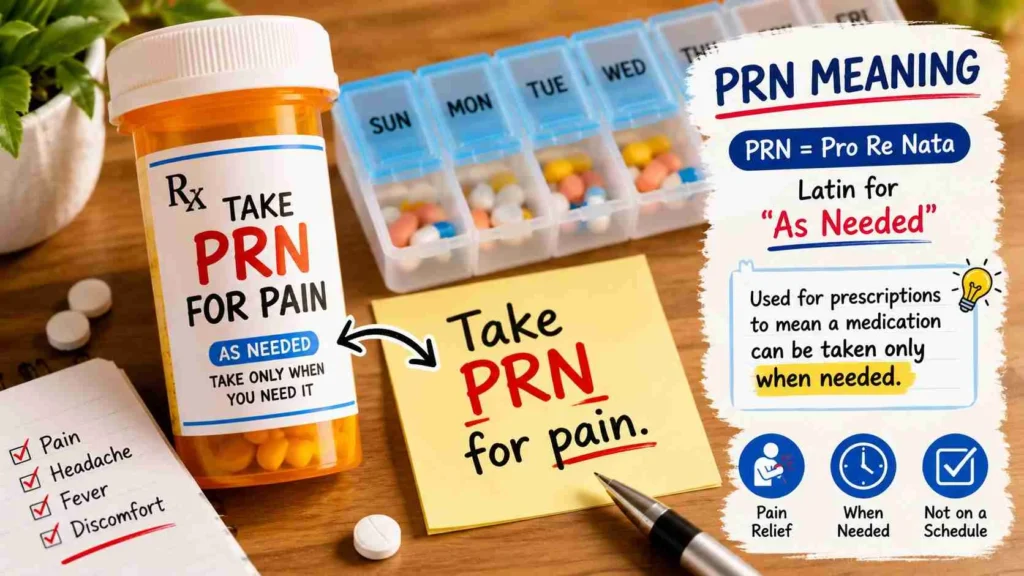

PRN stands for the Latin phrase pro re nata, which means “as needed.” In medicine, it tells you to take medication only when you have a specific symptom never on a fixed schedule.
You pick up a new prescription bottle. The label says, “Take one tablet PRN for headache.”
You pause. What does PRN mean? Is it a brand? A warning? Some secret hospital code?
Don’t worry. It’s none of those things.
PRN comes from Latin. But you don’t need to speak Latin to use it right. By the time you finish this guide, you’ll know exactly what PRN means on a prescription, how nurses use it in hospitals, and even how people type it in text messages.
Let’s start simple.
So, What Does PRN Mean?
PRN stands for pro re nata. That’s Latin for “as the situation arises.”
In plain, everyday English? “As needed.”
Doctors, nurses, and pharmacists use PRN on prescriptions and medical orders. It tells you not to take a drug on a strict schedule. Instead, you take it only when you actually need it.
Here’s the quick breakdown:
| Term | Meaning |
|---|---|
| PRN | pro re nata (Latin) |
| English translation | as needed / as the situation arises |
| Used in | Prescriptions, nursing orders, hospital charts |
| Opposite of | Fixed schedule meds (daily, every 6 hours, etc.) |
Example:
The doctor writes PRN when you shouldn’t take a drug on a fixed schedule.
That’s the core PRN definition. But context changes everything. A PRN order for pain works differently than a PRN order for anxiety. And a nurse uses PRN differently than a pharmacist reading a label.
Let’s dig into each one.
PRN Medical Meaning: How Doctors and Nurses Use It
Most people hear “PRN” for the first time from a doctor or a prescription label. So let’s start there.
On Prescriptions: “Take PRN for Pain”
Your physician writes a prescription. Next to the dosage, they write “PRN.” Then they add a symptom like pain, nausea, or itching.
That means: You decide when to take it based on how you feel.
For example:
- Ibuprofen 400 mg PRN for headache → Only take it when a headache starts.
- Loratadine 10 mg PRN for allergies → Take it only on days when your eyes itch or your nose runs.
- Bisacodyl 5 mg PRN for constipation → Don’t take it daily. Take it when you haven’t gone in two or three days.
This flexibility helps you avoid unnecessary medication. Why take a pain pill if you feel fine? Why take an allergy pill in the middle of winter with no symptoms? You don’t. That’s the point of PRN.
But there’s a catch.
Doctors must include limits. A good PRN order says:
- How much (one tablet or two?)
- How often at most (every 4 hours? every 6?)
- Maximum in 24 hours (no more than 6 tablets)
Without those limits, PRN becomes risky. You might overuse the drug.
Real example of a bad PRN order:
“Take PRN for pain” no dose, no frequency, no max.
Good PRN order:
“Take 1–2 tablets PRN for mild pain every 6 hours as needed. Not to exceed 6 tablets in 24 hours.”
PRN vs. Scheduled Medication: Key Differences
This table shows exactly how PRN differs from fixed-schedule drugs.
| Feature | Scheduled Medication | PRN Medication |
|---|---|---|
| Timing | Same time every day or every X hours | Only when symptoms appear |
| Example | Antibiotic taken BID (twice daily) | Antihistamine for sudden hives |
| Who decides? | The clock decides | You decide (based on symptoms) |
| Risk of missing a dose | Can reduce effectiveness | No risk you only take it when needed |
| Risk of overuse | Low (fixed dose) | Medium (you could take too often) |
Another way to think about it:
A scheduled med is like brushing your teeth. You do it every morning and night, regardless of how your mouth feels.
A PRN med is like taking an umbrella. You only grab it when you see rain clouds.
In Nursing & Hospitals: PRN Orders
Nurses see PRN every single shift. A doctor writes an order like:
“Administer ondansetron 4 mg IV PRN for nausea.”
The nurse doesn’t just give it automatically. First, they check: Does the patient feel nauseous? Did they vomit in the last hour? Only then do they administer the drug.
Hospitals use PRN orders for many reasons:
- To avoid over-medicating patients
- To let nurses use clinical judgment
- To respond to symptoms that come and go
Common PRN medications you’ll see in a hospital:
- Pain relievers (morphine, hydromorphone, acetaminophen)
- Anti-nausea drugs (ondansetron, promethazine)
- Anti-anxiety meds (lorazepam)
- Sleep aids (trazodone, zolpidem often written “PRN at bedtime”)
- Laxatives (senna, docusate PRN for constipation)
Important nuance: Some PRN orders include a time window.
“PRN q4h” means you can give it every 4 hours as needed. Not every 30 minutes. Not every hour. Every 4 hours at minimum.
Nurses also document every PRN dose. They write down:
- The time given
- The dose
- The symptom that triggered it
- How well it worked
This creates a record. If a patient needs PRN pain meds every 2 hours for three days straight, that’s a signal. Something else might be wrong.
What Does PRN Mean on a Prescription Label?
You’re holding a orange bottle from the pharmacy. The label says:
“Take 1 tablet by mouth PRN for itching.”
Now you know it means “as needed.” But let’s look at real label examples so you never feel confused again.
Examples You Might Actually See
| What the label saysWhat it really means | |
|---|---|
| “Take 1 tablet PRN for headache” | Only take it when you have a headache. |
| “Apply thin layer PRN for itching” | Put the cream on itchy spots. Stop when itching stops. |
| “Insulin sliding scale PRN” | Check your blood sugar first. Then decide the dose based on the scale. |
| “Take 2 capsules PRN at bedtime for sleep” | Don’t take it every night. Take it only on nights you can’t fall asleep. |
Why Doctors Prefer PRN Over Fixed Dosing
Doctors don’t write PRN to be lazy or vague. They write it because your body doesn’t follow a clock.
Pain doesn’t arrive at 8 AM sharp. Nausea doesn’t punch a timecard. Allergies flare up when pollen spikes, not on a schedule.
PRN gives you control without forcing you to call the office for every small symptom.
But here’s where PRN fails:
If a doctor writes a vague order just “PRN” with no other details you’re left guessing. How much? How often? When do I stop?
That’s not safe.
A high-quality PRN order always includes:
- The specific symptom (pain, nausea, itching, cough)
- The dose range (1–2 tablets)
- The minimum time between doses (every 4 hours)
- The maximum in 24 hours (no more than 6 tablets)
Quote from safe prescribing guidelines:
“A PRN order without a frequency and a maximum daily dose is incomplete and increases patient risk.”
How Pharmacists Interpret PRN
Your pharmacist checks every PRN prescription before you take it home. They ask themselves:
- Is the symptom clear enough?
- Does the patient know when not to take it?
- Is there a dangerous interaction with other meds?
If something looks wrong, the pharmacist calls the doctor. They don’t just fill it blindly.
So when you pick up a PRN prescription, feel free to ask your pharmacist: “What exactly should I watch for before I take this?” A good pharmacist will walk you through it.
PRN Meaning Outside Medicine: Slang & Internet Use
Not every PRN lives on a prescription bottle.
People also use PRN in texting, work chat, and casual online writing. The meaning stays the same “as needed” but the context changes completely.
PRN in Texting and Chat
You might see someone type:
- “Send me the files PRN” → Don’t wait for a deadline. Send them when you have them ready.
- “Update the spreadsheet PRN” → No fixed update schedule. Just keep it current whenever you make changes.
- “I’ll check in PRN” → I’ll reach out when I need to, not on a calendar.
In these cases, PRN replaces phrases like “as necessary” or “whenever it makes sense.”
It’s common in:
- Fast-paced office chats (Slack, Teams)
- Text messages between coworkers
- Informal project management notes
But be careful. Not everyone knows the medical or Latin origin. If you text your mom “PRN” out of the blue, she might think you made a typo. Use it with people who already use workplace abbreviations.
Other, Less Common PRN Meanings
Outside of healthcare and chat, PRN can stand for a few other things. But these are rare.
| Field | Meaning |
|---|---|
| Logistics | Product Release Number |
| Finance | Permanent Reference Number |
| Academia | Preprint (article before peer review) |
Real talk: You will almost never need these. 95% of PRN usage falls into medical prescriptions or casual “as needed” chat.
Stick with those two, and you’re safe.
Common Questions About PRN
Let’s clear up the confusion. These are the real questions real patients ask.
Does PRN mean “take daily”?
No. Absolutely not.
PRN means the exact opposite. Daily means every day regardless of symptoms. PRN means only when you have the symptom.
If a label says PRN and you take it every single day without symptoms, you’re not following the instruction.
Can I take PRN medication every day?
It depends. Ask your doctor.
Some PRN drugs are fine to take daily if your symptoms are daily. For example, a PRN allergy pill during spring pollen season. You might need it every morning for two months. That’s fine.
But other PRN drugs especially strong painkillers or sleeping pills should not become daily habits. If you need a PRN pain med every day for more than a week, call your doctor. Something else might need treatment.
Is PRN the same as “as directed”?
No. These sound similar but mean different things.
| Term | Meaning |
|---|---|
| PRN | Take only when you have the specific symptom |
| “As directed” | Follow the doctor’s verbal or written instructions (which might include a schedule) |
Doctors often write “as directed” for things like eye drops or creams. That could mean twice a day. Or once at night. Or only when flaring up.
PRN is stricter. It always means symptom-based. No symptom = no dose.
What’s the full form of PRN?
Pro re nata.
But honestly? You never need to say this out loud. No one in a pharmacy or hospital expects you to pronounce Latin. Just remember “as needed.”
Fun fact: Pro re nata literally breaks down to “for the thing born” meaning “for the situation that arises.” Latin is weird. But the meaning sticks.
How to Take PRN Medications Safely
PRN gives you freedom. But freedom without rules leads to mistakes.
Here’s how real patients (and nurses) handle PRN meds the right way.
Smart Rules for PRN Prescriptions
Follow these every time.
- Write down why you took it.
Keep a small notebook or use your phone’s notes app. Write: “2 PM took 1 ibuprofen for throbbing headache.” - Track the time between doses.
If the label says “every 6 hours,” don’t take it at 2 PM and again at 5 PM. That’s too soon. Set a timer if you need to. - Never exceed the “maximum in 24 hours.”
That number exists for a reason. Usually liver safety (for acetaminophen) or kidney safety (for ibuprofen). Respect it. - If you need PRN meds every single day for over a week, call your doctor.
Daily PRN use often means your underlying condition isn’t controlled. You might need a preventive med instead of a rescue med.
Analogy:
Think of PRN like an umbrella. You don’t carry it every sunny day. But when rain starts, you grab it. Same logic.
Example PRN Tracking Table
Here’s how a smart patient might track their PRN use over a week.
| Date | Time | Medication | Symptom | Next dose allowed | Max daily? |
|---|---|---|---|---|---|
| Mon | 8 AM | Ibuprofen 200 mg | Mild headache | 2 PM | 1200 mg total |
| Mon | 2 PM | Ibuprofen 200 mg | Headache worse | 8 PM | 1200 mg total |
| Tue | None | No headache | |||
| Wed | 10 AM | Ibuprofen 200 mg | Back pain | 4 PM | 1200 mg total |
This simple log helps you avoid double-dosing. It also gives your doctor real data at your next visit.
PRN vs. BID, TID, QHS | What’s the Difference?
Medical abbreviations confuse almost everyone. Let’s line them up so you can spot the difference instantly.
Quick Reference Table
| Abbreviation | Latin Origin | English Meaning | Schedule Type |
|---|---|---|---|
| PRN | pro re nata | as needed | Symptom-based (no fixed schedule) |
| BID | bis in die | twice a day | Fixed schedule |
| TID | ter in die | three times a day | Fixed schedule |
| QID | quater in die | four times a day | Fixed schedule |
| QHS | quaque hora somni | every bedtime | Fixed schedule |
| QD | quaque die | every day | Fixed schedule |
| STAT | statim | immediately | One-time urgent |
| AC | ante cibum | before meals | Fixed (timed with food) |
| PC | post cibum | after meals | Fixed (timed with food) |
Example Contrast
Let’s make this real.
“Take naproxen 220 mg BID for arthritis”
You take one in the morning and one at night. Every day. Even if your joints feel fine. Because arthritis causes inflammation you feel it or not. The BID schedule keeps that inflammation down.
*“Take naproxen 220 mg PRN for flare-ups”*
You take it only when your joints suddenly hurt more than usual. Maybe once a week. Maybe zero times this month. You decide based on symptoms.
Same drug. Different instructions. That’s the power of knowing your abbreviations.
Why Hospitals Still Use Latin Abbreviations
You might wonder: Why not just write “twice daily” instead of BID?
Fair question. Some hospitals now require plain English orders to prevent errors. But Latin abbreviations still show up everywhere because:
- They’re short (BID fits on a small label line)
- Doctors learn them in medical school
- Electronic health records use them by default
The safest approach? If you see an abbreviation you don’t know, ask. Your pharmacist or nurse will translate without judgment.
So Remember
Let’s wrap this up cleanly.
- PRN = “as needed” from Latin pro re nata
- Medical use: Prescriptions, nursing orders, hospital medication charts
- Slang use: “Whenever necessary” in texts and work chats
- Safety rule: Never take a PRN med without knowing the max daily dose and minimum time between doses
- When to call a doctor: If you need a PRN drug every single day for more than one week
Next time you see PRN on a bottle or a text message, you won’t pause. You’ll know exactly what it means.
And you’ll know exactly what to do.
Only when you need to.
Final Quick Reference | What Each Part of a PRN Order Means
| Part of order | Example | What it tells you |
|---|---|---|
| Drug name | Ibuprofen | What you’re taking |
| Dose | 200 mg | How much to take |
| Route | By mouth | How to take it (swallow, apply, inject) |
| Trigger symptom | For headache | The only reason to take it |
| Frequency | Every 4 hours | Minimum time between doses |
| Max daily | Not to exceed 1200 mg per 24 hours | The hard stop do not cross |
| Duration | PRN for 7 days | After 7 days, reassess or call doctor |
Keep this table handy. It answers 90% of PRN questions before you even ask them.
Conclusion
So here’s the bottom line. PRN isn’t some mysterious code or a scary medical secret. It simply means “as needed,” whether you’re looking at a prescription bottle, a nurse’s order, or even a casual text from a coworker. The magic of PRN is flexibility you take the medication only when symptoms actually show up. No symptoms? No dose. That approach saves you from unnecessary drugs and puts a little control back in your hands.
But flexibility only works when you pair it with common sense. Always check the limits on a PRN prescription: how much, how often, and the absolute max in one day. Track your symptoms and doses. And if you find yourself reaching for that PRN bottle every single day for more than a week, don’t guess call your doctor. Something else might need attention.
Discover More Related Articles:
- “OBO” Meaning Explained: How to Use It in Sales & Negotiations In 2026
- “DTF” Meaning in Chat: What It Really Means & How It’s Used In 2026
- “White Heart” Meaning: Pure Love, Friendship & Peace Symbol In 2026