
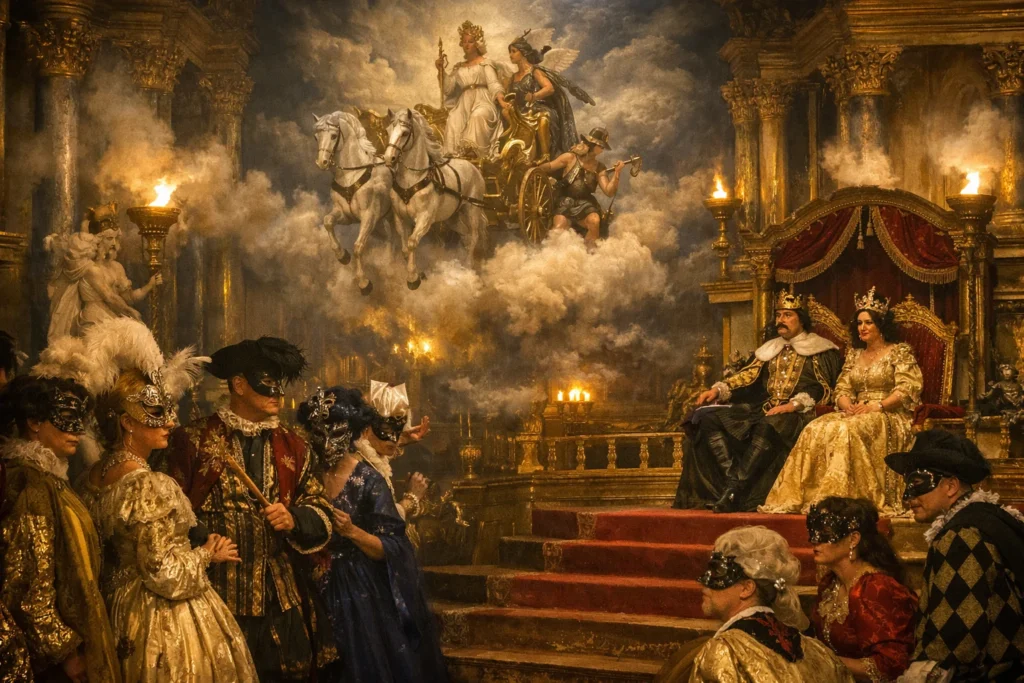

A masque was a short, elite form of Renaissance English entertainment that mixed poetry, music, dance and lavish spectacle to flatter a monarch or noble. Unlike a regular play, it ended with the audience joining the performers in a final dance part political propaganda.
Imagine walking into a candlelit great hall. The ceiling disappears into shadow. Musicians play lutes and viols from a hidden gallery. Then a massive painted cloud descends from above. Gods and goddesses step off it. They aren’t actors. They’re your friends dukes, earls, even the queen herself.
This wasn’t a dream. This was a masque.
The masque meaning goes far beyond a simple dictionary entry. It represents one of the most expensive, exclusive, and bizarre art forms in English history. Part theater, part dance, part political propaganda the masque flattered kings and dazzled nobles for nearly a century.
So what does masque mean exactly? Where did it come from? And why did it vanish so completely?
Let’s find out.
What Is a Masque? The Straight Definition
Let’s cut through the confusion. A masque was a short, aristocratic form of dramatic entertainment. It flourished in England from roughly 1500 to 1642. Performances combined four key ingredients:
- Verse – Poets wrote allegorical speeches
- Music – Composers supplied songs and instrumental pieces
- Dance – Courtiers performed elaborate choreography
- Spectacle – Designers built moving sets and lavish costumes
The audience didn’t sit in silence. At the end, everyone danced together. The monarch led the final measure. Social rank melted away for one magical hour.
Here’s the crucial distinction. A mask covers your face. A masque covers your entire evening with theatrical wonder. Don’t pronounce it “mas-kay.” Say it like “mask.” Same sound, wildly different meaning.
Masque definition in literature: A short allegorical drama performed by amateur aristocrats and professional singers, presented before a royal or noble audience, combining poetry, music, dance, and elaborate visual design.
A Quick Origin Story
The masque didn’t spring from nowhere. Its roots lie in Italy during the 15th century. Wealthy Italian families loved mascherate masked processions and balls. These events celebrated weddings, diplomatic visits, and religious festivals.
France caught the bug next. The ballet de cour (court ballet) mixed dance, verse, and spectacle. French kings performed as sun gods and Roman emperors. They loved showing off.
England came late to the party. Henry VIII enjoyed early masked entertainments in the 1510s and 1520s. But these were crude affairs. Performers wore masks and threw sweets at the audience. Charming, but not yet a true masque.
The real transformation happened under Queen Elizabeth I. Her courtiers staged small allegorical shows called “disguisings.” Then came the Renaissance masque proper. By 1600, the genre had found its feet.
But the golden age arrived with King James I. James loved spectacle more than Elizabeth ever did. He poured money into masques. His son Charles I continued the obsession. Between 1603 and 1640, England produced hundreds of masques. Some cost as much as a warship.
Then came 1642. The English Civil War broke out. Puritans shut down all theaters. Masques required courts, costumes, and cash. All three disappeared. The genre died within a decade.
The Anatomy of a Masque: What Actually Happened?
You need a clear picture. Let’s walk through a typical masque performance step by step.
The Antimasque
The show didn’t start with gods and heroes. It started with monsters.
The antimasque opened the evening. Professional actors performed this section. They played grotesque characters:
- Witches
- Satyrs
- Wild men
- Gypsies
- Trickster gods
The antimasque was chaotic, funny, and ugly. Loud music. Jumping dances. Messy costumes. This chaos made the main masque look even more beautiful by contrast.
Ben Jonson invented the antimasque in 1609 for The Masque of Queens. Before Jonson, masques started with a single allegorical speech. After Jonson, chaos came first.
The Main Masque
The antimasque ended. Silence fell. Then the main masque began.
Noble amateurs appeared as idealized figures:
- Greek gods (Apollo, Jupiter, Venus)
- Roman heroes
- Personified Virtues (Beauty, Truth, Harmony)
- Mythological creatures (Nereids, Tritons)
These performers wore costumes worth a fortune. Silk, cloth of gold, real pearls, ostrich feathers. Inigo Jones designed mechanical wonders: floating islands, moving trees, cloud machines. Stage lighting used hundreds of candles and oil lamps.
The main masque told a simple story. Chaos threatens order. Virtue fights back. The gods descend. They restore harmony. Then they turn toward the king.
The Revels
Here’s the part modern theatergoers find strangest.
After the main masque ended, the performers stopped being characters. They became courtiers again. They walked into the audience. Each noble chose a partner from the seated guests.
Musicians struck up a dance. Everyone joined in. The king danced first. Then the queen. Then the rest of the court.
The revels erased the line between performer and spectator. For thirty minutes, a duke danced with a lady-in-waiting. An earl held hands with a merchant’s daughter. Social rules bent. The court became one happy family.
The Final Song
The last dance ended. A final song praised the monarch directly. No allegory. No hiding.
“Look, look, the king! Whose grace the heavens do bless!”
The masque closed with everyone bowing to the throne. Then servants brought food. The party continued until dawn.
Who Made Masques Happen? The Four Key Roles
No single person created a masque. Four specialists worked together. Often they argued.
The Poet
The poet wrote the verse. He invented the allegory. He chose the mythological framework.
Ben Jonson dominated this role. He wrote masques for James I between 1605 and 1634. Jonson was a classicist. He stuffed his masques with Latin references, moral lessons, and complicated symbolism. He also had a massive ego.
Jonson insisted the words mattered most. He published his masque scripts in fancy folios. He wanted to be remembered as a literary giant. Today, we do remember him but mostly for his plays Volpone and The Alchemist.
Other poets included Thomas Campion, Samuel Daniel, and (briefly) John Milton. Milton’s Comus (1634) is the last great English masque.
The Set Designer
The set designer built the spectacle. He painted the clouds. He rigged the flying machines and he designed the costumes.
Inigo Jones was the master. Jones had studied architecture in Italy. He brought Italian Renaissance stagecraft to England. His innovations included:
- The proscenium arch (framing the stage like a picture)
- Wing and shutter scenery (moving panels for quick changes)
- Painted backdrops with forced perspective
- Elaborate cloud machines for godly descents
Jones and Jonson hated each other. Jonson thought words were art. Jones thought spectacle was art. Their feud became legendary. At one performance, Jones’s scenery broke. Jonson gleefully wrote a poem mocking him.
Jones won in the end. After the masque died, Jones focused on architecture. He designed the Queen’s House at Greenwich and the Banqueting House in Whitehall. You can still visit both today.
The Composer
The composer wrote the music. Most masque music is lost. What survives shows a mix of styles:
- Solo songs for tenor voice
- Choral sections for multiple singers
- Instrumental dances (allemandes, corantos, galliards)
- Recitative-like passages for storytelling
Composers like Alfonso Ferrabosco and Nicholas Lanier wrote for Jonson’s masques. Lanier later became the first Master of the King’s Music.
Masque music wasn’t background noise. It drove the action. Characters announced themselves with songs. Dances followed musical cues. The final revels used popular court dance tunes.
The Performers
Performers fell into two groups.
Professionals handled the antimasque. They were working actors and singers. Some belonged to the King’s Men (Shakespeare’s company). They played the grotesques. They took no bows and they left before the revels.
Amateurs handled the main masque. These were aristocrats: dukes, earls, ladies-in-waiting. Rehearsals lasted weeks. Nobles learned dance steps, memorized verse, and wore revealing costumes which scandalized foreign ambassadors.
Queen Anne (James I’s wife) performed in multiple masques. She appeared as a Blackmore, a goddess, and a nymph. She loved the attention. Her courtiers followed her lead.
The Audience
You couldn’t buy a ticket. Masques invited only the nobility. A typical audience held 50 to 200 people. The king sat centrally on a raised throne. Everyone else sat on benches or stood along the walls.
The audience talked during the show. They ate sweets. They commented on the costumes and they flirted with neighbors. Masques were social events first, theater second.
Masque vs. Regular Play: A Clear Comparison
Let’s put the masque in context. How did it differ from a normal Renaissance play? Here’s a table.
| Feature | Masque | Elizabethan/Jacobean Play |
|---|---|---|
| Venue | Royal court or noble mansion | Public theaters (Globe, Fortune, Rose) |
| Audience | 50–200 invited nobles | 1,500–3,000 paying commoners |
| Price to attend | Free if invited. Priceless if not. | One penny for standing room |
| Performance time | Evenings, after dinner | Afternoons, around 2 PM |
| Script length | 30–60 minutes | 2–3 hours |
| Plot complexity | Thin allegory. No conflict. | Complex characters. Murder, revenge, romance. |
| Ending | Revels + royal praise | Death or marriage (or both) |
| Cost | £1,000–£3,000 (a warship cost £5,000) | £50–£100 per production |
| Who performed | Aristocrats (main masque) + pros (antimasque) | Professional actors (all male) |
| Surviving texts | Many (Jonson published his scripts) | Very many (First Folio, quartos) |
The differences are stark. A masque wasn’t a play. It was a ritual. A play told a story. A masque enacted a fantasy where the king was already a hero.
Famous Masques You Should Know
Theory is fine. Examples are better. Here are five famous masques with real historical weight.
The Masque of Blackness (1605)
Poet: Ben Jonson
Designer: Inigo Jones
Audience: King James I and Queen Anne
Queen Anne played a nymph. She and her ladies painted their faces black. The plot: African nymphs want to become white. The river Thames turns them pale. Modern readers cringe. Jacobean audiences called it exotic and sophisticated.
This masque introduced the Jonson-Jones collaboration. It cost £3,000 roughly £500,000 today. Jones built a giant mechanical seashell that floated across the stage. The shell carried the queen and her ladies.
The Masque of Queens (1609)
Poet: Ben Jonson
Designer: Inigo Jones
Audience: King James I
Jonson invented the antimasque here. Eleven witches opened the show, dancing wildly around a cauldron. Then twelve virtuous queens descended on a cloud throne. Virtue defeated vice. The queens praised King James as the sun god Apollo.
This masque survives complete. Jonson published detailed notes. We know exactly what the witches looked like, how the queens moved, and what songs they sang.
Oberon, the Faery Prince (1611)
Poet: Ben Jonson
Designer: Inigo Jones
Audience: King James I
Prince Henry (the king’s eldest son) played Oberon, king of the fairies. He entered in a giant mechanical rock. The rock opened like a flower. Inside sat Oberon on a crystal throne.
The plot is thin. Oberon wakes. He praises the king. Everyone dances. That’s it. But the spectacle was unforgettable. Jones built a moving lunar landscape. Stars spun overhead. Satyrs leaped through trapdoors.
The Masque of Augurs (1622)
Poet: Ben Jonson
Designer: Inigo Jones
Audience: King James I
This masque celebrated Prince Charles’s return from Spain. The plot involves Roman priests reading bird omens. Boring on paper. Stunning in performance.
Jones built a full two-story Roman temple. The temple rotated to reveal different rooms. Doves flew across the stage on wires. The king laughed at the antimasque characters a comic astrologer and a dancing bear.
Comus (1634)
Poet: John Milton
Designer: Henry Lawes (also composer)
Audience: The Earl of Bridgewater
Milton was a young man when he wrote Comus. The masque tells the story of a lady lost in the woods. Comus, a witch’s son, traps her on an enchanted chair. Her brothers rescue her. The goddess Sabrina frees her.
Comus is different. It has a real plot. It doesn’t flatter a monarch it flatters the Earl and his children. And it survives as a performing text. You can see Comus staged today at Renaissance fairs and university theaters.
Why Did Masques Die So Fast?
The masque flourished for only 70 years. Then it collapsed. Why? Four reasons.
The Civil War (1642–1651)
Parliament banned all stage plays in September 1642. Puritans controlled London. They thought theater was sinful. Masques required courts, costumes, and dancing. Without a royal court, masques couldn’t exist.
The Cost
A single masque cost a fortune. Jones charged £500 for a set of costumes. The queen’s dress might require 100 yards of silk. Musicians demanded payment. Poets expected gifts.
When Charles I lost the Civil War, his court went into exile. No money meant no masques.
Changing Fashion
Charles II returned to the throne in 1660. He brought French tastes back from exile. Paris loved opera and ballet. London followed suit.
Italian opera with its continuous singing and dramatic plots replaced the masque. French ballet with its professional dancers replaced amateur court performances. The masque looked old-fashioned.
Ideological Exhaustion
Masques flattered the monarchy as divinely appointed. But England had beheaded a king in 1649. After that trauma, flattery felt fake. Audiences wanted different stories. They wanted comedies about middle-class life, not myths about sun-kings.
The last true court masque happened in 1640. After 1660, the genre never recovered.
The Masque’s Weird Afterlife
Just because masques died doesn’t mean they disappeared. Their DNA lives on in surprising places.
Shakespeare Borrowed Masque Elements
William Shakespeare used masque scenes in several plays.
- The Tempest (1611) – Act IV contains a full wedding masque. Iris, Ceres, and Juno appear. Spirits dance. The masque breaks when Prospero remembers Caliban’s plot.
- A Midsummer Night’s Dream (1595) – The mechanicals’ play-within-a-play isn’t a masque. But the fairy world and the noble wedding frame it like one.
- Henry VIII (1613) – The “Vision of the Queen” scene uses masque conventions. Dancing shepherds. A descending throne. Flattery of the monarch.
Shakespeare never wrote a full masque script. But he knew the genre. He borrowed its best tricks.
Modern Theater References
- The Boy Friend (1971 film) – Sandy Wilson’s musical includes a “masque” sequence where characters wear domino masks and courtly costumes.
- The King’s Masque (2008 play) – A fictional retelling of the 1613 wedding masque that burned down the Globe Theatre.
- Nell Gwynn (2015 play) – Jessica Swale’s comedy mentions masques as old-fashioned entertainment the new king rejects.
Fantasy Fiction
- Jonathan Strange & Mr Norrell (2004) – Susanna Clarke’s novel includes a dreamlike masque scene. Gentlemen with thistle-down hair dance with captive women.
- The Masque of the Red Death (1842) – Edgar Allan Poe’s short story uses the word “masque” in its title. But Poe describes a masquerade ball, not a theatrical performance. Close, but not identical.
Role-Playing Games
- Vampire: The Masquerade (1991) – The title borrows “masquerade,” not “masque.” But the game’s theme of hidden noble courts maps directly onto Renaissance masque culture.
- Dungeons & Dragons – Many campaign modules feature masque-like court entertainments. A typical scenario: the players attend a noble ball. A villain disrupts the masque. Heroes restore order.
Masque Meaning in One Sentence
Here’s the cleanest definition you’ll find.
A masque was Renaissance England’s most expensive, exclusive, and flattering form of political theater part party, part propaganda, and utterly magical while it lasted.
Every word matters in that sentence.
- Expensive – Thousands of pounds per performance.
- Exclusive – Invitation only. No tickets sold.
- Flattering – The monarch always won.
- Political theater – Masques made kings look like gods.
- Party – Dancing and feasting afterward.
- Propaganda – Allegory justified royal power.
- Magical – Flying gods. Moving scenery. Silk and gold.
The masque meaning isn’t dusty history. It’s a window into how power entertains itself.
FAQs
Let’s answer the questions real readers ask.
What is a masque in literature?
A short allegorical drama performed by amateur aristocrats and professional singers. It combines poetry, music, dance, and elaborate visual design. The audience is a single noble or monarch.
How is a masque different from a mask?
A mask covers your face. A masque is a full theatrical performance. They sound the same. They are not the same.
Where did the masque originate?
Italian court festivals called mascherate. French ballets de cour. English disguisings under Henry VIII. The full form emerged around 1600.
What are examples of a masque?
- The Masque of Blackness (1605)
- The Masque of Queens (1609)
- Oberon, the Faery Prince (1611)
- Comus (1634)
Why were masques popular in royal courts?
They let aristocrats perform on stage. They let the monarch feel like a living god. And they gave everyone an excuse to wear gorgeous costumes and dance until dawn.
What is the purpose of a masque?
Entertainment first. Then political propaganda. Then social bonding. The masque taught the court how to behave gracefully, obediently, joyfully under the king’s gaze.
How do you pronounce masque?
It rhymes with “task.” Not “mas-kay.” Not “moss-que.” Just one syllable: /mæsk/.
Did Shakespeare write masques?
No full masques. But he included masque-like scenes in The Tempest, A Midsummer Night’s Dream, and Henry VIII.
When did masques end?
The last great court masque happened in 1640. The Civil War (1642–1651) killed the genre. After 1660, Italian opera and French ballet replaced it.
Can I see a masque today?
Yes. Comus by John Milton gets occasional revivals. Renaissance fairs sometimes stage short masques. And opera productions occasionally borrow masque conventions for baroque works.
Conclusion
You might never see a live masque. That’s fine. But understanding masque meaning helps you spot something important.
Every era has its own way of flattering power. Today we have state dinners, televised inaugurations, and royal weddings. The Tudors and Stuarts had masques.
When you watch a modern political convention or a celebrity award show, look for masque elements. The careful staging. The flattering lighting. The scripted speeches praising the leader. The audience participation (applause, standing ovations). The final dance (handshakes, photo opportunities).
The masque never really died. It just changed costumes.
Now you know what the word means. You know its history. You know its players. And next time someone confuses “masque” with “mask,” you can smile and correct them.
Discover More Related Articles:
- “OBO” Meaning Explained: How to Use It in Sales & Negotiations In 2026
- “DTF” Meaning in Chat: What It Really Means & How It’s Used In 2026
- “White Heart” Meaning: Pure Love, Friendship & Peace Symbol In 2026