
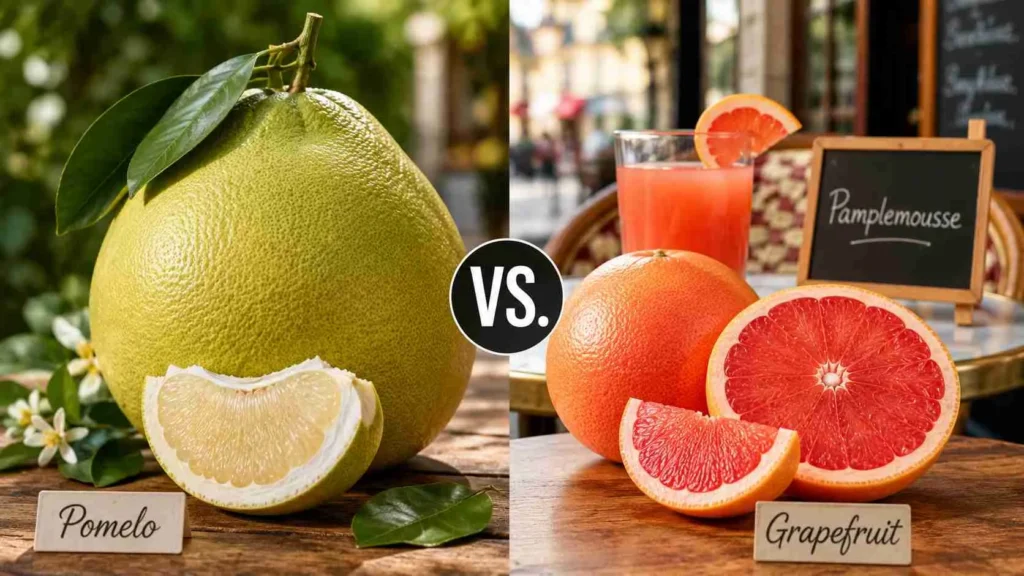

Pamplemousse is the French word for grapefruit in everyday modern usage, though it originally referred to the pomelo the large, thick-skinned ancestor of all citrus fruits. The meaning depends on context, but in France, ordering a pamplemousse will always get you a tart, pink grapefruit.
You’ve probably spotted pamplemousse on a trendy juice bottle. Maybe you heard it in a French film or saw it on a fancy restaurant menu. It rolls off the tongue with a certain charm pam-pleh-moose and it feels sophisticated. But here’s the thing: nobody seems to agree on what it actually means.
Does it mean grapefruit? Pomelo? Both? Neither?
I’ve spent weeks digging through linguistic archives, botanical records, and culinary history to untangle this mess. And honestly? The answer surprised me.
This guide covers everything you need to know about the pamplemousse meaning. We’ll explore its true definition, trace its wild journey across continents, and finally settle the grapefruit versus pomelo debate once and for all.
What Is the Pamplemousse Meaning?
Let’s start with the simplest answer.
The pamplemousse meaning in French is “grapefruit.” If you walk into any French supermarket today and grab a pamplemousse, you’ll walk out with a grapefruit. Order a jus de pamplemousse at a Parisian café, and you’ll get tart pink grapefruit juice.
But that’s only half the story.
The word has a split personality. In botanical circles, pamplemousse still refers to the pomelo the giant, thick-skinned citrus ancestor that looks like a deformed basketball. In some French-speaking regions like Belgium and Switzerland, the word can mean either fruit depending on context.
So the pamplemousse meaning depends entirely on where you are and who you’re talking to.
The Two Fruits Behind the Confusion
To understand the pamplemousse meaning, you need to meet both fruits.
The Grapefruit
The grapefruit is a relatively modern invention. It didn’t exist in the wild. Instead, it emerged sometime in the 18th century as a natural hybrid between the pomelo and the sweet orange. Botanists believe this cross happened accidentally in the Caribbean likely in Barbados where sailors had dumped seeds from both fruits.
The grapefruit has:
- A thin, yellow or pinkish rind
- Pink, white, or ruby flesh
- A famously bitter and tart flavor
- A diameter of 4 to 6 inches
- An average weight of 1 to 2 pounds
The Pomelo
The pomelo is the granddaddy of citrus fruits. It’s one of the original citrus species the ancestors from which all other citrus fruits descended.
The pomelo has:
- A massive size of 6 to 12 inches in diameter
- A thick rind up to 2 inches deep
- A sweet, mildly tangy flavor with almost no bitterness
- A weight of 2 to 5 pounds (though some can reach 25 pounds)
- Flesh that ranges from pale yellow to pink
The pomelo tastes more floral and sweet than grapefruit. Many people describe it as a sweeter, less acidic cousin.
A Side-by-Side Comparison
| Feature | Grapefruit | Pomelo |
|---|---|---|
| Scientific name | Citrus × paradisi | Citrus maxima |
| Size | 4-6 inches across | 6-12 inches across |
| Skin thickness | Thin (under 0.5 inches) | Thick (up to 2 inches) |
| Weight | 1-2 pounds | 2-5 pounds (sometimes more) |
| Flavor | Bitter, acidic, tart | Sweet, tangy, mildly floral |
| Bitterness level | High | Very low |
| Origin | Natural hybrid (18th century) | Original species (ancient) |
| Pith thickness | Thin | Very thick, spongy |
| Seed count | Few to many seeds | Many large seeds |
| Peak season | Winter through spring | Late fall through winter |
Where Did the Word Pamplemousse Come From?
The etymology of pamplemousse reads like a travelogue. This word crossed oceans and transformed through multiple languages before settling into French.
The Tamil Connection
Most linguists trace the pamplemousse meaning back to the Tamil language of southern India. The Tamil phrase pampa limāsu roughly translates to “big citrus.” Tamil speakers used this phrase to describe large citrus fruits growing in the region.
The Portuguese Stopover
Portuguese sailors arrived in India during the Age of Discovery. They encountered these giant citrus fruits and heard the Tamil phrase. In true sailor fashion, they adapted it into something more Portuguese-sounding. The word became pomposos limões or variations thereof.
The Dutch Transformation
The Dutch East India Company played a massive role in spreading both fruits and words across Asia and Europe. Dutch merchants picked up the Portuguese version and transformed it into pompelmoes.
The Dutch word combined pompel (meaning “swollen” or “big”) with limoes (meaning “lemon”). So the pamplemousse meaning in Dutch was literally “big lemon.”
The French Adoption
The French borrowed the Dutch word sometime in the 17th century. They gave it a more French-friendly spelling and pronunciation pamplemousse. The earliest recorded use appears in a 1665 travel account describing exotic Asian fruits.
The Historical Timeline of Pamplemousse
Here’s how the pamplemousse meaning evolved over centuries.
1600s: The Pomelo Era
French explorers and botanists used pamplemousse exclusively to describe the pomelo. They encountered this giant fruit in Southeast Asia and the Indian Ocean islands. The word didn’t yet apply to grapefruits because grapefruits didn’t exist yet.
1700s: The Grapefruit Appears
The grapefruit hybrid emerged in the Caribbean around the 1750s. Early botanical records called it the “forbidden fruit” or the “Barbados grapefruit.” The term grapefruit came from how the fruits grew in clusters like grapes.
1800s: The Confusion Begins
As grapefruit cultivation spread to Europe and beyond, French speakers started using pamplemousse to describe both fruits. Botanists tried to maintain the distinction, but everyday people didn’t care. A citrus fruit was a citrus fruit.
1900s: Grapefruit Takes Over
By the mid-20th century, the pamplemousse meaning had shifted in most French-speaking regions. People used it almost exclusively for grapefruit. The pomelo became known by other names or was simply called a pamplemousse still.
Today: The Bifurcation
The pamplemousse meaning varies by region and context. In France, it’s grapefruit. In botanical circles, it’s often pomelo. In international contexts, it can be either or both.
How Do You Pronounce Pamplemousse?
Let’s get the pronunciation right.
French pronunciation: pahm-pluh-mooss
Break it down:
- pam — like “palm” but cut off the L sound
- pleh — rhymes with “blah” but with an ‘ay’ sound (think “play” without the Y)
- moose — exactly like the large animal, but with a softer, more breathy S
The final S in French is often silent in some contexts, but here, it’s pronounced. So you don’t say “pahm-pluh-moo” like you might with other French words.
English speakers often say: pam-pull-moose
This is close enough, though it sounds distinctly more American. The true French pronunciation has that rounded, nasal quality that’s hard to replicate without practice.
Is Pamplemousse the Same as Grapefruit?
This is the million-dollar question.
In everyday French conversation: Yes. Absolutely. If you ask for a pamplemousse, you’ll get a grapefruit. Full stop.
In botanical terms: Not exactly. Pamplemousse botanically refers to the pomelo species (Citrus maxima). The grapefruit is a separate hybrid (Citrus × paradisi).
In practical terms: It depends on context. A French chef means grapefruit. A plant taxonomist means pomelo. A market vendor in Southeast Asia might mean either.
The pamplemousse meaning has become flexible over time. It’s one of those words where usage beats technical accuracy every time.
Pamplemousse in French Culture
The word appears everywhere in French life.
On Breakfast Tables
The French love grapefruit for breakfast. They eat it plain, sprinkled with sugar, or juiced. Pamplemousse is a staple of the classic French continental breakfast alongside a croissant and café au lait.
In Cocktails
The Pamplemousse cocktail mixes grapefruit juice with vodka or gin, often with a splash of elderflower liqueur. It’s refreshing, tart, and distinctly sophisticated.
In Perfumes and Cosmetics
Grapefruit essential oil carries the name pamplemousse on many French skincare and fragrance labels. The scent is bright, energizing, and popular in men’s and women’s products alike.
In Literature and Pop Culture
French novels and films reference pamplemousse enough that it’s one of the first fruit words French learners pick up. It’s memorable, fun to say, and distinctly French.
The Botanical Reality |Understanding Citrus Classification
Let’s get scientific for a moment.
The Citrus Family Tree
The genus Citrus contains a complicated family tree. Most commercial citrus fruits are hybrids of just three original species:
- Citrus maxima — the pomelo
- Citrus medica — the citron
- Citrus reticulata — the mandarin
Every other citrus fruit you know comes from crossing these three ancestors.
The grapefruit is a natural hybrid of the pomelo and the sweet orange (which itself is a mandarin-pomelo cross). So grapefruit is the pomelo’s grandchild, in a sense.
| Fruit | Parentage | Original species involved |
|---|---|---|
| Pomelo | Original species | Citrus maxima |
| Grapefruit | Pomelo × orange | C. maxima × (C. reticulata × C. maxima) |
| Orange | Mandarin × pomelo | C. reticulata × C. maxima |
| Lemon | Citron × sour orange | C. medica × (C. reticulata × C. maxima) |
| Lime | Various crosses | Multiple species |
Why Classification Matters
For botanists, the pamplemousse meaning must be precise. They need to know exactly which species they’re studying. Using the same word for two different species creates confusion in research, cultivation, and conservation.
For everyday people, this precision doesn’t matter much. You just want to know what you’re buying at the market.
Pamplemousse Around the World
The pamplemousse meaning changes across borders.
France
Pamplemousse means grapefruit. Everyone knows this. You’ll see it on juice cartons, fruit labels, and restaurant menus.
Belgium and Switzerland
French speakers in these countries use the word similarly to France. However, some regions distinguish between pamplemousse (grapefruit) and pomélo (pomelo) more consistently.
Quebec
Canadian French uses pamplemousse for grapefruit too, though you might also hear the English loanword “grapefruit” in casual conversation.
French Caribbean
In Martinique and Guadeloupe, the word can refer to a local variety that blurs the line between pomelo and grapefruit. These island fruits have been growing and cross-breeding for centuries.
West Africa
French-speaking African nations use pamplemousse for grapefruit, but local names often prevail in markets and casual speech.
Southeast Asia
In former French colonies like Vietnam and Laos, the word exists in local vocabulary but doesn’t always map directly to one fruit. The pamplemousse meaning there might lean more toward pomelo, especially given the region’s native pomelo varieties.
Why Everyone Gets Confused
The pamplemousse meaning is genuinely confusing for several reasons.
Reason One: The Fruits Look Similar
Both grapefruit and pomelo are large, round citrus fruits with yellow or greenish skin. To a casual observer, they’re hard to tell apart. The size difference isn’t obvious unless you compare them side by side.
Reason Two: Historical Usage
The word existed for pomelos for centuries before grapefruits appeared. When grapefruits arrived in France, people just used the existing word. Why invent a new one when an old one works?
Reason Three: Regional Variation
Different French-speaking regions settled on different meanings. Some kept the historical pomelo meaning, while others shifted to grapefruit. Neither group is wrong; they just speak different regional dialects.
Reason Four: Translation Issues
English dictionaries often list “grapefruit” as the only translation. This simplifies the pamplemousse meaning but erases the historical pomelo connection. Then people encounter a pomelo described as a pamplemousse and get confused.
Reason Five: The Pomelo’s Limited Western Presence
Pomelos aren’t as common in Western markets as grapefruits. Most Westerners encounter the word pamplemousse in French contexts first, where it means grapefruit. They never learn the pomelo connection until they stumble into a botanical discussion.
Fun Facts About Pamplemousse
- The grapefruit gets its English name from how the fruits grow in clusters like grapes on a vine. The French ignored this entirely and kept the older pamplemousse.
- The world’s largest pomelo weighed over 25 pounds. That’s bigger than a bowling ball.
- Pomelo peel can be candied and eaten as a sweet treat. The thick pith absorbs sugar beautifully and turns into a chewy, fragrant candy.
- Some French speakers jokingly call grapefruit pamplemousse rose (pink grapefruit) to distinguish it from the less common pamplemousse blanc (white grapefruit).
- The pomelo is a symbol of prosperity and good fortune in Chinese culture. People exchange them during Lunar New Year celebrations.
- Grapefruit interacts with certain medications due to an enzyme in the fruit that affects drug metabolism. This doesn’t affect pomelos nearly as much.
- Essential oil from pamplemousse is one of the most popular aromatherapy scents for energy and focus. It’s also a natural insect repellent.
How to Use Pamplemousse in Everyday Life
In the Kitchen
- Juice it. Fresh pamplemousse juice (grapefruit) is bright, tart, and perfect with breakfast.
- Segment it. Add grapefruit or pomelo segments to salads with arugula, avocado, and a light vinaigrette.
- Zest it. The zest adds citrusy punch to baked goods, dressings, and cocktails.
- Candy the peel. The thick pomelo peel makes excellent candied citrus peel.
In Drinks
- Classic juice. Fresh-squeezed grapefruit juice is a morning classic.
- Cocktails. The Pamplemousse cocktail with gin or vodka is crisp and elegant.
- Spritzers. Mix grapefruit juice with sparkling water for a refreshing non-alcoholic drink.
- Mimosas. Swap the orange juice for grapefruit juice in your brunch mimosa.
In Skincare
Grapefruit essential oil appears in:
- Facial cleansers for brightening
- Body scrubs for exfoliation
- Perfumes for a fresh, uplifting scent
- Hair products for shine and fragrance
The Linguistic Beauty of Pamplemousse
Words carry stories. Pamplemousse has one of the most colorful linguistic histories you’ll find.
Think about it. A Tamil phrase became Portuguese, then Dutch, then French. Each language adapted it to its own sounds and spelling. The meaning shifted from “big lemon” to “that Asian fruit” to “the grapefruit we eat for breakfast.”
The pamplemousse meaning now contains all that history. When you say the word, you’re not just naming a fruit. You’re invoking centuries of travel, trade, and linguistic evolution.
French speakers love the word for its musical quality. It’s fun to say. It sounds playful and sophisticated at the same time. That’s probably why it appears in so many product names, restaurant titles, and even children’s books.
Pamplemousse in Language Learning
For anyone learning French, pamplemousse is a vocabulary gem.
Why It Stands Out
- It’s visually distinct you won’t confuse it with other words
- It’s fun to pronounce
- It appears in everyday contexts
- It’s a great conversation starter
Common Mistakes
- Mispronouncing the final S (it’s pronounced, unlike many French words)
- Using it for the wrong fruit in the wrong context
- Forgetting the gender (it’s masculine le pamplemousse)
Helpful Phrases
- Un pamplemousse — a grapefruit
- Un jus de pamplemousse — grapefruit juice
- Un pamplemousse rose — a pink grapefruit
- Un pamplemousse blanc — a white grapefruit
- Le pamplemousse est acide — grapefruit is tart
Nutritional Profile of Both Fruits
Understanding the pamplemousse meaning also means knowing what you’re eating.
Grapefruit
| Nutrient | Amount |
|---|---|
| Calories | 42 |
| Carbohydrates | 11g |
| Fiber | 1.6g |
| Sugar | 7g |
| Protein | 0.8g |
| Vitamin C | 31mg (52% DV) |
| Vitamin A | 1150 IU |
| Potassium | 135mg |
Grapefruit is famous for its vitamin C content. One medium fruit provides over 100% of your daily requirement. It also contains antioxidants like lycopene (in pink and red varieties) and beta-carotene.
Pomelo (per 100g)
| Nutrient | Amount |
|---|---|
| Calories | 38 |
| Carbohydrates | 10g |
| Fiber | 1g |
| Sugar | 8g |
| Protein | 0.8g |
| Vitamin C | 61mg (102% DV) |
| Potassium | 216mg |
Pomelos actually contain more vitamin C than grapefruits by weight. They’re also lower in acidity, making them gentler on sensitive stomachs.
When to Choose Grapefruit vs Pomelo
Choose Grapefruit When:
- You want a tart, bitter flavor to wake up your taste buds
- You’re making a classic breakfast juice
- You need a fruit that pairs with savory dishes
- You’re watching your calories grapefruit is low-calorie
- You want the classic pink or ruby color
Choose Pomelo When:
- You prefer a sweeter, less acidic taste
- You want a fruit that’s easier to segment cleanly
- You’re making a fruit salad and don’t want the bitterness to overpower
- You want a unique, show-stopping fruit at a dinner party
- You’re sensitive to the acidity of grapefruit
The Future of Pamplemousse
Language evolves. The pamplemousse meaning will likely continue shifting.
One trend: as global trade brings more pomelos to Western markets, the distinction between grapefruit and pomelo becomes more important. Consumers want to know exactly what they’re buying.
Another trend: the word pamplemousse appears more frequently in English contexts, especially in food writing and product names. It carries a certain exotic appeal that plain “grapefruit” lacks.
We might see pamplemousse become a standalone loanword in English like “croissant” or “sushi.” That means the pamplemousse meaning would exist independent of its French origins, taking on new nuances in English usage.
Summary | What You Need to Remember
Here’s the quick takeaway on the pamplemousse meaning.
- In everyday French: Pamplemousse means grapefruit. Period.
- Botanically: Pamplemousse refers to the pomelo species (Citrus maxima).
- Historically: The word started as Tamil, traveled through Portuguese and Dutch, and became French in the 17th century.
- In practice: Context matters. Ask what people mean if you’re unsure.
- The difference: Grapefruit is the bitter hybrid. Pomelo is the sweeter ancestor. They look similar but taste completely different.
- Nutritionally: Both are packed with vitamin C, though pomelo edges out grapefruit by a little.
- Culturally: Pamplemousse is woven into French food, drink, and skincare culture.
FAQs
Does pamplemousse mean grapefruit in French?
Yes. In modern French, pamplemousse means grapefruit. You’ll find this definition in any standard French dictionary.
What is the English translation of pamplemousse?
The most common translation is “grapefruit.” However, some dictionaries also list “pomelo” as a secondary definition.
Is pamplemousse a pomelo?
Originally, yes. Today, usually not. The pamplemousse meaning has shifted toward grapefruit in most contexts. However, botanical texts still use it for pomelos.
What language is pamplemousse from?
French. But the French borrowed it from Dutch, which borrowed from Portuguese, which likely adapted from Tamil.
How do you use pamplemousse in a sentence?
- “I ordered a jus de pamplemousse and got a perfectly tart grapefruit juice.”
- “The farmer showed me a giant pamplemousse from his orchard and insisted it was sweeter than any grapefruit.”
- “She added pamplemousse zest to the salad dressing for a bright, citrusy kick.”
Why is grapefruit called pamplemousse in French?
The name stuck because grapefruit arrived in France when the word already existed for the pomelo. French speakers just extended the existing word to cover the similar-looking hybrid.
What’s the difference between pamplemousse and pomelo?
A pomelo is the original fruit species. Pamplemousse is the French word that can mean either the pomelo or the grapefruit, depending on context. In modern usage, they’re distinct pomelo refers specifically to the giant sweet fruit, while pamplemousse usually means grapefruit.
Conclusion
The pamplemousse meaning isn’t just about fruit. It’s about how words travel, how meanings shift, and how languages borrow from each other. A Tamil phrase for a Southeast Asian fruit became a Dutch word, then a French word, then became tangled with a fruit hybrid that didn’t even exist when the word was first coined.
Now it sits on breakfast tables, juice labels, and fragrance bottles. It’s a word that tells a story every time you say it.
The next time you order jus de pamplemousse or pick up a giant greenish-yellow fruit at the market, you’ll know exactly what you’re getting and you’ll know the rich history behind the name.
And if someone asks you what pamplemousse means, you can tell them the whole story. From the Tamil coast to a Parisian café, the pamplemousse meaning has traveled a long, winding road to get where it is today.
Discover More Related Articles:
- “YN” Mean on TikTok: You’ve Seen It Everywhere In 2026
- “HN” Mean in Text: Here’s What It Really Means in Text In 2026
- “FML” Mean in Text: The Truth Behind This Popular Expression In 2026