
Definition
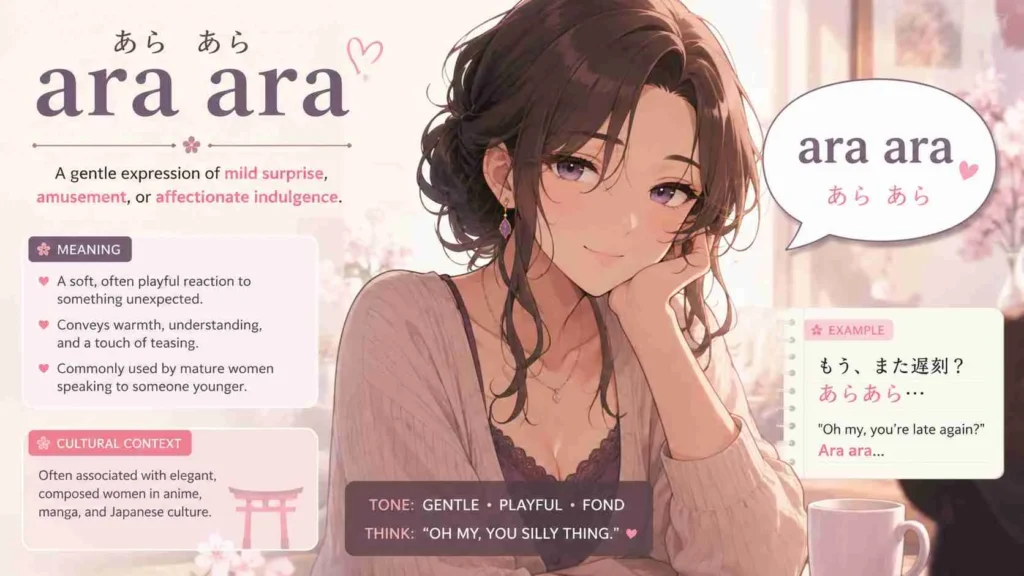
Ara ara is a Japanese expression used mainly by women to show mild surprise, amusement, affection or playful concern. In English, it is often translated as “oh my,” “my my,” or “oh dear,” depending on tone and context.
If you have spent even a little time on anime, social media, or meme culture, you have probably heard the phrase “ara ara.” It is soft, expressive, and often delivered in a charming voice that instantly catches attention. Over time, this small Japanese expression has become globally popular, especially among anime fans and online communities.
But what does it actually mean? Is it romantic, funny, flirty, or just a simple expression?
The truth is that “ara ara” is more flexible than it looks. Its meaning changes depending on tone, situation, and who is saying it. In this guide, you will learn everything about what “ara ara” means, where it comes from, how it is used in real life, and how it became an internet sensation.
Origin of Ara Ara
The phrase “ara ara” comes from the Japanese language. It is not slang or a modern invention. Instead, it is a traditional interjection used mostly by women in polite or soft-spoken conversations.
Linguistic background
In Japanese, “ara” is an exclamation used to express surprise or realization. When repeated as “ara ara,” it softens the emotion and adds a more expressive or affectionate tone.
Historically, it has been used in everyday Japanese speech for centuries, especially in polite or feminine communication styles.
Cultural usage in Japan
In Japan, “ara ara” is commonly used by:
• Mothers speaking to children
• Teachers reacting to small mistakes
• Women expressing gentle surprise
• Older women reacting playfully or teasingly
It is important to understand that in Japan, it is NOT inherently romantic or flirtatious. That interpretation mostly comes from anime culture.
Why Ara Ara Became So Popular Online
The global popularity of “ara ara” is heavily influenced by anime and internet memes.
Anime influence
Many anime characters, especially mature or older female characters, use “ara ara” in a soft, teasing tone. This created a specific stereotype of:
• Calm voice
• Slight smile
• Playful or teasing personality
Because of this portrayal, international audiences started associating “ara ara” with flirtation or seductive behavior.
Internet culture impact
Social media platforms like TikTok, Reddit, and YouTube further amplified the phrase. It became a meme sound, often used humorously or exaggeratedly.
Today, “ara ara” is part of global pop culture vocabulary, even for people who do not watch anime.
Meaning of Ara Ara in Different Contexts
The meaning of “ara ara” depends entirely on tone and situation. It can express multiple emotions.
Common interpretations
• Surprise
• Mild shock
• Playful teasing
• Affection
• Concern
• Amusement
Example Table: Ara Ara in Real Situations
| Situation | Tone | Meaning of Ara Ara | English Equivalent |
|---|---|---|---|
| Child spills juice | Concerned | Oh dear, what happened? | Oh no |
| Friend says something silly | Playful | Oh my, that is funny | Haha, really? |
| Anime character teasing | Flirty playful | Well well, look at you | Oh my, aren’t you interesting |
| Elder reacting politely | Neutral surprise | Oh, I see | Oh really |
| Teacher correcting mistake | Mild disappointment | Oh dear, be careful | You should be careful |
How Ara Ara Is Used in Real Japanese Conversation
Even though anime made it famous, “ara ara” is still used in real life Japanese communication.
Everyday usage examples
• It, mou sukoshi yasunde kudasai
Meaning: Oh dear, please rest a bit more
• Ara ara, sore wa taihen desu ne
Meaning: Oh my, that sounds difficult
- It, dokka de mita koto arimasu ne
- Meaning: Oh, I feel like I have seen that somewhere
Key point
In real Japanese culture, it is usually calm, polite and soft. It is NOT exaggerated like in anime.
Ara Ara in Anime and Pop Culture
Anime has shaped the global understanding of “ara ara” more than anything else.
Typical anime portrayal
Characters who say “ara ara” are often:
• Mature women
• Older sisters or “onee-san” types
• Calm and confident personalities
• Slightly teasing or playful figures
Common emotional tone
• Soft voice
• Slight smile
• Gentle eye contact
• Calm attitude
Because of this styling, many fans mistakenly believe it is always flirtatious.
Comparison With Similar Japanese Expressions
To understand “ara ara” better, it helps to compare it with similar Japanese interjections.
Comparison Table: Ara Ara vs Other Expressions
| Expression | Meaning | Tone | Usage |
|---|---|---|---|
| Ara ara | Oh my, oh dear | Soft, playful | Surprise or teasing |
| Ehh | What? Really? | Neutral surprise | Confusion or shock |
| Sugoi | Wow, amazing | Excited | Positive reaction |
| Yare yare | Good grief | Tired, annoyed | Frustration |
| Maa maa | Now now, calm down | Soothing | Comfort or calming someone |
Is Ara Ara Flirty or Romantic?
This is one of the most searched questions online.
Simple answer
No, “ara ara” is NOT inherently flirty.
Why people think it is flirty
• Anime character stereotypes
• Social media exaggeration
• Voice acting style in shows
• Meme culture interpretations
Real truth
In Japan, it is mostly:
• Neutral
• Gentle
• Polite
• Sometimes motherly or caring
So the romantic meaning is mainly a Western internet interpretation.
Alternate Meanings and Variations
While “ara ara” itself is fixed, it can appear in different variations:
Variants
• Ara
• Araaa
• Ara ara ara (emphasized surprise)
Related expressions
• Maa
• Yare yare
• Oya oya
Each has slightly different emotional tone but serves similar conversational purposes.
Polite or Professional Alternatives in English
If you want to use similar expressions in English conversation, here are some alternatives:
• Oh my
• Oh dear
• My my
• Goodness
• Oh really
• I see
• That is interesting
These can be used depending on tone:
• Formal: “I see” or “Oh dear”
• Casual: “Oh my” or “Really?”
• Playful: “My my”
When You Should Not Use Ara Ara
Even though it is popular, there are situations where using it is not appropriate.
Avoid using it in:
• Formal business communication
• Academic writing
• Serious emotional situations
• Professional emails
• Conversations with strangers in formal settings
It is best used in casual or entertainment contexts.
Emotional Tone Breakdown of Ara Ara
Here is a deeper look at emotional layers:
• Surprise but controlled
• Soft amusement
• Slight teasing without aggression
• Gentle concern
• Calm observation
It is a “low intensity emotion” phrase, meaning it never sounds extreme.
Example Usage Table: Natural Sentences
| Japanese PhraseSituationEnglish Meaning | ||
|---|---|---|
| Ara ara, okurechatta ne | Someone is late | Oh my, you are late |
| Ara ara, sore wa omoshiroi | Something interesting happens | Oh, that is interesting |
| Ara ara, daijoubu? | Someone looks hurt | Oh dear, are you okay? |
| Ara ara, minna genki? | Greeting group | Oh my, is everyone fine? |
Why Ara Ara Became a Meme
The meme popularity comes from:
• Anime voice exaggeration
• Internet humor culture
• Reaction video usage
• TikTok sound trends
• Cosplay influence
It became symbolic of “anime feminine charm” even though its real meaning is much simpler.
Cultural Misunderstandings About Ara Ara
Many learners misunderstand it due to:
• Anime overrepresentation
• Lack of context in translation
• Meme exaggeration
• Voice tone misinterpretation
In reality, Japanese speakers use it casually without any special intention.
Practical Tips for Learners
If you are learning Japanese or just curious:
• Listen to tone, not just words
• Do not assume romantic meaning
• Watch real Japanese conversations
• Understand context before copying usage
FAQs
What does ara ara mean in simple words?
It means “oh my” or “oh dear” and is used to express mild surprise or amusement in a soft tone.
Is ara ara a flirty word?
No, it is not originally flirty. The flirty meaning comes mainly from anime and internet culture.
Why do anime characters say ara ara?
It is used to show a calm, mature, and slightly teasing personality in fictional characters.
Can men say ara ara?
Yes, but it is less common. It is traditionally associated with feminine speech styles.
Is ara ara used in real Japan?
Yes, it is used in daily conversation but in a natural and gentle tone, not exaggerated like anime.
What is the English equivalent of ara ara?
Words like “oh my,” “my my,” or “oh dear” are the closest English equivalents.
Does ara ara mean oh no?
Sometimes, depending on context, it can express mild concern similar to “oh no.”
Is ara ara outdated in Japanese?
No, it is still used, but mostly in specific polite or playful situations rather than everyday modern slang.
Conclusion
Ara ara is a simple yet expressive Japanese phrase that carries different meanings depending on tone and context. While global pop culture, especially anime, has turned it into a playful or even flirty expression, its original meaning is much more gentle and neutral.
Understanding its true meaning helps avoid common misunderstandings and gives better cultural appreciation. So the next time you hear “ara ara,” remember that it is less about romance and more about tone, context, and emotion.
Discover More Related Articles:
- “A Burger and a Grape Snow Cone” Mean: in Social Media Slang Guide In 2026
- “EYP” Mean in Text: What People Really Mean In 2026
- “ASF” Meaning in Chat Apps: Why People Use ASF In 2026