
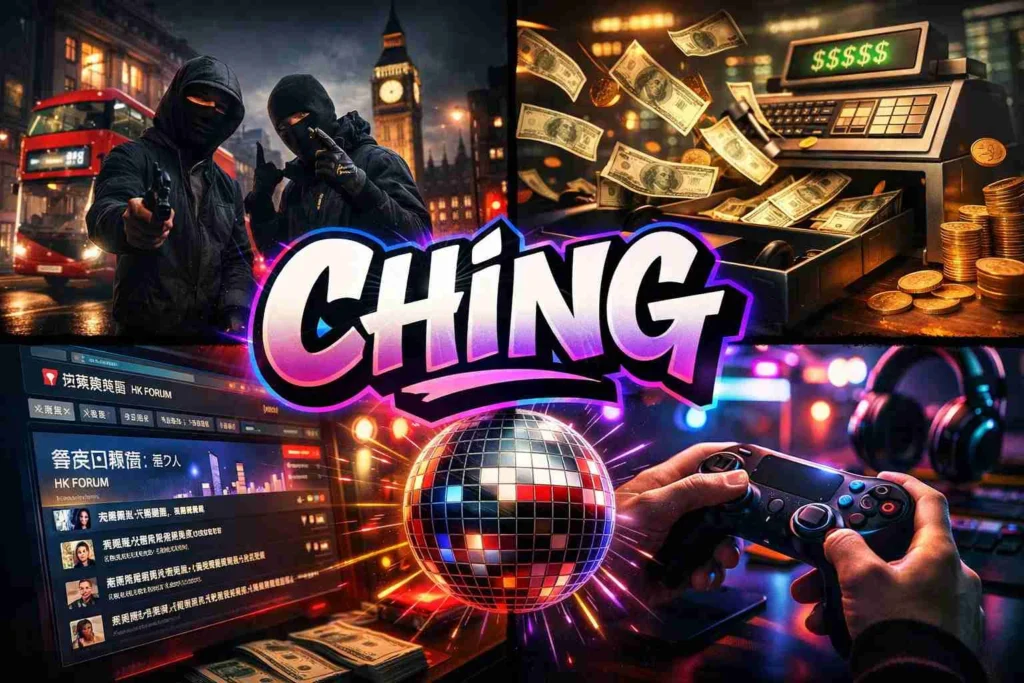

Ching is a versatile slang term that primarily means a stabbing or knife attack in UK drill culture (onomatopoeia for a blade’s sound), while also serving as an exclamation for money or profit (short for “cha-ching”) in business and hip-hop contexts plus it works as a respectful address (“C-hing”) in Hong Kong internet culture and a playful victory cry in gaming.
Four letters. One word. A dozen meanings.
You’ve scrolled past it on TikTok. You’ve heard it spit in UK drill tracks. And you’ve seen it pop up in group chats and forum threads. Yet every time it appears, the meaning shifts like sand under your feet.
Is someone talking about money? Are they referencing a knife attack? Or are they just giving a playful shoutout to a fellow gamer?
The ching meaning depends entirely on who’s saying it and where they’re standing. A teenager in London uses it differently than a Hong Kong netizen. A hip-hop fan interprets it differently than a gamer. And if you mix them up? Well, you might end up looking clueless at best or offensive at worst.
This guide breaks down every single variation of this slippery slang term. We’ll dig into its gritty origins in UK street culture. We’ll trace its journey from cash registers to rap lyrics. And we’ll explore how it became a respectful honorific in Cantonese internet spaces. And we’ll show you exactly how to tell the difference so you never confuse a stabbing reference with a money flex.
By the end, you’ll know what does ching mean in any context. You’ll recognize it in drill songs, decode it in text messages, and use it confidently in your own conversations. No more guessing. No more awkward misunderstandings. Just clear, actionable knowledge.
The UK Drill Slang Meaning| Knives, Violence and Street Culture
When most people search for ching meaning, they’re looking for this one. And honestly? It’s the heaviest interpretation of the lot.
In UK slang, particularly within London’s drill music scene, “ching” refers to a knife. But it goes deeper than that. It also means to stab someone. Or the wound itself. Or the sound of a blade cutting through the air.
Where Did This Meaning Come From?
The origin is simple: onomatopoeia.
Say it out loud. “Ching.” That metallic ring? That sharp, high-pitched slice? It mimics the exact sound a blade makes when you draw it from a sheath or strike it against something hard. The word evolved from that auditory experience into a shorthand for the act itself.
In London’s street culture, slang often emerges from shared experiences and coded language. Communities develop their own vocabulary to communicate without outsiders understanding. “Ching” became part of that lexicon, spreading through rap lyrics, social media, and eventually mainstream awareness.
How Drill Music Popularized the Term
UK drill music exploded in the mid-2010s, and with it came a whole new vocabulary. Artists like Headie One, Digga D, and Loski routinely dropped “ching” in their bars. The word became synonymous with the gritty realities of street life in London boroughs.
Drill lyrics don’t shy away from violence. They paint raw pictures of survival, rivalry, and loss. When you hear a rapper say “I heard he got chinged,” they’re describing a stabbing. When they mention “twenty-two chings,” they’re referencing a specific number of stab wounds a detail that, tragically, appears in real-world crime reports.
The music gave the term global exposure. American listeners started asking what does ching mean. The word jumped from London estates to YouTube comment sections to TikTok reactions. Drill’s international reach turned a local slang term into a globally recognized piece of street vocabulary.
Real-World Usage Examples
Let’s break down how this actually looks in conversation. The ching definition in this context covers three main uses:
As a verb:
“He got chinged outside the estate last night.”
Translation: Someone was stabbed outside the housing complex.
As a noun:
“He pulled out the ching and everyone scattered.”
Translation: The knife appeared and the crowd dispersed.
Compound phrases:
- “Window ching” – stabbing someone through a car window
- “Ching-ching” – repeated stabbing action
- “Get chinged” – to be stabbed
The Context You Can’t Ignore
Here’s the thing about this particular ching slang meaning: it’s not casual. It’s not playful. It’s rooted in real violence and real consequences.
Knife crime in the UK remains a serious issue. According to Office for National Statistics data, knife-related offenses in England and Wales exceeded 50,000 in recent years. London alone accounts for a significant portion of these incidents. When drill artists talk about chinging, they’re not glorifying without consequence they’re reporting lived realities.
Using this term lightly shows ignorance. If you’re not immersed in that culture, if you haven’t experienced that world, throwing around “ching” like it’s harmless slang misses the point entirely. It’s not a word to adopt for cool points. It’s a word to understand and respect from a distance.
Where You’ll Encounter It
Expect to see this meaning in:
- UK drill and grime lyrics
- London street conversations
- British crime dramas and documentaries
- YouTube comment sections discussing UK music
- Social media posts about London culture
If you’re outside the UK, you’ll almost always encounter this version through music or viral clips. Pay attention to the accent and the surrounding words. If you hear estate, yard, opps, or any other London slang, you’re in the right context.
The Money Meaning| Cash Registers and Financial Wins
Now let’s flip the script entirely. Same word. Completely different vibe.
When “ching” shows up in conversations about money, it carries none of the weight from the previous section. No violence. No grit. Just the sweet sound of cash flowing in.
The Cha-Ching Connection
You’ve probably heard “cha-ching” before. It’s the classic sound of an old-school cash register opening its drawer. That distinctive two-tone ring was impossible to ignore in shops and supermarkets for decades. Over time, it evolved into slang for making money, closing a deal, or celebrating a financial win.
The ching meaning in this context is essentially a shortened version of “cha-ching.” People drop the “cha” and just use “ching” as shorthand.
How People Use It Today
The money interpretation shows up in everyday conversations, business wins, and even hip-hop lyrics. Here’s how it looks:
As an exclamation:
“Just closed that contract for 50 grand. Ching!”
Translation: Instant celebration. The deal is done. Money’s coming.
As a noun for money itself:
“We made so much ching-ching this weekend.”
Translation: We earned a lot of cash.
And as a descriptor for motivation:
“Tell me what’s important here. Ching!”
Translation: Focus on the financial outcome.
Hip-Hop’s Take on Ching
Rappers love this one. Alongside “racks,” “bands,” “guap,” and “bread,” “ching ching” appears in tracks across the US and UK when artists flex their earnings. It’s upbeat. It’s celebratory. And it’s the opposite of the drill version.
Here’s the key difference: when it’s about money, what is ching becomes a positive, energetic term. You use it when things are going well. You use it to hype yourself up or celebrate with others.
The Psychology Behind Money Slang
Why do we use sound-based words for money?
Because money is sensory. It’s not just numbers on a screen. It’s the feel of a stack of bills. And it’s the sound of coins dropping. And it’s the visceral thrill of a big win. Using a word like “ching” brings that sensory experience into the conversation.
There’s also the scarcity factor. Talking about money directly can feel vulgar. Slang lets you reference financial success without being too blunt. It’s coded, playful, and it builds community among people who share the same language.
Where You’ll See This Version
Expect the money interpretation of ching meaning in:
- Business conversations about closed deals
- Hip-hop lyrics (particularly US rap)
- Memes and GIFs about payday
- Social media captions celebrating financial milestones
- Casual conversations about earnings
How to Tell It Apart from Drill Slang
This is where context becomes your best friend.
If someone says “ching” while talking about a contract, a check, or a purchase, it’s about money. If they use it alongside words like “profit,” “deal,” or “bank,” you’re in the financial lane.
And if they say “ching” while discussing London, street culture, or listening to UK drill, you’re looking at the violence interpretation.
The surrounding vocabulary gives everything away.
The Cantonese Internet Slang| C-Hing as a Mark of Respect
This one surprises most people.
In Hong Kong’s online communities, “ching” takes on an entirely different role. It’s not violent. It’s not about money. And it’s a respectful way to address someone.
What C-Hing Actually Means
Spelled “C-hing” to distinguish it from the English word, this term translates roughly to “senpai,” “elder brother,” or “master.” It’s used in forums, social media, and group chats to show deference to other users.
Think of it as the digital equivalent of a respectful nod. You’re acknowledging someone’s seniority, expertise, or status within the community.
The Linguistic Origins
The term comes from Romanized Cantonese. In Hong Kong, internet culture developed its own hybrid language mixing Cantonese, English, and code-switching in ways that feel natural to locals. “C-hing” emerged as a way to bridge those worlds.
The “C” stands for “see” (pronounced like the letter), and “hing” means brother or peer. Together, they create a term that’s both formal and casual. Formal enough to show respect. Casual enough to use in a Reddit thread.
How It’s Used Online
Addressing a knowledgeable user:
“C-hing, could you let us know if this is already fact-checked?”
Translation: Respected member, could you verify this information for us?
Thanking someone for help:
“Thanks C-hing for the detailed breakdown!”
Translation: Thanks senior member for the explanation.
Asking for guidance:
“C-hings, what’s the best approach here?”
Translation: Respected peers, what should we do?
Cultural Significance
This usage reveals something deeper about Hong Kong internet culture. There’s an emphasis on hierarchy, but it’s not rigid. It’s playful respect. You use “C-hing” to acknowledge that someone knows more than you do, but you also use it ironically between friends.
The term builds community. When you call someone “C-hing,” you’re saying, “You belong here, and I value your contribution.” In anonymous online spaces where respect is earned through quality content, this kind of shorthand matters.
The Spelling Distinction
Note the hyphen. “C-hing” isn’t the same as “ching.” The spelling difference signals to insiders that you’re talking about the Cantonese meaning. If you just write “ching” without that distinction, people might assume you’re talking about drill slang or money.
When you’re communicating in these spaces, spelling matters. Use “C-hing” to show you know the culture. Skip the hyphen, and you risk being misunderstood.
Where You’ll Encounter This Meaning
Look for “C-hing” in:
- Hong Kong internet forums
- Cantonese gaming communities
- Tech and gadget discussion boards
- Social media groups with HK membership
- WhatsApp and Discord groups within the Hong Kong diaspora
Why It Matters Beyond Hong Kong
Global internet culture is fragmented. Different regions develop their own lexicons. Understanding the ching meaning in Hong Kong context shows you’re paying attention to how language travels.
For brands, content creators, or anyone communicating with international audiences, this awareness is crucial. Using “ching” in a Hong Kong forum thinking it means “money” would mark you as an outsider. Using “C-hing” correctly signals cultural competence.
The Social Media and Gaming Exclamation| Playful Mic Drops
Let’s talk about the fun one.
On social media, in gaming chats, and across TikTok comments, “ching” serves as a playful exclamation. It’s a sound effect turned into a verbal punchline. It punctuates cleverness, victories, and sharp comebacks.
The Sword Slice Origin
Remember those old martial arts movies where a sword slices through the air with a distinctive “shing” sound? “Ching” is its cousin. Gamers adopted it as a way to mark a clean kill, a perfect play, or a moment of pure skill.
Over time, it evolved beyond gaming. Now you’ll hear it anytime someone lands a witty comeback or executes something perfectly. It’s the verbal equivalent of a mic drop.
How It’s Used Today
After a clever response:
“You really thought you could beat me in that debate? Ching!”
Translation: I just won and we both know it.
Celebrating a gaming win:
“That headshot was absolute perfection. Ching!”
Translation: I pulled off something impressive.
Acknowledging someone else’s win:
“Bro just went full ching on that roast.”
Translation: Your friend just delivered a devastatingly good insult.
Highlighting a clutch moment:
“Three enemies down. One bullet left. Ching.”
Translation: I pulled off the impossible and it felt amazing.
The Tone Is Everything
This version of ching slang meaning is lighthearted and playful. It’s not aggressive. It’s not violent (despite the sword origin). And it’s about celebrating a moment of excellence, serious or silly.
You’ll often see it paired with emojis. 😏 🔥 🎮. The emojis reinforce the playful tone. They tell the reader, “I’m joking around. This is fun, not serious.”
Platform-Specific Usage
TikTok: “Ching” shows up in comments on funny videos, reaction clips, and gaming content. It’s quick, punchy, and easy to type.
Discord: Gaming communities use it as a victory cry. You’ll see it in voice chats and text channels after clutch plays.
Instagram: Used in captions celebrating personal achievements or in comment threads roasting friends.
Twitter/X: Appears in threads where people are flexing their wins or delivering spicy takes.
The Evolution of Digital Exclamations
Think about how many sound-effect words have entered digital slang. “Boom.” “Pow.” “Zing.” “Ching” fits right in.
We use these words because text lacks tone. You can’t hear excitement through words alone. So we import sounds that carry emotion. “Ching” brings the energy of a punchline delivered perfectly. It’s concise, visceral, and instantly understood by people in the know.
When to Use This Meaning
Use “ching” as an exclamation when:
- You or someone else just did something impressive
- A clever comeback lands perfectly
- You want to celebrate a small victory
- You’re participating in gaming culture
- You’re keeping the tone light and fun
Avoid it when:
- The situation is serious
- You’re in a formal context
- You’re discussing real-world violence
- You’re communicating with people who might misinterpret it
The Surname Meaning| Chinese Heritage and Historical Figures
Now we move into more formal territory.
“Ching” is also a romanized Chinese surname. It appears in genealogical records, historical texts, and family trees. If you’re researching Chinese heritage, you’ll encounter this spelling frequently.
The Origin and Pronunciation
The surname originates from the Mandarin character 程 (Chéng). It ranks among the top 50 most common surnames in China. Historically, it traces back to the Tang Dynasty (618–907 AD), derived from an ancient word meaning “step by step” or “gradually.”
In Cantonese, the pronunciation shifts. It becomes “Ching” more closely. The romanization reflects Cantonese phonetics rather than Mandarin.
The character itself has deeper meaning. 程 combines the radical for grain/rice with a component indicating a path or journey. The concept of gradual progress, of following a path step by step, is embedded in the name itself.
Notable Historical Figures
Ching Shih (1775–1844) stands out as one of history’s most remarkable figures. This woman commanded a fleet of over 1,800 ships and 80,000 pirates in the South China Sea. She controlled the sea, negotiated with the Chinese government, and retired with her fortune intact. Her story deserves more recognition than it gets.
Soong Ching-ling (1893–1981) also carried the name. She married Sun Yat-sen, the founder of modern China, and became an influential political figure. She served as Vice President of China and held significant power during a transformative period in Chinese history.
Ching Chong Chen (born 1961) made waves in the culinary world as a celebrity chef and food writer.
Modern Variations
The surname romanization varies by region and dialect:
| Dialect | Romanization |
|---|---|
| Mandarin | Cheng |
| Cantonese | Ching |
| Hokkien/Teochew | Seng, Teng |
| Vietnamese | Trình |
| Korean | Jeong |
The presence of “Ching” in family histories often indicates Cantonese or Hakka heritage. Knowing which variation appears in documents can help trace family origins.
Name Meaning in Chinese Culture
In Chinese tradition, family names carry deep significance. They connect individuals to generations of ancestors. The meaning of the name itself gradual progress, following a path speaks to values of persistence and steady improvement.
When someone asks ching name meaning, you can explain both the literal translation and the cultural weight it carries. It’s not just a label. It’s a legacy.
The Distinction from Slang
This version of ching meaning has nothing to do with slang. It’s formal, historical, and respectful. Confusing a person’s surname with a slang term would be embarrassing at best and offensive at worst.
If you’re addressing someone with this surname, use proper titles and forms of address. Don’t joke about their name. Don’t reference slang meanings. Treat it with the dignity it deserves.
Where You’ll Encounter This Meaning
- Genealogical research
- Historical documents
- Chinese family records
- Biographies of historical figures
- Census data and immigration records
How to Pronounce It Correctly
The Cantonese pronunciation of “Ching” sounds like “ching” (rhymes with “ring”). The Mandarin “Chéng” sounds like “chung” but with a rising tone. Both are valid depending on the speaker’s background.
If you’re unsure which pronunciation to use, ask. Most Chinese speakers appreciate the effort to get names right.
Honorable Mentions| Rare and Regional Variations
Not every ching definition fits neatly into the major categories. Some are niche. Some are regional. and some appear only in specific subcultures.
Mexican-American Prison Slang
In 1970s Texas prisons, “ching” appeared in “dale ching,” derived from “chingasos” meaning fight or hitting. Inmates used it before altercations or to describe physical conflict. This usage never spread widely but remains documented in linguistic research on prison slang.
The Musical Note
In some music contexts, “ching” describes a high-pitched metallic sound produced by cymbals or bells. It’s not slang it’s descriptive. Producers and musicians use it to discuss specific tonal qualities.
Burmese Language
In Burmese, “ching” appears in certain names and words. It’s not related to English slang at all. If you hear it in that context, treat it as a completely separate term.
The Ching Dynasty
Some non-native speakers confuse “Ching” with “Qing” (the Qing Dynasty). They’re not the same. The Qing Dynasty (1644–1912) refers to the last imperial dynasty of China. “Ching” is either a surname or a slang term. Don’t mix them up.
Why These Variations Matter
Understanding these rare uses shows you’re doing your homework. The ching meaning landscape is broader than most people realize. When you know the niche variations, you avoid confusion and demonstrate cultural awareness.
Context Guide| How to Tell Which Meaning Someone Means
This is the most practical section of the guide. When you encounter “ching” in the wild, how do you decode it?
Here’s a detailed breakdown.
The Context Clues Chart
| Context Clue | Likely Meaning |
|---|---|
| UK drill lyrics, London slang, mentions of estate, opps, yard | Knife/stabbing |
| Talking about money, deals, sales, checks, earnings | Cash register/profit |
| Hong Kong online forums, C-hing spelling, tech discussions | Respectful address |
| Gaming chats, TikTok comments, playful banter | Playful exclamation |
| Family names, historical figures, genealogy | Chinese surname |
| Prison conversations, Texas slang, 1970s references | Physical fight |
| Music production talk, cymbal sounds, percussion | Sound description |
The Tone Indicator
Tone matters immensely:
- Serious and gritty? You’re in UK drill territory.
- Excited and celebratory? You’re looking at money.
- Respectful and formal? That’s Cantonese internet culture.
- Playful and competitive? Gaming and social media usage.
- Neutral and biographical? You’ve found the surname.
The Audience Check
Who is speaking or writing?
- A UK rapper or London teenager? Drill meaning.
- A businessperson or rapper flexing wealth? Money meaning.
- A Hong Kong forum user? C-hing meaning.
- A gamer or content creator? Exclamation meaning.
- Someone discussing family history? Surname meaning.
The Platform Factor
- Spotify or YouTube playing UK drill? Look for violence meaning.
- Twitter celebrating a business win? Money meaning.
- Reddit in a Hong Kong subreddit? C-hing meaning.
- Twitch or Discord after a clutch play? Exclamation meaning.
- Genealogy site or family history forum? Surname meaning.
The Surrounding Vocabulary
This is your most reliable indicator. The words around “ching” tell you everything.
- Around “wound,” “knife,” “stab,” “window,” “estate” → violence
- Around “deal,” “cash,” “profit,” “bank,” “money” → financial
- Around “C-hing,” “forum,” “HK,” “Cantonese” → respectful
- Around “game,” “win,” “victory,” “clutch,” “bro” → playful
- Around “family,” “history,” “ancestor,” “surname” → name
Practice Examples
Let’s test your skills. What does “ching” mean in each sentence?
“He got chinged outside the chicken shop.”
UK drill slang. The chicken shop is a London landmark. The context screams violence.
“We just made so much ching-ching this quarter.”
Money meaning. Quarter suggests business or financial reporting.
“C-hing, can you check my code for errors?”
Cantonese meaning. The “C-hing” spelling and tech context confirm it.
“That 360 no-scope was pure ching.”
Gaming exclamation. “360 no-scope” is a gaming term. The tone is celebratory.
“My grandmother’s maiden name was Ching.”
Surname meaning. Family context makes this clear.
Pronunciation Guide| Say It Right
Mispronouncing “ching” in the wrong context can create awkward moments. Here’s how to pronounce each version correctly.
UK Drill Slang Pronunciation
Sound: “Ching” rhymes with “ring.”
Stress: One syllable. Equal stress.
Tone: Short, sharp, and percussive. The sound itself mimics the metal ring.
Example: “He got chinged” → “He got ching-d”
Cash Register Meaning
Sound: “Cha-ching” or “Ching-ching.”
Stress: Two syllables. Equal emphasis.
Tone: Upbeat and melodic. The repeated sound feels celebratory.
Example: “Ching-ching, we’re rich” → “Ching-ching, we’re rich”
Cantonese C-Hing
Sound: “See-hing.” The “C” is pronounced like the letter.
Stress: Two syllables. Slight emphasis on “hing.”
Tone: Respectful and measured. Not rushed.
Example: “C-hing, thank you” → “See-hing, thank you”
Chinese Surname
Sound (Mandarin): “Chéng” – rhymes with “chung” but with a rising tone.
Sound (Cantonese): “Ching” – rhymes with “ring.”
Stress: One syllable.
Tone: Neutral to rising depending on dialect.
Example: “Ms. Ching” → Depends on she speaks Mandarin or Cantonese.
Common Mispronunciations to Avoid
- Don’t say “ching” with a hard “g” at the end. It’s not “ching-uh.” Keep it crisp.
- Don’t elongate the “ch” sound. It’s not “ch-hing.” It’s a single consonant.
- For C-hing, don’t skip the “C” pronunciation. “Hing” alone loses the meaning.
Common Mistakes to Avoid
Even experienced slang users mess up sometimes. Here’s how to avoid the most frequent errors.
Mistake 1: Confusing Contexts
Using “ching” for money in a London drill conversation will leave everyone confused. Drill fans won’t understand your financial reference. Businesspeople won’t get the street reference. Always check the room.
Mistake 2: Overusing the Word
Slang loses impact when you spam it. If you drop “ching” in every other sentence, it stops being clever and starts being annoying. Use it intentionally. Let it land.
Mistake 3: Using Drill Slang Casually
The violence-associated meaning isn’t a joke. Don’t use it in casual conversation if you don’t understand the weight it carries. You might offend someone who’s lost a friend to knife crime. You might sound like you’re cosplaying a culture you don’t belong to.
Mistake 4: Misspelling C-Hing
Writing “ching” instead of “C-hing” in a Cantonese context makes you look uneducated about the culture. The hyphen and capital letter are intentional. Use them.
Mistake 5: Assuming Everyone Knows the Same Meaning
Slang isn’t universal. A word that means one thing in London means something else entirely in Hong Kong. Don’t assume your audience shares your interpretation.
Mistake 6: Using Slang in Formal Settings
None of these meanings belong in professional writing, academic papers, or formal correspondence. Keep “ching” in informal spaces where it belongs.
Mistake 7: Misunderstanding the Tone
Some uses are playful. Others are deadly serious. If you misread the tone, you’ll come across as tone-deaf at best and offensive at worst.
How to Recover from a Mistake
If you misused “ching” and got called out, here’s how to handle it:
- Acknowledge the mistake immediately
- Apologize if you offended anyone
- Ask for clarification on the correct usage
- Learn from the experience
Nobody expects you to be perfect. But people do expect you to learn when you make an error.
Summary Table| All Ching Meanings at a Glance
| Meaning | Context | Origin | Tone | Pronunciation | Example |
|---|---|---|---|---|---|
| Knife/stabbing | UK drill, street slang | Onomatopoeia | Serious, dangerous | “ching” rhymes with ring | “He got chinged” |
| Money/profit | Business, casual speech | Cash register sound | Excited, triumphant | “cha-ching” | “We made ching-ching” |
| Respectful address | Hong Kong internet | Cantonese romanization | Polite, formal | “see-hing” | “Thanks C-hing” |
| Playful exclamation | Gaming, social media | Sword sound effect | Lighthearted, cool | “ching” rhymes with ring | “That was pure ching” |
| Surname | Personal names, history | Chinese language | Neutral, formal | “chéng” (Mandarin) | “Ms. Ching” |
The Evolution of Slang| Why Words Like Ching Matter
Language isn’t static. It shifts, morphs, and adapts to new environments. “Ching” offers a perfect case study in how a four-letter word can travel across continents and cultures, picking up entirely new baggage along the way.
The Lifecycle of Slang Terms
- Emergence: A community creates a new word to describe something in their experience.
- Propagation: The word spreads through music, social media, or cultural exchange.
- Diversification: Different communities adopt and adapt it for their own purposes.
- Mainstream acceptance: The word enters broader vocabulary, though often with diluted meaning.
- Obsolescence or permanence: Some slang dies out. Others become permanent fixtures.
“Ching” sits somewhere between diversification and mainstream acceptance. It’s not obscure. But it’s not universally understood either.
Why People Love Slang
Slang serves multiple psychological functions:
- In-group signaling: Using slang correctly marks you as an insider.
- Emotional expression: Slang carries more emotional weight than standard language.
- Identity construction: The words you choose say something about who you are.
- Linguistic creativity: Slang lets you play with language in ways formal speech doesn’t allow.
The Cultural Exchange Factor
Globalization accelerates slang transmission. A word from London streets can appear in an American TikTok within days. A Hong Kong term can spread to gaming communities worldwide. This exchange enriches language but also creates confusion.
Understanding the ching meaning in all its forms makes you a more culturally aware communicator. You’re not just memorizing definitions. You’re understanding how language moves through communities.
Why Understanding Ching Meaning Matters
You might wonder: “Why do I need to know all of this about a single slang word?
Here’s the thing.
It Prevents Embarrassing Mistakes
Imagine you’re in a business meeting and you say “ching” to celebrate a deal. Fine. That works.
Now imagine you’re in a different meeting with a Hong Kong colleague, and you mispronounce their surname. Awkward.
Or imagine you’re discussing UK drill music with a fan, and you refer to “ching” as a fun exclamation. They’ll correct you. And you’ll feel foolish.
Knowing the distinctions prevents all of these scenarios.
It Shows Cultural Competence
In today’s interconnected world, cultural awareness matters. Knowing how different communities use the same word demonstrates respect. It shows you’ve done your homework. And it signals that you’re not just assuming your own interpretation is universal.
It Enhances Media Literacy
When you understand ching definition, you understand music, memes, and social media posts more deeply. You catch references others miss. You appreciate the layers in drill lyrics. And you decode internet humor with greater precision.
It Builds Connection
When you use slang correctly, people feel seen. They feel like you’re part of their world. That builds rapport faster than formal speech ever could.
It’s Just Interesting
Let’s be honest. The journey of a word from London streets to Hong Kong forums to American gaming chats is fascinating. Language is alive. Watching it evolve is like watching a documentary about human culture in real time.
Real-World Scenarios| Putting It All Together
Let’s walk through some real situations where knowing the ching meaning matters.
Scenario 1: You’re Listening to UK Drill
You put on a new Headie One track. He raps, “I heard they got chinged on the block.”
What do you think?
If you know the drill meaning, you understand he’s talking about stabbings. You recognize the serious tone. You appreciate the rawness of the lyric.
If you don’t know, you might think he’s talking about money or making a playful comment. You’d be completely wrong.
Scenario 2: You’re in a Hong Kong Tech Forum
You need help with a software issue. You post: “Can someone help me? Ching?”
Nobody responds.
Why? You used “ching” without the hyphen. Locals read it as a misspelling of the slang term. They ignore it. If you’d posted “C-hing, can you help?” you’d get responses immediately.
Scenario 3: Your Friend Makes a Killer Comeback
Someone insults your friend. Your friend fires back with a devastating line. You say, “Ching!”
That works. Everyone laughs. The tone is playful. You’re celebrating cleverness.
Scenario 4: You’re Discussing Business Profits
Your team closes a major deal. You shout, “Ching-ching!”
Everyone understands. You’re talking about money. It’s celebratory. It’s not offensive.
Scenario 5: You Meet Someone with the Surname Ching
You’re at a networking event. You meet a woman named Olivia Ching. You say, “Oh, like the slang?”
Don’t do that. Just don’t.
Meet her with respect. Use her name properly. Pronounce it correctly based on her preference. The slang is irrelevant in this context.
FAQs
What Does Ching Mean in Text?
In text messages, ching meaning depends on the conversation. If you’re discussing money, it means profit. If you’re talking about gaming, it’s an exclamation. And if you’re in a UK context, it might refer to stabbing. Always look at the surrounding messages for clues.
What Does Ching Mean on TikTok?
On TikTok, “ching” usually appears as a playful exclamation after something clever or impressive. You’ll see it in comments on funny videos, gaming clips, and reaction content. The tone is lighthearted and celebratory.
What Does Ching Mean in Rap?
In UK drill and grime, “ching” refers to stabbing or knife violence. In US rap, it more often refers to money (as in “cha-ching”). The regional difference is crucial.
Is Ching a Bad Word?
It depends on the context. In UK drill slang, it references violence, which makes it heavy and potentially offensive if used casually. In other contexts, it’s neutral or positive. The word itself isn’t bad. The usage determines the weight.
How Do You Use Ching in a Sentence?
- Drill context: “He got chinged outside the estate.”
- Money context: “We made ching-ching on that deal.”
- Cantonese context: “C-hing, thanks for the help.”
- Gaming context: “That win was pure ching.”
What Is the Origin of Ching?
The word has multiple origins depending on the meaning. The drill slang comes from onomatopoeia. The money meaning comes from cash register sounds. The Cantonese term comes from Romanized Cantonese. The surname comes from Chinese characters.
What Does Ching Mean in British Slang?
In British slang, particularly in London, “ching” almost always refers to stabbing or knife violence. It’s associated with UK drill music and street culture. Use it carefully.
What Does Ching Mean in UK Slang?
Same as above. In UK slang, ching meaning connects to knife crime, drill music, and London street culture. It’s not a casual term.
What Does Ching Mean in Urban Dictionary?
Urban Dictionary entries for “ching” capture multiple meanings, primarily the UK drill slang and the money reference. The entries show how the word has evolved over time.
What Does Ching Mean in Social Media?
On social media, “ching” serves as an exclamation for cleverness, victory, or celebration. It’s playful and concise. The tone varies by platform but usually stays positive.
What Does Ching Mean in Music?
In drill music, it references violence. In pop or hip-hop, it might reference money. The genre determines the meaning.
What Does Ching Mean in Chinese?
In Chinese, “Ching” is a surname (程). It’s also used in “C-hing” as a respectful address in Hong Kong internet culture. The meaning depends on the characters and context.
Conclusion
“Ching” is a reminder that language is alive.
A single word can carry the weight of knife crime in one context and the joy of a business win in another. It can show respect in Hong Kong forums and celebrate victories in gaming chats. It can connect you to centuries of Chinese heritage or land you in the middle of a UK drill track.
The ching meaning changes because communities change. Words adapt to serve the people who use them. And when you understand those adaptations, you understand the people.
Here’s what to take away from this guide:
Context is everything. Never assume a meaning without checking the surroundings.
Respect the weight. Some meanings carry real-world consequences. Don’t use them lightly.
Stay curious. Language evolves constantly. Today’s slang is tomorrow’s history.
Listen before you speak. Understand the room before you drop a word like “ching.”
Appreciate the complexity. Behind every slang term is a story of migration, culture, and creativity.
You’re now equipped with everything you need to decode “ching” in any situation. You know the drill slang. You understand the money reference. And you get the Cantonese internet culture.
Discover More Related Articles:
- “MK” Mean in Text: How It’s Used in Everyday Conversations In 2026
- “DW” Meaning in Texting: Everything You Need to Know In 2026
- “GNG” Meaning in Slang: What It Really Means & How to Use It In 2026