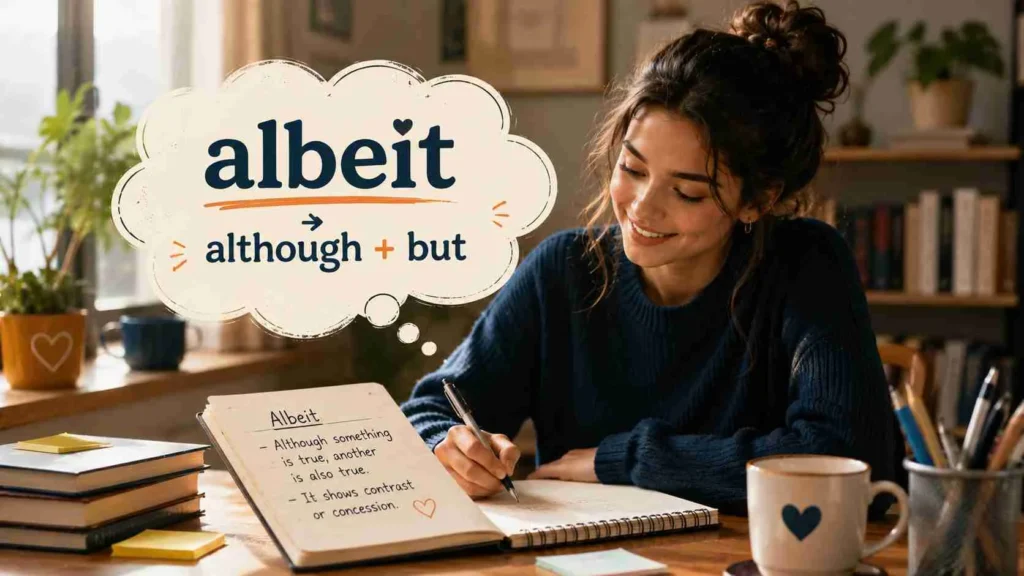

Albeit means “although” or “even though,” but it only introduces a short phrase never a full sentence. Use it to add a small concession right after your main point, like this: The coffee was hot, albeit bitter.
You’re reading a sharp article. Or listening to a British lawyer on a podcast. Then they drop the word albeit. You sort of get it. But not really.
I’ve been there.
Here’s the good news. The albeit reluctantly meaning is simpler than you think. And once you learn it, you’ll start noticing it everywhere. You might even use it yourself.
By the end of this guide, you won’t just know the definition of albeit. You’ll use it correctly in your next email, essay, or even a tweet. No awkwardness. No mistakes.
Let’s dive in.
Define Albeit | Meaning, Usage and Examples
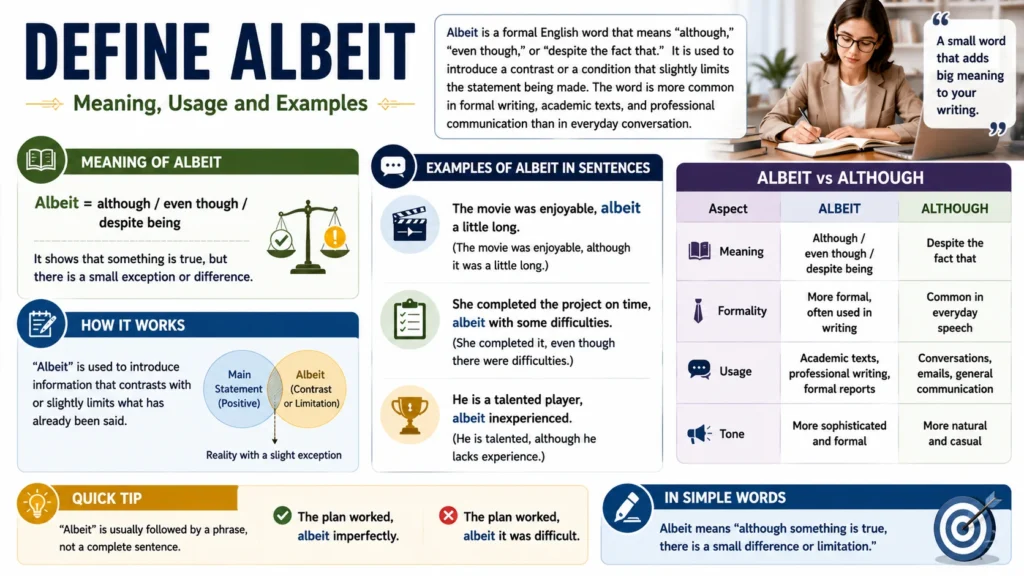
Albeit is a formal English word that means “although,” “even though,” or “despite the fact that.” It is used to introduce a contrast or a condition that slightly limits the statement being made. The word is more common in formal writing, academic texts, and professional communication than in everyday conversation.
Meaning of Albeit
- Albeit = although / even though / despite being
- It shows that something is true, but there is a small exception or difference.
Examples of Albeit in Sentences
- The movie was enjoyable, albeit a little long.
(The movie was enjoyable, although it was a little long.) - She completed the project on time, albeit with some difficulties.
(She completed it, even though there were difficulties.) - He is a talented player, albeit inexperienced.
(He is talented, although he lacks experience.)
Albeit vs Although
| Word | Meaning | Usage |
|---|---|---|
| Albeit | Although / even though | More formal, often used in writing |
| Although | Despite the fact that | Common in everyday speech |
Quick Tip
“Albeit” is usually followed by a phrase, not a complete sentence.
✅ The plan worked, albeit imperfectly.
❌ The plan worked, albeit it was difficult.
In simple words, albeit means “although something is true, there is a small difference or limitation.”
What Does Albeit Actually Mean?
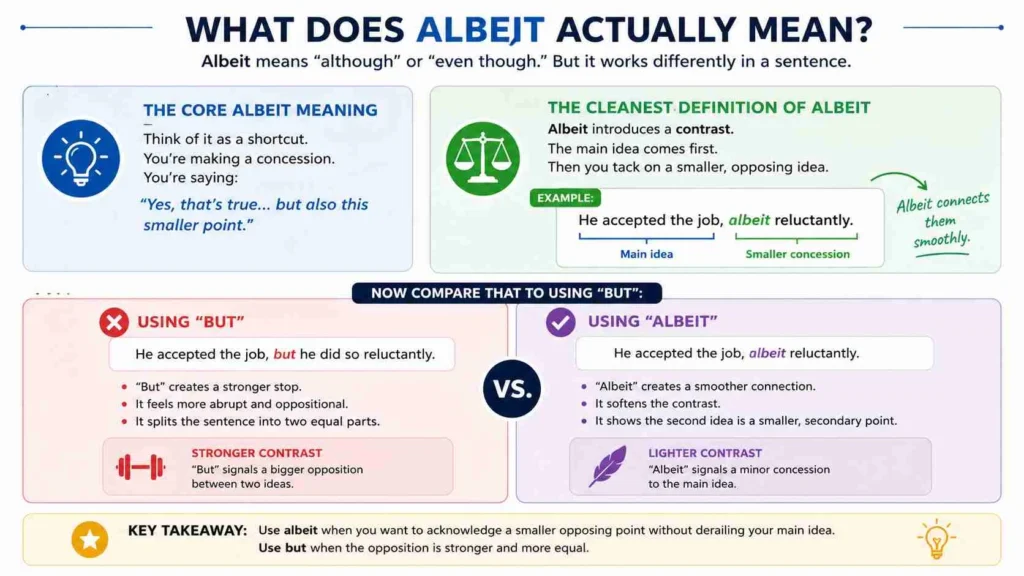
Let’s start with the core albeit meaning.
Albeit means “although” or “even though.” But it works differently in a sentence.
Think of it as a shortcut. You’re making a concession. You’re saying: “Yes, that’s true… but also this smaller point.”
Here’s the cleanest definition of albeit I can give you:
Albeit introduces a contrast. The main idea comes first. Then you tack on a smaller, opposing idea.
Look at this example:
He accepted the job, albeit reluctantly.
See what happened? The main idea = he accepted the job. The smaller concession = he didn’t feel great about it. Albeit connects them smoothly.
Now compare that to using “but”:
He accepted the job, but he was reluctant.
That works too. But it’s clunkier. You need two clauses. Albeit lets you skip the extra words.
The One-Word Formula
Here’s a simple way to remember the albeit word meaning:
Main idea + albeit + smaller contrasting point (usually just an adjective or phrase)
No full sentence needed after albeit. That’s the secret.
Let me prove it with more examples.
| Main Idea | Albeit | Contrasting Point |
|---|---|---|
| The hotel was beautiful | albeit | expensive |
| She agreed to help | albeit | with some hesitation |
| His explanation made sense | albeit | barely |
See the pattern? Short. Clean. Powerful.
How Is Albeit Different From Although?
This is where most people get confused. So let’s clear it up for good.
Both albeit and although show contrast. But their grammar is totally different.
Although starts a full clause. That means a subject + verb.
Although he was tired, he finished the race.
Albeit cannot do that. It only introduces a phrase – usually an adjective, adverb, or noun group.
He finished the race, albeit tired.
Same meaning. Fewer words. More elegant.
Here’s a quick albeit vs although breakdown:
| Feature | Albeit | Although |
|---|---|---|
| Needs a full clause? | No | Yes |
| Can start a sentence? | No | Yes |
| Formality level | High | Medium |
| Best for | Writing | Speech or writing |
So when someone asks what does albeit mean compared to although, you now have the answer. Albeit is the tighter, more formal cousin.
The Real Grammar Rule
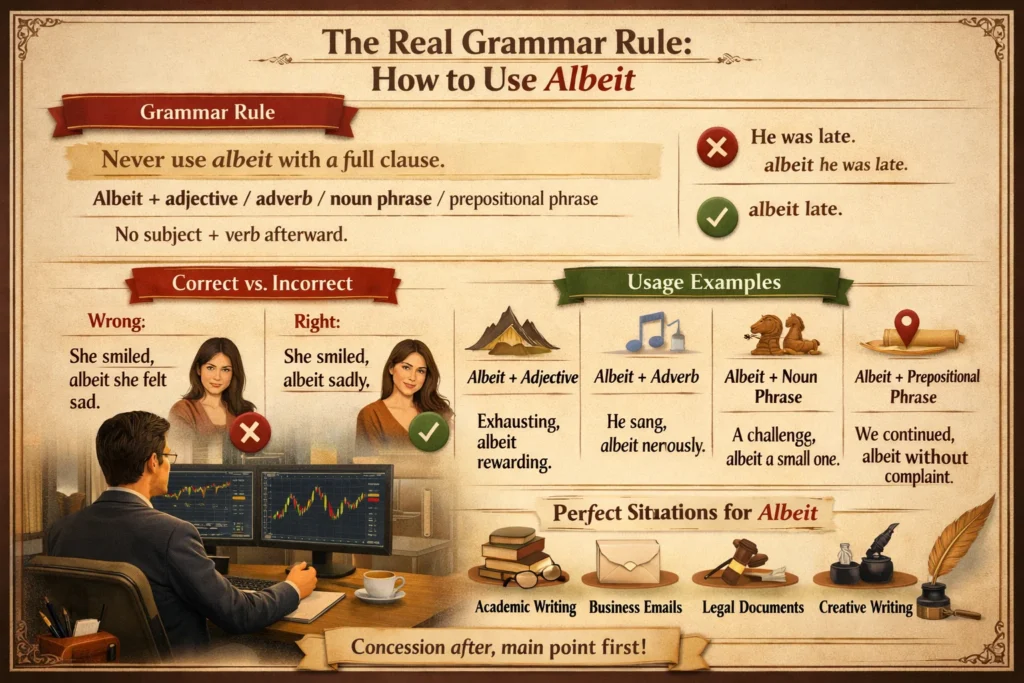
Let me explain the grammar usage of albeit without putting you to sleep.
Albeit is a concessive conjunction. Fancy term, simple job. It concedes a point. It says “I know this other thing is true… but here’s my main point.”
But here’s the key rule you must remember:
Never follow albeit with a full independent clause.
That means no subject + verb after albeit.
Wrong: He came, albeit he was late.
Right: He came, albeit late.
Wrong: She smiled, albeit she felt sad.
Right: She smiled, albeit sadly.
Once you lock this rule in, you’ll never misuse albeit again.
How to Use Albeit in a Sentence
Let’s move from rules to real life. Here are sentence examples with albeit that actually sound natural.
Albeit + Adjective
This is the most common pattern.
- The hike was exhausting, albeit rewarding.
- His answer was correct, albeit strange.
- The movie moved slowly, albeit beautifully.
Albeit + Adverb
- She sang, albeit nervously.
- They agreed, albeit quickly, to the terms.
- He drove, albeit carefully, through the storm.
Albeit + Noun Phrase
- He joined the team, albeit a reluctant member.
- The speech felt honest, albeit a bit long.
- She accepted the apology, albeit with doubt.
Albeit + Prepositional Phrase
- We continued, albeit without much hope.
- The plan moved forward, albeit under protest.
Notice something? Every single example keeps the main idea first. The concession comes second. And nothing after albeit forms a full sentence on its own.
That’s the magic.
When Should You Actually Use Albeit?
Knowing the albeit meaning is one thing. Knowing when to use it is another.
Let’s get practical.
Perfect Situations for Albeit
Academic writing
Professors love albeit. It shows precision. It tightens your prose. Use it in essays, research papers, and literature reviews.
The study had limitations, albeit minor ones.
Business emails
Especially to senior colleagues or clients. It sounds polished without being stuffy.
We met the deadline, albeit with a late night.
Legal or policy documents
Albeit appears constantly in contracts and official reports. It adds clarity and formality.
Creative writing
Narrative voice benefits from albeit. It adds rhythm.
He trusted her, albeit foolishly.
Situations to Skip Albeit
Texting friends
Just say “but” or “though.” Albeit sounds weirdly formal in a group chat.
Casual spoken English
Unless you’re joking or mimicking a professor, avoid it. You’ll sound like a dictionary.
Social media captions
“Had a great day, albeit tired” – no. Just write “tired but happy.”
Common Mistakes
Let me save you from embarrassment. Here are the top errors with albeit meaning and usage.
Mistake 1: Using a Full Clause After Albeit
Wrong: Albeit it was raining, we went outside.
Right: We went outside, albeit in the rain.
Remember: no subject + verb after albeit.
Mistake 2: Starting a Sentence With Albeit
You cannot do this. Albeit is not a sentence starter. Ever.
Wrong: Albeit tired, she finished.
Right: She finished, albeit tired.
Mistake 3: Using Albeit in Every Sentence
Albeit is a spice, not the whole meal. Overusing it makes your writing feel pretentious.
Bad: The coffee was hot, albeit strong, albeit small, albeit cheap.
Stop. Just stop.
Mistake 4: Confusing Albeit With However
However needs a semicolon or a period. Albeit doesn’t.
Wrong: He tried hard, however he failed.
Right: He tried hard; however, he failed.
But albeit would change the meaning:
He tried hard, albeit unsuccessfully.
Different tools for different jobs.
Albeit vs. Though vs. Even Though | A Complete Comparison
Let’s settle this once and for all. Here’s how albeit stacks up against its cousins.
| Word | Formality | Can Start Sentence? | Followed By | Best Example |
|---|---|---|---|---|
| Albeit | High | No | Phrase (adj/adv/noun) | He smiled, albeit weakly |
| Although | Medium | Yes | Full clause | Although he was weak, he smiled |
| Though | Low | Yes (often at end) | Full clause or phrase | He smiled. Weak, though. |
| Even though | Medium | Yes | Full clause (strong contrast) | Even though he was weak, he smiled |
Here’s a simple rule of thumb:
- Chat with a friend? Use though.
- Write an essay? Use although.
- Impress a professor or boss? Use albeit.
But don’t force it. Natural writing wins every time.
A Memory Trick That Actually Works
Want to never forget the albeit meaning again?
Here’s my favorite trick.
Think: “All be it” = “although it may be”
Albeit is a contraction of “all be it.” That’s where it came from historically. “All be it that…” meaning “although it may be that…”
So when you write albeit, you’re really saying “all be it.”
Now picture a seesaw.
On one side, your main idea weighs heavy. On the other side, a small concession. Albeit holds them in balance.
The steak was delicious, albeit overpriced.
Main idea = delicious. Small concession = overpriced. Balanced.
Try it yourself. Say “all be it” out loud three times. Now say albeit. Hear the connection?
You’ll never forget it.
Real-World Examples From Published Writing
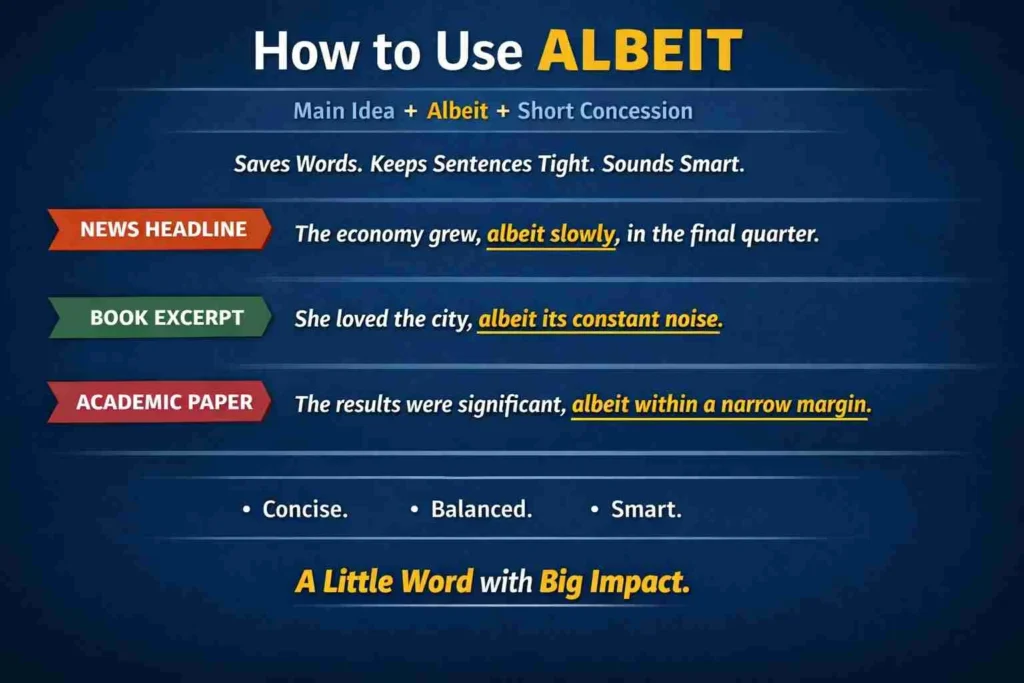
Let’s look at how professional writers use albeit. These aren’t made-up sentences. This is real usage.
News headline example:
The economy grew, albeit slowly, in the final quarter.
Book excerpt style:
She loved the city, albeit its constant noise.
Academic paper example:
The results were significant, albeit within a narrow margin.
Notice the pattern again. Main idea first. Albeit second. Short concession third.
Professional writers love albeit because it saves words. It keeps sentences tight. And it sounds smart without screaming for attention.
Albeit in Different Tenses and Moods
Does albeit change with past or future tense?
No. Albeit never changes form. It’s invincible.
Past:
He arrived late, albeit apologetically.
Present:
She works hard, albeit without recognition.
Future:
They will attend, albeit briefly.
Same word. Same structure. No conjugations to memorize. albeit slowly meaning.
That’s the beauty of learning the albeit definition once and applying it everywhere.
A Quick Reference Table for Albeit Usage
Here’s your cheat sheet. Bookmark it. Screenshot it. Share it.
| Situation | Correct Use | Incorrect Use |
|---|---|---|
| Before an adjective | The car was fast, albeit old | Albeit the car was old |
| Before an adverb | She spoke, albeit softly | Albeit she spoke softly |
| Before a noun phrase | He joined, albeit a rookie | Albeit a rookie, he joined |
| Starting a sentence | (Never correct) | Albeit tired, she ran |
| Before a full clause | (Never correct) | He came, albeit he was sick |
Print this. Put it on your wall. You’re welcome.
Practice What You Learned
Let’s make sure the albeit meaning sticks.
Complete each sentence with albeit plus the word in parentheses.
- The coffee was hot, ______ (bitter)
- She accepted the award, ______ (tearful)
- He drove home, ______ (slowly)
- Their offer was generous, ______ (with strings attached)
- The movie was funny, ______ (a little long)
Answers:
- albeit bitter
- albeit tearful
- albeit slowly
- albeit with strings attached
- albeit a little long
How did you do? If you got 4 or 5 right, you’ve mastered the grammar usage of albeit.
Why People Google “Albeit Meaning” So Often
Here’s an interesting fact. Searches for what does albeit mean spike every September and January.
Why? Because students start writing essays. They see albeit in their readings. And they panic.
You’re not alone.
Albeit looks strange. It sounds old. And most teachers never explain it clearly.
But now you know the secret. Albeit is just a tight, formal although that cuts extra words.
That’s it.
Albeit in Other Languages For Multilingual Learners
If you speak another language, here’s how albeit translates roughly:
- Spanish: aunque (but used differently)
- French: bien que (followed by subjunctive)
- German: wenngleich (even more formal)
- Italian: sebbene
But careful. Other languages use their equivalents differently. English albeit is unique. It never starts a sentence. And it never takes a full clause.
So if your brain wants to use albeit like aunque or bien que, stop. Rethink. Use the formula.
Main idea + albeit + short phrase.
Advanced Tip| Albeit for Elegant Variation
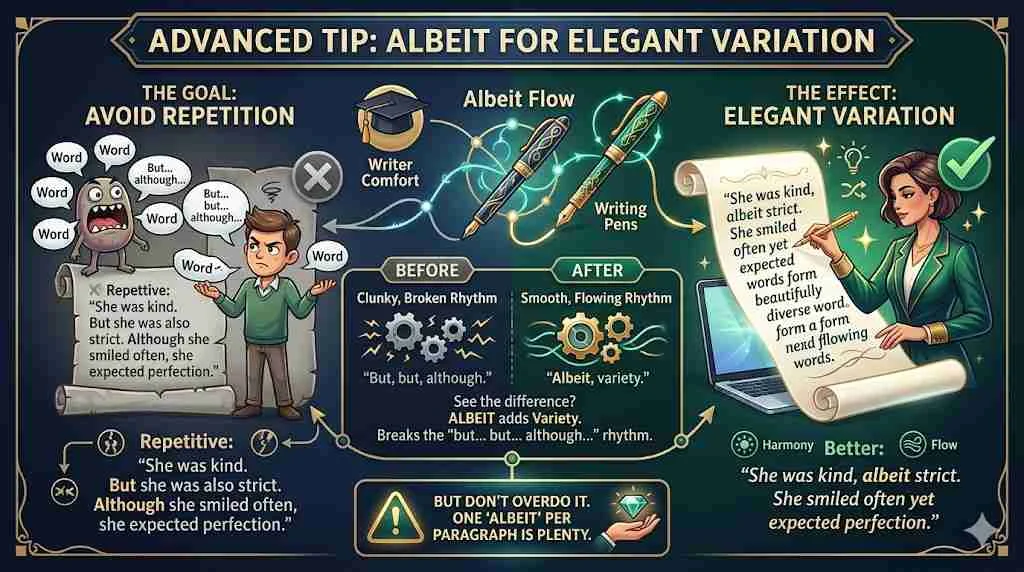
Once you’re comfortable with the albeit meaning, try this advanced move.
Use albeit to avoid repeating “but” or “although” in the same paragraph.
Repetitive:
She was kind. But she was also strict. Although she smiled often, she expected perfection.
Better:
She was kind, albeit strict. She smiled often yet expected perfection.
See the difference? Albeit adds variety. It breaks the “but… but… although…” rhythm.
But don’t overdo it. One albeit per paragraph is plenty.
FAQs
Can I use albeit in an essay?
Yes. Especially in analytical or persuasive essays. It shows range. Use it once or twice.
Is albeit old-fashioned?
Slightly. But in a good way. Think polished, not obsolete. Like a well-tailored jacket.
Does albeit need a comma?
Usually yes. Place a comma right before albeit.
He was happy, albeit surprised.
No comma after albeit unless a pause feels right.
What’s a simpler alternative to albeit?
Use though or but. They’re less formal but work fine.
Can albeit start a sentence in poetry?
Poets break rules. But for normal writing? No.
Conclusion
You now have everything you need to use albeit with confidence. The word isn’t scary or overly complicated. It simply lets you add a small “but” without breaking your sentence’s flow. Remember the golden rule: main idea first, then albeit, then a short phrase never a full clause. Skip it in casual texts or tweets but reach for it in essays, emails, or any place where polished writing matters.
So go ahead and try it today. Write one sentence with albeit. Own the word. You’ll sound sharper, clearer, and just a little more elegant. And the next time someone asks you what does albeit mean, you won’t stumble. You’ll smile, give them this two-paragraph answer, and move on like the grammar pro you’ve become.
Discover More Related Articles:
- “IIRC” Meaning: What It Stands For, How to Use It & When It Sounds Right In 2026
- “Sigma” Meaning Slang: Why Everyone Is Talking About Sigma Personality In 2026
- “Medusa Tattoo” Meaning: Symbolism & Cultural Significance In 2026