
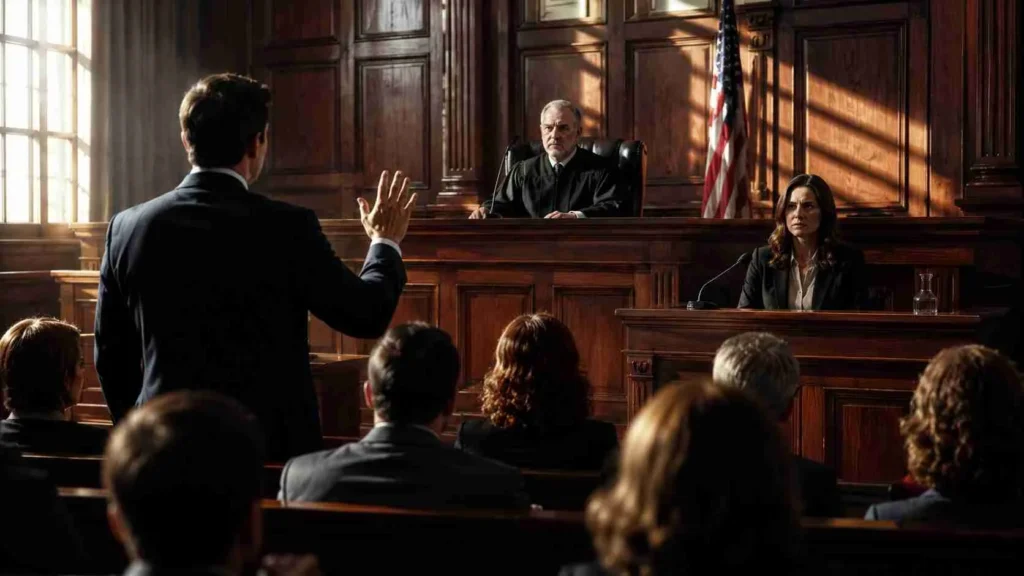

Hearsay is an out-of-court statement offered to prove the truth of what it says. Courts usually ban it because the original speaker isn’t under oath and can’t be cross-examined.
Your neighbor knocks on your door. “Hey, I heard Sam stole a car,” they say. Can that single sentence send Sam to jail?
No. Absolutely not.
That’s hearsay. And courts across the United States throw it out every single day. Not because judges are picky. Because the law demands something better.
The core hearsay meaning is simple. An out-of-court statement offered to prove the truth of what it says. But simple doesn’t mean weak. This rule shapes thousands of criminal trials, civil lawsuits, and even workplace investigations.
Let’s break it down. No law degree required.
A Simple Definition First
Before we wade into exceptions and edge cases, start here.
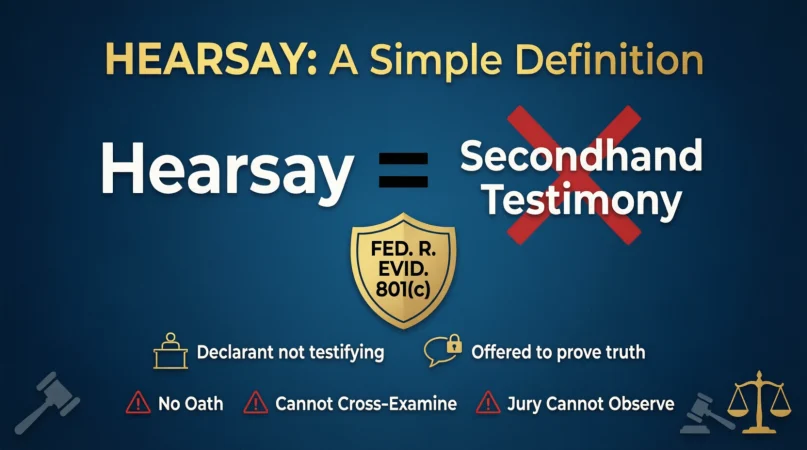
Hearsay = Secondhand testimony. The original speaker isn’t in court. They’re not under oath. You can’t cross-examine them. Yet someone wants the jury to believe what that absent person said.
The legal definition of hearsay comes straight from Federal Rule of Evidence 801(c). It says a statement is hearsay if:
- The declarant (the person who made the statement) does not make it while testifying at the current trial or hearing.
- A party offers the statement into evidence to prove the truth of the matter asserted.
That second part matters enormously. More on that later.
For now, remember this. Hearsay in law is not about gossip. It’s not about rumors. It’s a precise, technical rule with sharp teeth.
Why Courts Ban Hearsay
Picture a courtroom. A witness sits in the box. The lawyer asks, “What did your friend tell you about the accident?”
The other lawyer jumps up. “Objection. Hearsay.”
Why does that objection often work?
The reliability problem.
When a witness testifies about their own knowledge, the opposing side can cross-examine. They can ask: “Were you wearing your glasses? How far away were you? Do you have a bias against the defendant?”
But when a witness repeats what someone else said outside court, that someone else isn’t there to answer questions. Their eyesight, memory, honesty, and motives remain unexamined.
That’s the core hearsay evidence meaning. Untested statements don’t belong in a system built on testing.
Consider direct evidence vs hearsay:
| Type | Example | Cross-examination possible? |
|---|---|---|
| Direct evidence | “I saw the defendant run the red light.” | Yes. The witness is in court. |
| Hearsay | “My friend told me she saw the defendant run the red light.” | No. The friend isn’t there. |
That’s why the law labels hearsay as presumptively unreliable evidence. Not always false. Just unproven. And in court, unproven doesn’t count.
Common Misconceptions
Most people get hearsay wrong. Let’s fix that.
Misconception 1: Hearsay is just gossip.
Not exactly. Gossip has no legal definition. It’s just chatter. Hearsay vs rumor matters because hearsay has a specific legal meaning with specific exceptions. Gossip stays gossip. Hearsay can become admissible.
Misconception 2: Hearsay is never allowed.
False. This surprises almost everyone. The hearsay rule has dozens of exceptions. Some whole categories of hearsay come into court routinely. Business records. Excited utterances. Dying declarations.
Misconception 3: All secondhand information is hearsay.
No. If you’re not offering it for the truth of the statement, it’s not hearsay. Confusing? Here’s an example. A witness says, “My boss told me to clean the warehouse.” If the point is to show the boss gave an order (not that the warehouse actually needed cleaning), that’s not hearsay. It’s a verbal act.
Misconception 4: Hearsay is always bad evidence.
Sometimes hearsay is actually reliable. The law knows this. That’s why the exceptions exist. A spontaneous shout right after a car crash? Likely truthful. A detailed business log kept daily? Probably accurate.
The ban on hearsay isn’t about quality. It’s about process. Courts want the original speaker on the stand whenever possible.
Real Examples of Hearsay Evidence
Examples make the abstract concrete. Let’s walk through three real courtroom scenarios.
1 Example | Classic Hearsay
A worker sues for wrongful termination. On the stand, the worker says, “My boss told me that HR said I’m fired.”
Is this hearsay?
Yes. The worker offers the boss’s statement to prove the truth of the firing. But HR didn’t testify. The boss just repeated what HR said. The jury would believe the firing happened based on HR’s unsworn, absent words. That’s textbook hearsay.
Admissible? Not unless an exception applies. Without HR in court, the statement likely stays out.
2 Example | Not Hearsay Verbal Act
During a fight, the defendant yells, “I’ll kill you!”
Is this hearsay?
No. The prosecution isn’t offering the statement to prove the defendant would actually commit murder. They’re offering it to show the threat itself occurred. The utterance of the words has legal meaning regardless of their truth.
Admissible? Yes. This is a verbal act, not hearsay.
3 Example | Not Hearsay Impeachment
A witness testifies in court, “I never told anyone the light was red.” The opposing lawyer plays a recording. On it, the witness says last week, “The light was red.”
Is the recording hearsay?
No. The lawyer offers the recording not to prove the light was actually red. They offer it to contradict the witness’s current testimony. That’s impeachment, not hearsay.
Admissible? Yes, for impeachment purposes only. The judge will instruct the jury not to consider the statement as proof the light was red.
These distinctions matter. Hearsay statement meaning turns entirely on why you offer the statement. Same words. Different purpose. Different outcome.
When Is Hearsay Allowed in Court?
Now for the part that surprises people. When is hearsay allowed in court? Often. Very often.
The Federal Rules of Evidence list nearly thirty exceptions. Some require the original speaker to be unavailable. Others don’t. Let’s focus on the ones you’ll actually see.
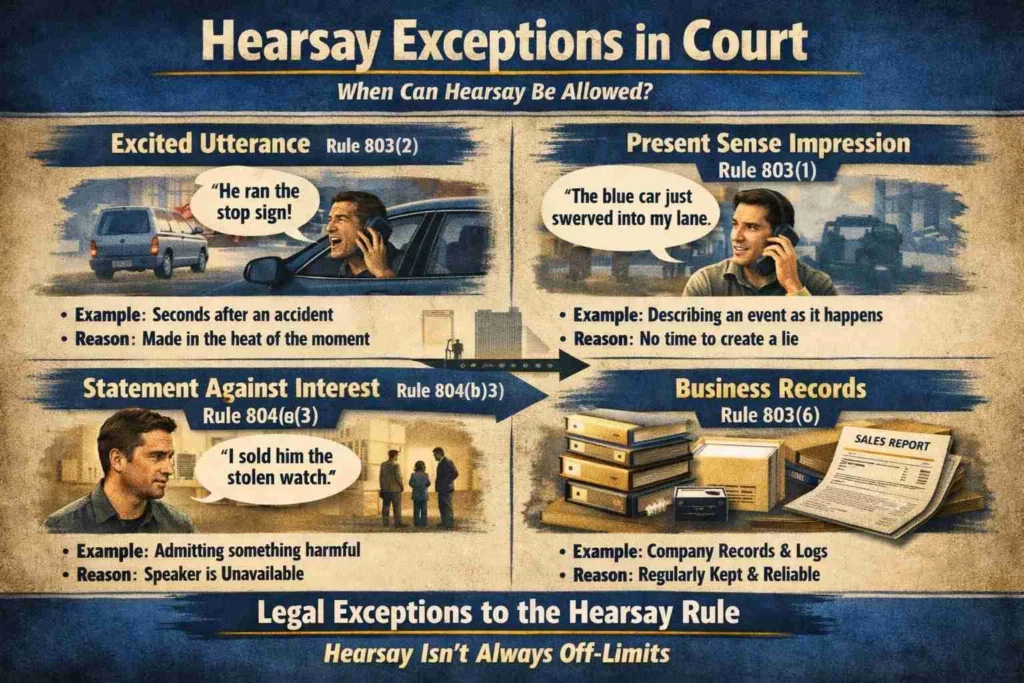
Excited Utterance (Rule 803(2))
A statement about a startling event. The speaker makes it while still under the stress of the event.
Example: Seconds after a car crash, a passenger yells, “He ran the stop sign!” Even if the passenger later refuses to testify, that statement can come into evidence.
Why it works: Excitement supposedly beats reflection. People don’t usually fabricate while still shaking from an accident.
Present Sense Impression (Rule 803(1))
A description of an event while the speaker is perceiving it.
Example: “The blue car just swerved into my lane.” Spoken during the swerve or immediately after.
Why it works: No time to make up a lie.
Statement Against Interest (Rule 804(b)(3))
The speaker says something that would harm them legally or socially. Then they become unavailable to testify.
Example: “I sold him the stolen watch.” That’s admitting a crime. The speaker can’t testify because they’ve died or fled. The statement may still come in.
Why it works: People rarely lie to hurt themselves.
Business Records (Rule 803(6))
Regularly kept records made at or near the time of an event. The maker had a duty to be accurate.
Example: A warehouse log showing “January 5: Customer returned 20 units.”
Why it works: Businesses rely on these records daily. The routine creates reliability.
Dying Declaration (Rule 804(b)(2))
In a homicide case or civil case, the speaker believes death is imminent and talks about the cause or circumstances.
Example: “It was Marcus. He shot me.” Then the speaker dies.
Why it works: Legal tradition says no one meets their maker with a lie on their lips.
Forfeiture by Wrongdoing (Rule 804(b)(6))
The opponent made the speaker unavailable. Intentionally. Through wrongdoing.
Example: The defendant kills the only witness. Now the witness can’t testify. The court can admit the witness’s prior statements.
Why it works: You don’t get to benefit from your own bad acts.
Here’s a quick reference table for hearsay rule examples and explanation:
| Exception | Key Requirement | Example |
|---|---|---|
| Excited utterance | Startling event + stress | “He pushed her!” right after a shove |
| Present sense impression | While perceiving | “It’s raining hard now.” |
| Statement against interest | Harms speaker + speaker unavailable | “I faked the receipt.” |
| Business records | Regular practice + timely entry | Daily sales log |
| Dying declaration | Belief death is near | “Your honor, she whispered the name before she died.” |
| Forfeiture by wrongdoing | Opponent caused unavailability | Defendant threatened the witness |
Simple Explanation of Hearsay Evidence
If you forget everything else, remember this.
Simple explanation of hearsay evidence: Courts want the person who saw it, heard it, or did it. Not someone who heard about it secondhand.
Think of the broken telephone game. One person whispers a message. It passes down the line. By the end, “The dog ate my homework” becomes “The fog ate my home, work.” Each retelling adds error.
Hearsay is like that. Except instead of children playing, it’s a witness repeating what someone else said. And instead of a silly mistake, someone’s freedom or money hangs in the balance.
The meaning of hearsay in court comes down to one question: Is the original speaker available to swear this is true under oath?
If yes, call them. If no, the statement probably doesn’t belong in front of the jury.
That’s the rule. The exceptions exist, but the presumption stands.
Hearsay Meaning in Criminal Law Cases
Criminal law treats hearsay even more strictly. The Sixth Amendment’s Confrontation Clause gives defendants the right “to be confronted with the witnesses against them.”
That’s not just a nice phrase. It’s a constitutional guarantee.
In 2004, the Supreme Court decided Crawford v. Washington. That case changed everything. Before Crawford, if a hearsay exception existed under evidence rules, the statement could often come in. After Crawford, testimonial hearsay faces an extra hurdle.
What’s testimonial hearsay? Statements made primarily for a legal proceeding. Police interrogations. Affidavits. Grand jury testimony. Depositions.
If the statement is testimonial, the Constitution demands two things:
- The declarant must be unavailable to testify.
- The defendant must have had a prior opportunity to cross-examine that declarant.
No prior cross-examination? No admission. Period.
This doesn’t apply to non-testimonial hearsay. A spontaneous cry to a friend? Probably not testimonial. A recorded interview with a detective? Almost certainly testimonial.
So hearsay meaning in criminal law cases has two layers. First, check the evidence rules. Second, check the Constitution. The second layer often blocks what the first layer might allow.
Difference Between Hearsay and Evidence
People confuse these terms constantly. Let’s clean it up.
Evidence is the broad category. It includes everything a judge allows a jury to consider. Testimony. Documents. Weapons. Photographs. Videos. Forensic reports.
Hearsay is a narrow slice of evidence. Specifically, it’s an out-of-court statement offered for its truth.
Think of it like this:
- All hearsay is evidence (if a party offers it in court).
- Not all evidence is hearsay.
A gun found at the scene? Not hearsay. A surveillance video? Not hearsay. A witness describing what they personally saw? Not hearsay.
Only secondhand statements offered for their truth qualify as hearsay.
This matters because many people hear “objection, hearsay” and think the lawyer is objecting to all evidence. Nope. They’re objecting to a very specific type. And the judge might overrule them if an exception applies.
Why This Matters Outside Court
You don’t need to be a lawyer to benefit from understanding what does hearsay mean in legal terms.
Here’s where it helps in real life.
At work. Someone says, “I heard the boss is firing the whole team.” Before you panic, ask: Who said that? Can we talk to them directly? You’ve just spotted potential hearsay.
In a dispute. Your landlord claims, “The superintendent told me you broke the lease.” Your response: “Did the superintendent see it happen? Or did someone else tell them?” That’s the difference between admissible and inadmissible.
In negotiations. The other side says, “Our customer said your product failed.” Your question: “Can the customer testify to that? Or are you repeating someone else’s claim?” Push for the original source.
In everyday conversations. Your friend insists, “Everyone says she’s untrustworthy.” That’s not proof. That’s rumor dressed up as consensus. Knowing hearsay vs rumor helps you separate social chatter from reliable information.
A practical rule: Whenever someone says “I heard that…” stop them. Ask “From whom?” and “Can we check with that person directly?” You’ll save yourself from acting on bad secondhand information.
Quick Reference Table | Admissible vs. Inadmissible Hearsay
| Scenario | Hearsay? | Admissible? | Why |
|---|---|---|---|
| Police officer says, “Witness Jones told me the suspect ran.” | Yes | No (unless Jones testifies or exception applies) | No cross-examination of Jones |
| 911 caller shouts, “He’s pointing a gun at me!” then hangs up | Yes | Yes | Excited utterance / present sense impression |
| Business log entry: “Customer returned item on Jan 5.” | Yes | Yes | Business records exception |
| Defendant’s diary: “I stole the watch.” | Yes | Yes | Statement against interest |
| Bystander at a fire screams, “The arsonist is wearing a red hat!” | Yes | Yes (if still under stress) | Excited utterance |
| A letter written last year: “My neighbor owns a pit bull.” | Yes | No (unless neighbor unavailable + prior cross) | Testimonial? No. But still hearsay. No exception fits. |
| Witness in court says, “I told my wife I was innocent.” | Yes | No (self-serving, no exception) | Offered for truth of innocence? Yes. No exception. |
The Law of Evidence | Where Hearsay Lives
Hearsay doesn’t float alone. It sits inside a larger body of law called the Law of Evidence. Think of evidence law as the rulebook for what a jury gets to see or hear.
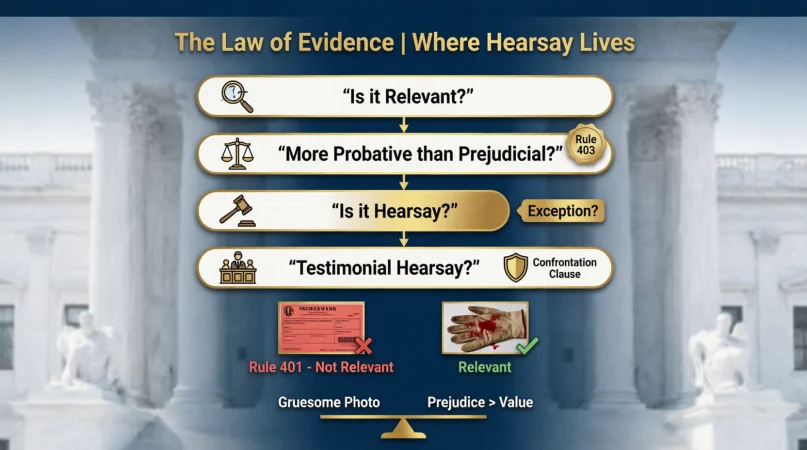
Evidence law asks four big questions:
- Is it relevant? Does this fact make something more or less likely?
- Is it more probative than prejudicial? Even relevant evidence can be too inflammatory. Judges can exclude it under Rule 403.
- Is it hearsay? If yes, does an exception apply?
- Is it testimonial hearsay? If yes, does the Confrontation Clause block it?
Hearsay is question three. But you can’t understand question three without the others.
Two other evidence concepts worth knowing:
Relevance (Rule 401). Evidence must relate to a fact that matters. A defendant’s old traffic ticket probably isn’t relevant to a murder charge. A bloody glove found at the scene? Very relevant.
Prejudice vs. Probative Value (Rule 403). A judge can exclude evidence if its unfair prejudice substantially outweighs its value. Gruesome photos of a victim might be too prejudicial if the defendant already admitted the act.
Hearsay adds complexity to all of this. But at its heart, the rule serves a simple goal: keep unreliable secondhand statements away from the jury.
FAQs
1. Is all hearsay automatically thrown out of court?
No. The hearsay rule has nearly thirty exceptions. Excited utterances, business records, dying declarations, and statements against interest can all come into evidence. Judges allow reliable hearsay all the time.
2. What’s the difference between hearsay and gossip?
Gossip has no legal definition. Hearsay vs rumor matters because hearsay follows specific court rules with real consequences. Gossip stays social chatter. Hearsay can send someone to jail if an exception applies.
3. Can I use hearsay to defend myself in court?
Sometimes. The same rules apply to both sides. But criminal defendants face an extra hurdle: the Confrontation Clause. If the hearsay is testimonial (like a police interview), you need a prior chance to cross-examine that witness.
4. Why do courts care so much about cross-examination?
Because cross-examination tests honesty, memory, and perception. You can ask, “Were you wearing glasses?” or “Do you have a grudge?” When the original speaker isn’t in court, you lose that chance. That’s why hearsay evidence meaning centers on untested statements.
5. What does “offered for the truth of the matter asserted” actually mean?
It means you’re asking the jury to believe the statement is factually correct. Example: “My friend said the light was red.” If you want the jury to believe the light was actually red, that’s hearsay. If you just want to prove your friend said those words (not that they’re true), that’s not hearsay.
Conclusion
Hearsay meaning comes down to one sentence. An out-of-court statement offered to prove the truth of what it says.
Courts ban it because you can’t cross-examine the original speaker. That makes hearsay presumptively unreliable.
But the hearsay rule has many exceptions. Excited utterances. Present sense impressions. Business records. Dying declarations. Statements against interest. Each exception rests on a theory of reliability.
In criminal cases, the Confrontation Clause adds another layer. Testimonial hearsay needs both unavailability and prior cross-examination.
Not every secondhand statement is hearsay. Offer a statement for another purpose? It’s not hearsay. Impeachment. Verbal acts. Effect on the listener. All fall outside the rule.
Understanding hearsay evidence meaning helps you outside court too. It sharpens how you evaluate secondhand information at work, in disputes, and in daily conversations.
Discover More Related Articles:
- “Mhm” Slang Meaning : What It Really Means in Texting In 2026
- “LMS” Mean in Text: Internet Slang and Everyday Usage In 2026
- “NGL” Meaning in Chat: What People Actually Mean When They Say It In 2026