


Attrition is the gradual reduction of a group’s size or strength through natural departure, decay, or loss not through sudden events. Think of water slowly leaking from a barrel: the level drops not because someone tips it over, but because small drips never stop.
You’ve heard the word before. Someone says “attrition” at work. You nod along. But deep down, you’re not entirely sure what they mean.
Here’s the truth. Attrition meaning is simple but widely misunderstood.
Attrition is a gradual reduction in numbers or strength. Not a sudden crash. Not a mass firing. A slow leak. Think of air hissing out of a tire over weeks. The car still drives. But eventually, you’re riding on rims.
That slow leak changes everything. It affects companies, military battles, customer lists, and even the languages we speak.
Most people think attrition only belongs in HR meetings. Wrong. Attrition shows up everywhere. War. Geology. Linguistics. Customer success. Even your gym membership suffers from attrition when people stop showing up in February.
So let’s kill the confusion. This guide covers the attrition definition across every major context. You’ll learn the exact formula to calculate it. You’ll understand why voluntary attrition destroys companies faster than layoffs. And you’ll never mix up attrition with turnover again.
Let’s drain the confusion dry.
The Core Definition | One Word With Many Worlds
Let’s start where all good definitions start. The root.
Attrition comes from Latin atterere. It means “to rub against” or “to wear down.” Picture water rubbing against a river rock for ten thousand years. That’s atterere. Slow friction. Gradual loss.
Now here’s the universal meaning of attrition across every field:
Attrition is the gradual reduction of a group’s size or an object’s strength through natural separation, departure, decay, or wear – not through sudden destruction.
Three ingredients must exist for real attrition to happen:
- Time – It doesn’t happen overnight
- Loss – Something decreases (people, customers, soldiers, words)
- Natural separation – No single event causes it
That last point matters. A layoff isn’t attrition. A plane crash isn’t attrition. Those are sudden spikes. Attrition is the slow drip.
But here’s where people trip up. What is attrition in one context looks completely different in another. Let’s map it out clearly.
| Context | Attrition Definition | Real-World Example |
|---|---|---|
| Human Resources | Employees leave and company doesn’t replace them | 12 people quit this year. You hire 3 back. |
| Military | Wearing down enemy through sustained losses | WWI’s Battle of Verdun – 700,000 casualties for zero strategic gain |
| Customer Success | Users cancel subscriptions over multiple months | Gym loses 5% of members each month after New Year’s rush |
| Linguistics | Losing fluency in your first language | Immigrant forgets native vocabulary after 20 years abroad |
| Geology | Erosion by wind, water, or ice | Cliffs at Dover shrink 1cm per year |
| Demographics | Population decline through low birth rates and aging | Japan loses 800,000 people annually since 2010 |
That last row surprises most readers. Japan isn’t shrinking because of disasters. It’s shrinking from population decline through attrition. Fewer births. More deaths. A slow drain over decades.
So when someone asks for attrition meaning in English, here’s your one-sentence answer: The gradual loss of people, things, or strength over time through natural departure rather than sudden destruction.
Now let’s dive into the place where this word matters most – your workplace.
Attrition Meaning in Business and HR
Walk into any HR department. Ask them what keeps them up at night. They won’t say recruiting. They’ll say attrition.
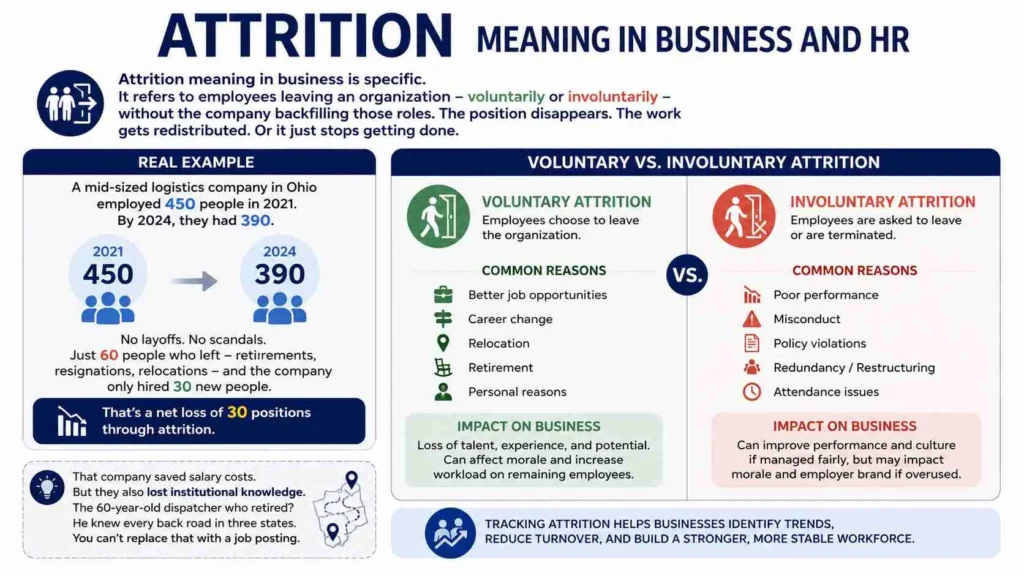
Attrition meaning in business is specific. It refers to employees leaving an organization – voluntarily or involuntarily – without the company backfilling those roles. The position disappears. The work gets redistributed. Or it just stops getting done.
Here’s a real example. A mid-sized logistics company in Ohio employed 450 people in 2021. By 2024, they had 390. No layoffs. No scandals. Just 60 people who left – retirements, resignations, relocations – and the company only hired 30 new people. That’s a net loss of 30 positions through attrition.
That company saved salary costs. But they also lost institutional knowledge. The 60-year-old dispatcher who retired? He knew every back road in three states. You can’t replace that with a job posting.
Voluntary vs. Involuntary Attrition (The Critical Split)
Not all attrition feels the same. Smart leaders separate voluntary attrition from involuntary attrition because they signal completely different problems.
Voluntary attrition happens when the employee chooses to leave. They quit. And they move to another city. They find a better job.
Reasons for voluntary attrition fall into five buckets:
- Compensation – Another company offered 20% more
- Management – Their boss is a micromanaging nightmare
- Growth – No promotion path for three years
- Burnout – 60-hour weeks with no end in sight
- Culture – Toxic environment, gossip, or exclusion
Involuntary attrition happens when the employer triggers the departure. The employee doesn’t choose this.
Causes of involuntary attrition include:
- Termination for poor performance
- Layoff (though this blurs into downsizing, not pure attrition)
- Medical leave that becomes permanent
- Death of an employee
- End of a fixed-term contract with no renewal
Here’s the hard truth. Voluntary attrition signals a broken system. Involuntary attrition sometimes signals a healthy cleanup.
Think about it this way. If your top three salespeople quit voluntarily, you have a culture problem. If you fire three low performers involuntarily, you just raised your team’s average talent level.
The real danger? Talent loss in company isn’t about numbers. It’s about who leaves. Losing your bottom 10% barely hurts. Losing your top 10% is a slow-motion disaster.
Why HR Leaders Obsess Over Attrition
Employee attrition costs real money. The Society for Human Resource Management (SHRM) estimates each lost employee costs 33% of their annual salary to replace. A $60,000 employee leaves. That’s $20,000 gone. Training. Recruiting. Lost productivity. Interview hours.
Multiply that by 50 departures. You just lost a million dollars.
But the invisible cost hurts worse. Remaining employees work harder. They cover empty roles. And they stay late. They burn out. Then they leave. Now you have a cascade. Attrition begets attrition.
That’s why staff attrition isn’t just an HR metric. It’s a financial warning light.
Attrition vs. Turnover vs. Churn
Here’s where most blogs get lazy. They use attrition vs turnover as if the words mean the same thing. They don’t. Using them wrong makes you look uninformed.
Let’s settle this once.
Turnover = employees leave AND you replace them
Attrition = employees leave AND you do NOT replace them
That’s the entire difference.
A restaurant has high employee turnover. Servers quit every three months. But the restaurant keeps hiring new servers. The headcount stays steady at 30 people. That’s turnover.
A government agency has workforce attrition. Ten people retire. The agency gets approval for only five new hires. Headcount drops from 200 to 195. That’s attrition.
Now add churn to the mix. Churn usually refers to customers, not employees. A streaming service loses 100,000 subscribers in a month. They sign up 80,000 new ones. Net loss of 20,000. That’s customer churn. If they sign up 120,000 new ones, they still have churn (lost customers) but net positive growth.
Here’s a table to lock this in:
| Term | Definition | Replacement Happens? | Headcount Impact |
|---|---|---|---|
| Turnover | Employees leave | Yes (usually) | Stays same or grows |
| Attrition | Employees leave | No | Decreases |
| Churn (customers) | Subscribers cancel | Sometimes | Can go up or down |
| Labor turnover | British term for turnover | Yes | Stays similar |
Staff turnover meaning in the UK equals what Americans call employee turnover. Same concept. Different phrasing.
So why does this distinction matter? Because you solve turnover and attrition differently.
High turnover means fix your recruiting, onboarding, or work conditions. High attrition might be intentional – shrinking a division without layoffs. One is a problem. The other is a strategy.
How to Calculate Attrition Rate
Most articles give you a formula and walk away. That’s not helpful. Let’s actually calculate attrition rate step by step.
Here’s the formula:
Attrition Rate = (Number of leavers during period ÷ Average headcount for period) × 100
That’s it. But the magic is in the details.
1 Step | Define your time period
Monthly. Quarterly. Yearly. Choose one and stick with it. Monthly catches problems fast. Yearly smooths out seasonal noise.
2 Step | Count your leavers
Anyone who left voluntarily or involuntarily. Don’t count internal transfers. Don’t count contractors. Count only permanent employees whose employment ended.
3 Step | Calculate average headcount
Add your headcount at the start of the period to your headcount at the end. Divide by two.
Example:
- Start of year: 200 employees
- End of year: 180 employees
- Average: (200 + 180) ÷ 2 = 190
4 Step | Divide and multiply
Leavers = 30
Average headcount = 190
30 ÷ 190 = 0.1578
0.1578 × 100 = 15.8% annual attrition rate
Now let’s make this real with a concrete business scenario.
Real example – Call center:
- January 1: 150 agents
- People who leave during year: 45
- December 31: 130 agents
- Average headcount: (150 + 130) ÷ 2 = 140
- Attrition rate: (45 ÷ 140) × 100 = 32%
A 32% attrition rate means the average agent stays less than four years. That’s expensive. Each departure costs $8,000 in training. 45 departures = $360,000 gone. Every year.
Industry benchmarks
| Industry | Average Annual Attrition Rate |
|---|---|
| Retail | 60-65% |
| Hospitality | 70-75% |
| Call centers | 30-45% |
| Technology | 13-20% |
| Healthcare (nurses) | 18-22% |
| Government | 8-12% |
| Education (teachers) | 16% |
A 15% attrition rate in retail would be incredible. The same rate in government would raise alarms. Context is everything.
The Hidden Causes of Employee Attrition
Everyone thinks people leave for higher pay. That’s partly true. But money ranks surprisingly low on most exit interview lists.
Let’s look at actual causes of employee leaving based on real exit data.
The top five real reasons people quit
Bad management – This is number one. People don’t leave companies. They leave managers. A boss who criticizes publicly, takes credit for work, or ignores personal problems drives attrition faster than any pay cut.
No growth path – An employee masters their role. No new challenges. And no skill development. They get bored. Bored people leave.
Burnout – Consistent overtime. Weekend emails. No recovery time. The body breaks down. The mind follows. Burnout isn’t a weakness. It’s a predictable outcome of chronic overload.
Work-life mismatch – A new parent needs flexibility. A single parent needs predictable hours. An older worker wants reduced schedule. When the job won’t bend, the person leaves.
Compensation – Notice this is fifth. Yes, money matters. But only when it’s unfair. People tolerate fair pay with great management. They won’t tolerate unfair pay even with good management.
Voluntary attrition vs. involuntary attrition by the numbers
| Type | Percentage of Total Departures | Main Driver |
|---|---|---|
| Voluntary – better job | 42% | Higher pay or title |
| Voluntary – retirement | 18% | Age and financial readiness |
| Voluntary – personal reasons | 12% | Family, health, relocation |
| Involuntary – performance | 15% | Consistent underperformance |
| Involuntary – role elimination | 8% | Restructuring |
| Other (death, disability) | 5% | Life events |
The 42% who leave for better jobs? That’s your canary in the coal mine. When good employees find better opportunities elsewhere, your retention strategy failed.
When Attrition Helps Your Organization
Most writing treats workforce attrition as a problem to solve. That’s incomplete. Sometimes attrition saves you.
Let me give you three scenarios where attrition beats the alternatives.
Scenario one| Low performers leave voluntarily
Imagine an employee who produces half as much as their peers. They show up late. They miss deadlines. Firing them costs severance, legal risk, and management time.
Then one day, they quit. Problem solved. No firing required. That’s workforce reduction through natural attrition. It’s the cheapest way to upgrade your talent pool.
Scenario two| Overstaffed teams shrink without layoffs
You hired aggressively during a boom. Now business slowed. You have 120 people but only need 90. Layoffs hurt morale and reputation. Attrition doesn’t.
Stop backfilling. Let retirements and resignations shrink headcount naturally. In 18 months, you hit 90 people without a single layoff. Morale stays intact. Survivors don’t fear for their jobs.
Scenario three| Older workers retire on schedule
Age discrimination lawsuits cost millions. Forcing early retirement is illegal. But natural retirement attrition is clean.
Each year, 5% of your workforce retires. That opens promotion paths for mid-career employees. New ideas enter. Old hierarchies loosen. That’s employee attrition as a healthy reset button.
The downsizing comparison
Downsizing meaning gets confused with attrition constantly. Here’s the difference:
| Downsizing | Attrition | |
|---|---|---|
| Speed | Fast (weeks) | Slow (months or years) |
| Method | Layoffs, firings | Natural departure, no backfill |
| Morale impact | Severe | Mild |
| Legal risk | High | Low |
| Control | High | Low |
Downsizing gives you control but costs you trust. Attrition preserves trust but tests your patience.
Surprise Contexts Where Attrition Shows Up
You clicked for business attrition definition. But the word travels far beyond office walls. Let me show you where else attrition lives.
Military attrition (the war of slow bleeding)
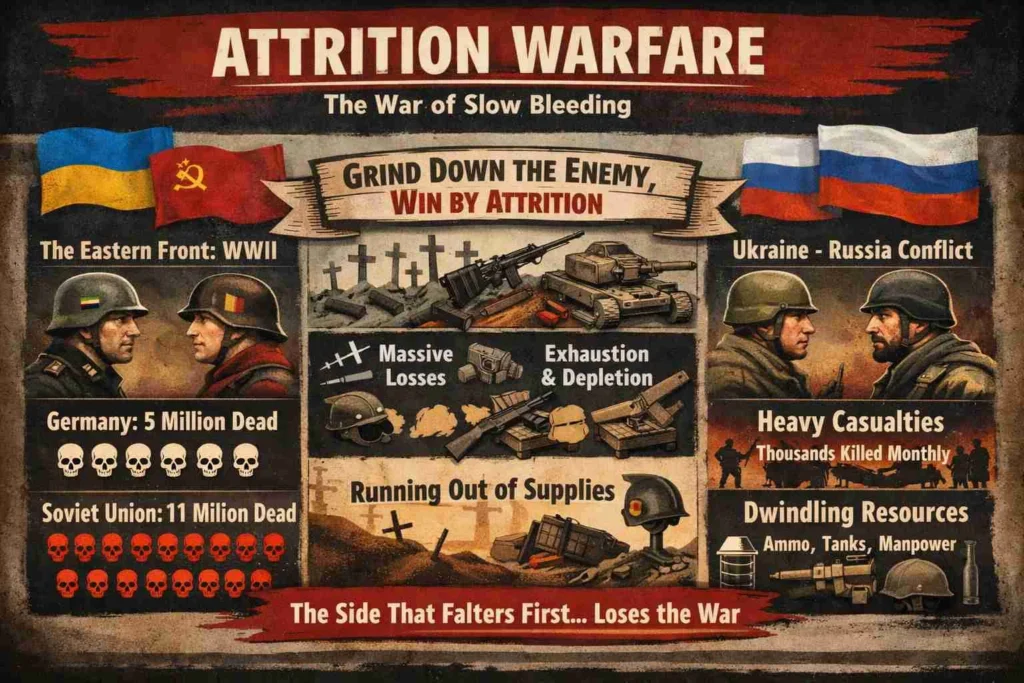
A war of attrition means winning by outlasting the enemy’s ability to fight. Not through brilliant tactics. Through grinding loss.
The Eastern Front in World War II is the clearest example. Germany lost 5 million soldiers. The Soviet Union lost 11 million soldiers and 7 million civilians. The Soviets could absorb those losses. Germany couldn’t. That’s attrition warfare. No single battle decided the war. The slow bleed did.
Modern Ukraine-Russia war shows attrition again. Both sides lose thousands monthly. The side that runs out of soldiers, equipment, or will first loses.
Language attrition (when your mother tongue fades)
Language attrition happens when bilingual speakers lose fluency in their first language. Immigrants experience this most.
A woman moves from Mexico to the US at age 30. She speaks Spanish daily for the first five years. By year fifteen, she speaks mostly English. By year thirty, she struggles to find Spanish words. Vocabulary fades first. Then grammar. Then accent.
Research shows language attrition follows a predictable pattern:
- First 5 years: minimal loss
- Years 5-15: vocabulary declines 30-40%
- Years 15-25: grammar errors appear
- After 25 years: fluency comparable to a learner
The brain doesn’t delete the first language. It just stops prioritizing retrieval. The knowledge stays buried. But access grows slow and rusty.
Customer attrition (the business cousin you already know)
Customer churn and customer attrition describe the same thing. Customers stop buying. But unlike employee attrition, companies fight customer attrition aggressively.
SaaS companies obsess over monthly churn. A 5% monthly churn means you lose half your customers every 12 months. That’s unsustainable. Most healthy B2B SaaS companies target under 1% monthly churn.
Geological attrition (the slowest version)
Rock faces erode. Beaches shrink. Mountains become hills. That’s geological attrition. Wind, rain, ice, and gravity rub away material one grain at a time.
The White Cliffs of Dover lose about 1 cm per year. That doesn’t sound dramatic. But over 10,000 years, that’s 100 meters of cliff gone. Attrition on a geological scale moves at glacial speed. But it never stops.
Semantic Shifts | How “Attrition” Changed Meaning Over Time
This is the linguistic nerd section. Stick with me – it explains why the word causes confusion.
Semantic shift happens when a word’s meaning drifts over centuries. Attrition drifted twice.
Original meaning (1400s): Physical rubbing or grinding. Theologians used “attrition” to describe imperfect sorrow for sins – sorrow that grinds down the soul but doesn’t fully cleanse it.
Second meaning (1600s): Medical. Doctors described attrition as the wearing down of bones or teeth.
Modern meaning (1900s onward): Reduction of personnel, resources, or numbers through natural loss.
So when you ask for attrition meaning in English, you’re using the newest layer of a very old word. That’s lexical meaning at work – how words accumulate new layers while keeping old ghosts.
Word sense disambiguation is the NLP term for figuring out which meaning someone intends. If a CEO says “we’re managing attrition,” they mean employees. And if a geologist says “coastal attrition,” they mean erosion. If a priest says “attrition of the soul,” they mean something else entirely.
Context-based meaning saves you here. Always check the domain. Business = people. Military = casualties. Nature = erosion. Language = vocabulary loss.
Simple Explanation of Attrition
Someone asks you for a simple explanation of attrition. Don’t give them jargon. Say this:
“Attrition is when something shrinks slowly because pieces fall off naturally over time. Like a rope fraying one thread at a time. Not a sudden snap. Just gradual thinning until one day you notice it’s half as thick as it used to be.”
That works for employees, armies, languages, and cliffs.
Actionable Takeaways
You read 4,000+ words. Now what? Here’s exactly what to do.
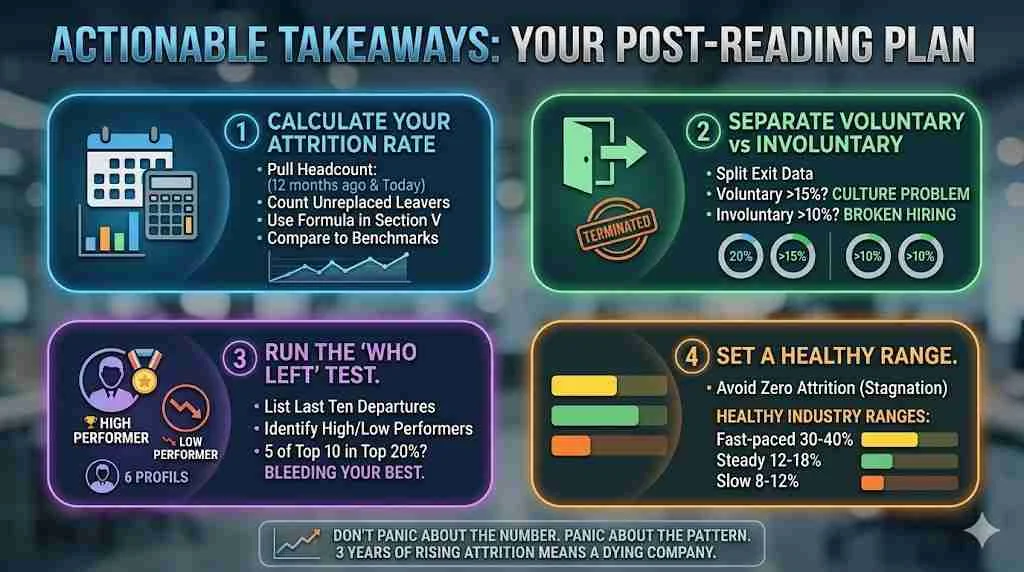
Calculate your actual attrition rate this week
Pull your headcount from 12 months ago. Pull today’s headcount. Count everyone who left during that year who wasn’t replaced. Use the formula in Section V. Compare your number to the industry benchmarks above.
Separate voluntary from involuntary
Go through your exit data. Split leavers into two columns. Voluntary rate above 15% in a healthy industry? You have a culture problem. Involuntary rate above 10%? Your hiring process might be broken.
Run the “who left” test
List your last ten departures. Were they high performers or low performers? If five of the ten were in your top 20% of talent, you’re bleeding your best. Fix management on those teams immediately.
Set a healthy range
Don’t aim for zero attrition. Zero means stagnation. No one leaves. No one gets promoted. And no fresh ideas enter. Healthy ranges depend on your industry:
- Fast-paced (retail, hospitality): 30-40% is normal
- Steady (tech, healthcare): 12-18% is healthy
- Slow (government, education): 8-12% is fine
Don’t panic about the number. Panic about the pattern.
A single year of high attrition might mean nothing. Three consecutive years of rising attrition means your company is slowly dying. React before it becomes irreversible.
FAQs
What does attrition mean in simple terms?
Attrition means slowly losing people, customers, or strength over time without sudden shocks. Imagine a bucket with a tiny hole. Water doesn’t splash out all at once. It just drips until one day you notice the bucket is half empty. That’s attrition. The loss happens gradually and naturally, not through a single catastrophic event.
What’s the difference between attrition and turnover?
Turnover happens when people leave and you replace them. Attrition happens when people leave and you don’t. A restaurant losing servers but hiring new ones immediately has high turnover. A school where three teachers retire and the district only hires one replacement has attrition. The first keeps headcount steady. The second shrinks it. Mixing up these terms makes it impossible to diagnose the real problem.
Is attrition always bad for a company?
No. Sometimes attrition helps. Low performers quit on their own, saving you from messy firings. Older workers retire naturally, opening promotion paths for younger talent. Overstaffed teams shrink without painful layoffs that crush morale. The danger isn’t attrition itself. It’s who leaves. Losing your bottom 10% of performers barely moves the needle. Losing your top 10% is a slow-motion disaster.
How do I calculate attrition rate?
Use this formula: (Number of leavers ÷ Average headcount) × 100. For example, 30 people leave during the year. Your average headcount is 190. Calculate 30 ÷ 190 = 0.158. Then multiply by 100 = 15.8% annual attrition rate. Just remember only count leavers you didn’t replace. If you backfilled the role, that’s turnover, not attrition. The formula is simple but only works if you feed it clean data.
What’s a normal attrition rate?
It depends entirely on your industry. Retail runs 60-65%. Hospitality hits 70-75%. Technology averages 13-20%. Government sits at 8-12%. A 15% rate is amazing for a call center but terrible for a law firm. Compare yourself to companies like yours, not to some random number you found online. Context changes everything. What looks like a crisis in one field looks like a victory in another.
Conclusion
Attrition meaning boils down to one idea: slow loss over time. Not a crash. Not a bang. A leak.
That makes attrition dangerous. It hides. A layoff gets headlines. An attrition problem gets ignored until the department is half empty and no one remembers why.
Check your own attrition numbers this week. Compare them to the tables above. Ask the hard question: are you losing the right people or the wrong ones?
Because the slow leak always wins. But now you know how to find it.
And finding it is the first step to plugging the hole.
Discover More Related Articles:
- “Mhm” Slang Meaning : What It Really Means in Texting In 2026
- “LMS” Mean in Text: Internet Slang and Everyday Usage In 2026
- “NGL” Meaning in Chat: What People Actually Mean When They Say It In 2026