


Animosity is a strong, active dislike toward someone that goes beyond simple anger it includes genuine ill will and a quiet wish for them to fail. Unlike hatred, which wants to destroy, animosity just wants you to lose.
You know that heavy feeling when a coworker’s voice suddenly makes your jaw tighten? Or when a family member walks in and the whole room’s temperature seems to drop. That’s not anger. That’s not hatred. And that’s something quieter but just as toxic: animosity.
Animosity doesn’t announce itself with shouting. It creeps in. It lives in small silences, in avoided eye contact, in the way you secretly hope someone’s presentation goes badly. And most people don’t even have a name for it.
This article gives you that name. You’ll learn the animosity meaning in plain English. You’ll see real examples from work, family, and romance. And you’ll understand how animosity differs from hatred and resentment. And you’ll walk away with practical ways to spot it, name it, and decide what to do next.
No fluff. No dictionary dumping. Just useful knowledge.
What Is Animosity Meaning in Simple Words
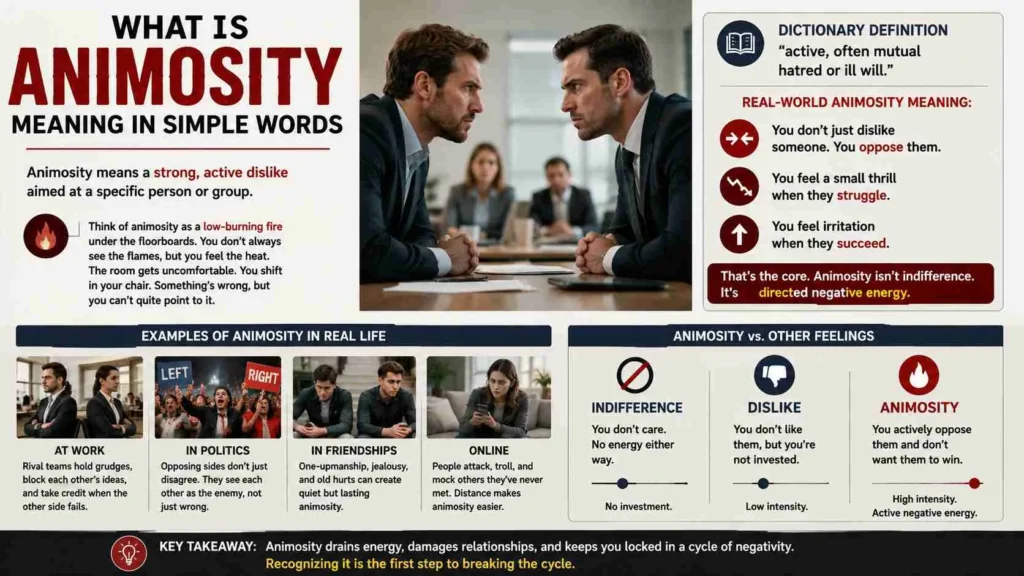
Let’s start clean. Animosity means a strong, active dislike aimed at a specific person or group. It’s not passive. You don’t just feel uncomfortable. You feel genuine ill will. And you want them to fail. Maybe not catastrophically. But you don’t want them to win.
Think of animosity as a low-burning fire under the floorboards. You don’t always see the flames but you feel the heat. The room gets uncomfortable. You shift in your chair. Something’s wrong, but you can’t quite point to it.
Here’s the dictionary animosity definition without the jargon: “active, often mutual hatred or ill will.” But that’s still stiff. Let’s make it human.
Real-world animosity meaning:
- You don’t just dislike someone. You oppose them.
- You feel a small thrill when they struggle.
- You feel irritation when they succeed.
That’s the core. Animosity isn’t indifference. It’s directed negative energy.
How to Pronounce Animosity Correctly
Say this out loud: AN – uh – MAH – suh – tee
Stress the third syllable: “MAH.”
First syllable sounds like “an” as in “an apple.”
Second syllable is quick: “uh.”
Fourth syllable is “suh” like “sun” without the n.
Last syllable is “tee” like the letter T.
Fun memory trick:
“An enemy sees me.” Say it fast. “An enemy sees animosity.” Works weirdly well.
You’ll hear people mispronounce it as “an-uh-MOSS-ity.” That’s wrong. The correct animosity pronunciation keeps the “MAH” sound strong.
Real Examples of Animosity You’ve Probably Seen
Examples make the meaning of animosity click faster than any definition. Here are four real-world scenarios. See if any feel familiar.
Workplace Animosity
Two senior developers competed for the same promotion. Sarah got it. Mark didn’t. Now Mark won’t share his code reviews with Sarah. He doesn’t yell. He doesn’t complain to HR. And he just… blocks. Small delays. Forgotten meeting invites. That’s animosity. Not laziness. Not ignorance. Deliberate friction.
Another example: A manager always dismisses one employee’s ideas in meetings. Then later, the manager uses that same idea as their own. The employee doesn’t quit. They just start hoping the manager fails. Quietly. Deeply.
Family Animosity
Two sisters. Same parents. One always gets praised for academic achievements. The other gets ignored for similar grades. Years pass. They’re adults now. They don’t fight. They don’t argue. But the less-favored sister feels a cold knot in her stomach every time the phone rings and it’s her sibling. That’s animosity in relationships without a single raised voice.
Or consider inheritance disputes. A brother feels the family house should have gone to him. His sister got it instead. Now every holiday dinner carries this low-grade tension. He asks pointed questions about repairs. He smiles but his jokes sting. Animosity.
Romantic Animosity
A couple breaks up. Three years later, one of them still checks the other’s social media. Not because they want them back. They want to see failure. A bad job change. A relationship that looks shaky. That’s not heartbreak anymore. That’s animosity toward someone you used to love.
One person says, “I don’t care if they’re happy. I just don’t want them happier than me.” That’s the quiet confession of romantic animosity.
Group or Political Animosity
Fans of two rival soccer clubs can’t sit in the same stadium section. Not because they’ll brawl instantly. But because mutual hostility sits between them like a wall. They don’t know each other personally. Yet they feel genuine ill will.
Same thing in office politics. The marketing team vs. the sales team. No single fight started it. But now they hide information from each other. They celebrate each other’s small failures. That’s group animosity.
Animosity vs Hatred | The Critical Difference
Most people use these words interchangeably. That’s a mistake. Animosity and hatred are not the same. Here’s why.
| Aspect | Animosity | Hatred |
|---|---|---|
| Intensity | Moderate to high, but focused | Extreme, often irrational |
| Duration | Can be temporary or long-term | Usually deep and lasting |
| Action tendency | Opposition, blocking, silent hostility | Desire to harm or destroy |
| Emotional flavor | Bitter, cold, resentful | Hot, loathing, disgust |
| Example thought | “I don’t want them to win.” | “I want them to suffer.” |
Hatred wants to destroy. It fantasizes about harm. It feels almost consuming. Hatred says, “I wish they’d lose their job, their health, their peace.”
Animosity just wants you to lose. It’s smaller but still toxic. Animosity says, “I don’t need you to crash and burn. I just need you to finish second. Behind me.”
Think of it this way: Hatred is a forest fire. Animosity is a slow leak in your tire. Both will leave you stranded. But one takes longer to notice.
Here’s an animosity vs hatred example in action.
A worker hates their boss. They fantasize about the boss getting fired. They feel joy imagining the boss’s humiliation.
A different worker feels animosity toward their boss. They don’t want the boss fired. They just want the boss’s big project to fail so the worker looks better in comparison. Smaller. Colder. Still damaging.
Animosity vs Resentment | Subtle but Crucial
People confuse animosity and resentment all the time. They feel similar. But they point in different directions on the timeline.
Resentment looks backward. It says, “You wronged me in the past. I remember. I haven’t forgiven you. And I carry that weight.”
Animosity looks forward. It says, “Based on what happened (or who you are), I will oppose you going forward.”
Example to lock this in:
You resent an old boss for skipping your promotion three years ago. You still feel the sting. And you replay the conversation. That’s resentment.
That same old boss joins your new company. Now you start subtly undermining their authority. You “forget” to cc them on important emails. You question their decisions in meetings. That’s animosity. You moved from feeling wronged to acting against them.
Another way to say it:
Resentment is a grudge you hold inside. Animosity is a grudge you act on.
Both hurt you. But animosity hurts others more directly.
What Causes Animosity in People
Animosity doesn’t come from nowhere. It builds. Psychology research points to several clear causes.
Repeated Small Humiliations
One big fight rarely creates lasting animosity. But daily disrespect? That’s the factory. A coworker who always interrupts you. A friend who “jokes” about your weight. A partner who rolls their eyes when you speak. Each small cut doesn’t kill. But after fifty cuts, you feel genuine ill will.
Perceived Unfairness
People can tolerate bad outcomes. They cannot tolerate unfair ones. When someone gets a reward you deserved, animosity grows like weeds.
Example: Two employees work equally hard. One gets a bonus. The other doesn’t. The one who lost out doesn’t just feel sad. They feel hostility toward the winner. Even if the winner did nothing wrong.
Unresolved Conflict
You avoid a hard conversation. You tell yourself, “I’ll let it go.” But you don’t actually let it go. You just bury it. Over time, that buried conflict solidifies into bitter feelings. Now you don’t even remember the original fight. You just know you don’t like them.
Group Identity
“Us vs. them” thinking is ancient. It’s also fast. Put ten strangers on two teams for ten minutes. Watch how quickly they favor their own group and dislike the other. That’s social conflict built from nothing. Now imagine real stakes. Politics. Sports. Department budgets. Animosity grows fast when groups form.
Jealousy
Not envy. Envy says, “I want what you have.” Jealousy (in this context) says, “I want you to lose what you have so I feel better.” That’s pure animosity. You don’t need their promotion. You just want them demoted.
Signs You’re Dealing with Animosity
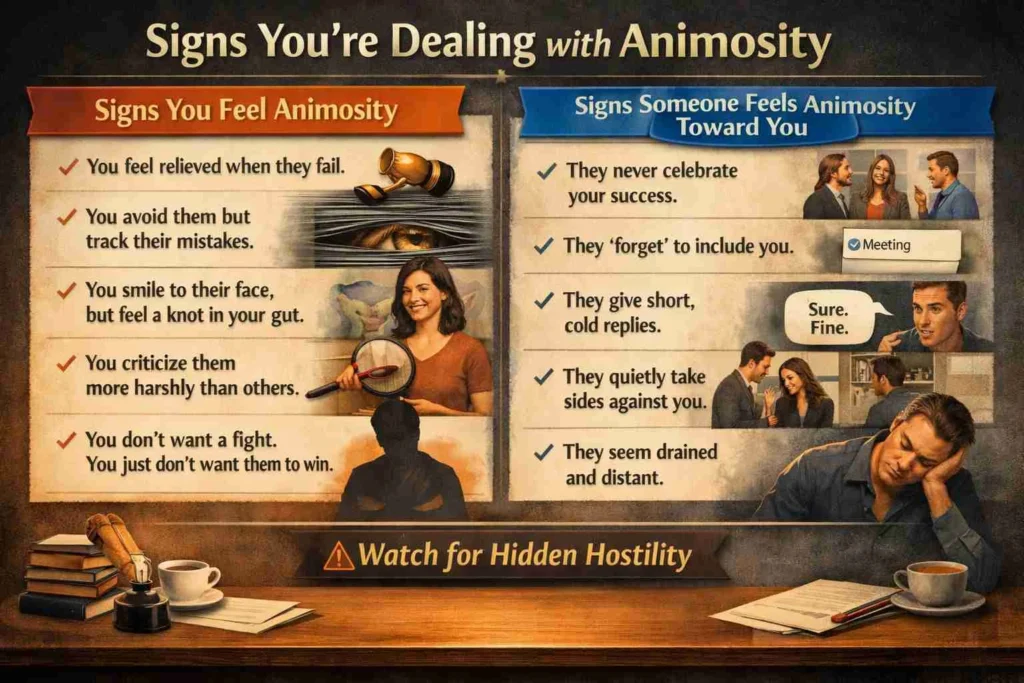
How do you know if you hold animosity toward someone? Or if someone holds it toward you? Look for these signs.
You feel animosity when:
- You feel relief when they fail.
- You avoid them but secretly track their mistakes.
- You smile to their face but feel a cold turn in your gut.
- You criticize them more harshly than others for the same behavior.
- You don’t want a fight. You just don’t want them to win.
Someone feels animosity toward you when:
- They never celebrate your wins. They just go silent.
- They “forget” to include you in important emails or meetings.
- They give you short, polite answers but no warmth.
- They side against you in small ways when no one else is watching.
- They seem tired around you, not angry. Exhaustion is a sign of suppressed hostile feelings.
Animosity in Relationships | Romantic, Family, Friendship
Animosity meaning in relationships changes slightly depending on the bond. Let’s break each one down.
Romantic Animosity
This is the most painful kind. You once loved this person. Now you feel deep dislike. You might still live together. You might still share a bed. But you don’t want them to succeed anymore.
Signs of romantic animosity:
- You stop defending them to friends.
- You feel annoyed by their presence, not indifferent.
- You track their flaws like a mental list.
- You feel a small victory when they fail at something small.
Romantic animosity often ends relationships. But sometimes people stay for years. They become roommates who quietly oppose each other.
Family Animosity
Family animosity runs deep because you can’t easily leave. A sibling who always competed. A parent who played favorites. An in-law who never accepted you. define animosity.
Family animosity shows up at holidays. Birthdays. Funerals. It shows up in who gets invited and who gets left out. It shows up in whispered comments and loaded silences.
One study in social psychology suggests family conflict (including animosity) creates longer-lasting stress than workplace conflict. Because you expect family to be safe. When they’re not, the betrayal cuts deeper.
Friendship Animosity
Friendship animosity is strange. You stay “friends” but you don’t like them anymore. You still hang out. And you still laugh. But underneath, you oppose their growth. You don’t want them to get that job. You don’t want them to move away and be happy.
People rarely admit this. But it’s common. Especially in long friendships where one person changed and the other didn’t.
Animosity in the Workplace | A Special Case
Workplace animosity deserves its own section. Why? Because you can’t just leave. You need the paycheck. So you stay. And the ill will builds.
Common causes of workplace animosity:
- Credit theft (someone takes credit for your work)
- Unequal workloads
- Favoritism from management
- Gossip and exclusion
- Promotions that feel unfair
Workplace animosity costs companies real money. According to workplace studies, unresolved interpersonal tension leads to:
- Lower productivity
- Higher turnover
- More sick days
- Worse collaboration
Example: Two managers at a mid-sized company held animosity for two years. They stopped sharing client information. Clients started getting conflicting messages. The company lost three major contracts. No one yelled. No one fought. Just slow, steady opposition.
What does workplace animosity look like day to day?
- One employee never invites a certain coworker to lunch.
- Teams hoard information like treasure.
- People celebrate when a rival department makes a mistake.
- Meetings feel tense before anyone speaks.
Animosity Synonyms and Antonyms for Writers
If you’re writing about animosity or just want to understand its word family, here’s a useful list.
Synonyms (similar emotional weight)
| Word | Slight difference |
|---|---|
| Hostility | Broader. Can be open or hidden. |
| Enmity | More formal. Often mutual. |
| Antagonism | Active opposition. Less emotional. |
| Ill will | Softer. Still means dislike. |
| Bitterness | Focuses on past hurt. More passive. |
| Malice | Darker. Suggests desire to harm. |
Example swapping synonyms:
“They felt animosity toward each other.”
“They felt enmity toward each other.” (More formal, longer-lasting.)
“They felt antagonism toward each other.” (More active, less emotional.)
Antonyms (opposite feelings)
| Word | Meaning |
|---|---|
| Goodwill | Friendly, helpful feelings |
| Rapport | Smooth, positive connection |
| Harmony | Peaceful coexistence |
| Amity | Friendly peace (rare but perfect) |
| Affection | Warm liking |
Example with antonym:
“They swapped animosity for an uneasy peace. Not friendship. Just functional neutrality.”
Animosity in Psychology | What Researchers Say
Psychologists study animosity under broader terms like “hostility” and “interpersonal antagonism.” Here’s what the research shows.
Chronic hostility (which includes animosity) links to:
- Higher blood pressure
- Increased inflammation markers
- Poorer immune function
- Higher risk of heart disease
One longitudinal study tracked hostile individuals for 15 years. Those with high negative emotions toward others had significantly worse health outcomes. Not because they fought more. But because their bodies stayed in low-grade stress mode constantly.
Animosity meaning in psychology:
It’s not just an emotion. It’s a pattern of interpreting others’ actions as intentionally harmful. Even when they’re not.
Example: You feel animosity toward a coworker. They forget to cc you on an email. A neutral person thinks, “Honest mistake.” You think, “They did that on purpose.” That interpretation fuels more animosity. It’s a loop.
Psychologists call this “hostile attribution bias.” And it’s a hallmark of people who hold long-term resentment toward someone.
Can Animosity Be Resolved? Yes. But Not with Clichés.
Let’s be honest. Most advice on resolving animosity is useless. “Just forgive and forget.” “Let it go.” “Be the bigger person.” That’s not help. That’s pressure.
So let’s talk about what actually works. And what doesn’t.
What Doesn’t Work
- Forcing forgiveness. You can’t fake your way out of animosity. The feeling stays. You just suppress it.
- Avoiding the person completely. Sometimes you can’t. And avoidance often makes the emotional tension worse because your mind fills in the gaps.
- Confronting them hot. Yelling about animosity never works. They’ll get defensive. You’ll feel worse.
What Actually Helps
Name it silently.
Say to yourself, “This is animosity. Not anger. Not annoyance. I actively oppose this person’s success.” That naming alone breaks some of the automatic thinking.
Stop watching them.
Animosity feeds on attention. Check their social media less. Ask fewer mutual friends about them. Stop tracking their wins and losses. Every time you look, you water the weed.
Find one shared goal.
At work: “We both want the project done.” At home: “We both want peace at dinner.” A single shared goal won’t erase animosity. But it creates a narrow bridge.
Use time and distance.
Not sexy. But real. Some animosity fades after six months apart. Not all. But enough to make life livable.
Accept that some animosity stays.
You don’t have to resolve every feeling. Sometimes you keep the animosity but limit contact. That’s not failure. That’s strategy. You can hold ill will toward someone and still pay your bills, raise your kids, and sleep at night. Just don’t let it run your choices.
Animosity Used in a Sentence | 10 Real Examples
Here are ten sentences using animosity in different contexts. Each shows a different tone. Study these to understand how the word moves in real language.
- “The animosity between the two departments started over a shared printer. Ridiculous but real.”
- “She spoke with no animosity, just tired facts.”
- “Why do you hold such animosity toward a person who never even knew your name?”
- “Their animosity lasted twenty years. Then one got sick. The other visited. Strange how that works.”
- “Animosity doesn’t need a big reason. Small cuts do the job fine.”
- “He felt no hatred for his rival. Just a clean, cold animosity that made him work harder.”
- “The merger failed not because of bad numbers but because of quiet animosity between the two leadership teams.”
- “You can’t build trust on top of buried animosity. The foundation cracks every time.”
- “Her animosity showed up in small things. A pause before agreeing. A shoulder turn away.”
- “They resolved the contract but not the animosity. So the partnership limped along for another year.”
Animosity Meaning in Different Languages
People often search for animosity meaning in Urdu or animosity meaning in Hindi. Here’s a simple translation guide.
| LanguageWord/PhraseRough meaning | ||
|---|---|---|
| Urdu | دشمنی (Dushmani) | Enmity, hostility |
| Hindi | दुश्मनी (Dushmani) | Same root. Means active opposition. |
| Spanish | Animosidad | Direct cognate. Same meaning. |
| French | Animosité | Direct cognate. |
| German | Feindseligkeit | “Enemy-likeness.” Stronger than animosity. |
Note: In Urdu and Hindi, dushmani is slightly stronger than English animosity. It implies active enmity, not just passive opposition.
When Animosity Becomes Useful

Let’s be unusual for a moment. Can animosity ever be good?
Rarely. But yes.
In sports: A runner holds animosity toward a rival who beat them unfairly. That animosity fuels extra training. Extra focus. The runner doesn’t wish harm. They just refuse to lose again.
In social justice: Historical animosity toward oppressive systems has fueled necessary change. Oppressed groups held active opposition toward unjust laws. That opposition wasn’t hatred of people. It was animosity toward a structure.
In creative work: Some artists and writers hold animosity toward critics who dismissed them. They use that feeling to prove the critics wrong. Not revenge. Just quiet, focused opposition. Animosity meaning in english.
The key difference: Useful animosity stays controlled. It doesn’t consume you. It becomes fuel, not fire.
FAQs
What does animosity mean in a relationship?
It means one or both partners actively oppose each other’s happiness. Even subtly. Even silently. Romantic animosity kills love slowly. Not with one fight but with a thousand small oppositions.
Is animosity the same as hatred?
No. Hatred wants to destroy. Animosity just wants you to lose. Hatred is hot. Animosity is cold. Both are bad. But they’re not the same.
Can animosity be one-sided?
Yes. One person can hold animosity while the other feels nothing. That’s common in workplace rivalries and one-sided friendships. The target might not even know you feel ill will toward them.
What is the root of the word animosity?
Latin animositas from animus meaning “spirit, courage, will.” Over centuries, it soured from “spiritedness” into “hostile spirit.” Words corrode over time.
What is the difference between animosity and anger?
Anger is hot and short. Animosity is cold and long. You can be angry at someone for an hour. Animosity lasts months or years.
What is an example of animosity in a sentence from literature?
From The Great Gatsby: “There was an unmistakable air of natural hostility between them.” That’s animosity. Unspoken but clear.
Can children feel animosity?
Yes. Children as young as eight can hold negative feelings toward a peer that go beyond simple anger. It looks like exclusion, quiet sabotage, or refusing to help.
Does animosity always involve two people?
No. You can feel animosity toward a group. A company. A political party. Even an institution. The feeling is still active opposition. The target just gets bigger.
Is animosity the same as hate?
No. Animosity is strong dislike or hostility, while hate is usually a deeper and more intense emotion. Someone can feel animosity toward a person without truly hating them.
Conclusion
You will feel animosity toward someone in your life. That doesn’t make you evil. It makes you human. The real question isn’t how to avoid the feeling. It’s what you do with it. You can feed it, fake its absence, or name it honestly. Naming it is the strongest move.
So notice that one person you quietly oppose. Don’t fix it today. Just stop pretending it’s nothing. That small honesty breaks animosity’s grip better than any forced forgiveness ever could.
Discover More Related Articles:
- “ISO” Meaning Slang: From Online Posts to Marketplace Use In 2026
- “PTSO” Meaning Slang: How to Use It & Real-Life Examples In 2026
- “JOI” Meaning Slang: How It’s Used in Online Conversations In 2026