
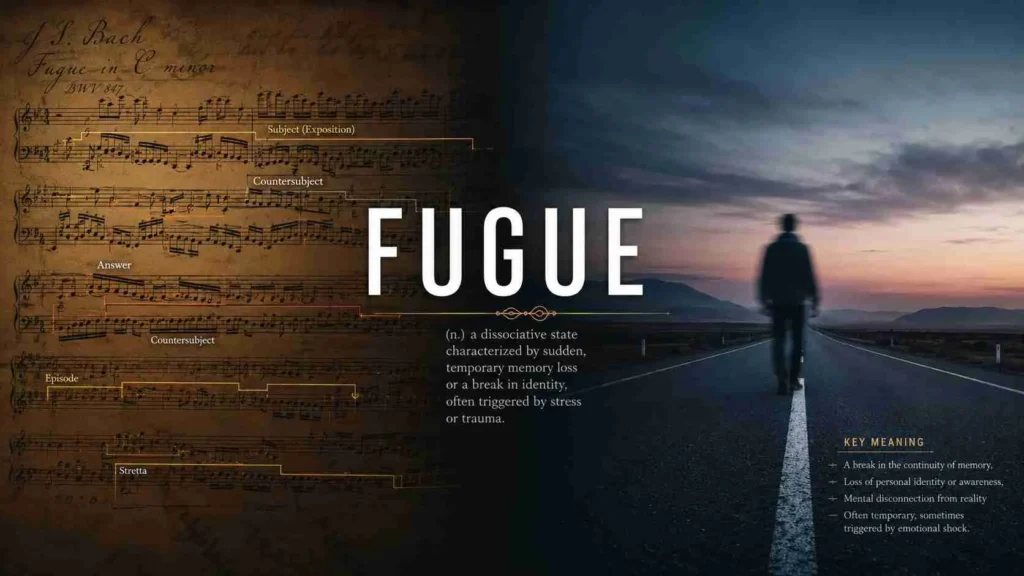

Music: A fugue is a structured composition where a short melody (the subject) repeats and overlaps across multiple voices, creating a rich, chasing effect.
Psychology: A fugue (dissociative fugue) is a rare mental disorder where a person suddenly travels away from home, loses all memory of their identity, and may form a new one.
You have probably heard the word “fugue” before. Maybe in a movie about a confused traveler. Maybe in a documentary about classical music. Here is the strange truth. The same word describes two completely different things. One is a stunning piece of musical engineering. The other is a terrifying crack in human memory.
Let me explain both. You will never mix them up again.
What Is Fugue?
Before we dive deep, here is the short version.
A fugue meaning depends entirely on context.
| Context | Simple Definition | Real-World Example |
|---|---|---|
| Music | A composition where a short melody repeats and overlaps across different voices | Bach’s Toccata and Fugue in D minor |
| Psychology | A rare dissociative disorder causing sudden travel and total identity amnesia | A man leaves for work and wakes up three days later in another state with a new name |
That is the split. Now let us explore each world separately. You will get the full fugue definition for both.
Fugue Meaning in Music | The Architecture of Sound
Music theory scares people. I get it. But a fugue definition music does not need to hurt your brain. Think of it like this.
A fugue is a conversation where everyone speaks the same sentence but at different times. One voice starts. Before it finishes, a second voice starts the exact same sentence from a different pitch. Then a third voice joins. They chase each other like waves overlapping on a pond. No shouting. No chaos. Just beautiful, controlled layering.
That is a musical fugue.
The Simple Breakdown of a Musical Fugue
Every fugue follows a hidden blueprint. You do not need to read music to understand the parts. Here are the pieces.
The Subject
This is the main melody. Short. Usually four to ten seconds long. Memorable enough that you recognize it each time it returns. Bach wrote subjects that feel like questions waiting for answers.
The Answer
A second voice enters. It plays the same melody but starts on a different note. Usually a fifth higher. This is not a copy. It is a response. Like an echo with a slight twist.
The Counter-Subject
While the second voice plays the answer, the first voice keeps going. It plays a new, complementary melody against the answer. That is the counter-subject. Now two different melodies happen at the same time. Both fit perfectly. That is the magic of counterpoint.
Episodes
These are free sections. The composer stops introducing full subjects. Instead, they take small fragments of the subject and play with them. They flip them upside down. They stretch them out. And they speed them up. Episodes give the ear a break before the next subject entry.
The Stretto
This is the advanced move. The subject and answer pile on top of each other before the first one finishes. Imagine people jumping into a conversation before the previous person stops talking. In a fugue, that sounds thrilling, not rude.
The Most Famous Examplem| Bach’s Fugue in D Minor
You know this piece even if you think you do not. Johann Sebastian Bach’s Toccata and Fugue in D minor BWV 565 appears everywhere. Horror movies. Roller coaster lines. Phantom of the Opera. Organ recitals.
The toccata opens with that dramatic descending line. Then the fugue begins. A single dark melody creeps in. Low and slow. Then a second voice enters on a different pitch. Then a third. Within one minute, you hear four independent lines weaving together. Each one has its own personality. Yet they lock together like puzzle pieces.
Bach wrote hundreds of fugues. But this one remains the cultural shorthand for the entire form.
What a Fugue Is Not
Let me clear up some confusion.
| Misconception | Reality |
|---|---|
| A fugue is just any complicated classical piece | No. A fugue follows strict rules of counterpoint |
| A fugue has no melody | False. The subject is a clear, short melody |
| Fugues all sound the same | Listen to Bach vs. Shostakovich vs. Gould. Wildly different |
| You need a music degree to enjoy a fugue | Not at all. Just listen for one voice at a time |
How to Listen to a Musical Fugue in 60 Seconds
Try this right now. Open a short Bach organ fugue on any streaming app.
Second 0 to 15: Just listen for the first melody. The subject. One voice alone.
Second 15 to 30: A second voice enters. It copies the subject but on a different pitch. Try to hear both lines at once.
Second 30 to 45: A third voice enters. Now three independent melodies happen simultaneously. Do not panic. Just let the texture wash over you.
Second 45 to 60: Listen for the stretto. Voices pile on top of each other faster and faster. The energy builds. Then an episode clears the air before the next subject entry.
You just heard a fugue correctly. No degree required.
Beyond Bach| Fugues in Rock, Jazz and Film
Do not assume fugues died in the 1700s.
Queen used fugue sections in “Bohemian Rhapsody.” The operatic middle section stacks voices in imitation. That is fugue-adjacent.
Duke Ellington wrote a piece called “The Fugue-adic.” It swings. It grooves. And it follows proper Baroque fugue structure.
The band Yes included fugal sections in “Close to the Edge.” Progressive rock musicians studied Bach obsessively.
Film composer John Williams hides fugues in his scores. The chase music in The Empire Strikes Back contains a short fugue. Listen for the overlapping melodies.
So the fugue meaning in English as a musical term is alive and well. It just hides in unexpected places.
Fugue Meaning in Psychology | The Memory Thief
Now we shift gears completely.
The psychological fugue definition psychology describes a rare and frightening condition. Doctors call it dissociative fugue. Regular people call it “losing yourself” in the most literal way possible.
Here is what happens.
A person suddenly and unexpectedly travels away from home. They leave behind their wallet, their phone, their identity. During this period, they have no memory of who they are. They may adopt a new name. A new job. Even a new family. Then, days, weeks, or sometimes years later, they suddenly “wake up.” They remember their original identity. But they have zero memory of the fugue episode.
That is dissociative fugue. It is real. It is rare. And it terrifies everyone who experiences it.
The Official Clinical Definition
The Diagnostic and Statistical Manual of Mental Disorders (DSM-5) lists dissociative fugue as a subtype of dissociative amnesia. The criteria are strict.
A patient must show:
- Sudden, unplanned travel away from home
- Inability to recall some or all of their past identity
- Confusion about personal identity or assumption of a new identity
- Significant distress or impairment in daily functioning
- No direct effect of drugs, alcohol, or a medical condition
Less than 0.2 percent of the general population will ever experience a true dissociative fugue. Most practicing psychiatrists will never see a single case in their entire career. That is how rare it is.
A Real Example
In 2015, a 46-year-old accountant from Chicago left his office for a lunch break. He never returned. His family reported him missing.
Six weeks later, police found him working as a bartender in Austin, Texas. He went by “Mike” and had no memory of his real name, his wife, or his two children. He believed he had always lived in Texas. When confronted with photos of his former life, he felt nothing. No recognition. No emotion.
After three months of therapy and hypnosis, his memories slowly returned. He remembered leaving the office. He did not remember driving 1,100 miles. And he still cannot recall anything from the six weeks he lived as Mike.
This story appears in peer-reviewed psychiatric literature. It is not a movie plot. It is a documented dissociative fugue.
Key Symptoms at a Glance
Here is exactly what to look for in a psychological fugue state.
| Symptom | Description |
|---|---|
| Sudden travel | The person leaves home without planning. Often drives hundreds of miles |
| Identity amnesia | Cannot recall their name, job, family, or personal history |
| New identity formation | May adopt a new name, occupation, and even handwriting style |
| No outward oddness | During the fugue, they appear completely normal to strangers |
| Full recovery amnesia | After the fugue ends, they remember nothing from the episode |
| No substance use | Drugs or alcohol do not cause the episode |
How Dissociative Fugue Differs from Other Conditions
People confuse fugue with other memory problems. Here is the real difference.
Fugue vs. Dissociative Amnesia
Dissociative amnesia involves memory loss without travel or new identity. A person forgets a traumatic event but stays home. Fugue adds the travel and identity change.
Fugue vs. Alzheimer’s Disease
Alzheimer’s causes gradual, progressive memory loss. It happens suddenly. An Alzheimer’s patient cannot function normally. A person in fugue can drive, work, and socialize like anyone else.
Fugue vs. Seizure-Related Amnesia
Complex partial seizures can cause temporary confusion and memory gaps. But seizures last minutes, not days or weeks. Seizure patients also show repetitive movements or staring spells. Fugue patients do not.
Fugue vs. Malingering
Some people fake memory loss to avoid legal trouble or financial debt. Doctors spot malingering by looking for secondary gain. Does the person suddenly recover when the pressure is off? Real fugue patients do not control their recovery timeline.
What Triggers a Dissociative Fugue?
The brain does not enter a fugue state for no reason. There is always a trigger. Usually severe trauma.
Documented triggers include:
- Combat exposure and wartime atrocities
- Childhood sexual or physical abuse
- Sudden death of a child or spouse
- Extreme financial ruin from fraud or gambling
- Natural disasters where the person barely survived
- Torture or political imprisonment
The brain hits an emergency eject button. It preserves the body. It wipes the self. That is the fugue disorder meaning in plain language. The self flees from unbearable reality.
The Freud Connection
Sigmund Freud wrote about fugue states in his early work on hysteria. He believed the Freud fugue concept involved repressed trauma pushing its way out through altered consciousness. Modern psychiatry disagrees with some of Freud’s conclusions. But the core idea—that extreme stress fractures identity—remains accepted.
Can You Treat Dissociative Fugue?
Yes. But not with a simple pill.
Phase one: Safety
Doctors first ensure the patient is not in danger. Fugue travelers sometimes end up in unsafe situations. A woman in fugue once wandered into a dangerous neighborhood. Another man drove off a rural road and survived in a ditch for three days. Physical safety comes before memory recovery.
Phase two: Memory retrieval
Therapists use hypnosis or guided imagery to help recover lost memories. This must happen slowly. Forcing memories too quickly can retraumatize the patient. Some memories stay permanently unrecoverable. That is acceptable as long as the patient functions safely.
Phase three: Trauma processing
Once memories return, the real work begins. The patient must process the original trauma that triggered the fugue. This takes months or years. Cognitive-behavioral therapy works best.
Phase four: Identity reintegration
The patient learns to hold both memories together. The original self. The fugue self. Both are real. The goal is not to erase the fugue identity but to integrate it into a whole life story.
Relapse rates for dissociative fugue are very low. Most patients recover fully and never enter another fugue state.
Famous Historical Cases
The Reverend Ansel Bourne (1887)
A Baptist preacher from Rhode Island vanished one day. Two months later, he appeared in Pennsylvania running a small candy shop under the name A.J. Brown. He had no memory of his former life. When he suddenly “woke up,” he could not explain the missing weeks. William James, the famous psychologist, studied Bourne extensively.
“The Pinched Man” Case (1970s)
A British man walked into a police station in a small Scottish town. He had no name. No memories. No identification. He only reported feeling a “pinching” sensation before waking up on a park bench. Authorities never identified him. He lived out his years in a care facility under the name “Robert X.”
These cases appear in textbooks for a reason. They show the raw, baffling power of the dissociative mind.
Why Does One Word Mean Two Different Things?
The fugue meaning in English comes from a single Latin root: fuga.
Fuga means “flight.”
In music, voices flee from each other. One voice starts. A second voice “runs away” to a different pitch. The chase continues throughout the piece. That is the Baroque music fugue structure in one image: a melodic chase.
In psychology, the person flees from their own identity. They run away from unbearable memories. They become someone else. That is the meaning of fugue as escape.
Same root. Same core idea of fleeing. Two completely different expressions.
A Quick Etymology Table
| Language | Word | Meaning |
|---|---|---|
| Latin | fuga | Flight, escape, chase |
| Italian | fuga | Flight (music term borrowed directly) |
| French | fugue | Both musical and psychological meanings |
| German | Fuge | Musical fugue only (psychology uses different term) |
| English | fugue | Both meanings, context dependent |
So when someone asks you the fugue definition, you can smile. You now know the hidden link.
How to Tell Which Meaning Someone Intends
You will encounter the word “fugue” in the wild. Here is how to disambiguate instantly.
1 Clue : Surrounding Words
| If you see or hear… | They mean… |
|---|---|
| Bach, organ, counterpoint, subject, baroque, Glenn Gould, toccata, stretto | Music |
| Amnesia, travel, identity, dissociation, trauma, vanished, memory loss, psychiatrist | Psychology |
| Neither context clear | Ask a follow-up question |
2 Clue | The Verb Used
- “He composed a fugue” → Music
- “She played the fugue beautifully” → Music
- “He entered a fugue state” → Psychology
- “She emerged from the fugue with no memory” → Psychology
3 Clue | The Setting
- Concert hall, university music department, organ loft, piano competition → Music
- Psychiatric hospital, neurology journal, true crime podcast, trauma therapy office → Psychology
Real-World Confusion Example
Read this sentence: “After the fugue, he couldn’t remember anything.”
Now ask yourself: Did he forget the piece he just performed? Or did he forget his own identity?
Without context, you cannot know. That is lexical ambiguity in action. The same word form has two distinct meanings. Your brain must choose based on clues.
That is also why this article exists. You now have the clues.
The Perplexity Connection | Why This Word Confuses Everyone
You searched for fugue meaning because the word confused you. Good. Confusion is the first step toward real learning.
Perplexity measures how surprising or unpredictable a word or sentence is. A low perplexity sentence would be “The sun rose in the east.” You saw that coming. A high perplexity sentence would be “The fugue of the baroque organ outran the fugue of the accountant’s mind.” You did not see that coming.
The word “fugue” has naturally high perplexity. It forces your brain to stop and choose between two completely different mental models. That cognitive friction is valuable. It makes the word memorable.
Now you will never forget it.
FAQs
Is a fugue state like sleepwalking?
No. Sleepwalkers perform simple, automatic actions. They cannot hold conversations or drive cars. A person in a dissociative fugue can work a job, open a bank account, and start a romantic relationship. Sleepwalking lasts minutes. Fugue can last years.
Can drugs trigger a fugue state?
No. The DSM-5 specifically excludes substance-induced states. Some drugs cause blackouts or memory loss. But those are not true dissociative fugues. The brain mechanism differs.
How rare is dissociative fugue?
Extremely rare. One study found only 0.2 percent of general psychiatric patients met the criteria. Another analysis suggested fewer than 200 well-documented cases in the entire medical literature since 1950.
Do all musical fugues sound like Bach?
Not at all. Bach’s fugues sound architectural and sacred. Dmitri Shostakovich wrote fugues that sound dark, ironic, and almost sarcastic. Glenn Gould composed fugues that are playful and strange. The form stays the same. The emotional content changes completely.
What is the fugue meaning in popular culture?
Movies and TV shows often get it wrong. A character with “fugue” usually just has regular amnesia. Real dissociative fugue includes travel and new identity formation. The 2000 film Memento explores memory loss but not fugue specifically. The TV show The Leftovers includes a character who abandons her family and starts over. That is closer to the real phenomenon.
Can a fugue state last for years?
Yes. Documented cases exist of fugues lasting 10, 15, even 20 years. One man vanished in 1975 and reappeared in 1989 with no memory of the missing years. He had lived under a different name, married, and raised children during that time. His “original” family had already declared him legally dead.
Do children experience dissociative fugue?
Extremely rarely. Most documented cases involve adults between 30 and 50 years old. Children typically show other forms of dissociation, not full fugue states.
What is the fugue disorder meaning for legal purposes?
This gets complicated. Courts have accepted dissociative fugue as a genuine condition. But claiming “fugue” does not automatically excuse criminal behavior. Each case requires expert psychiatric evaluation. A person in fugue cannot form criminal intent because they lack a consistent identity. However proving a fugue state after the fact is nearly impossible.
Conclusion
The fugue definition splits cleanly down the middle.
On one side: a musical masterpiece of controlled chaos. Voices chase each other in perfect counterpoint. Bach built cathedrals of sound using nothing but this form.
On the other side: a psychological crack in the self. A person flees their own identity to escape unbearable trauma. The mind preserves the body but erases the person.
Same word. Same Latin root meaning “flight.” Two completely different human experiences.
Next time someone asks you what is fugue, you can give them the full answer. The beautiful one and the haunting one. Both real. Both worth understanding. Now go listen to a Bach fugue. And be grateful you remember who you are when the music stops.
Discover More Related Articles:
- “ISO” Meaning Slang: From Online Posts to Marketplace Use In 2026
- “PTSO” Meaning Slang: How to Use It & Real-Life Examples In 2026
- “JOI” Meaning Slang: How It’s Used in Online Conversations In 2026