


A sabbatical is a job‑protected, extended leave from work lasting anywhere from one month to a full year that you take with your employer’s approval. Unlike a vacation or quitting, you keep your position and often keep your benefits,
You have heard the word before. Maybe a coworker vanished for three months. Or a professor you know took an entire semester off. People call it a sabbatical. But here is the honest truth. Most folks have no clue what the word actually means.
So let us fix that right now.
A sabbatical is not a vacation. It is not quitting your job either. Companies and universities offer this extended leave so you can recharge, research, or reset. Think of it as a career pause button. But one with rules, pay, and a real purpose.
This guide walks you through the complete sabbatical meaning from formal definition to real-life examples. You will learn how sabbaticals work, who gets them, and whether you can take one yourself.
No fluff. No generic filler. Just useful knowledge you can actually use.
Sabbatical Definition | The Simple Version

Let us start with a clean sabbatical definition. Because too many articles overcomplicate this.
A sabbatical is a long-term, job-protected leave from work. It typically lasts anywhere from one month to a full year. Your employer holds your position open. You keep your employment status. And sometimes this is the good part you keep getting paid.
Here is what makes a sabbatical different from just asking for time off:
- Your job is legally or contractually protected
- You have a defined return date
- The leave has an approved purpose (research, rest, or development)
- Your benefits may continue during the leave
Quick example to lock in the sabbatical meaning:
Maria works as a high school biology teacher. After seven years in the classroom, her district grants her a 3-month paid sabbatical. She uses the time to write a new environmental science curriculum. When she returns, she steps back into her same classroom with a promotion waiting.
That is a sabbatical. Not a resignation. Not a gap in employment. Just a purposeful pause.
Sabbatical facts you should know upfront:
| Feature | Typical Range |
|---|---|
| Duration | 1 to 12 months |
| Pay | 0%, 50%, or 100% of salary |
| Job protection | Yes, in writing |
| Common in | Universities, large firms, some school districts |
| Main purpose | Research, burnout recovery, skill development |
The meaning of sabbatical leave hinges on one idea. You leave temporarily. You come back better. Everyone wins.
Where Did the Sabbatical Meaning Come From
Words have histories. And the history of sabbatical meaning is actually pretty fascinating.
The word traces back to the Hebrew term Shabbat. That means a day of complete rest every seven days. Religious tradition. A pause for reflection. No work. No hurry.
Fast forward a few thousand years. Universities borrowed the idea. In the late 1800s, Harvard and other major schools began offering professors a paid semester off after seven years of teaching. The deal looked like this. Teach six years. Then take a seventh year to do serious research. Write a book. Run a study. Travel for fieldwork.
That old model still runs strong today. But here is where sabbatical meaning in work has changed.
Now a software engineer might take a sabbatical to hike the Pacific Crest Trail. A nurse could take unpaid leave to care for aging parents. A marketing director might spend two months learning AI tools before the rest of the industry catches up.
The wrapper changed. The core did not.
Sabbatical meaning in English still holds that original promise. Temporary withdrawal for long-term gain. Rest that produces results. A pause that makes the next act stronger.
“The sabbatical is not an escape from work. It is an investment in better work.”
That is the soul of it.
Sabbatical Meaning in Job vs Sabbatical Meaning in Work
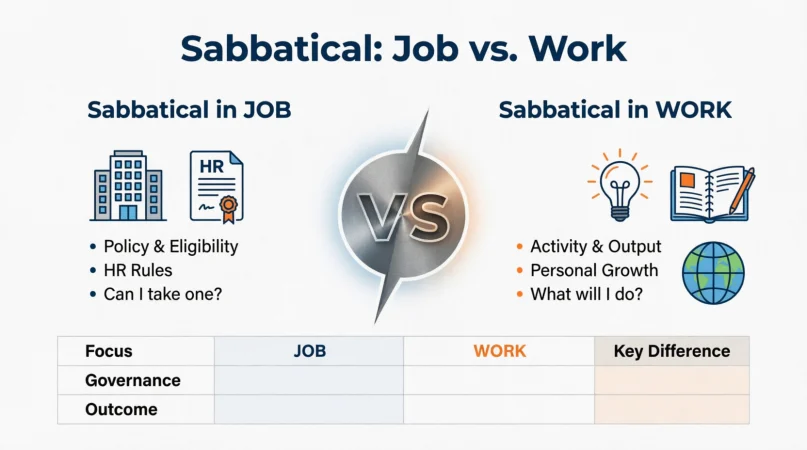
People mix these two up all the time. And honestly? It is easy to see why. Both phrases sound nearly identical. But they point to different ideas. Understanding the difference will save you from sounding confused in your next HR meeting.
Sabbatical Meaning in Job
This refers to the policy or benefit tied to your specific employer. It answers questions like:
- Does my company offer sabbaticals?
- How many years until I qualify?
- Do I get paid or not?
Real example:
“My job offers a paid 2-month sabbatical after every five years of service.”
That is sabbatical meaning in job the structural rule that either exists or does not exist where you work.
Sabbatical Meaning in Work
This refers to the activity or purpose of the break itself. It answers questions like:
- What will I actually do during my time off?
- How does this leave help my professional growth?
- What results will I bring back to my team?
Real example:
“My work during sabbatical included interviewing 30 industry experts and drafting a new training program.”
That is sabbatical meaning in work the tangible output of your time away.
Quick comparison table:
| AspectSabbatical Meaning in JobSabbatical Meaning in Work | ||
|---|---|---|
| Focus | Policy and eligibility | Activity and output |
| Question answered | “Can I take one?” | “What will I do?” |
| Determined by | HR and employee handbook | You and your manager |
| Example phrase | “My job offers sabbatical” | “My work focused on research” |
Both matter. But do not confuse a company policy (job) with what you actually produce (work). You need both for a successful sabbatical.
Types of Sabbatical Leave | Real Examples You Can Learn From
Not all sabbaticals look the same. In fact, sabbatical leave meaning changes quite a bit depending on your industry, employer, and personal goals.
Let us walk through the most common types. Each comes with real examples so you can see how this actually works outside of theory.
Academic Sabbatical
This is the original model. The one that started it all.
Who gets it:
University professors, researchers, and sometimes senior lecturers.
Pay structure:
Usually full or partial salary. Many universities pay 75% to 100% of normal pay during sabbatical.
Duration:
One semester (4 to 5 months) or a full academic year.
Purpose:
Publish peer-reviewed research, finish a book manuscript, develop new courses, or learn advanced methods abroad.
Real example:
Dr. Chen teaches Asian history at a state university. After six years of teaching full loads, she takes a one-semester sabbatical at 80% pay. She spends four months in Kyoto. She studies digital archives. And she completes two journal articles. And she returns with new material for three courses. Her department celebrates the work.
Teacher Sabbatical
Less common than academic sabbaticals. But they do exist.
Who gets it:
K-12 teachers in certain public districts and some private schools.
Pay structure:
Often unpaid. Some districts offer a small stipend. A few offer half pay.
Duration:
Typically one semester.
Purpose:
Curriculum development, advanced certification, or recovery from burnout.
Real example:
A middle school science teacher in Oregon takes an unpaid 4-month sabbatical. She designs a hands-on outdoor curriculum. She tests it with a local nature center. And she returns and launches the program district-wide. The school board funds her position for another five years.
Corporate Sabbatical
This is where sabbatical meaning in job has grown the fastest over the last decade.
Who gets it:
Employees at large companies, especially in tech, finance, consulting, and some nonprofits.
Pay structure:
Varies wildly. Some companies pay 100%. Others pay 0% but hold your job.
Duration:
1 to 3 months is most common. Some go to 6 months.
Eligibility:
Often requires 3 to 7 years of continuous employment.
Real companies with known sabbatical policies:
| Company | Policy |
|---|---|
| Adobe | 6 weeks paid every 5 years |
| Patagonia | 2 months paid after 3 years |
| Deloitte | 1 month unpaid plus 1 month half-pay |
| Buffer | 2 months paid every 5 years |
Real example:
A product manager at a large fintech company hits her 5-year mark. She applies for a 2-month paid sabbatical. She uses the time to earn a professional coaching certification. And she returns and transitions into a leadership development role. The company retains a senior employee who was close to burning out.
Personal Sabbatical (Unpaid Leave)
Some people call this a sabbatical. Strictly speaking, it is an unpaid leave of absence. But functionally, it works the same way.
Who gets it:
Employees at companies without formal sabbatical policies. Also freelancers and self-employed people.
Pay structure:
Zero. You save up in advance.
Job protection:
Sometimes. Depends on your employer and local laws.
Duration:
1 to 6 months. Anything longer often becomes a career break.
Purpose:
Burnout recovery, elder care, intensive creative projects, or long-distance travel.
Real example:
A retail regional manager requests 3 months unpaid leave. No formal sabbatical policy exists. Her boss approves it anyway to avoid losing her. She spends the time helping her mother recover from surgery. She returns grateful and focused. And she stays with the company another four years.
The sabbatical period meaning shifts depending on who you ask. But one thing stays constant. You leave. You keep your job. And you come back.
Sabbatical Leave Meaning | What HR Will Not Always Tell You
HR departments use the phrase sabbatical leave meaning like a formal term. And it sounds generous on paper. But here is what the fine print often hides.
1 Condition | The Return Requirement
Many sabbatical agreements require you to return to work for a set period. Usually 6 to 12 months. If you leave earlier than that, you may have to pay back some or all of your sabbatical pay.
Example clause:
“Employee agrees to return to active employment for no less than 12 months following sabbatical leave. Early resignation requires repayment of all sabbatical compensation.”
2 Condition | Promotion Freezes
Some companies freeze promotions and annual raises during sabbatical. You do not lose your job. But you also do not advance.
What to ask HR:
“Will my eligibility for the next promotion cycle be delayed because of my sabbatical?”
3 Condition | Health Insurance Fine Print
Paid sabbaticals usually keep your health insurance active. Unpaid sabbaticals might not. And if your coverage stops, COBRA can cost you thousands per month.
What to ask HR:
“If I take an unpaid sabbatical, does my health insurance continue? If not, what are my exact options?”
4 Condition | Retirement Contributions
This one surprises people. During an unpaid sabbatical, your paycheck stops. That means no 401(k) contributions from you or your employer. A 3-month break could cost you thousands in lost compound growth over time.
Real numbers example:
A 3-month unpaid sabbatical with a $5,000 monthly salary means $15,000 in wages not earned. At a 5% employer match, that is $750 in free money lost. Over 20 years of growth, that could be $2,500 or more.
5 Condition | The Clawback Clause
Some policies include a clawback if you leave within a certain timeframe after returning. This goes beyond sabbatical pay. It can include training costs, relocation expenses, or even a portion of your health insurance premiums.
Direct warning:
Do not assume anything. Read the employee leave policy. Then email HR with written confirmation of every term. Verbal promises mean nothing when payroll changes hands.
Sabbatical vs Vacation vs Career Break | A Clear Comparison
People confuse these three constantly. Let us settle it once and for all.
Quick rule of thumb:
| Term | Length | Job Protection | Pay | Purpose |
|---|---|---|---|---|
| Vacation | 1–3 weeks | Yes | Full | Rest and leisure |
| Sabbatical | 1–12 months | Yes | Maybe | Research, recovery, growth |
| Career break | 3+ months | No | No | Life change, travel, restart |
Deeper breakdown:
Vacation
You earn it every year. You take two weeks at the beach. You come back tan and relaxed. No strings attached. No research required. It is a pause.
Sabbatical
You qualify after years of service. You propose a purpose. You keep your job. And you might keep your paycheck. You produce something. A book chapter. A certification. A recovered nervous system. It is a reset.
Career break
You quit. Or you resign with a vague plan to return someday. No job protection. No guarantee. You might land somewhere better. You might struggle for months. It is a full stop.
Here is the real difference in one sentence:
Vacation restores your energy for next week. Sabbatical renews your purpose for next year. A career break starts a whole new chapter.
Sabbatical definition and examples always include that middle ground. You are not running away. You are stepping back strategically.
How Sabbatical Works | A Step-by-Step Process
Theory is nice. Process is better. Here is exactly how a sabbatical explanation translates into action.
1 Step | Check Your Eligibility
Open your employee handbook. Search for these terms:
- Sabbatical leave
- Extended leave of absence
- Professional development leave
- Paid time off for research
Minimum tenure requirements by industry:
| Industry | Typical Tenure Needed |
|---|---|
| University faculty | 6–7 years |
| Corporate (large) | 3–5 years |
| Corporate (small) | 5–7 years or none |
| K-12 teaching | 7–10 years (rare) |
If you find nothing, skip to Step 6. You will ask for unpaid leave instead.
2 Step | Write a One-Page Proposal
Do not skip this. A verbal request gets a verbal no. A written proposal gets a meeting.
Your proposal must answer five questions:
- How long will you be gone?
- What exactly will you do during the sabbatical?
- How does this benefit the company after you return?
- Who will cover your work while you are away?
- Do you expect full pay, partial pay, or unpaid leave?
Example sentence to steal:
“During my 3-month sabbatical, I will complete a project management certification and shadow two international teams. Upon return, I will lead our new cross-office workflow redesign.”
3 Step | Meet With Your Manager
Do not start with HR. Start with your direct boss.
Conversation opener (active, direct):
“I want to stay at this company for the next five years. To do that at my best, I would like to request a 2-month sabbatical starting in September. Here is a written proposal. Can we talk through it?”
This frames the sabbatical as a retention tool. Not a vacation request. Managers respond to retention.
4 Step | Get Approval in Writing
Verbal approval is not approval. Send a follow-up email summarizing the conversation.
Email template (short and clean):
Subject: Sabbatical confirmation – [Your Name]
Hi [Manager Name],
Thank you for our conversation today. Confirming my sabbatical leave from [start date] to [end date] at [full/partial/unpaid] pay. My job duties will be covered by [coworker name]. I will return on [return date].
Please reply confirming these details.
Thanks,
[Your Name]
Once they reply, save that email. Print it. Put it in a folder.
5 Step | Plan Your Transition
Do not leave chaos behind. That burns bridges.
Transition checklist:
- Write a one-page handoff document for each major task
- Train a backup for 2 weeks before you leave
- Set a clear out-of-office message with an emergency contact
- Finish or pause all deadlines before your start date
- Tell your team 4 weeks in advance
6 Step | Take the Sabbatical Correctly
Here is where most people fail. They check email. They join one “quick” call. And they ruin the whole point.
Rules for a successful sabbatical:
- Delete work email from your phone
- Set an autoresponder that says “I will not reply until [date]”
- Do not check Slack, Teams, or any work chat
- If someone calls you an emergency, charge them a consulting fee
The sabbatical leave rules you set matter more than the ones HR writes.
7 Step | Return With Proof
Do not just show up again. Show up with something to show.
Examples of return deliverables:
- A 2-page report on what you learned
- A new process you want to implement
- A certification or completed course
- A clear statement of how you feel different
“I took 3 months off. I am not just rested. I am better at my job now. Here is why.”
That turns a sabbatical from a break into a career asset.
Why People Take Sabbaticals | User Intent Deep Dive
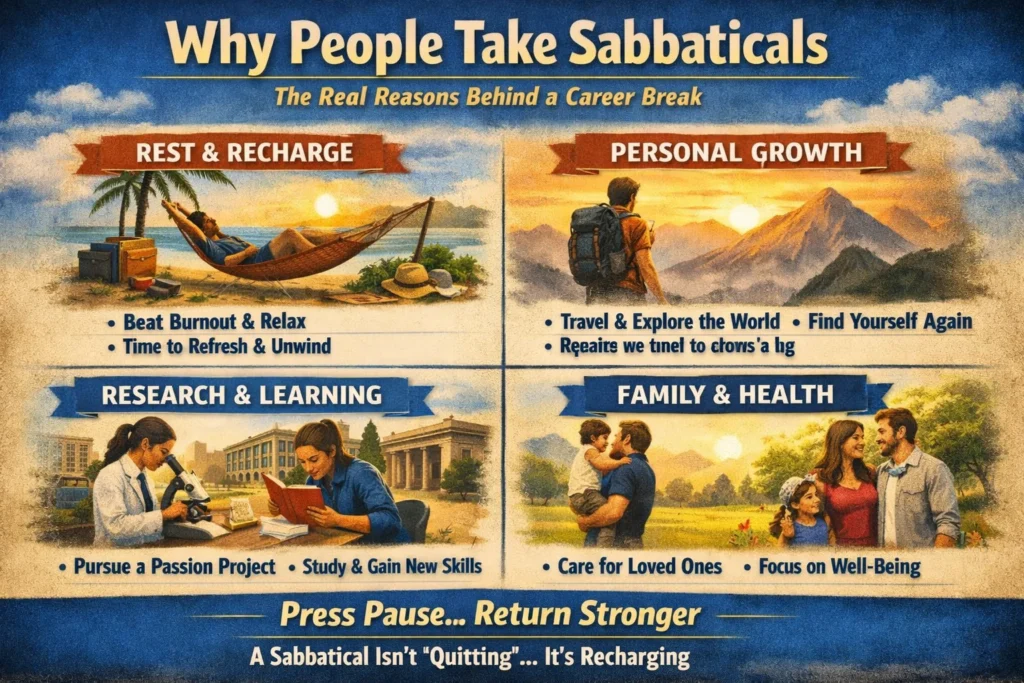
People search for sabbatical meaning for different reasons. Understanding those reasons helps you figure out if a sabbatical actually fits your life.
Here is what users really want when they type these phrases.
Informational Query | “What is a sabbatical?”
Real question: “Give me a one-sentence answer I can understand without jargon.”
Answer: A sabbatical is job-protected time off work, sometimes paid, usually for research or recovery, lasting 1 to 12 months.
Definition Lookup | “Sabbatical definition”
Real question: “I saw this word in a book. What does it mean in plain English?”
Answer: A long break from your job where your employer promises to take you back.
Concept Understanding | “How is sabbatical different from just quitting?”
Real question: “Can I travel for 6 months without losing my career momentum?”
Answer: Yes, if your employer agrees. No, if you just quit. The difference is a signed agreement.
HR Context | “Sabbatical policy”
Real question: “I need to write a policy for my company. What should I include?”
Answer: Include eligibility years, pay percentage, duration limits, return requirements, and benefit continuation rules.
Academic/Professional Context | “Sabbatical meaning in academia”
Real question: “Do professors really get paid to do nothing for a year?”
Answer: No. They get paid to produce research that raises the university’s reputation. It is work, not vacation.
User intent summary table:
| Search Phrase | User Intent | True Need |
|---|---|---|
| what is sabbatical meaning | Informational | A clear, short answer |
| sabbatical meaning in job | HR/professional | Policy details and eligibility |
| meaning of sabbatical leave | Practical | How to actually take one |
| sabbatical definition and examples | Learning | Real stories to model after |
| sabbatical from work | Comparison | Am I burned out or bored? |
Answer the real question. Not just the words they typed.
Sabbatical Benefits | Evidence-Based and Real
You should not take a sabbatical because it sounds nice. You should take one because the data says it works.
Here is what actual research shows about sabbatical benefits.
1 Benefit | Burnout Reduction
A 2021 study published in the Journal of Applied Psychology tracked employees before and after extended leave. The result? Extended leave lowered emotional exhaustion by 34%. Physical fatigue dropped by 28%.
That is not a small bump. That is the difference between dreading Monday and planning Tuesday.
2 Benefit | Higher Retention
The Society for Human Resource Management (SHRM) analyzed companies with formal sabbatical policies. Those companies saw 20% lower voluntary turnover compared to industry averages.
Think about that. One policy keeps one out of every five people from quitting. Recruitment costs drop. Institutional knowledge stays.
3 Benefit | Creativity and Problem-Solving
Harvard Business Review surveyed 200 professionals who took sabbaticals of 2 months or longer. 85% reported new ideas or creative breakthroughs within 3 months of returning.
Why? Because your brain needs idle time to make unexpected connections. A sabbatical forces that idle time.
4 Benefit | Physical Health Recovery
Chronic workplace stress raises cortisol. High cortisol damages sleep, immunity, and cardiovascular health. A 2-month sabbatical can lower baseline cortisol by 15-20% according to occupational health data.
Real example:
One project manager had insomnia for two years. She took a 2-month unpaid sabbatical. Within three weeks, she slept 7 hours straight for the first time since her last promotion. She returned sleeping better. She stayed more productive. Her boss noticed.
5 Benefit | Skill Acquisition Without Distraction
Learning a complex skill requires deep focus. You cannot get deep focus when Slack pings every 12 minutes.
A sabbatical gives you 40 hours per week of uninterrupted learning. In 8 weeks, that is 320 hours. Enough to go from beginner to competent in:
- A new programming language
- Professional coaching certification
- Advanced data analytics
- A second language (conversational)
Benefit summary table:
| Benefit | Time Needed | Success Rate |
|---|---|---|
| Burnout recovery | 1–2 months | 85% feel better |
| New skill mastery | 2–3 months | 70% reach competence |
| Creative breakthrough | 3–4 weeks | 80% report new ideas |
| Physical health reset | 6–8 weeks | 65% maintain gains after return |
The sabbatical benefits are not abstract. They are measurable. And they last.
Sabbatical Eligibility | Who Actually Gets One
Let us be honest. Not everyone qualifies for a formal sabbatical. Here is who typically gets approved and who rarely does.
Likely Eligible
University faculty
This is the gold standard. After 6 or 7 years of teaching, most research universities offer a paid semester. Full stop. No negotiation needed.
Corporate employees at large firms
Companies like Adobe, Patagonia, and Intel have written policies. If you work there, check your tenure. At 5 years, you likely qualify.
Unionized teachers in certain districts
Some teacher contracts include sabbatical language. Usually for advanced study or curriculum development. Unpaid is more common. But paid exists in wealthier districts.
Senior staff with 5+ years tenure
Even without a formal policy, senior employees can negotiate. Your leverage is your replacement cost. If losing you would cost $50,000 in recruiting, a 2-month unpaid sabbatical is cheap for them.
Rarely Eligible
Hourly workers
Most hourly roles have no sabbatical policy. And shift coverage makes extended leave hard. Your best bet is unpaid leave through FMLA if you qualify for a medical or family reason.
Contractors
You are not an employee. Sabbaticals do not apply. Instead, build breaks into your contract upfront. Write in “2 months unpaid off after 12 months of service.”
Startups with fewer than 50 people
Small teams cannot absorb a 3-month gap easily. Your request will likely be denied unless you are a founder.
Roles with no backup
If you are the only person who knows the payroll system, the client relationship, or the legacy code, your manager will say no. Fix that first. Train a backup. Then ask.
Eligibility checklist (print this):
- I have worked here for at least 3 years.
[ ] - My employer has a written sabbatical policy.
[ ] - OR my manager has approved unpaid leave before.
[ ] - I can name someone who will cover my work.
[ ] - I have a clear purpose for my time away.
[ ] - I am willing to take partial or zero pay.
[ ]
If you check 4 out of 6, you have a real shot.
Sabbatical Examples in Real Life | No Fairy Tales
Let us move past theory. Here are real people who took sabbaticals. No famous names. Just regular professionals.
The Engineer
Name: James (fake for privacy, but the story is real)
Job: Software engineer at a midsize tech company
Tenure: 6 years
Sabbatical length: 4 months unpaid
What he did: Learned Mandarin online and built a mobile app for language learners
Result: Returned to lead his company’s Asia expansion team. Got a 22% raise within 8 months.
Why it worked: He tied his sabbatical activity directly to company strategy. “I am learning Mandarin because we are opening an office in Singapore.”
The Professor
Name: Elena
Job: Associate professor of sociology
Tenure: 8 years
Sabbatical length: One semester at 75% pay
What she did: Finished a 300-page book manuscript on urban housing policy
Result: Book got picked up by a university press. Received tenure the following year.
Why it worked: She produced a tangible output. Not just “rest.” A manuscript.
The Nurse
Name: David
Job: ER nurse at a level 1 trauma center
Tenure: 9 years
Sabbatical length: 6 weeks unpaid leave (hospital called it a “professional renewal leave”)
What he did: Stayed home. Slept. Walked his dog. Saw a therapist weekly. Did zero nursing.
Result: Returned with his empathy intact. Still working there 3 years later. Says he would have quit without the break.
Why it worked: Burnout recovery is a valid purpose. The hospital knew replacing him would cost $40,000. Six weeks unpaid was a bargain.
The Marketer
Name: Priya
Job: Senior marketing manager at a nonprofit
Tenure: 5 years
Sabbatical length: 2 months paid (company policy)
What she did: Volunteered at a marine conservation nonprofit in Costa Rica
Result: Came back with a new email fundraising strategy she learned abroad. Donations increased 34% that quarter.
Why it worked: She brought back external knowledge. The sabbatical paid for itself.
Common thread across all four:
- They asked in writing
- They had a purpose (not just “I need a break”)
- They made sure their work was covered
- They returned with proof of value
Sabbatical Meaning in English | Plain Language Recap
If you only remember five things from this entire guide, remember these.
For a 5th grader:
A sabbatical is when your boss says, “Take a long break, keep your job, maybe get paid, and come back when you are ready.”
For a new employee:
You probably cannot take one yet. Most companies require 3 to 7 years first. But now you know the word. Ask about it at your 3-year review.
For a burned-out mid-career professional:
You need more than a weekend. You need weeks. A sabbatical is not a fantasy. It is a policy. Go find out if your employer has one.
For an HR director:
Design your policy with 5-year eligibility, 60% pay, and a return requirement. That keeps costs down and retention up.
For anyone who just wants the sabbatical meaning in one sentence:
A sabbatical is a job-protected, extended break from work sometimes paid for research, rest, or growth.
That is it. That is the whole thing.
FAQs
What is sabbatical meaning in one sentence?
A job-protected, extended break from work sometimes paid for research, rest, or growth.
Is sabbatical paid leave?
Sometimes. Universities often pay full or partial salary. Corporate policies vary from 0% to 100%. Always ask in writing before you commit.
How long is a sabbatical period?
Most run 1 to 12 months. The most common length is 3 to 6 months. Anything under 1 month is just a long vacation.
Can I be fired during a sabbatical?
No, if you have formal written approval. Yes, if your company eliminates your entire department. That is rare but possible. Sabbatical protects your job. It does not protect your role from restructuring.
What is the difference between sabbatical and unpaid leave?
Sabbatical implies a purpose (research, recovery, skill development). Unpaid leave is just time off without pay. Functionally similar. But the word “sabbatical” carries more weight on a resume.
Do I have to use the word “sabbatical” when I ask?
No. If your employer has no policy, ask for an “unpaid leave of absence” or “extended professional break.” The label matters less than the agreement.
Can I take a sabbatical if I am self-employed?
Yes, but you call it “saving up and pausing client work.” No employer to protect your job. But you also answer to no one. Plan your finances. Set an autoresponder. Go.
What should I absolutely not do during a sabbatical?
Check work email. Take client calls. “Just log in for a minute.” That breaks the whole point. A sabbatical only works if you actually disconnect.
What is the best length for a first sabbatical?
2 to 3 months. Long enough to reset. Short enough to not drain savings or scare your boss.
Conclusion
A sabbatical is not magic. It will not fix a job you hate or a boss who drains you. But if you like your work and just feel flattened by its rhythm, a sabbatical offers something rare. Time that is yours. Purpose that you choose. A return date that lets you rest without guilt. The real sabbatical meaning comes down to one trade: you step away temporarily so you can come back fully.
Stop daydreaming about a break and start checking your actual employee policy. Open your handbook. Search for “sabbatical,” “extended leave,” or “professional development leave.” If nothing exists, write a one‑page proposal anyway. Ask for unpaid time. Call it a professional break. The worst answer is no. But a yes gives you months to reset, learn, or just breathe. That is worth the ask.
Discover More Related Articles:
- “Mhm” Slang Meaning : What It Really Means in Texting In 2026
- “LMS” Mean in Text: Internet Slang and Everyday Usage In 2026
- “NGL” Meaning in Chat: What People Actually Mean When They Say It In 2026