
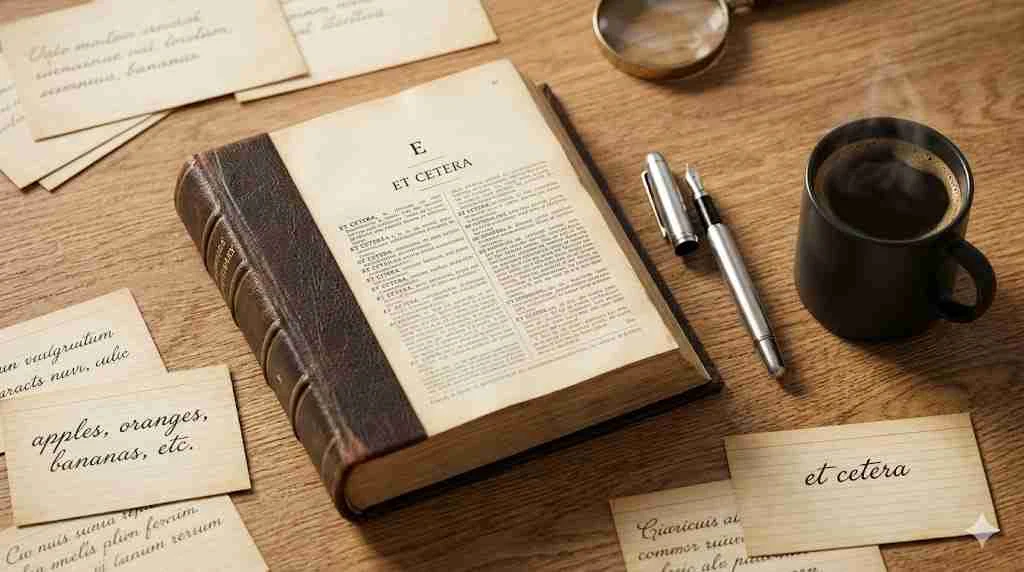

Etc. is the abbreviation for the Latin phrase et cetera, which translates to “and other things” or “and the rest.” You use it at the end of a list to signal that there are more similar items you haven’t mentioned, without spelling every single one out.
You have typed it thousands of times. Maybe you threw it at the end of a grocery list. Perhaps you used it in a work email to save space. But have you ever stopped mid-sentence and wondered if you were actually using it correctly?
That tiny little abbreviation carries a surprising amount of baggage. People argue about its punctuation. They debate it belongs in formal writing. And plenty of folks mix it up with other Latin abbreviations that look similar but mean completely different things.
Here is the truth. Most people use “etc.” incorrectly without even realizing it. And the mistakes are subtle enough that nobody bothers to correct you.
This guide changes that. We will break down everything you need to know about the etc meaning, its proper usage, the punctuation rules that trip everyone up, and the common pitfalls you should avoid. By the time you finish reading, you will never misuse etc. again.
Let us start with the most basic question.
What Is the Etc Meaning?
The etc meaning is simple. Etc. stands for the Latin phrase et cetera. This phrase translates to “and other things” or “and the rest.” When you use etc. in a sentence, you are telling your reader that the list you just started continues beyond what you actually wrote down.
Think of it as a shortcut. Instead of listing every single item in a category, you give a few examples and then drop in etc. to signal that more similar items exist. It saves time. It saves space. And it keeps your writing from becoming tedious.
The pronunciation trips some people up. You say it as “et SET-er-uh.” Not “ek SET-er-uh.” That hard “k” sound is a common mispronunciation, but it is incorrect. The Latin pronunciation uses a soft “c” because it precedes an “e.”
Here is the full breakdown of the etc meaning in plain English:
| Component | Meaning |
|---|---|
| Et | And |
| Cetera | The rest or other things |
| Et cetera | And the rest or and other things |
| Etc. | The abbreviated form |
The etc meaning in English has remained consistent for centuries. It does not change based on context. You use it in a text message or a business report, it always signals the same thing. You have more items in that category, but you are choosing not to list them all.
The Latin Roots and Full Form
Understanding the etc meaning requires a quick trip back to ancient Rome. The Latin language gave us this handy abbreviation, and its components tell the whole story.
Et means “and.” You see this word in other common phrases too. “Et tu, Brute?” means “And you, Brutus?” So that part is straightforward.
Cetera means “the rest” or “other things.” Put them together and you get “and the rest” or “and other things.”
The full form is et cetera. Some people write it as one word “etcetera” and that is acceptable in modern English. However, the abbreviation always stays as “etc.” with the period.
This Latin origin explains why the etc meaning feels slightly formal. It comes from a scholarly language. But over time, it has become so common that we use it in everyday conversation without thinking twice.
Here is a fun fact. The phrase “et cetera” appears in written English as far back as the 15th century. Writers have been using this abbreviation for over 500 years. It survived the transition from handwritten manuscripts to printed books to digital text. That staying power tells you something about its usefulness.
Etc vs Other Latin Abbreviations
People frequently confuse the etc meaning with other Latin abbreviations. This confusion leads to embarrassing mistakes. Let me clear it up for good.
Et al. stands for et alii, which means “and other people.” You use this when citing multiple authors in academic writing. For example, “Smith et al. (2020) conducted the study.” Never use etc. for people. That is a major grammatical error.
E.g. comes from exempli gratia, meaning “for example.” You use e.g. to introduce specific examples. It signals that you are about to give a sample, not an exhaustive list. Many people confuse this with etc. meaning, but they serve different purposes.
I.e. stands for id est, which translates to “that is” or “in other words.” You use i.e. to clarify or rephrase something you just said. It provides a more precise definition.
Here is a comparison table to keep them straight:
| Abbreviation | Latin Full Form | Meaning | When to Use |
|---|---|---|---|
| etc. | et cetera | and other things | unfinished lists of things |
| et al. | et alii | and other people | citing multiple authors |
| e.g. | exempli gratia | for example | introducing examples |
| i.e. | id est | that is | clarifying or rephrasing |
The etc meaning specifically relates to things. Not people. Not examples. And not clarifications. Just the rest of the items in a list.
How to Use Etc Correctly
Understanding the etc meaning is only half the battle. You also need to know how to use it correctly in sentences. The rules are not complicated, but they are strict. Break them and your writing looks sloppy.
Rule One: Use Etc for Things, Not People
This is the most common mistake I see. People use etc. to refer to groups of people all the time. That is grammatically incorrect.
Wrong: “The conference was attended by CEOs, managers, interns, etc.”
Right: “The conference was attended by CEOs, managers, interns, and others.”
When you talk about people, use phrases like “and others” or “among others.” If you must use a Latin abbreviation, use et al. But honestly, plain English works better.
The etc meaning restricts itself to objects, concepts, actions, or categories. If your list includes human beings, skip the abbreviation entirely.
Rule Two: Make the List Clear
You cannot just throw etc. at the end of any random list. The omitted items must be obvious to your reader. They need to understand what category you are referencing.
Good: “Please purchase paper, ink, toner, etc.”
The reader knows you mean other office supplies.
Bad: “Please purchase paper, ink, toner, coffee, etc.”
Coffee does not belong in that category. The reader has no idea what else you want.
Before using etc., ask yourself this question. Can my reader easily guess the missing items? If the answer is no, expand your list or choose a different phrase.
Rule Three: Never Use “And Etc”
This mistake happens because people think “etc.” already includes the word “and.” But adding “and” before etc. creates redundancy. You are essentially saying “and and other things.”
Wrong: “Bring your laptop, charger, mouse, and etc.”
Right: “Bring your laptop, charger, mouse, etc.”
Drop the “and.” The etc meaning already covers it.
Rule Four: Place Etc at the End
This rule seems obvious, but people still mess it up. Always place etc. after you have listed at least one item. You should never start a list with etc.
Wrong: “The toolkit includes etc. hammers and screwdrivers.”
Right: “The toolkit includes hammers, screwdrivers, wrenches, etc.”
The etc meaning implies continuation. That means you must establish the pattern first.
Rule Five: Keep It Relevant
Every item you list before etc. should belong to the same general category. The etc meaning covers the rest of that category, so mixing unrelated items confuses your reader.
Good: “We sell furniture, appliances, electronics, etc.” (All household goods.)
Bad: “We sell furniture, appliances, electronics, bananas, etc.” (Bananas do not belong.)
Your reader should be able to fill in the blank. If they cannot, you have failed to communicate effectively.
Punctuation Rules for Etc
Punctuation around etc. confuses people more than almost any other grammar topic. Let me break it down so you never second-guess yourself again.
The Period Question
In American English, always put a period after “etc.” This is non-negotiable. The period signals that “etc.” is an abbreviation, not a full word.
Correct: “I need tape, glue, scissors, etc.”
Incorrect: “I need tape, glue, scissors, etc”
British English sometimes drops the period, but US style is clear. Use the period every single time.
What Happens at the End of a Sentence?
If etc. lands at the end of a sentence, you do not add a second period. One period does double duty.
Correct: “I brought paper, folders, staples, etc.”
Incorrect: “I brought paper, folders, staples, etc..”
That extra period is a common typo. Avoid it.
Question Marks and Exclamation Points
When etc. appears before a question mark or exclamation point, keep the period first and then add your punctuation.
Correct: “Did you remember to bring pens, pencils, markers, etc.?”
Correct: “Bring your swimsuit, towel, sunscreen, etc.!”
The period stays. The question mark or exclamation point comes right after.
Comma Before Etc
This is where things get slightly controversial. Most style guides recommend using a comma before etc. in a list. The comma separates the last listed item from the abbreviation.
Correct: “Bring apples, oranges, bananas, etc.”
Correct (Oxford comma style): “Bring apples, oranges, bananas, etc.”
The comma before etc. is standard practice. However, if you use the serial comma, some writers find it awkward to place a comma before etc. in a series. The safest approach is to include the comma. It almost never looks wrong.
Here is the rule of thumb. If the list has three or more items, use a comma before etc. If the list has only two items, the comma is optional but still acceptable.
Comma After Etc
If your sentence continues after etc., you need a comma after the period.
Example: “Bring pens, pencils, markers, etc., and we will start the project.”
The period inside etc. stays, and you add a comma to separate it from the rest of the sentence. This can look strange, but it is grammatically correct.
Capitalization
Never capitalize etc. unless it starts a sentence. But you should avoid starting a sentence with etc. anyway. It feels awkward and reads poorly.
Wrong: “Etc. was used incorrectly.”
Better: “The writer used etc. incorrectly.”
Keep the abbreviation lowercase at all times.
Where Etc Works Best
Context matters when you use etc. The etc meaning never changes, but its appropriateness shifts depending on where and how you write.
Formal Writing
Academic papers, business reports, and professional documents generally frown on etc. The abbreviation feels vague and imprecise. In formal contexts, readers expect exactness. They want complete lists or clear categories.
If you must use etc. in formal writing, limit it to parenthetical remarks or footnotes. Never use it in your main arguments or conclusions.
Some style guides outright ban etc. in academic work. The APA and MLA guides allow it sparingly but suggest alternative phrasing. Your best bet is to avoid it entirely in scholarly writing.
Informal Writing
Emails, blog posts, text messages, and social media all welcome etc. with open arms. The abbreviation sounds natural and conversational in these settings. It mimics how we actually talk.
Consider this example from a work email:
“Let me know if you need anything else files, documents, reports, etc.”
That reads perfectly fine. It is professional without being stuffy. The etc meaning works in casual office communication.
Technical and Legal Documents
Avoid etc. like the plague in these fields. Technical writing demands precision. Legal writing requires specificity. Using etc. introduces ambiguity, and ambiguity can cause major problems.
A contract that says “equipment, supplies, materials, etc.” leaves too much open to interpretation. What else counts? Who decides? This vagueness creates disputes.
In technical documentation, etc. can also cause confusion. A procedure that says “connect the cables, wires, etc.” is not clear enough. The reader might skip something important.
Lists with Clear Categories
The etc meaning shines when your list items obviously belong together. If the category is self-evident, etc. works beautifully.
Examples:
- “The pantry contains rice, flour, sugar, etc.” (Baking supplies)
- “She enjoys running, swimming, cycling, etc.” (Cardio exercises)
- “The event includes food, music, dancing, etc.” (Celebration activities)
These lists make sense. The reader can infer the missing items without straining.
Alternatives to Etc
Sometimes etc. is not the right choice. Maybe you want to avoid it in formal writing. Perhaps you need more clarity. Or you just want to vary your sentence structure.
Here are strong alternatives to the etc meaning, along with guidance on when to use each.
And So On
This is the most direct replacement. It carries the same casual tone as etc. and works in most informal contexts.
Example: “The store sells chairs, tables, lamps, and so on.”
Use this in everyday writing and conversation. It sounds natural and does not carry the Latin baggage.
And the Like
This phrase works well when you are referencing similar items. It emphasizes the category more than the individual examples.
Example: “The museum displays paintings, sculptures, photographs, and the like.”
Use this in moderately formal writing. It adds a touch of sophistication without being pretentious.
Among Others
This alternative is excellent for lists that include people or abstract concepts. It also sounds more professional than etc.
Example: “The committee includes educators, parents, administrators, among others.”
Use this in business writing, reports, and professional correspondence.
Including But Not Limited To
This phrase is the heavyweight champion of clarity. It explicitly tells the reader that your list is incomplete while leaving no room for confusion.
Example: “The policy covers laptops, tablets, smartphones, including but not limited to these devices.”
Use this in legal documents, contracts, and formal policies. It protects you against claims that you omitted something.
And More
This is the modern, casual alternative. It feels fresh and conversational without sounding lazy.
Example: “Our services include design, development, marketing, and more.”
Use this in web content, marketing materials, and promotional writing. It is short and punchy.
Here is a quick reference table for choosing the right alternative:
| Alternative | Tone | Best Used For |
|---|---|---|
| and so on | neutral | everyday lists |
| and the like | slightly formal | categories of things |
| among others | professional | people and options |
| including but not limited to | very formal | legal and official docs |
| and more | informal, modern | marketing and web copy |
Common Mistakes and How to Avoid Them
Even experienced writers make errors with etc. Let me walk you through the most frequent blunders so you can sidestep them.
Mistake One: Using Etc for People
This mistake happens constantly. People treat etc. as a catch-all for any list, including human beings. That usage is incorrect.
Wrong: “The team includes John, Mary, Sarah, etc.”
Right: “The team includes John, Mary, Sarah, and others.”
When you mention people, use “and others” or “among others.” The etc meaning applies to things, not individuals.
Mistake Two: Adding “And” Before Etc
You would be surprised how many writers add “and” before etc. This is redundant and grammatically incorrect.
Wrong: “Bring your wallet, phone, keys, and etc.”
Right: “Bring your wallet, phone, keys, etc.”
The “et” in “et cetera” already means “and.” Adding another “and” creates a double meaning.
Mistake Three: Using Etc With Specific Numbers
This error is subtle but important. When your list includes exact numbers, etc. loses its purpose. The reader expects precision.
Wrong: “The costs are $100, $200, $300, etc.”
**Right:** “The costs are $100, $200, and more.”
Numbers imply that you know the exact values. If you do not know them, do not use numbers. “Etc.” works with words, not figures.
Mistake Four: Overusing Etc
Using etc. multiple times in one paragraph signals laziness. It suggests you cannot be bothered to complete your thoughts.
Wrong: “We offer printing, copying, faxing, etc. Our services include design, editing, proofreading, etc.”
Better: “We offer printing, copying, faxing, and related services. Our design, editing, and proofreading options cover your document needs.”
Vary your sentence structure instead of relying on etc. as a crutch.
Mistake Five: Forgetting the Period
In American English, the period after etc. is mandatory. Omitting it is a clear error.
Wrong: “I need supplies like paper, ink, etc”
Right: “I need supplies like paper, ink, etc.”
That tiny dot matters. It signals that “etc.” is an abbreviation, not a full word.
Mistake Six: Using Etc After “For Example”
Combining “for example” with etc. creates redundancy. The two phrases serve the same purpose.
Wrong: “We support many activities, for example, running, swimming, biking, etc.”
Right: “We support many activities, such as running, swimming, and biking.”
Just give two or three examples and stop. Your reader will understand the pattern.
Mistake Seven: Using Etc With Incomplete Lists
If your list does not establish a clear pattern, etc. confuses rather than clarifies.
Wrong: “The museum has paintings, sculptures, etc.” (Too vague. What else? Drawings? Photographs? Jewelry?)
Better: “The museum has paintings, sculptures, drawings, etc.” (Now the category is visual art.)
Your reader should be able to fill in the blanks. If they cannot, rewrite your sentence.
Real-World Examples of Etc in Context
Seeing the etc meaning in action helps solidify the rules. Here are examples from different contexts so you can see how the abbreviation fits naturally into real writing.
Email Examples
Professional Email:
“Please review the attached contracts, agreements, addendums, etc. and let me know if you have any questions.”
Casual Email:
“For the party, I will handle decorations, food, music, etc. You just show up.”
Workplace Email:
“The conference room has a projector, whiteboard, speakers, etc. You should have everything you need.”
Text Message Examples
Short Text:
“Grocery list: milk, bread, eggs, etc.”
Planning Text:
“Pack your swimsuit, sunscreen, towel, etc. The weather looks great.”
Social Text:
“The concert was amazing. We heard all the classics, deep cuts, etc.”
Academic Writing Examples
Acceptable Use:
“The survey collected demographic data (age, income, education level, etc.) from participants.”
Better Alternative:
“The survey collected demographic data, including age, income, and education level.”
Formal Academic Use:
“The study examined psychological traits such as resilience, adaptability, and problem-solving skills, etc.”
Blog and Web Content Examples
Blog Post:
“You will need a laptop, a reliable internet connection, a comfortable chair, etc. to work from home effectively.”
Product Description:
“Our software includes project management, time tracking, invoicing, etc.”
Landing Page:
“Learn marketing, sales, negotiation, etc. from industry experts.”
Social Media Examples
Instagram Post:
“Beach day essentials: sunscreen, towel, snacks, etc. Ready to go!”
LinkedIn Post:
“Excited to share my new role in strategy, operations, development, etc.”
Facebook Post:
“Decluttered my closet and donated clothes, shoes, bags, etc. Feels great.”
Punctuation Cheat Sheet
Keep this quick reference handy whenever you write with etc.
| Rule | Correct Example | Incorrect Example |
|---|---|---|
| Always use a period | pens, pencils, etc. | pens, pencils, etc |
| No double period at sentence end | Bring supplies, etc. | Bring supplies, etc.. |
| Comma before etc. | pens, pencils, markers, etc. | pens, pencils, markers etc. |
| Comma after etc. if sentence continues | pens, pencils, etc., and we will start | pens, pencils, etc. and we will start |
| Never use “and etc.” | pens, pencils, etc. | pens, pencils, and etc. |
| No capitalization | etc. | Etc. |
| Question mark after period | Did you bring pens, etc.? | Did you bring pens, etc? |
Synonyms and Alternatives Summary
When etc. does not feel right, try one of these alternatives.
For casual writing:
- And so on
- And more
- And the rest
Or for professional writing:
- Among others
- Including but not limited to
- And the like
For formal writing:
- And additional items
- And other related materials
- (List all items explicitly)
And for people:
- And others
- Among others
- Along with their colleagues
FAQs
Is it “etc” or “etc.”?
In American English, it is always “etc.” with a period. The period signals that this is an abbreviation of “et cetera.” British English sometimes drops the period, but US style requires it.
Can I use “etc.” in an essay?
Yes, but sparingly. Limit etc. to parenthetical remarks or informal sections of your essay. Avoid it in formal thesis statements, conclusions, or dense academic arguments.
What is the difference between “etc.” and “and so on”?
They mean essentially the same thing. “And so on” is the English equivalent of et cetera. “Etc.” is more compact and common in writing. Both signal that a list continues.
Is “etcetera” one word?
Yes, “etcetera” is an accepted spelling of “et cetera.” However, the abbreviation is always “etc.” with a period. The one-word version appears primarily in casual writing.
Does “etc.” need a comma after it?
Only if your sentence continues. Example: “Bring paper, pens, etc., and we will start.” The comma after etc. separates it from the rest of the sentence.
Can I start a sentence with “etc.”?
Technically yes, but you should avoid it. Starting with etc. feels awkward and unnatural. Restructure your sentence to place the abbreviation later.
What does “etc.” mean in texting?
The etc meaning remains the same in texting. It signals that a list has more items than you typed. Texters use it to save time and characters.
Is “etc.” formal or informal?
It leans informal. While you can use it in some professional contexts, it generally belongs in casual writing. Formal documents should use more precise alternatives.
What is the full form of “etc.”?
The full form is “et cetera,” a Latin phrase meaning “and other things.” Some people write it as one word “etcetera.”
How do you pronounce “etc.”?
You pronounce it as “et SET-er-uh.” The “c” is soft because it comes before an “e.” Avoid the common mispronunciation “ek SET-er-uh.”
Conclusion
The etc meaning is simple. It tells your reader that a list has more items than you have written. But simplicity does not mean you can use it carelessly.
Punctuation matters. Context matters. Clarity matters above all else.
Here is my final advice. Before you type etc., ask yourself one question. Does this abbreviation make my writing clearer or lazier? If you can honestly answer that it adds value, go ahead and use it. If you are just saving time without helping your reader, choose a better alternative.
Your writing improves when you think about your audience. Every choice you make shapes how your reader receives your message. Use etc. thoughtfully and your communication stays crisp, clear, and effective.
Master the etc meaning and you master a small but significant piece of written English. That tiny abbreviation has survived for over five centuries. Use it well and it will serve you for years to come.
Discover More Related Articles:
- “MK” Mean in Text: How It’s Used in Everyday Conversations In 2026
- “DW” Meaning in Texting: Everything You Need to Know In 2026
- “GNG” Meaning in Slang: What It Really Means & How to Use It In 2026