
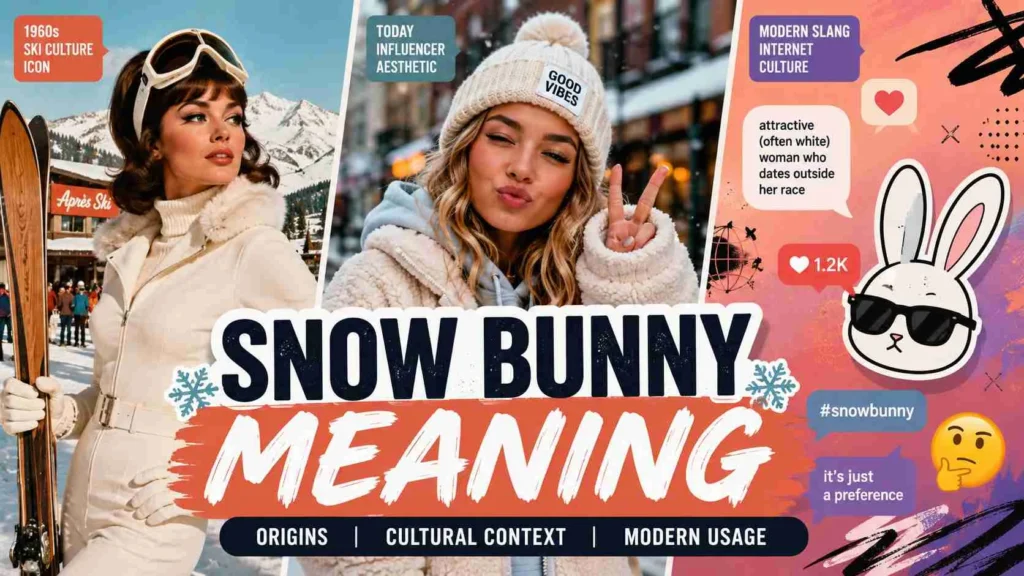

A “snow bunny” is a slang term with multiple meanings: it originally described a fashionable female skier, but it has evolved to also refer to a white woman who dates Black men, a cocaine user, or a winter fashion aesthetic.
You’re scrolling through Instagram and see a photo of someone wearing an oversized puffer jacket and designer snow boots. The caption reads “snow bunny vibes.” Then you open TikTok and hear a rapper use the exact same phrase to describe a completely different situation.
Confusion sets in. What does this term actually mean?
The snow bunny meaning has transformed so dramatically over the past seventy years that it now carries multiple distinct interpretations. Some are harmless. Others are loaded with cultural baggage. Understanding the snow bunny definition requires unpacking its history, its evolution through pop culture, and its current usage across different communities.
This comprehensive guide leaves no stone unturned. We’ll explore every variation of the snow bunny slang meaning, from its wholesome origins on ski slopes to its controversial place in modern hip-hop lyrics. By the end, you’ll know exactly what someone means when they drop this term in conversation, text, or social media post.
The term has become a linguistic chameleon. It can describe a fashion choice, a dating preference, a drug habit, or a lifestyle. The snow bunny term meaning shifts based on who says it, where they say it, and why they say it. This guide will teach you how to read those contextual cues like a pro.
Let’s dive into the fascinating, complicated, and sometimes confusing world of the snow bunny.
The Original Snow Bunny Definition | Ski Culture’s Golden Girl
Where It All Began
The snow bunny origin story starts in the 1950s. America was experiencing a post-war economic boom. The middle class suddenly had disposable income. They wanted to spend it on leisure activities. Skiing became the ultimate status symbol.
Picture this. Fresh powder covers the mountains. Wealthy families pile into station wagons and head for resorts like Aspen and Vail. The ski lodge becomes a social hub. And at the center of this glamorous scene sits the snow bunny.
The snow bunny definition in English originally described a novice female skier. The name came directly from the “bunny slope” or beginner hill at ski resorts. A snow bunny was someone learning the ropes. But the term quickly evolved beyond its literal meaning.
The Bunny Connection
Why “bunny” specifically? The word has a long history as slang for an attractive woman. It dates back to the 1700s. Playboy famously used it in the 1960s with their Playboy Bunnies. So combining “snow” with “bunny” created an image of a beautiful woman in a winter wonderland.
The snow bunny girl meaning in this era was fairly straightforward. She was fashionable, social, and present at ski resorts. Her skiing ability was almost secondary. What mattered was her presence. She contributed to the glamorous atmosphere that made skiing so appealing to the elite.
The Hollywood Effect
Hollywood cemented the snow bunny stereotype. Movies like Ski Party (1965) featured characters that fit this mold perfectly. The snow bunny was a stock character. She wore stylish ski outfits. She laughed at the lodge. And she was often more interested in romance than in slaloms.
This cinematic portrayal spread the snow bunny phrase meaning far beyond actual ski resorts. People who had never touched a ski could recognize the type. The snow bunny became a cultural shorthand for a specific kind of winter socialite.
The Ski Bunny vs Snow Bunny Distinction
Many people confuse “snow bunny” with “ski bunny.” The ski bunny meaning overlaps but isn’t identical. Both refer to attractive women associated with winter sports. However, “ski bunny” specifically emphasizes the skiing aspect. A ski bunny is someone who actually skis, or at least pretends to.
The snow bunny vs ski bunny distinction has blurred over time. Many use them interchangeably now. But historically, “snow bunny” had a broader scope. It could include anyone who enjoyed winter activities. “Ski bunny” was more narrowly focused on the sport itself.
The Gender Dynamic
Let’s be honest about something. The term has always carried sexist undertones. Men who ski are just skiers. Women who ski risk being labeled snow bunnies. The term reduces them to their appearance and social value rather than their athletic ability.
A male skier doesn’t have a similar label. There is no “snow stud” or “bunny boy” equivalent. This double standard reveals something important about the snow bunny stereotype. It’s a term created by and for a male gaze. The snow bunny exists to be looked at, not necessarily to be taken seriously.
Examples in Original Context
Here are some examples of how people used the term in its original context:
“She spent more time at the lodge bar than on the slopes. Total snow bunny.”
“The resort was full of snow bunnies in their expensive ski suits.”
“He wanted a girlfriend who skied, but he kept dating snow bunnies who just wanted photos.”
These examples show the snow bunny explained as someone more interested in the scene than the sport itself. The term wasn’t necessarily an insult. It was more of a description. But it carried an implication of superficiality.
The Evolution Begins
By the 1990s, the term started shifting. The history of the term snow bunny entered a new chapter. Ski culture became less elite. More people could afford winter vacations. The glamour faded somewhat. And the term began to migrate into other contexts.
This migration set the stage for the term’s most dramatic transformation. The snow bunny would soon leave the ski slopes behind entirely. Its new home would be far more controversial.
The Modern Slang Meaning| Race, Dating and Hip-Hop Culture
A Major Transformation
The snow bunny meaning in slang underwent a seismic shift in the late 1990s and early 2000s. It moved from ski resorts to the streets. The trigger for this change was hip-hop culture.
In this new context, “snow” became a reference to whiteness. The term began appearing in rap lyrics and urban slang. It now described white women, particularly those who date or show interest in Black men.
The snow bunny person meaning transformed completely. It was no longer about winter sports at all. The racial element became dominant. This shift created a term loaded with cultural significance and potential for controversy.
Hip-Hop’s Role in Popularization
Several prominent rappers helped cement the snow bunny slang term in popular consciousness. Artists like Gucci Mane, Lil Wayne, and Kodak Black used it in their lyrics. Their influence spread the term far beyond their immediate communities.
Consider these examples from hip-hop culture:
| Artist | Context of “Snow Bunny” Use |
|---|---|
| Gucci Mane | Used in multiple tracks to describe white women |
| Lil Wayne | Referenced the term in popular mixtapes |
| Kodak Black | Frequently uses the term in lyrics about dating |
| Future | Incorporated it in songs about lifestyle |
| 21 Savage | Referenced the dynamic in various tracks |
The snow bunny meaning in dating became tightly linked to interracial relationships. Specifically, it described white women who prefer Black partners. This usage carried both descriptive and prescriptive elements.
The Stereotype Deepens
The snow bunny characteristics in this context became more defined. The stereotype often includes specific physical features. Blonde hair is frequently mentioned. So is a certain style of dress or makeup.
The snow bunny personality meaning also evolved. The stereotype sometimes includes behavioral elements. The snow bunny might be portrayed as assertive in pursuing relationships. Or she might be depicted as having a particular taste in music or culture.
These stereotypes are obviously problematic. They reduce complex individuals to caricatures. The snow bunny stereotype doesn’t account for individual variation. It imposes rigid expectations on people based on race and gender.
The Mind Control Meme Phenomenon
In 2024, a viral meme called “Snowbunny Mind Control” exploded across X (formerly Twitter) and other platforms. The joke took the stereotype to a new level. It suggested that white women (“snow bunnies”) possess an almost supernatural ability to attract and influence Black men.
The meme usually features a photo of an attractive white woman and a Black man. The caption implies the woman has him under her spell. The humor comes from exaggerating this dynamic to absurd degrees.
This meme shows the snow bunny meaning on social media at its most complex. Some find it humorous. Others find it offensive. It plays on stereotypes while also critiquing them. The ambiguity is part of its power.
The TikTok and Instagram Factor
The snow bunny TikTok meaning overlaps with but differs from the hip-hop usage. On TikTok, the term appears in multiple contexts. Some use it to describe winter fashion. Others use it as a dating label. Still others create content exploring the stereotype itself.
The snow bunny Instagram meaning follows similar patterns. Instagram’s visual focus makes it ideal for showcasing the fashion aspect. But the term appears in captions and comments across various contexts.
Social media has accelerated the term’s evolution. New meanings can emerge overnight. Old meanings can resurface unexpectedly. The snow bunny meaning online is constantly in flux.
Is Snow Bunny a Compliment?
The question of the snow bunny is a compliment has no simple answer. It depends entirely on context.
In some situations, it functions as praise. A white woman called a snow bunny might see it as affirmation of her attractiveness or dating success. The term acknowledges her appeal within a specific social context.
In other situations, it functions as an insult. It can imply superficiality. It can reduce her to just her race and dating preferences. And it can be used dismissively or mockingly.
The is snow bunny offensive debate continues. Many Black women have expressed discomfort with the term. They feel it centers white women’s experiences at the expense of their own. The term’s focus on white women dating Black men can feel exclusionary.
A Table of Perspectives
| Perspective | View on “Snow Bunny” |
|---|---|
| Some white women | See it as a compliment or label |
| Some Black women | Find it exclusionary or offensive |
| Some Black men | Use it descriptively |
| Critics | View it as reductive stereotyping |
| Linguists | See it as fascinating language evolution |
| Skiers | Still use it in original context |
The Racial Dynamics
The snow bunny culture meaning cannot be separated from race. The term exists within a web of racial dynamics. It reflects and shapes attitudes about interracial relationships.
Some see the term as harmless. They view it as slang that describes a real social phenomenon. Others see it as reductive and potentially harmful. It reduces people to racial categories and dating preferences.
The snow bunny meaning in relationships often involves unspoken assumptions. The term implies certain patterns of attraction and behavior. These assumptions may or may not match reality.
Examples in Modern Context
Here are some examples showing the term’s modern usage:
“He only dates snow bunnies. I’ve never seen him with a Black woman.”
“She’s such a snow bunny. Her playlist is all rap and R&B.”
“The snow bunny stereotype on TikTok is getting out of hand.”
“Is it okay to call someone a snow bunny? I’m genuinely confused about the term.”
These examples demonstrate the snow bunny urban dictionary meaning in practice. The term operates as a form of social shorthand. But its implications vary widely.
The Hidden Meaning| The Cocaine Connection
An Unexpected Twist
The snow bunny meaning in text has yet another layer. In some circles, the term refers to cocaine use. This interpretation adds a darker dimension to the already complex term.
“Snow” has been slang for cocaine for decades. The connection is obvious. White powder. Snow. The winter bunny meaning gets a very different interpretation when you understand this usage.
The “bunny” in this context often refers to a female user. A snow bunny person meaning in drug culture is someone, usually a woman, who uses cocaine. The term can be descriptive or derogatory depending on context.
The Cultural Context
This usage emerged primarily in the 1970s and 1980s. Cocaine was heavily associated with disco culture. The term “snow bunny” fit into this landscape. It combined the drug slang with the playful “bunny” suffix.
The snow bunny phrase meaning in this context is unmistakable. Someone described as a snow bunny is likely a cocaine user. The term’s use in this context has declined somewhat. But it still appears, especially in older media.
Recognizing This Usage
You can usually identify this meaning through context. If the discussion involves nightlife or partying, the drug reference is possible. If it’s about dating or fashion, the drug reference is less likely.
Consider this example:
“She spent all night in the bathroom. She’s definitely a snow bunny.”
The implication here is about drug use, not skiing or dating. The bathroom reference is a classic sign. People use bathrooms for cocaine consumption at parties.
This usage demonstrates the snow bunny urban slang complexity. The term can mean wildly different things depending on the setting.
The Fashion Aesthetic| Snow Bunny Style in the Modern Era
The Instagram Effect
Social media transformed the snow bunny aesthetic into a distinct style category. Instagram and TikTok creators have embraced the visual potential of winter fashion. The snow bunny aesthetic combines luxury, coziness, and aspirational lifestyle imagery.
Key elements of the modern snow bunny aesthetic include:
- Oversized puffer jackets in neutral colors
- Designer snow boots from brands like Moncler or Canada Goose
- Chunky knit sweaters and turtlenecks
- Après-ski accessories like beanies and goggles
- Luxury ski wear from high-end brands
- Photogenic winter settings like chalets and snow-covered landscapes
The snow bunny outfit ideas circulating on social media emphasize looking effortlessly stylish in cold weather. The aesthetic is about appearing both warm and fashionable. It’s aspirational but also achievable.
The Powder Magazine Critique
Fashion publication Powder made an interesting observation about this aesthetic. When a woman wears expensive, stylish ski gear, she’s dismissed as a shallow “snow bunny.” But when a man wears the exact same gear, he’s seen as wealthy and successful.
This double standard reveals the gendered nature of the term. The snow bunny style criticism targets women specifically. Men who dress similarly receive admiration, not dismissal.
The Target Controversy
In late 2025, Target faced backlash over a product that illustrates the term’s complexity. The retailer sold sweatshirts featuring the phrase “100% Snow Bunny” printed on them. Shoppers posted about the product on TikTok. A mini-controversy erupted.
The snow bunny meaning in different contexts caused confusion. Some shoppers saw the phrase as an innocuous winter reference. Others found it offensive because of the term’s racial connotations. Target reportedly recalled the product, showing how the term’s ambiguity caused real-world problems.
The Vibe Culture
The snow bunny explained in current youth culture often emphasizes vibes over literal meaning. Someone using the term might not know its history or other connotations. They’re just describing an aesthetic that feels right.
This “vibe” approach to language has become common on social media. Words lose their precise definitions and become mood indicators. The snow bunny aesthetic serves this purpose perfectly. It communicates a specific winter feeling that’s instantly recognizable.
Visual Elements of the Aesthetic
| Element | Description |
|---|---|
| Outerwear | Puffer coats, wool coats, luxury parkas |
| Footwear | Snow boots, Uggs, designer winter shoes |
| Accessories | Beanies, goggles, scarves, face masks |
| Settings | Ski resorts, snowy cities, cozy cabins |
| Activities | Skiing, hot chocolate, fireplace photos |
| Colors | White, cream, black, pastel tones |
The snow bunny fashion meaning has become almost independent of the slang meanings. People can embrace the fashion aesthetic without engaging with the racial or drug connotations.
The Authenticity Question
A persistent question about the snow bunny aesthetic concerns authenticity. Are these people actually skiing? Or are they just posing for photos?
The answer varies. Some snow bunny influencers genuinely love winter sports. Others have never touched a ski. The aesthetic has become detached from its origins.
This detachment reflects broader trends in social media culture. Visual aesthetics often drift away from their sources. The image becomes more important than the reality.
Deconstructing the Stereotypes
The Sexist Undertones
The snow bunny stereotype has always been sexist. It reduces women to their appearance. It assumes they’re more interested in socializing than in athletic achievement.
Consider the following:
- Male skiers are just “skiers.” Female skiers risk being “snow bunnies.”
- Male ski fashion is practical. Female ski fashion is “aesthetic.”
- Men’s ski presence is taken seriously. Women’s ski presence is often dismissed.
This double standard persists. It affects how women are treated at ski resorts. It shapes how female ski influencers are perceived. The term “snow bunny” carries this sexist baggage wherever it goes.
The Racial Dynamics
The term’s racial usage adds another layer of complexity. The snow bunny meaning in dating often reinforces stereotypes about interracial relationships. It suggests that white women who date Black men fit a particular pattern.
These stereotypes can be harmful. They reduce complex relationships to simple categories. They ignore individual agency and preference. And they can create pressure to conform to expectations.
The Offensiveness Question
So, is it offensive? The answer depends on who you ask.
Some Black women find the term offensive. They feel it centers white women’s experiences. The term’s focus on white women dating Black men can feel exclusionary. It can also reinforce the idea that Black men are more desirable to white women than to Black women.
Some white women find it offensive too. They dislike being reduced to a label. They object to the assumption that their dating preferences define them.
Some people find the term neutral or playful. They see it as casual slang without harmful intent. The debate continues.
The Meaning in Different Contexts
The snow bunny meaning in different contexts can be summarized in a table:
| Context | Meaning | Notes |
|---|---|---|
| Ski resorts | Female skier, often novice or fashion-focused | Original meaning, still used |
| Hip-hop culture | White woman who dates Black men | Modern slang meaning |
| Drug culture | Cocaine user, usually female | Less common now |
| Social media fashion | Winter aesthetic with luxury elements | Visual trend |
| General slang | Attractive woman in winter setting | Catch-all usage |
The Gender and Race Intersection
The snow bunny term meaning sits at a fascinating intersection. It involves both gender and race. The term applies to white women specifically. It doesn’t have comparable terms for other groups.
This specificity matters. It means the term carries racial assumptions. It presumes that white women’s behavior regarding interracial dating deserves a special label. This presumption is itself loaded with meaning.
The Stereotype Chart
| Stereotype Component | Description | Problematic Aspect |
|---|---|---|
| Appearance | Blonde, stylish, physically attractive | Reduces person to looks |
| Behavior | Party-oriented, sexually assertive | Assumes motivations |
| Preferences | Prefers Black men | Erases individual variation |
| Knowledge | Minimal skiing skills | Assumes superficiality |
| Status | Often wealthy or aspiring | Class assumptions |
Why Stereotypes Persist
Stereotypes about snow bunnies persist because they serve social functions. They provide shortcuts for understanding complex situations. They offer easy categories for sorting people.
But these shortcuts come at a cost. They prevent us from seeing individuals clearly. They reinforce unfair assumptions. And they limit how people can express themselves.
The snow bunny personality meaning often assumes a particular type. But real people are more complex. They don’t fit neatly into categories.
Context Is Everything| How to Determine the True Meaning
Reading the Room
The snow bunny phrase meaning depends almost entirely on context. You can’t understand what someone means without considering the situation.
Here’s a simple framework for interpreting the term:
- Location: Where did you hear or see it?
- Speaker: Who used the term?
- Tone: How was it said?
- Topic: What were they discussing?
- Audience: Who is meant to understand it?
Each of these factors shapes the term’s meaning. Change one factor and the meaning can shift dramatically.
Location-Based Interpretation
| Location | Likely Meaning |
|---|---|
| Ski resort | Winter sports meaning |
| Hip-hop concert | Racial/dating meaning |
| Party scene | Possible drug reference |
| Fashion Instagram | Aesthetic/style meaning |
| Dating app profile | Usually the dating meaning |
Speaker-Based Interpretation
- Older ski enthusiast: Likely using original meaning
- Young person on TikTok: Could be aesthetic or slang
- Hip-hop artist: Almost certainly racial/dating meaning
- Fashion influencer: Probably aesthetic meaning
Tone-Based Interpretation
- Playful tone: Likely neutral or positive
- Derogatory tone: Could be an insult
- Descriptive tone: Probably neutral labeling
- Humorous tone: Often self-aware usage
The Urban Dictionary Indicator
The snow bunny urban dictionary meaning provides a useful reference point. Urban Dictionary users have defined the term in multiple ways. Reading these definitions gives you a sense of how different communities interpret it.
The most common Urban Dictionary definitions include:
- A female skier, especially a beginner
- A white woman who dates Black men
- A cocaine user
- An attractive woman in winter fashion
The variety of definitions confirms the term’s complexity. No single meaning dominates completely.
If You’re Unsure
The safest approach when encountering the term is to ask for clarification. This might feel awkward but it’s better than misinterpreting.
You can say something like:
“What do you mean by ‘snow bunny’? I’ve heard it used in different ways.”
This approach signals your awareness of the term’s complexity. It invites the speaker to explain their intended meaning. It avoids making assumptions that could be wrong.
The Usage Guide
If you’re considering using the term yourself, ask these questions:
- Do you understand all the potential meanings?
- Are you comfortable with those meanings?
- Is your audience likely to interpret it correctly?
- Could someone reasonably be offended?
The how to use snow bunny in a sentence question has no simple answer. The term is complicated. Using it requires awareness of its complexity.
Example Sentences by Meaning
Original ski meaning:
“My sister is a real snow bunny. She spends every winter weekend at the resort.”
Modern slang meaning:
“He’s dating a snow bunny from the city. They seem really happy together.”
Drug meaning:
“That club is full of snow bunnies. I’d avoid the bathroom.”
Aesthetic meaning:
“She’s going for a snow bunny look with that white puffer and boots.”
Each example is grammatically correct. But each carries different implications. Choosing the right one matters.
The Contextual Decision Matrix
| Factor | Original Meaning | Slang Meaning | Drug Meaning | Aesthetic Meaning |
|---|---|---|---|---|
| Location | Ski resort | Urban area | Club/nightlife | Social media |
| Speaker | Skier | Hip-hop fan | Partier | Fashion lover |
| Tone | Neutral/playful | Descriptive | Warning | Aspirational |
| Topic | Winter sports | Dating | Drugs | Fashion |
The Interpretation Challenge
The snow bunny meaning in chat and texting adds another layer of complexity. Text messages lack tone and context clues. Interpretations become even more uncertain.
When texting, consider adding clarifying information. You can say “snow bunny (as in skiing)” or “snow bunny (as in fashion).” This clarifies your meaning upfront.
The Linguistic Evolution| A Study in Semantic Shift
How Words Change
The snow bunny origin and evolution illustrate how language works. Words change meaning over time. They acquire new connotations. They lose old ones.
This process is called semantic shift. It happens when words move into new contexts. Snow bunny moved from ski culture to hip-hop culture. That move transformed its meaning.
The Factors Driving Change
Several factors drove the snow bunny’s semantic shift:
- Cultural contact: Different communities interacting
- Media influence: Hip-hop spreading the term
- Creative usage: Artists and creators using the term differently
- Social change: Evolving attitudes about race and dating
Each factor contributed to the term’s transformation. No single cause explains everything.
The Ski Bunny vs Snow Bunny Distinction Revisited
The snow bunny vs ski bunny distinction has become more complicated. Some people use them interchangeably. Others see meaningful differences.
Ski bunny remains more tied to skiing. It rarely appears in hip-hop contexts. Snow bunny has broader usage. It appears across multiple contexts.
This distinction reveals how words split and diverge. Related terms can develop different connotations. They can move in separate directions.
The Role of Urban Dictionary
Urban Dictionary has been crucial in documenting the snow bunny urban dictionary meaning. The site allows users to define slang terms. Multiple definitions can coexist. This flexibility captures the term’s complexity.
Urban Dictionary entries show how meaning shifts over time. Early entries focused on skiing. Later entries emphasized racial meanings. Recent entries often discuss the aesthetic.
The Future of the Term
Predicting the snow bunny vocabulary meaning future is impossible. Language evolves unpredictably. New meanings could emerge. Old meanings could disappear.
However, some trends are visible:
- The aesthetic meaning seems likely to persist
- The racial meaning may become more contested
- The drug meaning may fade further
- New meanings could develop
The term’s future depends on how communities use it. Their choices will shape its trajectory.
A Timeline of Evolution
| Period | Dominant Meaning | Key Influences |
|---|---|---|
| 1950s-1960s | Beginner female skier | Ski culture, Hollywood |
| 1970s-1980s | Ski fashion/accent | Drug reference emerges |
| 1990s-2000s | Racial/dating meaning | Hip-hop music |
| 2010s | Multiple meanings coexist | Internet, social media |
| 2020s | Aesthetic meaning emerges | TikTok, Instagram |
The Academic Perspective
Linguists study terms like snow bunny for their insights into language change. The term shows how slang moves between communities. It demonstrates how meaning shifts through context.
The snow bunny term meaning has been discussed in academic contexts. Scholars examine its gender implications. They analyze its racial dimensions. They study its role in popular culture.
The Power of Slang
Slang terms like snow bunny serve important social functions. They:
- Mark group membership
- Signal cultural knowledge
- Create in-group communication
- Express identity
- Navigate complex social dynamics
Understanding slang requires understanding these functions. The term means more than its dictionary definition. It signals belonging and cultural awareness.
The Complexity of a Simple Phrase
The snow bunny meaning is anything but simple. This seemingly straightforward phrase carries multiple interpretations. Its meanings range from harmless ski slang to loaded racial commentary.
Understanding the term requires understanding its history. You need to know its origin on 1950s ski slopes. You need to understand its transformation through hip-hop culture. And you need to recognize its aesthetic usage on social media.
The Importance of Context
Context matters enormously. The same phrase means different things in different settings. Using it requires awareness of these differences.
When someone calls someone a snow bunny, ask yourself:
- Where are they?
- Who are they?
- What’s the tone?
- What’s the topic?
These questions will guide your interpretation. They’ll help you understand what someone really means.
The Cultural Significance
The snow bunny’s evolution reveals something about our culture. It shows how language responds to social change. It demonstrates how words carry history and power.
The term’s racial dimension reflects ongoing conversations about race and relationships. Its gender dimension reflects persistent sexism. Its aesthetic dimension reflects social media’s influence.
Understanding the term means understanding these cultural currents. The snow bunny is a window into larger social dynamics.
Moving Forward
As language continues to evolve, the snow bunny will change too. New meanings may emerge. Old meanings may fade. The only certainty is change.
The snow bunny meaning in different contexts will continue to multiply. The term will remain complicated. It will continue to challenge our understanding.
Conclusion
The snow bunny teaches us something important about language. Words are not fixed. They shift and change. They acquire new meanings. And they lose old ones.
This flexibility is what makes language powerful. It allows us to express new ideas. It lets us adapt to new situations. And it gives us creative freedom.
But this flexibility also creates challenges. We must work to understand each other. We must be aware of context. And we must be sensitive to different interpretations.
The snow bunny is just one example of this linguistic complexity. But it’s an illuminating one. It shows how a single phrase can carry so much meaning. It demonstrates the richness and complication of human communication.
Discover More Related Articles:
- “A Burger and a Grape Snow Cone” Mean: in Social Media Slang Guide In 2026
- “Diddy” Meaning in Texting: When & How It’s Used In 2026
- “SMH” Mean in Text: Don’t Misuse This Acronym In 2026