


Definition:
FAFO stands for “F Around and Find Out.”* It’s a slang phrase used to warn someone that their risky, disrespectful, or reckless actions will lead to consequences often unpleasant ones. The tone can range from playful and humorous to serious and confrontational, depending on context.
If you’ve spent even a little time scrolling through social media, watching viral videos, or browsing comment sections, you’ve probably seen FAFO popping up everywhere. fago meaning.
At its core, FAFO captures a universal truth: actions have consequences. But instead of saying it politely, FAFO delivers the message with attitude, humor, or even a hint of warning ⚠️. fafo slang.
Whether you’re curious about its meaning, wondering when to use it, or trying to decode a meme, this guide breaks it all down in a clear, conversational way.
What Does FAFO Mean?
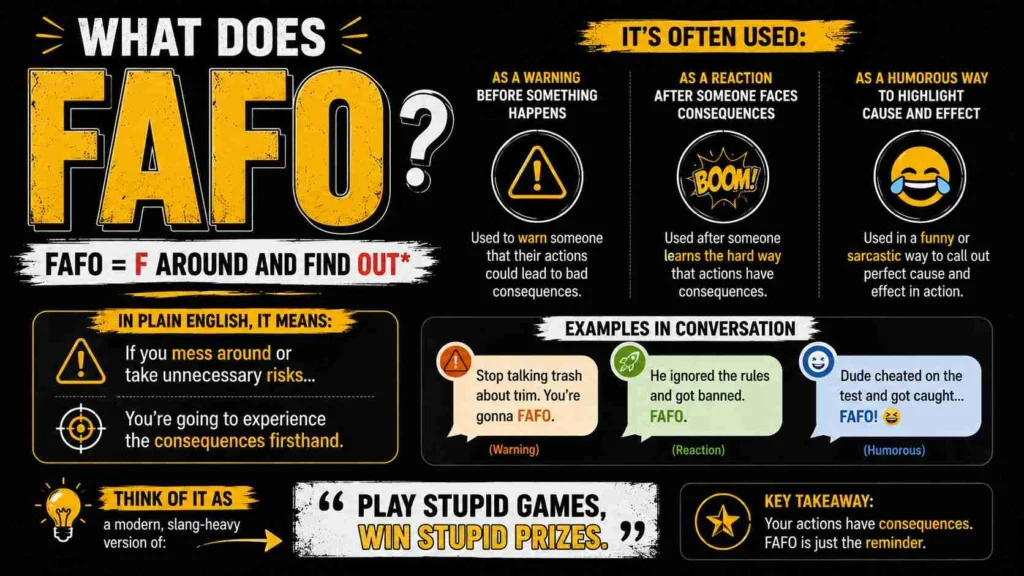
FAFO = F Around and Find Out*
In plain English, it means:
- If you mess around or take unnecessary risks…
- You’re going to experience the consequences firsthand
It’s often used:
- As a warning before something happens
- As a reaction after someone faces consequences
- As a humorous way to highlight cause and effect
👉 Think of it as a modern, slang-heavy version of:
“Play stupid games, win stupid prizes.”
Origin of FAFO
Where Did FAFO Come From?
FAFO didn’t come from a single moment or viral post it evolved organically from internet slang culture. The full phrase “F* Around and Find Out” has been around for years, especially in casual speech and online forums.
Rise in Popularity
FAFO gained serious traction in the early 2020s due to:
- Viral memes and reaction videos
- TikTok and short-form video platforms
- Twitter (X) threads and comment culture
- Internet humor focused on karma and consequences
The abbreviation FAFO became popular because:
- It’s shorter and easier to type
- It softens the explicit wording slightly
- It fits perfectly into memes and captions
How FAFO Is Used in Real Life
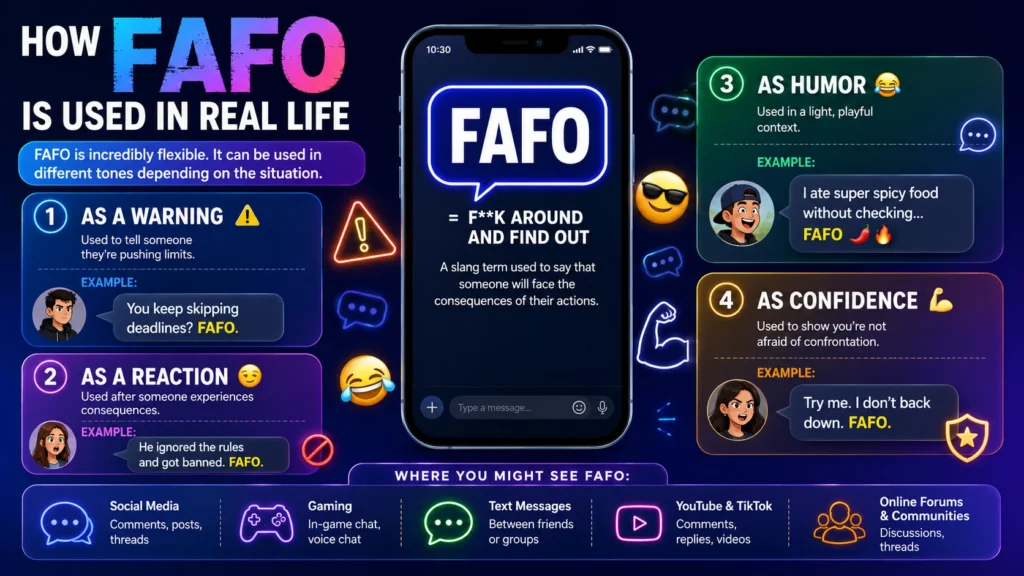
FAFO is incredibly flexible. It can be used in different tones depending on the situation.
1. As a Warning ⚠️
Used to tell someone they’re pushing limits.
Example:
- “You keep skipping deadlines? FAFO.”
2. As a Reaction 😏
Used after someone experiences consequences.
Example:
- “He ignored the rules and got banned. FAFO.”
3. As Humor 😂
Used in a light, playful context.
Example:
- “I ate super spicy food without checking… FAFO 🌶️🔥”
4. As Confidence 💪
Used to show you’re not afraid of confrontation.
Example:
- “Try me. FAFO.”
Tone Matters | Friendly vs. Aggressive Use
FAFO can feel very different depending on how it’s used.
| Tone Type | Meaning | Example |
|---|---|---|
| Friendly / Playful | Light teasing or joking | “You stayed up all night gaming? FAFO 😂” |
| Neutral | Simple cause-and-effect statement | “He broke the rules and got fined. FAFO.” |
| Dismissive | Slightly sarcastic or cold | “You didn’t listen. FAFO.” |
| Aggressive | Strong warning or threat | “Keep pushing and FAFO.” |
👉 Tip: Always consider context FAFO can sound funny or harsh depending on delivery.
Examples of FAFO in Context
Here are realistic examples across different situations:
Casual Conversation
- “I tried fixing my phone myself… FAFO 🤦♂️”
Social Media Comment
- “People ignore warnings and then act surprised. FAFO.”
Workplace (informal setting)
- “He didn’t back up his files. FAFO.”
Gaming
- “Rush into the enemy base alone? FAFO 🎮”
Relationships
- “You lied and got caught. FAFO.”
Why FAFO Became So Popular
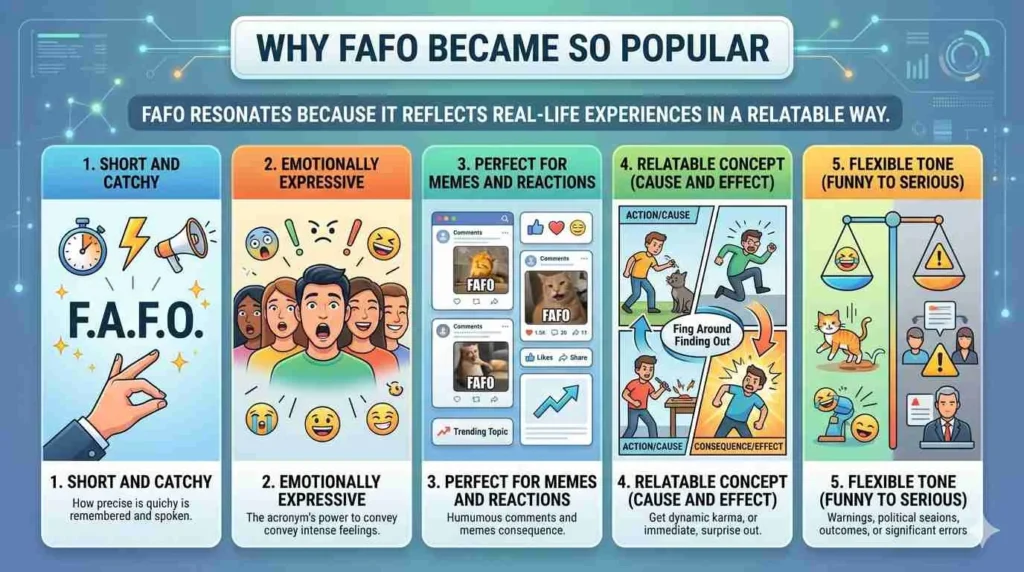
FAFO resonates because it reflects real-life experiences in a relatable way.
Key Reasons for Popularity:
- Short and catchy
- Emotionally expressive
- Perfect for memes and reactions
- Relatable concept (cause and effect)
- Flexible tone (funny → serious)
It’s also part of a broader trend where people prefer bold, direct communication online.
FAFO vs Similar Slang Terms
FAFO isn’t the only phrase that expresses consequences. Here’s how it compares:
| Term | Meaning | Tone | Difference from FAFO |
|---|---|---|---|
| Play stupid games, win stupid prizes | Actions have consequences | Mild, sarcastic | Less aggressive than FAFO |
| Karma | What goes around comes around | Neutral | More philosophical |
| You reap what you sow | Consequences of actions | Formal | More traditional |
| Mess around and find out | Same as FAFO | Casual | Full version of FAFO |
| That’s on you | Responsibility lies with you | Neutral | Less dramatic |
Alternate Meanings of FAFO
While FAFO almost always means “F Around and Find Out,”* there are rare or niche interpretations:
- Could be used jokingly as a placeholder acronym
- Sometimes misunderstood by new users
👉 However, in 99% of cases, it carries the standard meaning related to consequences.
When NOT to Use FAFO
Even though FAFO is popular, it’s not always appropriate.
Avoid using it in:
- Professional emails
- Formal presentations
- Customer service communication
- Serious or sensitive discussions
Because:
- It contains implied profanity
- It can sound confrontational
- It may be misunderstood
Polite and Professional Alternatives
If you want to express the same idea more professionally, try these:
- “Actions have consequences.”
- “You’ll need to consider the outcome.”
- “That decision may lead to consequences.”
- “It’s important to think this through.”
- “There may be repercussions.”
👉 These alternatives keep the message clear without sounding aggressive.
Usage Tips | How to Use FAFO Correctly
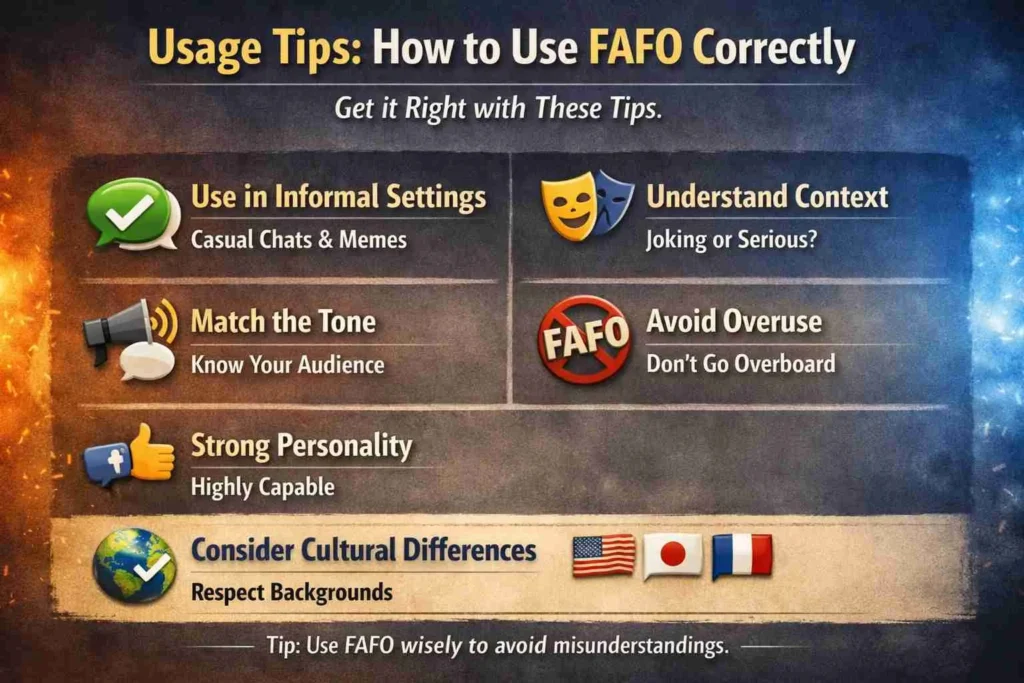
To use FAFO effectively:
- ✔ Use it in informal settings
- ✔ Match the tone to your audience
- ✔ Be aware of context (joking vs serious)
- ✔ Avoid overusing it
- ✔ Consider cultural differences
Quick Tip:
If you wouldn’t say the full phrase out loud in that situation, don’t use FAFO.
Labeled Example Table
| Scenario | FAFO Usage | Tone | Explanation |
|---|---|---|---|
| Friend eats extra spicy food | “You didn’t check the spice level? FAFO 🌶️” | Playful | Light teasing |
| Employee ignores rules | “He broke protocol. FAFO.” | Neutral | Cause and effect |
| Online argument | “Keep talking like that. FAFO.” | Aggressive | Warning |
| Student skips studying | “Exam tomorrow and you didn’t prepare? FAFO.” | Casual | Consequence |
FAQs
What does FAFO mean in texting?
FAFO in texting means “F* Around and Find Out,” and it’s used to warn someone that their actions will lead to consequences or to react when those consequences happen.
Is FAFO offensive?
FAFO can be considered mildly offensive because it implies profanity and can sound confrontational, especially in serious or formal contexts.
When should I use FAFO?
FAFO is best used in casual conversations, social media, or humor-based situations where tone is understood and not likely to offend.
Is FAFO a threat?
Not always FAFO can be playful or humorous, but in certain contexts it may sound like a warning or even a threat depending on how it’s used.
What are alternatives to FAFO?
Alternatives include phrases like “actions have consequences,” “you reap what you sow,” or “that’s on you,” which are more neutral or professional.
Why is FAFO trending?
FAFO became popular due to meme culture, short-form videos, and its ability to quickly express cause-and-effect situations in a bold and relatable way.
Can FAFO be used jokingly?
Yes, FAFO is often used humorously to describe harmless mistakes or funny situations, especially online.
What does FAFO mean on social media?
On social media, FAFO is commonly used in captions, comments, and memes to highlight someone facing the consequences of their actions.
What Does FAFO Mean in Texting?
FAFO stands for “F* Around and Find Out.”** It is a slang phrase used to warn that reckless actions or poor decisions can lead to consequences, often in a humorous or blunt way.
What Does FAFO Mean on TikTok?
On TikTok, FAFO stands for “F* Around and Find Out.”** It is commonly used in videos and comments to suggest that someone’s risky, foolish, or bold actions will eventually lead to consequences.
Conclusion
FAFO is more than just internet slang it’s a sharp, modern way of expressing a timeless idea: actions lead to consequences. Used as a warning, a reaction, or a joke, it carries a strong message that resonates across cultures and platforms.
The key to using FAFO effectively lies in understanding tone and context. In the right setting, it can be funny, relatable, and impactful. In the wrong one, it can come across as rude or aggressive.
So use it wisely, keep your audience in mind, and remember sometimes a softer phrase works better, especially in professional situations. Ultimately, FAFO is a reminder that choices matter, and outcomes often follow naturally.
Discover More Related Articles:
- “Ennui” Meaning: The Feeling of Boredom & Emptiness Explained In 2026
- “SMH” Meaning: What It Stands For, How to Use It & When It Fits In 2026
- “Skibidi” Meaning: What It Really Means in Internet Culture In 2026