
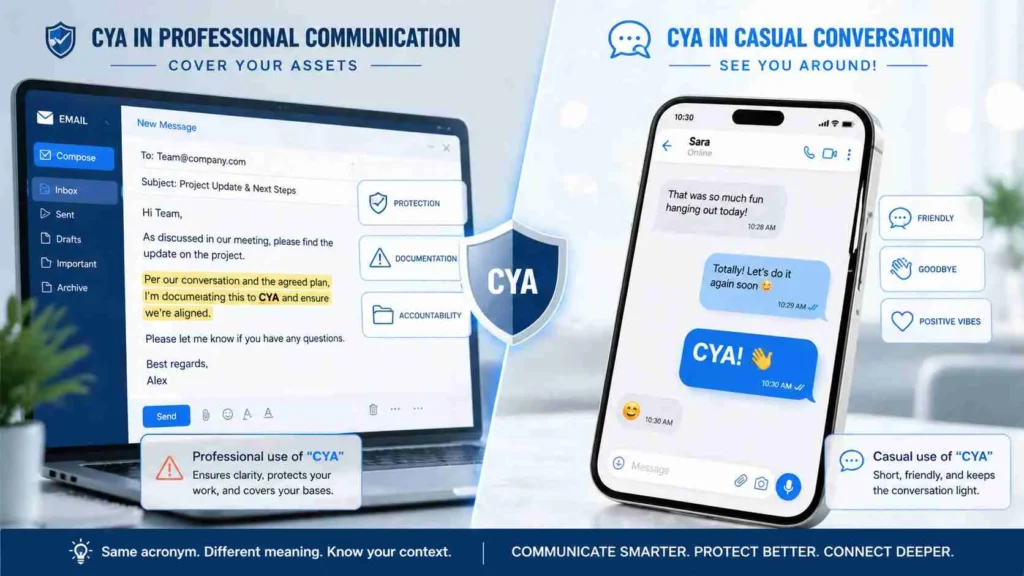

Definition
CYA meaning is a slang abbreviation for “Cover Your Ass”, used to describe actions taken to protect oneself from blame, responsibility, or consequences in a situation especially in work, legal, or professional contexts. In informal texting, it can also mean “See You Around”, depending on tone and context.
If you’ve ever seen the abbreviation CYA in a message, email, or workplace conversation and felt confused, you’re not alone. This short three-letter term carries surprisingly different meanings depending on where and how it’s used. cya full form.
In professional settings, it often sounds serious sometimes even strategic. In casual texting, however, it can feel friendly and light. And in technical or scientific fields, it may have an entirely different definition.
Understanding CYA meaning is important because misinterpreting it can completely change the tone of a message. Let’s break it down in a simple, clear, and practical way so you can confidently use or understand it anywhere.
CYA Definition: CYA is an abbreviation that most commonly means “See Ya,” a casual and friendly way to say goodbye in texts, chats, and online conversations. It can also mean “Cover Your Ass” in workplace or professional contexts, referring to taking steps to avoid blame or responsibility.
Origin of CYA Meaning

The slang CYA (“Cover Your Ass”) originated in informal American workplace culture. It became popular in offices, legal environments, and corporate settings during the late 20th century.
How it developed:
- Early usage appeared in military and bureaucratic communication
- Later adopted in corporate workplaces
- Spread widely through email culture in the 1990s and 2000s
- Eventually became part of internet slang
The phrase reflects a behavior where people take precautions like sending emails, keeping records, or documenting decisions to avoid being blamed later.
Meanwhile, the alternative casual meaning “See You Around” emerged from texting culture as shorthand for goodbye.
CYA Meaning in Different Contexts
The meaning of CYA changes based on tone, setting, and audience. Here’s a breakdown:
1. Professional or Workplace Meaning
CYA = Cover Your Ass
Used when someone is trying to protect themselves from blame or future issues.
Example:
- “I emailed the report just to CYA in case there’s a misunderstanding later.”
2. Casual Texting Meaning
CYA = See You Around
A friendly goodbye used in chats or messages.
Example:
- “Alright, I’ve got to go now. CYA!”
3. Technical / Scientific Meaning
In chemistry and pool maintenance:
- CYA = Cyanuric Acid
- Used in swimming pools to stabilize chlorine
Example:
- “Check the CYA level in the pool before adding more sanitizer.”
Real-World Usage of CYA With Tone Explanation
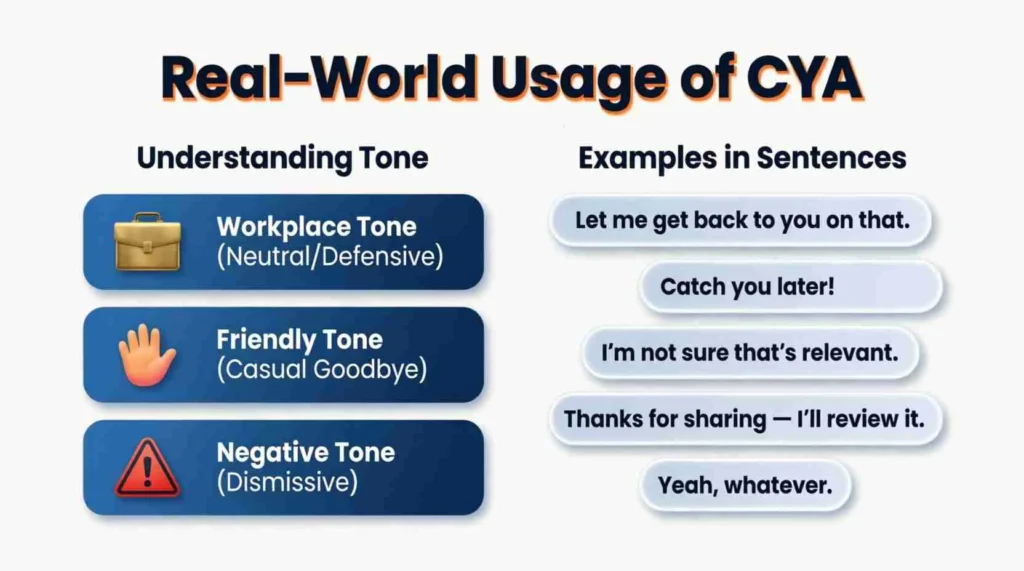
Understanding tone is key because CYA can sound very different depending on context.
Workplace Tone (Neutral to Defensive)
- “I documented everything just to CYA.”
👉 Meaning: Protecting oneself from blame
Friendly Tone (Casual Goodbye)
- “CYA later!”
👉 Meaning: See you later / goodbye
Negative or Dismissive Tone
- “He only did that to CYA himself.”
👉 Meaning: Someone is acting selfishly or avoiding responsibility
Examples of CYA in Sentences
Here are some real-life style examples:
- “Make sure you save that email it’s a CYA move.”
- “I’m forwarding this to the manager just to CYA.”
- “CYA tomorrow at school!”
- “She wrote everything down as a CYA strategy.”
- “Don’t worry, I already CYA’d by getting approval in writing.”
Comparison With Similar Abbreviations
Understanding similar slang helps avoid confusion.
| Abbreviation | Meaning | Tone | Usage |
|---|---|---|---|
| CYA | Cover Your Ass | Workplace/Defensive | Protecting oneself |
| FYI | For Your Information | Neutral | Sharing info |
| BTW | By The Way | Casual | Adding extra info |
| SMH | Shaking My Head | Negative | Disapproval |
| BRB | Be Right Back | Casual | Temporary absence |
| TTYL | Talk To You Later | Friendly | Ending conversation |
CYA is unique because it often carries a protective or defensive implication, unlike most neutral abbreviations.
Polite or Professional Alternatives to CYA
Since “CYA” can sound informal or even rude in professional environments, here are better alternatives:
Instead of saying “CYA” (Workplace):
- “To ensure clarity, I have documented this.”
- “For record purposes, I’ve sent a confirmation email.”
- “To avoid misunderstandings, I’ve included written approval.”
- “Just keeping a record for reference.”
These alternatives sound more professional and are safer in formal communication.
Alternate Meanings of CYA
While “Cover Your Ass” is the most common meaning, CYA can also refer to:
1. See You Around (Texting slang)
- Casual goodbye in chats
- Common among friends and informal messaging
2. Cyanuric Acid (Scientific term)
- Used in pool maintenance
- Helps stabilize chlorine in water
3. Rare or Contextual Uses
Sometimes used as:
- Abbreviation in organization names or programs (rare)
- Informal shorthand depending on niche groups
Why CYA Became So Popular
The popularity of CYA comes from modern communication habits:
Key reasons:
- Email culture encourages documentation
- Workplaces value accountability
- People prefer short abbreviations
- Internet slang spreads quickly
- Social media and texting normalize shorthand language
In short, CYA reflects a modern need for both speed and self-protection in communication.
Table: CYA Meaning Based on Context
| Context | Meaning | Example |
|---|---|---|
| Workplace | Cover Your Ass | “I saved the email to CYA.” |
| Texting | See You Around | “Okay, CYA!” |
| Science | Cyanuric Acid | “Check pool CYA levels.” |
Common Mistakes When Using CYA
Many people misunderstand or misuse CYA. Here are common mistakes:
- Using it in formal emails without understanding tone
- Assuming it always means “goodbye”
- Using it in professional communication without considering politeness
- Misreading it in technical documents
👉 Tip: Always check context before interpreting CYA.
When Should You Use CYA?
You can safely use CYA in:
- Casual texting with friends (meaning goodbye)
- Informal workplace communication (carefully)
- Internal notes or reminders (meaning documentation)
Avoid using it in:
- Formal emails to clients
- Legal documents
- Academic writing
- Professional reports
Why Understanding CYA Meaning Matters
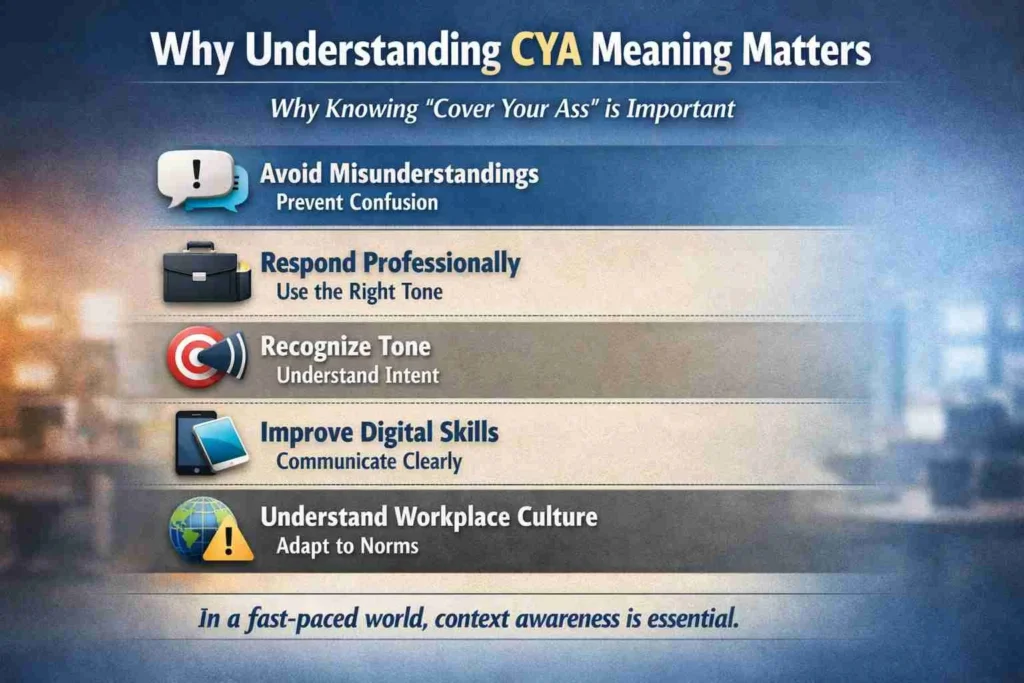
Knowing the CYA meaning helps you:
- Avoid communication misunderstandings
- Respond appropriately in professional settings
- Recognize tone in messages
- Improve digital communication skills
- Understand workplace culture better
In today’s fast-paced messaging world, abbreviations like CYA are everywhere, so context awareness is essential.
FAQs
What does CYA mean in texting?
In texting, CYA usually means “See You Around,” which is a casual and friendly way of saying goodbye when you expect to talk again later.
What does CYA mean in work emails?
In professional settings, CYA means “Cover Your Ass,” referring to actions taken to protect oneself from blame or misunderstandings.
Is CYA rude or offensive?
It depends on context. In workplace slang, it can sound slightly defensive, but in casual texting, it is harmless and friendly.
What is the full form of CYA in slang?
The slang full form of CYA is “Cover Your Ass,” meaning taking precautions to avoid responsibility or blame.
Can CYA mean something positive?
Yes, in texting, “See You Around” is a positive and friendly farewell expression used among friends.
Is CYA used in professional communication?
It is used informally in workplaces but is not recommended in formal emails or client communication due to its casual tone.
What does CYA mean in science or chemistry?
In chemistry, CYA refers to cyanuric acid, a compound used in swimming pools to stabilize chlorine levels.
What are polite alternatives to CYA in emails?
Polite alternatives include phrases like “for record purposes,” “to ensure clarity,” or “for documentation purposes.”
What Does CYA Mean?
CYA most commonly stands for “See Ya,” a casual way of saying goodbye in text messages and online chats. In professional contexts, it can also mean “Cover Your Ass,” referring to protecting yourself from blame or criticism.
What Does CYA Stand For?
CYA most commonly stands for “See Ya,” an informal way of saying goodbye. In workplace and business settings, it can also stand for “Cover Your Ass,” meaning to take precautions to avoid blame or responsibility.
Conclusion
The CYA meaningis a perfect example of how modern language adapts to different environments. It stands for “Cover Your Ass,” “See You Around,” or “Cyanuric Acid,” its meaning depends entirely on context. cya meaning in banking.
In professional settings, it often reflects caution and self-protection, while in casual texting it becomes a friendly goodbye. cya synonym.
Understanding these differences helps you communicate more effectively, avoid misunderstandings, and respond appropriately in any situation. The key takeaway is simple: always read the tone and context before interpreting CYA. cya full form.
Discover More Related Articles:
- “Schmaltz” Meaning: Stand For in Everyday Language In 2026
- “OFC” Meaning: What It Stands For & How It’s Used In 2026
- “IYKYK” Meaning: What It Stands For & How It’s Used In 2026