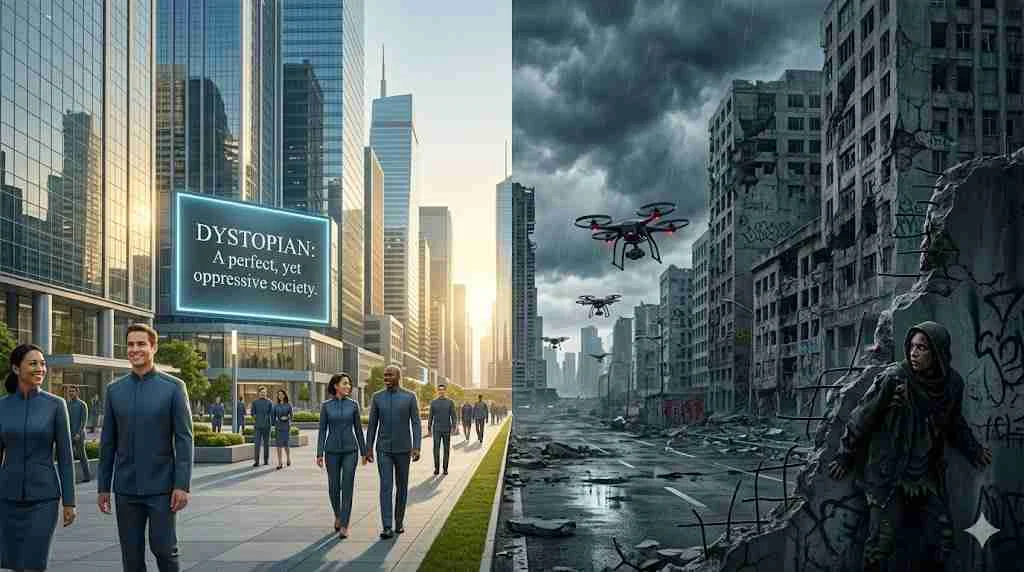

A dystopia is an imagined society where systemic oppression, fear and surveillance replace personal freedom often disguised behind promises of safety, order, or happiness.
You’ve heard the word a hundred times. Someone calls a new law “dystopian.” A movie gets described as “a dystopian thriller.” But if you stop and think about it what does dystopian actually mean?
Most people guess it means “a really bad future.” That’s close but not quite right.
A zombie apocalypse is bad. A meteor wiping out Earth is bad. But neither is automatically dystopian. So what’s the difference?
Let’s clear that up right now.
What Does Dystopian Mean in Plain English
Here’s the shortest version you’ll find anywhere:
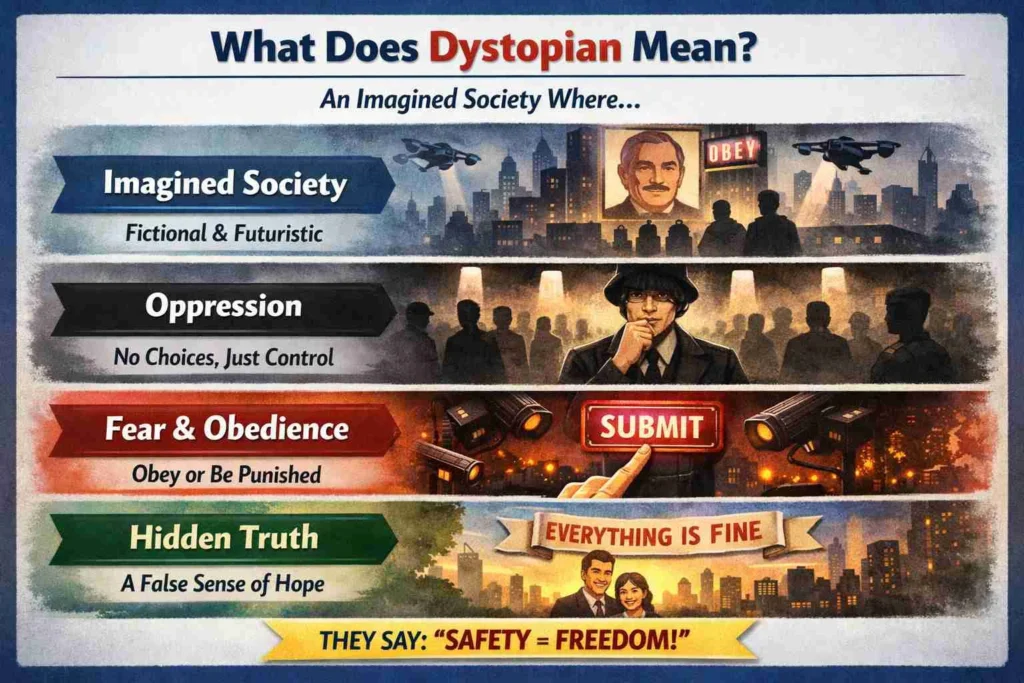
Dystopian describes an imagined society where oppression, fear, or control keeps people in line often hidden behind a promise of order, safety, or happiness.
Break that down word by word.
- Imagined – Dystopias live in fiction. But they feel real because they use real techniques: surveillance, propaganda, punishment.
- Oppression – Someone holds power. Everyone else loses choices.
- Fear or control – People obey not because they want to but because they’re scared.
- Hidden behind a promise – The rulers never say “we’re evil.” They say “we’re keeping you safe.”
That last part matters most. A dystopia always has a sales pitch. “Freedom is slavery.” “War is peace.” “We hurt you so you can be comfortable.”
Now you see why “bad future” isn’t enough. A disaster movie doesn’t have a government lying to you. A dystopian story always does.
Dystopia is the noun. Dystopian is the adjective.
- Nineteen Eighty‑Four is a dystopia.
- The world of Nineteen Eighty‑Four is dystopian.
Simple.
Dystopian Definition Straight from the Roots
The word breaks into two Greek pieces:
- Dys – means “bad,” “abnormal,” or “difficult.” You see it in words like dysfunctional or dyslexia.
- Topos – means “place.”
So dystopia literally means bad place. define dystopian.
John Stuart Mill, a British philosopher, coined the term in 1868. He used it as a direct opposite to utopia which means “good place” (from eu, meaning good, plus topos).
But here’s a twist. Thomas More invented the word utopia in 1516. But More made a pun. Utopia sounds like eu‑topos (good place) but also like ou‑topos (no place). So utopia is the good place that doesn’t exist.
Dystopia took that joke and made it dark. The bad place? Oh, it can exist. And in fiction, it usually does.
Dystopian Meaning vs Related Terms
| Term | Meaning in One Line | Example |
|---|---|---|
| Dystopia | Fictional society built on oppression, not just disaster | The Handmaid’s Tale |
| Utopia | Ideal, perfect society (usually impossible) | Thomas More’s Utopia |
| Anti‑utopia | Another word for dystopia; emphasizes rejection of utopian ideas | We by Yevgeny Zamyatin |
| Post‑apocalyptic | Society after a collapse; dystopian only if new rulers oppress people | Mad Max (not dystopian) vs The Hunger Games (dystopian) |
| Totalitarian | One‑party rule with total government control of public and private life | Nazi Germany in fiction like Fatherland |
| Speculative fiction | Broad genre including dystopias, alternate history, and future scenarios | The Man in the High Castle |
Keep this table handy. Most confusion happens when people mix up post‑apocalyptic and dystopian.
Quick test: Ask yourself, “Is there an active government or ruling group deliberately controlling people?” If yes, it’s probably dystopian. If no if everyone’s just surviving after a bomb it’s post‑apocalyptic.
Core Characteristics of a Dystopian Society
Not every dark future qualifies. Scholars who study dystopian meaning agree on a set of common traits. A fictional society usually needs most of these to count:
Propaganda Replaces Truth
The ruling group controls history, language, and news. They rewrite yesterday to fit today’s agenda. In *1984*, the Ministry of Truth changes old newspaper articles so no one can trust their own memory. Language itself shrinks (Newspeak) to make rebellion impossible to even think.
Constant Surveillance
Cameras on every corner. Neighbors encouraged to report each other. Digital tracking of every purchase, every conversation, every movement. In Nineteen Eighty‑Four, telescreens watch you even in your sleep. You can’t turn them off.
Fear of Speaking Out
Punishment for dissent is public, cruel, and unpredictable. You never know who’s listening. So you stay quiet. You smile. You nod. That’s the goal. The regime doesn’t need to arrest everyone just make everyone afraid of being next.
Individuality Is a Crime
Art, friendship, love, even private thoughts all get regulated. In Brave New World, people take drugs (soma) to stay happy and numb. In The Handmaid’s Tale, women can’t read. And in Fahrenheit 451, owning a book is a felony. Being different marks you for punishment.
False Promise of Stability
The rulers always say: “We’re tough on you now so things don’t get worse.” They create fake crises (wars, shortages, enemy spies) to justify control. Citizens trade freedom for a promise of safety. The safety never comes. Only more control.
Dehumanization
People become numbers, not names. Slaves, workers, Handmaids, Proles labels that strip away identity. The government doesn’t see you as a person. You’re a resource. Or a threat.
Government‑Controlled Economy
No private business. No free market. The state decides who gets what. Shortages are common but blame falls on enemies, not the system. In The Hunger Games, districts produce one thing each (coal, fish, grain) and can’t trade freely.
Real Example Breakdown
Let’s test these traits against a famous dystopian novel.
Book: Nineteen Eighty‑Four by George Orwell (1949)
| Trait | Present? | How It Shows Up |
|---|---|---|
| Propaganda | Yes | Ministry of Truth, Newspeak, Hate Week |
| Surveillance | Yes | Telescreens, Thought Police, microphones everywhere |
| Fear | Yes | Room 101, torture, vaporization (erasing people from history) |
| Individuality as crime | Yes | Writing a diary is punishable by death |
| False promise | Yes | “We’ll win the war soon.” “Big Brother protects you.” |
| Dehumanization | Yes | “We produce you… We produce everything.” |
| Controlled economy | Yes | No private trade; ration cards for everything |
Now test a non‑dystopian example.
Movie: Mad Max: Fury Road (2015)
- Active government? No. Warlords control small territories.
- Propaganda? Minimal. Rulers don’t rewrite history; they just hoard water.
- Surveillance? No cameras. Just scouts and violence.
- False promise of order? Not really. Everyone knows it’s chaos.
Result: Not dystopian. It’s post‑apocalyptic action.
See the difference? Dystopia requires organized, deliberate oppression. Not just chaos.
Dystopia vs Utopia | The One Showdown You Actually Need
Utopia asks: “What if everything worked perfectly?”
Dystopia asks: “What if perfection had a terrible price?”
Thomas More’s Utopia (1516) imagined an island where no one owned private property, everyone worked six hours a day, and gold was used for chamber pots. Sounds nice. Also impossible. That’s the catch with utopias. They’re fun to dream about but boring to read. No conflict. No tension.
Then in 1924, Yevgeny Zamyatin published We. He flipped the script. His utopian city, OneState, has glass walls (total transparency), identical uniforms, and sex passes issued by the government. Everyone lives by logic. No love. No privacy. And no poetry.
We isn’t a utopia. It’s a warning.
That book became the grandparent of every dystopian novel since. Orwell read it. Huxley read it. Ayn Rand read it. They all borrowed pieces.
Why dystopia wins over utopia in storytelling:
Flaws make drama. A perfect world has no problems. A broken world? That’s where every story lives.
Here’s a quick comparison table:
| Element | Utopia | Dystopia |
|---|---|---|
| Goal | Show an ideal to strive for | Warn about a path to avoid |
| Conflict | Little to none | High (man vs system) |
| Reader feeling | Hopeful, inspired | Uncomfortable, alert |
| Famous example | Utopia (More), Erewhon (Butler) | *1984*, Brave New World |
| Real‑world risk | Naivety, ignoring flaws | Paranoia, but also vigilance |
Neither exists in pure form. But dystopia gives you sharper tools for criticizing power. That’s why it aged better.
Landmark Dystopian Novels
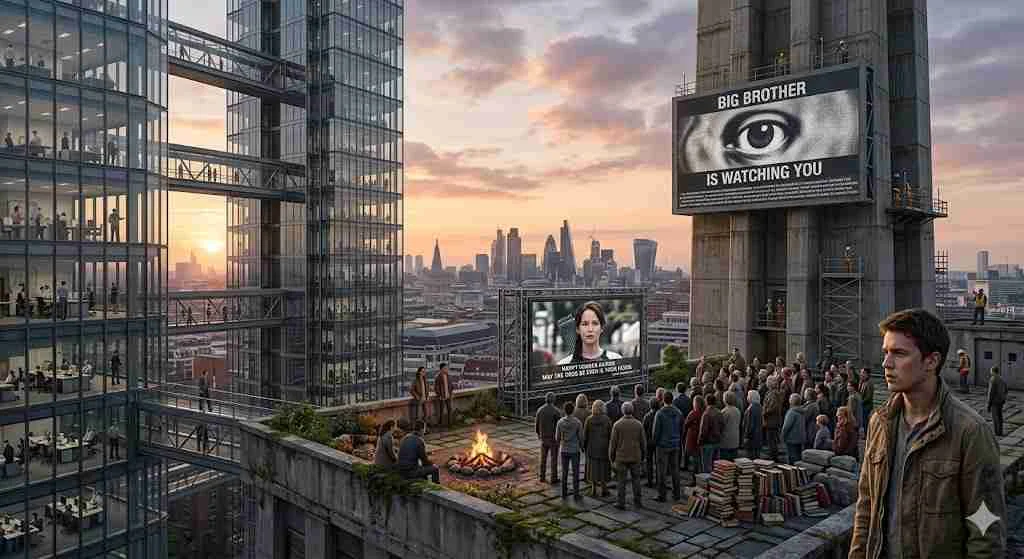
Let’s walk through five essential books. Each one adds a new layer to dystopian meaning.
We (Yevgeny Zamyatin, 1924)
Core mechanism: Total transparency and loss of private life
What it teaches: You can’t rebel if you’re never alone. The protagonist, D‑503, lives in a glass building. Every action is visible. When he falls in love (an illegal emotion), he can’t hide it. The state doesn’t need secret police architecture does the job.
Key quote: “There is no final one. Revolutions are infinite.”
Brave New World (Aldous Huxley, 1932)
Core mechanism: Pleasure as control
What it teaches: Oppression can feel like a good time. Citizens take soma (a happiness drug), have casual sex without attachment, and never feel sad. They also never read Shakespeare, never fall in love, and never choose their own lives. Huxley warned that we might destroy ourselves with comfort, not chains.
Key quote: “But I don’t want comfort. I want God, I want poetry, I want real danger, I want freedom, I want goodness. I want sin.”
Nineteen Eighty‑Four (George Orwell, 1949)
Core mechanism: Pain and surveillance as control
What it teaches: Fear works better than drugs. Orwell’s Oceania uses torture, rewriting history, and constant watching. The goal isn’t just obedience it’s believing the lies. Winston Smith breaks. Everyone breaks. That’s the horror.
Key quote: “He who controls the past controls the future. He who controls the present controls the past.”
The Handmaid’s Tale (Margaret Atwood, 1985)
Core mechanism: Religious + gender‑based control
What it teaches: Dystopia doesn’t need sci‑fi technology. Gilead uses the Bible, fertile women as property, and public executions at Harvard’s football stadium. No laser guns. No flying cars. Just old ideas weaponized. Atwood called it “speculative fiction” because every detail happened somewhere in real history.
Key quote: “Ignoring isn’t the same as ignorance, you have to work at it.”
The Hunger Games (Suzanne Collins, 2008)
Core mechanism: Entertainment as oppression
What it teaches: Dystopia works through spectacle. The Capitol forces twelve districts to send children to fight to the death on live TV. Citizens watch while eating luxury food. The violence isn’t hidden it’s the point. Collins updated Orwell for a reality‑TV generation.
Key quote: “Happy Hunger Games! And may the odds be ever in your favor.”
Dystopian Themes in Literature
Yes, control and surveillance are big. But dystopian fiction explores deeper ideas too.
Memory and Truth
Dystopian regimes always attack memory. If you can’t trust your own past, you can’t resist. In *1984*, Winston works at the Ministry of Truth rewriting history. In Fahrenheit 451, firemen burn books so no one remembers dangerous ideas. And in the film Equilibrium, citizens take drugs to suppress emotions.
Why this theme matters: Memory makes us human. Erase it and you can remake anyone.
Language as a Weapon
Newspeak in *1984* shrinks vocabulary every year. No word for “freedom” means no concept of freedom. In The Handmaid’s Tale, women become “Handmaids,” “Marthas,” “Wives” titles that erase individual names. In Kurt Vonnegut’s “Harrison Bergeron,” the word “equality” gets twisted into “forced mediocrity.”
Real‑world connection: Governments and corporations rename things constantly. “Collateral damage” instead of dead civilians. “Right‑sizing” instead of mass firing. Language shapes thought.
Rebellion and Its Cost
Most dystopian protagonists fail. Winston ends up loving Big Brother. Guy Montag in Fahrenheit 451 barely escapes. Only Katniss Everdeen wins and she loses her sister, her sanity, and nearly herself. Dystopian writers don’t give easy victories.
Why that’s honest: Real oppression survives for decades. One hero rarely topples a system. But small acts of resistance (reading a book, keeping a diary, saying a name) keep hope alive.
Characteristics of Dystopian World
Let’s go deeper. Scholars have identified more than a dozen recurring features.
1. Social Stratification
Rigid class systems. You’re born into a role and can’t leave it. In Brave New World, Alphas, Betas, Gammas, Deltas, and Epsilons are bred for their jobs. In The Hunger Games, districts feed the Capitol but can’t visit it.
2. Scapegoating and Enemy Creation
Every dystopia needs an external or internal enemy. In *1984*, it’s Emmanuel Goldstein and Eurasia. In The Handmaid’s Tale, it’s “gender traitors” and “unwomen.” Blaming outsiders keeps citizens loyal.
3. Ritualized Violence
Public executions, televised fights, mandatory watching. The state turns brutality into ceremony. In The Hunger Games, the reaping (choosing tributes) feels like a holiday. In Logan’s Run, people turn 30 and get “renewed” (killed) in a cheering crowd.
4. Worship of a Leader or Symbol
Big Brother. The Party. The Capitol. The system becomes a god. Citizens salute, chant, or wear pins. The leader rarely appears in person but watches from every poster.
5. Restricted Information
No internet. No free press. One state newspaper. In Fahrenheit 451, firemen burn books and people watch “parlor walls” (giant TVs) all day. In real history, Nazi Germany burned 25,000 books in one night (May 10, 1933).
6. Forced Conformity
Clothing, haircuts, speech patterns, even facial expressions become standardized. In Equilibrium, citizens take “prozia” to suppress emotion. Smiling is illegal without a permit.
7. Environmental Decay
Dystopias often wreck nature. Smog, dead rivers, toxic soil. In Blade Runner, Los Angeles rains constantly from chemical clouds. In The Road, everything is gray ash. The environment mirrors the soul of the society.
Totalitarian Society Meaning and Its Role in Dystopia
You’ll see “totalitarian” paired with “dystopian” constantly. They’re not synonyms but they overlap heavily.
Totalitarian society meaning: A political system where the state holds total authority over public and private life. No legal opposition. No independent courts. And no free press. One party. One leader. One truth.
Key traits of totalitarian regimes (real or fictional):
- Secret police (Thought Police, the SS, the KGB)
- Show trials (confessions beaten out of innocent people)
- Cult of personality (Stalin, Mao, Kim Il‑sung)
- Control of education (textbooks rewritten each year)
- Forced labor camps (Gulag, labor colonies)
- No rule of law (leaders are above any law)
Real totalitarian governments in the 20th century:
- Nazi Germany (1933–1945)
- Soviet Union under Stalin (1928–1953)
- North Korea (1948–present)
- Fascist Italy (1925–1943, though less total than Nazis)
Fictional totalitarian societies:
- Oceania (*1984*)
- The Party (Brave New World – though softer)
- Gilead (The Handmaid’s Tale)
- Panem (The Hunger Games)
Not every dystopia needs full totalitarianism. A dystopia could be corporate (like RoboCop’s Omni Consumer Products) or religious (Gilead). But most classic dystopias lean totalitarian because it’s the cleanest model of absolute control.
Dystopian Explanation Through Real‑World Alerts
Why learn dystopian meaning? Because the genre warns us about real trends.
Trend 1: Surveillance capitalism
Companies track your location, purchases, clicks, and even your gaze. Phones listen. Cameras scan faces. In 2023, a report showed that 1 in 3 US adults lives under some form of automated license plate recognition. Not dystopian yet. But the building blocks are there.
Trend 2: Social credit systems
China’s pilot social credit programs reward “good” behavior (paying bills on time, volunteering) and punish “bad” behavior (jaywalking, complaining online). Low scores block plane tickets or jobs. That’s straight out of Black Mirror (episode “Nosedive”).
Trend 3: Algorithmic management
Amazon warehouse workers wear monitors tracking speed. Systems fire them automatically if they fall below targets. No human review. No appeal. That’s dehumanization one of the core characteristics we listed earlier.
Trend 4: Erosion of truth
“Alternative facts.” Deepfake videos. AI‑generated news. When no one can agree on reality, a government could easily follow the *1984* playbook: “Who controls the past controls the future.”
The difference between a real society and a dystopian fiction is usually scale and intent. A little surveillance isn’t dystopian. Widespread surveillance plus punishment for dissent plus propaganda plus no way out? That’s the fictional line. And we’re inching closer.
Dystopian Meaning in English for Modern Readers
You’ll see three common uses of “dystopian” today.
Use 1: Literary criticism
“Parable of the Sower by Octavia Butler offers a dystopian view of 2020s America.” (Correct. Butler imagined climate collapse, private police forces, and walled communities.)
Use 2: Political commentary
“The new immigration policy has dystopian overtones.” (Figurative. The speaker means the policy feels cruel, controlling, or reminiscent of dystopian fiction.)
Use 3: Everyday exaggeration
“My open‑plan office is dystopian.” (Hyperbole. Annoying, yes. Totalitarian oppression, no.)
Most people mean #2 or #3. But knowing the precise definition helps you spot when someone’s using it seriously vs loosely.
Dark Future Meaning in Fiction | How It Differs from Dystopian
“Dark future” is a broader umbrella. It means any story set in a time worse than the present. Dystopian is a specific type of dark future.
Think of a Venn diagram.
Dark future includes:
- Post‑apocalyptic (nuclear winter, zombie plague)
- Climate disaster (flooded cities, dust bowl)
- Alien occupation (if chaotic, not organized)
- Dystopian (organized oppression)
So all dystopias are dark futures. But not all dark futures are dystopias.
Example: The Road by Cormac McCarthy. Dark future? Yes. Bleak, burned landscape, cannibals, no hope. Dystopian? No. No government. No surveillance. And no propaganda. Just survival.
Example: Snowpiercer (film). Dark future? Yes. Frozen Earth. Dystopian? Yes. The train has a rigid class system, propaganda, and a leader (Wilford) who controls everything.
Use “dark future” when you mean grim setting. Use “dystopian” when you mean oppressive system.
Control and Surveillance Society | A Deeper Look
This characteristic deserves its own section. Why? Because it’s the most common feature in modern dystopian fiction and the one hitting closest to home.
What a control and surveillance society looks like in fiction:
- Every home has a screen or camera you can’t disable
- Children report parents for wrongspeak
- Facial recognition follows you across the city
- Social scoring punishes you for associating with “undesirables”
- No unmonitored public spaces
Real surveillance numbers (as of 2024):
- China has over 600 million surveillance cameras (one for every 2.3 people)
- London has roughly one camera per 14 people
- US airports use facial recognition on 97% of passengers
- 1 in 3 American households owns a smart speaker (always listening)
Why surveillance matters for dystopian meaning:
Surveillance creates self‑censorship. You behave even when no one’s watching because you might be watched. That’s the goal. The state doesn’t need to arrest everyone. Just make everyone afraid to step out of line.
Classic quote on this:
“The most effective way to control people is to make them think they are free.” often misattributed to Foucault, but captures the idea perfectly.
Science Fiction Dystopia Meaning | Not All Sci‑Fi Is Dystopian
Science fiction (sci‑fi) explores future technology and its impact. Dystopian fiction explores future oppression. They overlap often but not always.
Sci‑fi that is NOT dystopian:
- Star Trek (optimistic future, no oppression)
- The Martian (survival story, no evil government)
- Contact (first contact, hopeful)
Sci‑fi that IS dystopian:
- Blade Runner (oppressive society, replicant slavery)
- Gattaca (genetic hierarchy, discrimination built into law)
- Minority Report (pre‑crime surveillance, false arrests)
How to tell the difference:
Ask yourself: “Would I want to live in this world?”
If yes → probably not dystopian.
If no, because of technology alone → could be either.
If no, because of how people treat each other under a system → probably dystopian.
Loss of Freedom in Society Meaning | The Core Wound of Dystopia
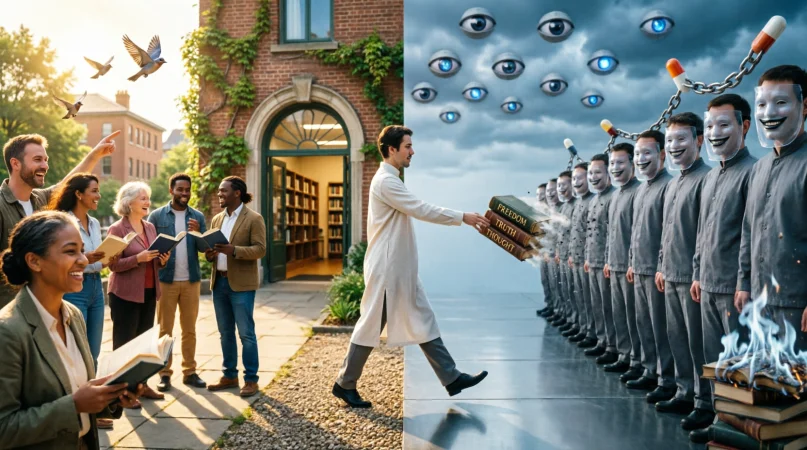
Every dystopian story bleeds from the same wound: loss of freedom.
But not all freedom. Usually specific kinds:
- Freedom to speak without punishment
- Freedom to read and learn
- Freedom to love who you choose
- Freedom to move where you want
- Freedom to disagree
- Freedom to be alone
Dystopian fiction rarely takes all freedoms. It takes the ones that matter most for human dignity.
In The Handmaid’s Tale:
Women lose the freedom to read, work, own money, or refuse sex. Men lose freedom to choose partners or express emotion.
In Fahrenheit 451:
Everyone loses freedom to think differently. Firemen destroy ideas. Neighbors report readers. Intellectuals live in hiding.
In Brave New World:
Citizens lose freedom to feel sadness, struggle, or create art. They’re happy. But it’s a shallow, drugged happiness.
Loss of freedom doesn’t always look like chains. Sometimes it looks like a pill. Or a smile. Or a promise.
Government Oppression in Dystopia | How It Works Mechanically
Let’s get technical for a moment. How does oppression actually function in dystopian fiction?
Method 1: Legal oppression
The regime passes laws that strip rights. No need for secret actions. The law itself is the weapon. In The Handmaid’s Tale, the “Fertility Act” declares all fertile women government property. Legal. Public. Horrifying.
Method 2: Extra‑legal oppression
Secret police, disappearances, “accidents.” No trial. No record. In *1984*, the Thought Police arrest you for a thought crime. You vanish. Your neighbors don’t ask questions.
Method 3: Economic oppression
Make people too poor and tired to rebel. The Capitol in The Hunger Games keeps districts on starvation rations. No energy for revolution when you’re hunting squirrels for dinner.
Method 4: Ideological oppression
Control what people believe. Use schools, media, and ceremonies to shape reality. In *1984*, children chant “Two plus two equals five” until they mean it.
Method 5: Technological oppression
Use machines to monitor, track, or pacify. Soma in Brave New World. Telescreens in *1984*. Pain‑anklets in The Maze Runner. Tech makes oppression efficient.
Most dystopias use two or three methods together. The most terrifying ones use all five.
Fictional Dystopian Setting | Anatomy of a World
What makes a dystopian setting feel real? Writers borrow from a shared toolbox.
Architecture:
Brutalist concrete. Gray towers. Identical housing blocks. Glass walls for surveillance. Underground bunkers. In Equilibrium, the city has no curves only sharp angles and metal.
Weather:
Constant rain (Blade Runner), endless sun (The Road), gray overcast (The Hunger Games). Weather reflects the mood of oppression. No bright, cheerful days.
Technology:
Retro tech or hyper‑advanced. *1984* has telescreens but no computers. Black Mirror has neural implants. Dystopian tech is never neutral. It always serves control.
Clothing:
Uniforms. Gray or blue jumpsuits. Color is rare and regulated. In The Handmaid’s Tale, red for Handmaids, blue for Wives, brown for Martha (servants). Clothing marks your rank and role.
Language:
Acronyms, slogans, shortened words. “Big Brother.” “Soma.” “Panem.” “Gilead.” Names carry weight. Dystopian settings rename everything. Old words die. New words control.
Movement:
Restricted travel. Checkpoints. Curfews. Papers required. In The Hunger Games, traveling between districts is illegal without permission. Your world shrinks to your assigned zone.
Examples of Dystopian Societies
Let’s group them by what kind of control they use.
Surveillance‑Based
- *1984* (Oceania)
- The Circle (The Circle company)
- Minority Report (Precrime division)
Pleasure‑Based
- Brave New World (World State)
- Wall‑E (humans on the Axiom ship)
- Demolition Man (San Angeles)
Religious‑Based
- The Handmaid’s Tale (Gilead)
- The Giver (Sameness community)
- His Dark Materials (Magisterium)
Class‑Based
- The Hunger Games (Panem)
- Snowpiercer (the train)
- Altered Carbon (Meths vs everyone else)
Corporate‑Based
- RoboCop (Omni Consumer Products)
- Neuromancer (megacorporations)
- Ready Player One (IOI)
Bureaucratic‑Based
- Brazil (Ministry of Information)
- The Trial (Kafka’s court system)
- The Castle (unnamed bureaucracy)
Each type warns about a different real‑world danger: surveillance state, hedonism, theocracy, inequality, corporate power, or faceless bureaucracy.
Dystopian Novels Meaning | Why This Genre Won’t Die
Dystopian novels keep selling because they do three things no other genre does as well.
First: They externalize our fears.
We worry about surveillance, loss of rights, climate collapse. A dystopian novel puts that worry into a concrete story. It’s cathartic.
Second: They teach resistance.
Reading about Winston Smith or Katniss Everdeen models small acts of defiance. Keep a diary. Say no. Hide a book. Help a friend. These feel tiny. In a dystopian world, they’re heroic.
Third: They inoculate us.
A vaccine gives you a dead virus to train your immune system. Dystopian novels give you a dead political system to train your vigilance. You spot propaganda faster. You notice surveillance creep. And you ask “Who benefits?” more often.
That’s the real value of dystopian meaning. Not just knowing a definition. But carrying a warning system in your head.
George Orwell 1984 Themes | The Gold Standard
*1984* isn’t the first dystopian novel but it’s the most influential. Let’s pull out its major themes because they define the genre.
Theme: Power for its own sake
O’Brien (the Party insider) tells Winston: “Power is not a means, it is an end.” The Party doesn’t want money or happiness. It wants power. Pure, endless power.
Theme: Controlling the past
“He who controls the past controls the future.” The Party rewrites history every day. Winston’s job is to make yesterday match today’s orders. No objective truth exists.
Theme: The destruction of love
The Party forbids loyalty to anyone except Big Brother. Love between Winston and Julia is the rebellion. The Party destroys it in Room 101 using Winston’s worst fear: rats.
Theme: Language as control
Newspeak shrinks English. Fewer words mean fewer thoughts. The goal is to make “thoughtcrime” impossible because the words to think it won’t exist.
Theme: The banality of evil
O’Brien isn’t a monster. He’s a true believer. He tortures Winston calmly, reasonably, even kindly. That’s more disturbing than a screaming villain.
Theme: The broken human
Winston breaks. He betrays Julia. He loves Big Brother. There’s no heroism at the end. Orwell refuses comfort. That’s why the book still stings.
Brave New World Dystopia Explanation | A Different Kind of Horror
Brave New World (1932) offers a softer but equally terrifying dystopia. No torture chambers. No secret police. Just pleasure, drugs, and shallow happiness.
Key differences from *1984*:
| Element | *1984* | Brave New World |
|---|---|---|
| Control method | Pain and fear | Pleasure and conditioning |
| Citizens feel | Miserable | Happy (artificially) |
| Rebellion looks like | Secret diary, love affair | Reading Shakespeare, feeling sad |
| Famous line | “Freedom is slavery” | “Everyone belongs to everyone else” |
| Ending | Protagonist broken | Protagonist exiled (John the Savage) |
Why Brave New World matters:
Huxley predicted our age of comfort addiction. Social media, streaming, fast food, antidepressants all ways to avoid pain. The question Huxley asks: If you’re happy, does it matter that you’re not free?
Most people today would say yes, it matters. But Huxley isn’t sure. That uncertainty is the horror.
Bleak Future World Concept | When Dystopia Meets Hopelessness
Some stories go beyond dystopian into pure bleakness. No resistance. No hope. And no change. Just suffering.
Examples of bleak future (not classic dystopia):
- The Road – Father and son walk through ash. No government. No rebellion. Just slow death.
- Blindness by José Saramago – Sudden epidemic of white blindness. Society collapses into filth and rape.
- On the Beach by Nevil Shute – Nuclear fallout kills everyone. Slowly. The last Australians wait for death.
These aren’t dystopias because there’s no system to fight. Just a bad situation with no exit.
What bleak futures teach:
Sometimes there’s no villain. No plan. No hope. That’s a different kind of fear existential, not political. Both matter. But don’t confuse them with dystopian meaning.
FAQs
What does dystopian mean in one sentence?
An imagined society where oppression, fear, or control replaces freedom often hidden behind promises of order or safety.
Is The Hunger Games dystopian?
Yes. The Capitol forces districts into poverty, televises children fighting to the death, and uses fear and propaganda to maintain control.
Can a dystopia exist without government?
Rarely. Dystopias need an authority (state, corporation, religion, AI) to enforce the rules. No authority means anarchy or post‑apocalypse not dystopia.
What’s the opposite of dystopian?
Utopian (an ideal, perfect society). But pure utopias are rare in fiction because they lack conflict.
Is Black Mirror dystopian?
Many episodes are. “Nosedive” (social scoring), “Fifteen Million Merits” (forced cycling for currency), and “The Entire History of You” (memory surveillance) all fit. Some episodes are just dark sci‑fi without systemic oppression.
When did dystopian fiction start?
Yevgeny Zamyatin’s We (1924) is the first modern dystopia. But you can find proto‑dystopian elements in Jonathan Swift’s Gulliver’s Travels (1726).
Why do dystopian stories end badly so often?
Because real oppression doesn’t end with one hero winning. Dystopian writers prioritize honesty over comfort. Some stories (like The Hunger Games) allow hope. Most don’t.
What is dystopian?
Dystopian describes an imagined society, world, or future where life is often controlled, unfair, frightening, or deeply flawed. Dystopian stories usually show problems like government oppression, loss of freedom, social inequality, environmental disasters, or misuse of technology to explore warnings about society.
Conclusion
You now know dystopian meaning isn’t just “sad future.” It’s a specific warning about power, fear, and the slow loss of choice.
Remember the checklist: propaganda, surveillance, fear, crushed individuality, false promises, dehumanization. Spot those together in fiction? That’s dystopia. Spot them in real life? That’s a reason to pay attention.
Next time you watch a show or read a book, ask two questions:
- Who controls whom?
- What happens if you break the rules?
If the answer makes you uncomfortable, you’ve found a dystopia. And that discomfort? It’s doing its job. Keeping you alert. Keeping you free.
Discover More Related Articles:
- “Cap” Slang Meaning: From Street Language to Social Media in 2026
- “Glaze” Meaning Slang: What It Really Means in Internet Conversations In 2026
- “67” Meaning Slang: How It’s Used in Online Conversations In 2026