
Ironic meaning describes a situation where reality directly contradicts what you’d reasonably expect, or where someone says the opposite of what they actually mean. It’s not bad luck or coincidence it’s a meaningful clash between expectation and outcome, often with a dark or humorous twist.
You’ve heard someone call a rainy picnic “ironic.” Maybe you’ve done it yourself. Don’t worry. We’ve all been there.
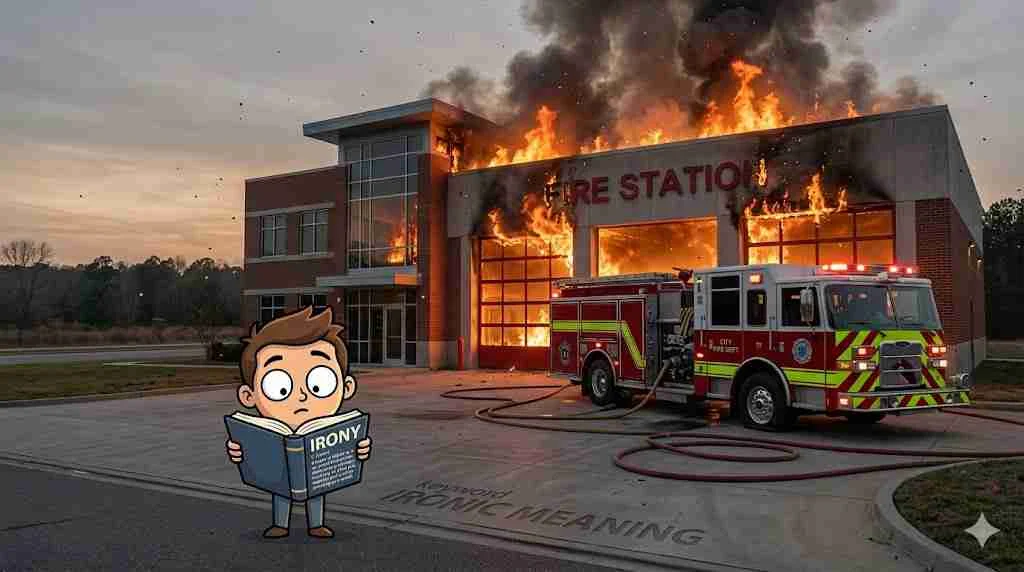
But here’s the truth. Rain on your wedding day isn’t ironic. It’s just disappointing. A traffic cop getting a speeding ticket? Now that’s closer. A fire station burning down? Yes. That’s the real ironic meaning.
So what does ironic actually mean?
Let’s clear this up once and for all.
What Does Ironic Mean in Plain English
Here’s the simplest definition I can give you.
Ironic meaning: A situation where reality does the exact opposite of what you expect. Or someone says the opposite of what they actually mean. And there’s a kind of quiet, sometimes dark humor in that gap.
That’s it. Expectation vs reality. With a twist.
The word “ironic” describes things that have this quality. An ironic comment. An ironic twist. And an ironic situation.
The word “irony” is the noun. You can say “the irony of it all” but you wouldn’t say “that’s so irony.” You’d say “that’s so ironic.”
Quick example to lock it in:
“It’s ironic that the safety instructor drowned in a pool.”
Why? Because you expect a safety expert to be the safest person around. Reality flipped that expectation. That contradiction creates the ironic meaning.
Not every surprising thing is ironic. Surprise alone doesn’t count. There has to be a meaningful clash between what should happen and what actually happens.
Think of it this way. Irony is the universe telling a joke you didn’t ask for. Sometimes you laugh. Sometimes you wince. But you always notice the contradiction.
The Three Types of Irony You Actually Need to Know
Most people don’t realize there are three distinct types. Each one works differently. Each one shows up in different places.
Let’s break them down.
Verbal Irony | Saying the Opposite
This is the simplest type. You say one thing but mean another.
You step in a puddle. Your shoes are soaked. You look down and say “Perfect.”
You don’t mean perfect. And you mean the complete opposite. But you use the word “perfect” to highlight how imperfect things really are.
That’s verbal irony.
Here’s another one. Your friend shows up two hours late. You smile and say “Nice of you to make it on time.”
You’re not confused about the clock. You’re using irony to point out the delay.
Key fact: Verbal irony is the most common type in everyday conversation. Linguists estimate we encounter verbal irony multiple times per day, often without noticing it.
But here’s where people get tripped up.
Sarcasm is a form of verbal irony. But not all verbal irony is sarcasm.
The difference comes down to intent and tone.
| Feature | Verbal Irony | Sarcasm |
|---|---|---|
| Intent | Point out contradiction | Mock or insult |
| Tone | Can be neutral or dry | Usually sharp or bitter |
| Target | Situation or idea | Specific person |
| Emotion | Amused or matter-of-fact | Contemptuous or frustrated |
Example of verbal irony without sarcasm:
“I love waiting in line for an hour.” (Said with a tired smile, no target)
Example of sarcasm:
“Wow, you’re a genius.” (Said after someone makes a dumb mistake)
Both say the opposite of what they mean. But one attacks. The other just observes.
Situational Irony | Life’s Unexpected Punchline
This is what most people try to describe when they misuse the word “ironic.”
Situational irony happens when an outcome directly contradicts what anyone would reasonably expect.
Not a small surprise. A true flip.
The fire station burning down is the gold standard example.
Why? Because firefighters know fire. They have equipment. They train daily. So when their own building catches fire, reality mocks expectation.
Another example:
A vegan leather jacket made of plastic. You want to avoid animal products. But you end up buying petroleum-based material that harms the planet in a different way. That’s ironic.
A spelling bee champion misspelling the word “misspell” on live television. The irony writes itself.
Important distinction: Coincidence is not situational irony.
Let me show you the difference.
| Situation | Ironic? | Why |
|---|---|---|
| You think of a friend then they call | No | No expectation flip. Just timing. |
| A lifeguard drowns | Yes | Lifeguards prevent drowning. Their own drowning flips expectation. |
| You wear the same shirt as a stranger | No | Random match. No contradiction. |
| A marriage counselor gets divorced | Yes | They advise others on marriage. Their own marriage fails. That’s the flip. |
See the pattern? Irony requires a direct clash between the expected and the real.
Dramatic Irony | The Audience Knows First
This one lives mostly in stories, movies, and plays.
Dramatic irony happens when you know something that a character doesn’t. You watch them make a mistake. You want to yell at the screen. But you can’t. They just walk into the trap.
Classic example:
In horror movies, you see the killer hide in the closet. The teenage girl walks toward that same closet. You scream “Don’t open it!” She opens it anyway.
That tension? That’s dramatic irony.
Shakespeare used this constantly. In Romeo and Juliet, the audience knows Juliet isn’t really dead. But Romeo doesn’t. So he drinks poison. You sit there helpless. That’s dramatic irony at its most painful.
Fun fact: Dramatic irony is one of the oldest literary devices. Ancient Greek playwrights used it thousands of years ago. The word “dramatic” comes from “drama” (a play), not from “dramatic” meaning overly emotional.
You can also find dramatic irony in daily life, though it’s less common.
Example: You know your coworker’s surprise party plan. Your other coworker complains “No one ever does anything nice for me.” You smile and nod. That’s mild dramatic irony.
Ironic vs Sarcastic vs Coincidental | Stop Confusing Them
This is where most people stumble. Let me fix it for you permanently.
Here’s a simple three-part test for any situation.
Ask yourself:
- Does someone say the opposite of what they mean? That’s verbal irony (possibly sarcasm).
- Does reality do the opposite of what anyone expects? That’s situational irony.
- Do you know something another person doesn’t? That’s dramatic irony.
If none of those fit? It’s not ironic.
Now let’s kill a few common myths.
Myth 1: “Irony” means “unfortunate coincidence.”
No. A coincidence is two things happening at once. Irony is a contradiction. A friend visiting from out of town the same week you leave? That’s bad timing. Not ironic.
Myth 2: “Ironic” and “sarcastic” are the same.
Sarcasm is a sharp, mean version of verbal irony. Verbal irony can be gentle or neutral. Sarcasm always has a sting.
Myth 3: Dramatic irony only exists in Shakespeare.
False. You see it in every thriller, every romance movie, every crime show. Anytime you know the twist before the hero does? That’s dramatic irony.
Quick reference table for clarity:
| Term | Definition | Example |
|---|---|---|
| Verbal Irony | Say opposite of meaning | “Great weather” during a storm |
| Sarcasm | Verbal irony + mockery | “Nice job, Einstein” after a mistake |
| Situational Irony | Reality contradicts expectation | Traffic cop gets a ticket |
| Dramatic Irony | Audience knows more than character | You know the killer is inside |
| Coincidence | Random alignment of events | Meeting a friend in another country |
| Bad luck | Unfortunate but expected outcome | Rain on a picnic |
Here’s a bold statement: Most viral “ironic” memes get the definition wrong. That includes Alanis Morissette’s famous song. The track “Ironic” lists several situations. Most aren’t actually ironic. A fly in your Chardonnay? That’s annoying. Not ironic. A no-smoking sign on your cigarette break? Getting closer. But still not quite right.
The real irony? A song about irony that doesn’t understand irony. That’s actually ironic.
Real-Life Ironic Meaning Examples You’ve Actually Seen
Let’s get concrete. Here are real situations where the ironic meaning jumps out.
Example 1: The vegan leather jacket
You care about animals. You refuse to wear cowhide. So you buy a “vegan leather” jacket made of polyurethane. That’s plastic. Plastic comes from fossil fuels. Fossil fuels destroy habitats and harm wildlife. You wanted to help animals but you bought a petroleum product. That’s ironic.
Example 2: The therapist who fears people
A licensed therapist. Years of training. They help patients overcome social anxiety. But they themselves feel terrified of conversations. They cancel sessions. They avoid eye contact. The expert on connection can’t connect. Ironic.
Example 3: The anti-technology blogger
Someone writes a popular blog about the dangers of smartphones. They preach digital minimalism. Then a data leak reveals they own five phones and spend nine hours a day on social media. The person warning you about tech can’t quit tech. That’s situational irony.
Example 4: The safe driver’s accident
A man brags about his perfect driving record. Zero tickets. Zero crashes. “I’m the safest driver you’ll ever meet,” he says. He crashes into a parked car while leaving the parking lot. The boast and the crash happen minutes apart. Ironic.
Notice the pattern in every example:
- Expectation forms first
- Reality delivers the opposite
- The contradiction feels meaningful, not random
That’s the ironic meaning in action.
Why Language Models and Humans Struggle with Ironic Meaning
This section gets a little technical. Stick with me. It’s fascinating.
Irony breaks normal communication rules. Most of the time, when someone says “nice day,” they mean the weather is nice. When they say “great job,” they mean your work was good.
Irony flips that.
Someone says “nice day” during a hurricane. They mean the opposite. But a computer reading those words sees positive sentiment. “Nice” is positive. “Day” is neutral. The model predicts a positive meaning. Wrong.
The NLP problem in plain terms:
Sentiment analysis models look for positive or negative words. “Love” = positive. “Hate” = negative. Irony takes a positive word and uses it in a negative situation. The model gets confused.
Example for NLP researchers:
Input sentence: “Oh great, another email.”
- Literal meaning: great = positive. email = neutral. Total = positive.
- Ironic meaning: speaker feels annoyed. Negative sentiment.
- The gap between literal and intended meaning is the irony.
Modern language models like GPT-4 and BERT handle this better than older systems. But they still make mistakes. Why?
Three reasons irony is hard for AI:
- No tone of voice. In speech, you hear the sarcastic lilt. In text, that’s gone.
- World knowledge required. To know a fire station shouldn’t burn, the model must understand what fire stations are and what firefighters do.
- Intent isn’t explicit. Irony requires guessing what the speaker really thinks. Models don’t “think.” They predict patterns.
How context-aware models improve:
Newer models use surrounding sentences to guess intent. If sentence one says “I love Mondays” and sentence two says “My alarm didn’t go off and I missed the meeting,” the model might flag the first sentence as ironic.
But it’s not perfect. A 2023 study found that even advanced models misclassify ironic statements about 15-20% of the time. Humans aren’t perfect either. But we do better because we understand contradiction and intent.
Word sense disambiguation (WSD) helps here.
WSD is a technical term for figuring out which meaning of a word applies in context. The word “great” has multiple meanings. In “great job,” it’s praise. In “oh great,” it’s often sarcasm. WSD algorithms try to pick the right one. Irony makes this much harder.
Pragmatics is the deeper field here.
Pragmatics studies how context changes meaning. Irony is a purely pragmatic phenomenon. The literal words don’t change. The situation changes their meaning. That’s why irony is so interesting to linguists and NLP engineers.
How to Spot Ironic Meaning in Writing or Speech
You don’t need a linguistics degree to catch irony. You just need a checklist.
Use this five-step test whenever you’re unsure.
Step 1: Identify the literal meaning.
What do the words actually say? Write it down if you need to.
Step 2: Identify the situation.
What’s happening in reality? What does anyone expect to happen?
Step 3: Compare them.
Do they match? If yes, no irony. If no, move to step 4.
Step 4: Check for a meaningful contradiction.
Is the mismatch just random or bad luck? Or does it feel like a deliberate flip? A meaningful contradiction has a kind of poetic logic. A random mismatch is just noise.
Step 5: Consider the speaker’s likely intent.
Would a reasonable person in this situation mean the opposite of their words? If yes, you’ve found verbal irony. If the situation itself flipped expectation, you’ve found situational irony.
Quick real-time example:
Someone says “Great job” after you drop a plate.
- Literal meaning: your job was great.
- Situation: you dropped a plate. That’s not great.
- Contradiction? Yes, a clear one.
- Speaker’s intent? They don’t mean “great.” They mean “you messed up.”
- Conclusion: Verbal irony. Possibly sarcasm depending on tone.
Now apply the same test to “It’s raining on my picnic. How ironic.”
- Literal meaning: It’s raining.
- Situation: You expected sunshine for your picnic.
- Contradiction? Weather changed. That’s not a meaningful flip. Rain during a picnic is normal bad luck.
- Speaker’s intent? They feel frustrated but there’s no deeper contradiction.
- Conclusion: Not ironic. Just unfortunate.
Common Mistakes and How to Fix Them
Let me save you from the most embarrassing errors.
Mistake 1: Calling any weird coincidence ironic.
We covered this. But it’s worth repeating. A coincidence is random alignment. Irony is a meaningful contradiction. They are not the same.
Wrong: “It’s ironic that I ran into my ex at the grocery store.”
Why wrong: Running into someone is random. There’s no expectation flip. You didn’t expect to avoid them forever. It’s just an awkward moment.
Right: “It’s ironic that my ex, who always said grocery shopping was a waste of time, now works at a grocery store.”
See the difference? The second one has a contradiction. The person criticized grocery shopping but now depends on it for income. That’s ironic.
Mistake 2: Using “ironically” as a fancy way to say “unfortunately.”
This happens all the time in writing. People write “Ironically, I forgot my keys.” No. Forgetting keys isn’t ironic. It’s forgetful.
Wrong: “Ironically, it started snowing right after I put away my winter coat.”
Why wrong: Snow after storing a coat is bad timing. Not a meaningful contradiction. The coat isn’t related to the snow.
Right: “Ironically, I put away my winter coat to make room for summer clothes then a blizzard hit the next day.”
Still borderline. A stronger example: “Ironically, I bought a heavy winter coat to prepare for the coldest month on record then the temperature hit 70 degrees every single day.”
Now the expectation (coat = needed for cold) and reality (no cold) clearly clash.
Mistake 3: Confusing dramatic irony with suspense.
Suspense is “what will happen next?” Dramatic irony is “I know what happens next but the character doesn’t.” Different feelings.
Wrong: “There was dramatic irony when the hero entered the dark room.”
Why wrong: That’s just suspense. Dramatic irony requires you to know something specific the hero doesn’t.
Right: “There was dramatic irony when the hero entered the dark room because we had already seen the villain hide behind the door.”
Now you have the knowledge gap. That’s dramatic irony.
Mistake 4: Thinking all verbal irony is sarcasm.
Sarcasm is a subset of verbal irony. Not all verbal irony is sarcastic.
Wrong: “She used sarcasm when she said ‘lovely weather’ during the flood.”
Check: Was there mockery? Was the intent to insult someone? If not, it’s just verbal irony. Not sarcasm.
Right: “She used verbal irony when she said ‘lovely weather’ during the flood. It wasn’t sarcastic because she wasn’t mocking anyone. She was just pointing out the absurdity.”
The Alanis Morissette Problem | A Teachable Moment
Let’s talk about the song. You know the one.
“Ironic” by Alanis Morissette came out in 1995. It’s a great song. Catchy. Emotional. But it’s also the biggest source of ironic confusion in pop culture history.
Let’s review the lyrics.
“An old man turned ninety-eight. He won the lottery and died the next day.”
Is that ironic? Not really. Winning the lottery then dying is sad. But there’s no contradiction. Old people die. Winning money doesn’t prevent death. It’s just bad timing.
“It’s like rain on your wedding day.”
No. Rain on a wedding day is unlucky. Not ironic. You expect weather to be unpredictable. Rain is a normal possibility.
“A no-smoking sign on your cigarette break.”
This one is closer. You take a break to smoke. The sign says don’t smoke. That’s a mild contradiction. But it’s more of an inconvenience than true irony.
“It’s like ten thousand spoons when all you need is a knife.”
That’s just poor kitchen design. Not ironic.
The real irony of the song “Ironic”:
A song titled “Ironic” that lists situations which mostly aren’t ironic. That is actually ironic. The expectation is that the songwriter understands irony. Reality suggests she didn’t at the time. Contradiction achieved.
Morissette has since acknowledged this. In later interviews, she said the song’s title became ironic because of how people reacted. That’s a good recovery.
Ironic Meaning in Literature and Storytelling
Writers love irony. It adds depth. It creates surprise. And it makes readers feel smart.
Verbal irony in books:
Jane Austen’s Pride and Prejudice opens with one of the most famous ironic lines in English literature:
“It is a truth universally acknowledged, that a single man in possession of a good fortune, must be in want of a wife.”
Austen doesn’t mean this literally. She means the opposite. Rich men don’t necessarily want wives. But society pushes them to marry. The irony sets the tone for the entire novel.
Situational irony in short stories:
O. Henry mastered situational irony. His story “The Gift of the Magi” is a perfect example. A wife sells her hair to buy her husband a watch chain. The husband sells his watch to buy her combs for her hair. Each sacrifices what the other wanted. The outcome completely flips expectation. That’s situational irony at its finest.
Dramatic irony in modern TV:
Every thriller uses dramatic irony. In Breaking Bad, you know Walt is lying to Skyler. She doesn’t. Every scene where she asks “How was work?” while you know he cooked meth is dripping with dramatic irony. The tension comes from your superior knowledge.
Why irony works in stories:
Irony engages the audience. Verbal irony makes dialogue feel real because people use it constantly. Situational irony creates memorable twists. Dramatic irony builds unbearable suspense. A writer who masters all three types controls the reader’s emotions.
A Complete Reference Table | Ironic Meaning at a Glance
| Question | Answer |
|---|---|
| What is ironic meaning in one sentence? | A contradiction between expectation and reality or between literal words and intended meaning. |
| What are the three types of irony? | Verbal, situational, dramatic. |
| Is sarcasm the same as irony? | No. Sarcasm is a sharp form of verbal irony. |
| Is coincidence ironic? | No. Coincidence is random alignment. Irony is meaningful contradiction. |
| Can a single sentence be ironic? | Yes. “What a beautiful day” during a storm is verbally ironic. |
| Can an image be ironic? | Yes. A “No Diving” sign next to an empty pool. |
| Can a situation be ironic without anyone speaking? | Yes. That’s situational irony. The fire station burning down needs no words. |
| Is dramatic irony only for fiction? | Mostly, but you can find mild examples in real life (surprise parties, hidden gifts). |
| Do all cultures use irony? | Most do, but frequency and recognition vary. Some cultures prefer direct communication. |
| Why is irony hard for AI? | Because irony requires understanding context, intent, and world knowledge. |
How to Use Ironic Meaning Correctly in Your Own Writing
You don’t need to be a professional writer to nail irony. Just follow these guidelines.
Guideline 1: Always ask “What does the reader expect?”
Before you call something ironic, state the expectation out loud. Then state the reality. If they aren’t direct opposites, it’s not irony.
Guideline 2: Avoid irony when clarity matters.
Irony confuses people who don’t share your context. In safety instructions, legal documents, or technical manuals? Skip irony entirely. Be direct.
Guideline 3: Use verbal irony sparingly in writing.
Without tone of voice, readers might miss your irony. Signal it with context. Put the ironic sentence next to a clear factual one so readers can spot the contrast.
Example of well-signaled verbal irony:
“The meeting only lasted three hours. I said ‘efficient’ as I rubbed my sore back.”
The word “efficient” contradicts the three-hour meeting. The back-rubbing action signals the real feeling.
Guideline 4: For situational irony, build expectation first.
Describe what anyone would expect. Then hit them with the opposite reality. The gap creates the irony.
Weak: “It was ironic when the chef burned his hand.”
Strong: “The chef had cooked for forty years without a single burn. He gave safety seminars. He mocked other chefs for their carelessness. Then he burned his hand reaching for a coffee mug. Not even cooking. Just a mug.”
Now the irony lands because you feel the expectation.
Guideline 5: Use dramatic irony to create tension.
Give your reader information that a character lacks. Then show the character making decisions based on incomplete knowledge. Your reader will feel anxious, amused, or both.
Final Test | Can You Spot the Irony Now?
Let’s check your understanding. Read each situation. Decide if it’s ironic. Then check your answer.
Situation 1: A pilot has a fear of heights.
Answer: Ironic. You expect a pilot to be comfortable with heights. Fear of heights directly contradicts that expectation.
Situation 2: You buy a new umbrella. That same day, it doesn’t rain.
Answer: Not ironic. Not raining after buying an umbrella is normal. No meaningful contradiction.
Situation 3: A sign that says “We don’t need signs to tell us what to do.”
Answer: Ironic. The sign itself is a sign telling you what to do. The message contradicts its own existence.
Situation 4: A dentist with crooked teeth.
Answer: Ironic. Dentists fix teeth. Their own crooked teeth contradict their professional role.
Situation 5: You dream about falling then wake up on the floor.
Answer: This is borderline. The expectation is that dreams aren’t real. Waking up on the floor blurs that line. Many would call this ironic. Purists might say it’s just a funny coincidence.
Situation 6: A social media influencer posting “Log off and touch grass.”
Answer: Ironic. The person telling you to log off makes money by keeping you online. Contradiction.
How did you do? If you got at least four right, you understand ironic meaning better than most people.
Why Getting Ironic Meaning Right Matters
You might think this is just grammar nerd stuff. It’s not.
Using words correctly builds trust. When you say something is ironic and it’s not, people notice. They might not correct you out loud. But they silently judge. They think “this person doesn’t know what they’re talking about.”
That’s fine among friends. But in writing, in professional settings, in anything public? Precision matters.
More importantly, understanding irony helps you understand people. Irony is a sophisticated form of communication. It requires reading between the lines. It requires noticing contradictions. People who miss irony miss meaning. They take sarcastic comments literally. They miss the humor in dark situations. And they don’t understand why a movie scene feels tense.
Learning ironic meaning isn’t just vocabulary. It’s learning how humans layer meaning on top of words.
FAQs
Q1: Is “rain on your wedding day” actually ironic?
No. That’s just bad luck. For it to be ironic, the rain would need to directly contradict something specific like if you married a meteorologist who guaranteed sunshine. Otherwise, it’s an unfortunate coincidence, not irony.
Q2: What’s the fastest way to tell if something is ironic?
Run the expectation test. Ask yourself: “What did I expect to happen?” Then ask: “What actually happened?” If those two answers aren’t direct opposites, it’s not ironic. If they are opposites and the contradiction feels meaningful, you’ve got irony.
Q3: Can a single word be ironic?
Yes. Saying “Great!” after stubbing your toe is verbally ironic. That one word carries the opposite meaning of how you actually feel. The shorter the statement, the harder irony can hit.
Q4: Is dramatic irony only for movies and books?
Mostly yes, but you see small doses in real life. When you hide a friend’s birthday gift and they say “I guess everyone forgot about me,” that’s mild dramatic irony. You know something they don’t. But full dramatic irony works best in stories where the audience stays in on the secret.
Q5: Why does everyone get irony wrong so often?
Blame the Alanis Morissette song and decades of social media misuse. People hear “ironic” used incorrectly so many times that the wrong meaning starts to feel right. Add in the human habit of wanting fancy words for ordinary situations, and confusion spreads fast.
Conclusion
Irony isn’t some elite literary secret. It’s just contradiction with a point. Verbal irony flips your words. Situational irony flips your expectations. Dramatic irony flips who knows what. Master these three and you’ll never be the person who calls a parking ticket “ironic” again.
So use the word with confidence now. Test each situation against expectation. If the mismatch feels meaningful and a little surprising? Call it ironic. If not? Just call it what it is bad luck, coincidence, or a bummer. Your vocabulary will thank you, and so will everyone who has to listen to you explain things.
Discover More Related Articles:
- “Cap” Slang Meaning: From Street Language to Social Media in 2026
- “Glaze” Meaning Slang: What It Really Means in Internet Conversations In 2026
- “67” Meaning Slang: How It’s Used in Online Conversations In 2026