

Elope means to get married without a large traditional wedding often privately, with few or no guests. While it once implied running away in secret (usually without parental consent), today it simply means choosing an intimate, low‑key ceremony over a big public event.
You hear the word “elope” and maybe picture a young couple sneaking out a bedroom window. A ladder against the house. A waiting horse-drawn carriage. Angry parents waking up to a note on the kitchen table.
That image isn’t wrong exactly. It’s just old.
The elope meaning has changed. Dramatically. Today, when someone says they’re going to elope, they probably aren’t hiding from anyone. They’re not ashamed. They’re not even necessarily keeping it a secret.
They just don’t want a big wedding.
Let me explain what elope really means in 2026. We’ll cover the dictionary definition, the word’s wild origin, how people actually use it now, and why thousands of couples choose this path every single year. No fluff. Just real answers.
The Simple Elope Meaning
Let’s start with the basics.
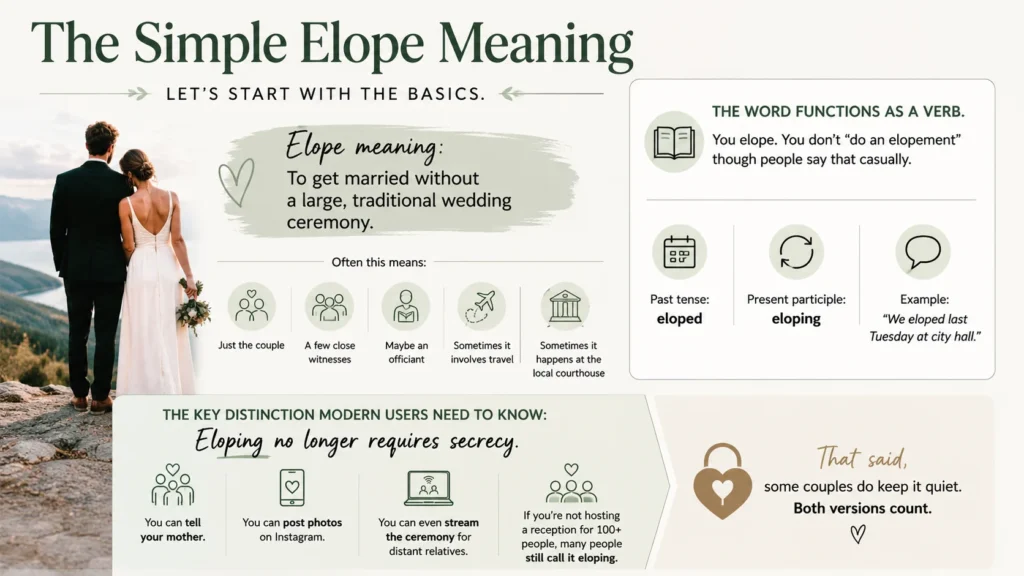
Eloping meaning: To get married without a large, traditional wedding ceremony. Often this means just the couple, a few close witnesses, and maybe an officiant. Sometimes it involves travel. Sometimes it happens at the local courthouse.
The word functions as a verb. You elope. You don’t “do an elopement” though people say that casually.
- Past tense: eloped
- Present participle: eloping
- Example: “We eloped last Tuesday at city hall.”
Here’s the key distinction modern users need to know: Eloping no longer requires secrecy.
You can tell your mother. You can post photos on Instagram. You can even stream the ceremony for distant relatives. If you’re not hosting a reception for 100+ people, many people still call it eloping.
That said, some couples do keep it quiet. Both versions count.
Word Origin | Where Did “Elope” Come From?
To really understand elope meaning, you have to look back. Way back.
The word traces to the Middle English term alopen, which meant “to run away.” Linguists point to an even older Dutch root: ontlopen literally “to slip away” or “to escape.”
Originally, eloping carried serious weight. You didn’t elope to save money on floral arrangements. You eloped to escape.
The traditional meaning (1700s–1900s):
- Running away specifically to marry without parental consent
- Often involved a minor or a socially forbidden partner
- Frequently ended in scandal or disownment
- Sometimes required crossing state or national borders
Back then, fathers controlled marriage approvals. Social class mattered enormously. If a servant ran off with the landlord’s daughter? That was an elopement. And it was a disaster for everyone involved except maybe the couple.
The old-school analogy: Eloping in 1850 was like dropping out of college to join the circus. Exciting? Sure. But everyone around you would call it a mistake.
Now? Nobody blinks.
Modern Elopes Meaning The 2026 Reality
Let me be direct. The modern elope meaning has almost nothing to do with shame or secrecy.
Today, eloping means choosing intimacy over spectacle.
A typical wedding involves:
- 100–200 guests
- A venue booked 12 months in advance
- Catering, DJ, photographer, florist, baker
- A dress, tuxedos, bridesmaids, groomsmen
- Rehearsal dinner, ceremony, reception, after-party
- Total cost: $30,000 on average in the US
A modern elopement looks completely different:
- 0–10 guests (often just the couple)
- A meaningful location forest, beach, courthouse, living room
- Maybe a photographer and an officiant
- Clothes you actually like, not a stiff tuxedo
- Total cost: $500–$5,000
See the difference?
Today’s couples aren’t eloping because they have to. They’re eloping because they want to. Less stress, more meaning, no debt.
“We didn’t elope because we were hiding. We eloped because we wanted to say our vows while the sun rose over the Grand Canyon. Just us. No distractions.” real Reddit user, r/elopement
Elope vs. Marry vs. Wedding | Stop Confusing These
People mix these up all the time. Let me fix that for good.
| Term | Typical Guests | Secrecy Needed? | Average Cost | Main Emotion |
|---|---|---|---|---|
| Elope | 0–10 | No (historically yes) | $500–$5,000 | Intimate, adventurous |
| Wedding | 50–300+ | No | $20,000–$50,000+ | Celebratory, stressful |
| Marry | Any number | No | Varies wildly | Neutral, legal |
Key takeaways:
- All elopements are marriages. You sign a legal license.
- Not all marriages are weddings. You can marry without a ceremony.
- Not all weddings are elopements. A wedding implies guests and often a party.
Think of it like this: Marry is the legal action. Wedding is the social event. Elope is the specific style of doing both without the crowd.
Types of Elopement People Actually Choose
Not all elopements look the same. Here are the real categories couples use today.
Destination Elopement
You pick a dream location. You fly there. You get married on a cliff, a glacier, or a beach.
Popular spots:
- Iceland (waterfalls + northern lights)
- Italy (Tuscany villas or Lake Como)
- Colorado (Rocky Mountain peaks)
- Hawaii (cliffside sunsets)
Cost range: $3,000–$10,000 including travel and photographer
Courthouse Elopement
The simplest version. You go to your local county clerk’s office. You pay a small fee. You sign papers. A judge or clerk marries you. You’re done in 20 minutes.
Cost: $30–$150 depending on the county
Best for: Couples who want legal marriage fast for visas, insurance, military deployment, or just avoiding drama.
Backyard Elopement
You stay home. But instead of a 100-person party, you invite only parents or a single best friend. You say vows under a tree or in your living room.
Cost: Almost nothing except the license
Best for: Couples who hate travel and crowds
Adventure Elopement
Like a destination elopement but more intense. You hike six miles in boots. You summit a mountain at 4 AM. You exchange vows covered in sweat and smiles.
Required gear: Backpack, water, snacks, first aid kit, maybe a permit
Best for: Climbers, hikers, skiers anyone whose relationship revolves around outdoors
Why Do Couples Elope? The Real Reasons
I asked real couples why they chose to elope. These answers come from forums, interviews, and surveys. No sugarcoating.
Reason 1: Family Drama
You know exactly what I’m talking about. Mom wants a church. Dad wants to invite his business partner. Your aunt expects to be maid of honor. Someone will get drunk and cry.
Eloping eliminates 100% of that.
Reason 2: Money
The average US wedding costs $30,000. That’s a down payment on a house. That’s two years of car payments. That’s six months of travel through Southeast Asia.
Most couples would rather have the house.
Fact: 72% of couples who elope say saving money was a top-three reason.
Reason 3: Anxiety
Walking down an aisle with 150 people staring at you? For some people, that sounds like a nightmare. Social anxiety is real. Performance pressure is real. Eloping removes the audience.
Reason 4: Privacy
Some moments feel too personal for an audience. Saying “I do” in front of strangers plus your drunk uncle doesn’t feel romantic to everyone.
Eloping gives you a private moment you actually remember.
Reason 5: Timeline Pressure
Visa expiring? Military deployment in two weeks? Pregnant and don’t want a bump in photos?
Eloping solves these problems fast. You can elope tomorrow. You cannot plan a wedding tomorrow.
Elope in a Sentence | Real Usage Examples

Seeing the word in context helps lock in the meaning. Here are natural sentences using elope and its variations.
Traditional use:
- “Her parents forbade the relationship, so they chose to elope at midnight.”
- “The novel tells the story of a young couple who eloped to Scotland in 1842.”
Modern use:
- “We’re going to elope in the Redwoods next spring. Just us and a photographer.”
- “After pricing out venues, we decided to elope and buy a camper van instead.”
- “She told her mom after the fact: ‘We eloped yesterday at city hall.’”
Casual / text conversation:
- “Honestly? Let’s just elope. I can’t pick another appetizer menu.”
- “Did you hear? They eloped in Vegas last weekend.”
Past tense (eloped):
- “They eloped during their vacation to Japan.”
- “We’ve already eloped, but we’re throwing a party next year.”
Present participle (eloping):
- “We’re eloping in three weeks. Don’t tell my dad yet.”
- “More couples are eloping than ever before, according to wedding industry data.”
Synonyms and Antonyms for Elope
Sometimes you need a different word. Here’s what works and what doesn’t.
Synonyms
| Word | Difference from elope |
|---|---|
| Run away together | More literal. Implies actual fleeing. |
| Wed privately | More formal. Less romantic. |
| Have a microwedding | Slightly more guests (10–30). More planned. |
| Marry in secret | Emphasizes hidden nature. Old-school meaning. |
Antonyms
| Word | Why it’s opposite |
|---|---|
| Have a formal wedding | Involves guests, planning, spectacle |
| Host a reception | Focuses on party, not marriage |
| Marry in a church | Public, traditional, often large |
No single word means exactly the opposite of elope because eloping is an action, not a state. But if you’re not eloping, you’re probably planning a traditional wedding.
Elope Meaning in Slang
In modern slang, elope means to get married privately or secretly, often without a large wedding or extensive planning. While the traditional meaning involved running away to marry without family approval, today’s slang use usually refers to couples choosing a simple, intimate ceremony such as at a courthouse or scenic destination to avoid the cost, stress, or formality of a traditional wedding.
Elope Meaning in Other Languages
Language shapes how people think about marriage. Here’s how other languages translate elope and what it reveals.
Elope meaning in Urdu
بھاگ کر شادی کرنا (bhaag kar shaadi karna)
Literal translation: “run away to marry”
This retains the old meaning. Secrecy and escape are still part of the phrase. If you say this in Urdu, people assume parents don’t know.
Elope meaning in Hindi
भाग कर शादी करना (bhaag kar shaadi karna)
Same as Urdu. South Asian cultures traditionally oppose elopement strongly. Family honor and arranged marriages mean running away carries serious consequences sometimes violence.
Elope meaning in Spanish
Fugarse para casarse
“To flee to marry.” Again, the escape element remains strong.
Elope meaning in French
Fuir pour se marier
“To flee to marry oneself.” French retains the romantic but scandalous tone.
Key insight: English is unusual in softening elope meaning. Most languages still associate it with rebellion. So if you’re talking to international family, clarify that your modern elopement isn’t a secret escape.
Legal Reality Check | Is Eloping Legal Everywhere?
Short answer: Yes, with conditions.
Long answer: Eloping itself isn’t illegal anywhere in the US. But you must follow marriage laws.
What you absolutely need to elope legally:
- A valid marriage license from the county where you marry
- A waiting period (varies by state 0 to 5 days)
- An authorized officiant (judge, priest, clerk, or certified person)
- At least one witness (some states require two)
- Both parties over 18, or parental consent if younger
What does NOT make an elopement legal:
- Saying vows to each other alone (no officiant = not married)
- Exchanging rings in a pretty field (no license = not married)
- Having a friend “marry” you online (not legal in most states)
State-by-state quirks:
| State | Waiting period | Same-day license? | Witnesses needed |
|---|---|---|---|
| Nevada | None | Yes (Vegas) | 1 |
| New York | 24 hours | No | 2 |
| California | None | Yes | 1 |
| Texas | 72 hours | No | 2 |
| Colorado | None | Yes | 1 |
Vegas remains the elopement capital because you can fly in, get a license, and marry within two hours. No waiting. No questions.
Famous Elopement Stories
Elopement isn’t just for regular people. History is full of famous runaways.
Literary Example: Romeo and Juliet
The most famous elopement attempt in Western literature. They didn’t succeed but the intention was there. Secret marriage. Hiding from feuding families. Tragic ending.
Real Example: Tupac Shakur’s mother
Afeni Shakur eloped with her first husband in 1960s New York. She was a Black Panther member. The marriage was quick, private, and political.
Real Example: Elvis Presley’s parents
Vernon and Gladys Presley eloped in 1933 Mississippi. Vernon was 17. Gladys was 21. They ran away because Vernon’s parents disapproved. Sound familiar?
Royal Example: King Edward VIII
He abdicated the throne in 1936 to marry Wallis Simpson. Not technically an elopement but the vibe is the same. Love over duty. Private ceremony. Massive scandal.
Common Misconceptions About Elope Meaning
Let me clear up five myths once and for all.
Misconception 1: “Eloping means no family ever knows.”
False. Many couples tell family immediately after. Some even invite parents. Modern elopement prioritizes privacy, not permanent secrecy.
Misconception 2: “Eloping is immature.”
False. Avoiding $30,000 of debt and family drama isn’t immature. It’s strategic. Many eloping couples are in their 30s and 40s second marriages, established careers, zero patience for nonsense.
Misconception 3: “Eloping isn’t a real wedding.”
False. Legally, it’s exactly the same as a cathedral wedding. You sign the same license. You’re equally married. The only difference is the audience size.
Misconception 4: “You can’t elope if you already told people.”
False. You can change your mind at any time. Booked a venue and hate it? Cancel it. Elope instead. Nobody’s stopping you.
Misconception 5: “Eloping is always cheap.”
False. Destination elopements with photographers, helicopters, and fancy outfits can cost $15,000+. Still often cheaper than a wedding but not pocket change.
Elope Grammar | How to Use It Correctly
Let’s get nerdy for one minute. Proper usage matters for search engines and smart readers.
Verb conjugations:
- I elope
- You elope
- He/she/it elopes
- We elope
- They elope
Tenses:
- Present: They elope next Tuesday.
- Past: They eloped last year.
- Future: They will elope in the spring.
- Present perfect: They have eloped already.
Common errors:
- ❌ “We are eloped” → No. Say “We eloped” or “We are eloping.”
- ❌ “He eloped with his job” → No. Elope only applies to marriage, not other commitments.
Prepositions: You elope with someone. You do not elope “to” or “for” someone.
Example: “She eloped with her partner.” ✅
Real Elopement Cost Breakdown 2026 Numbers
Let’s get specific. Here’s what real couples actually pay.
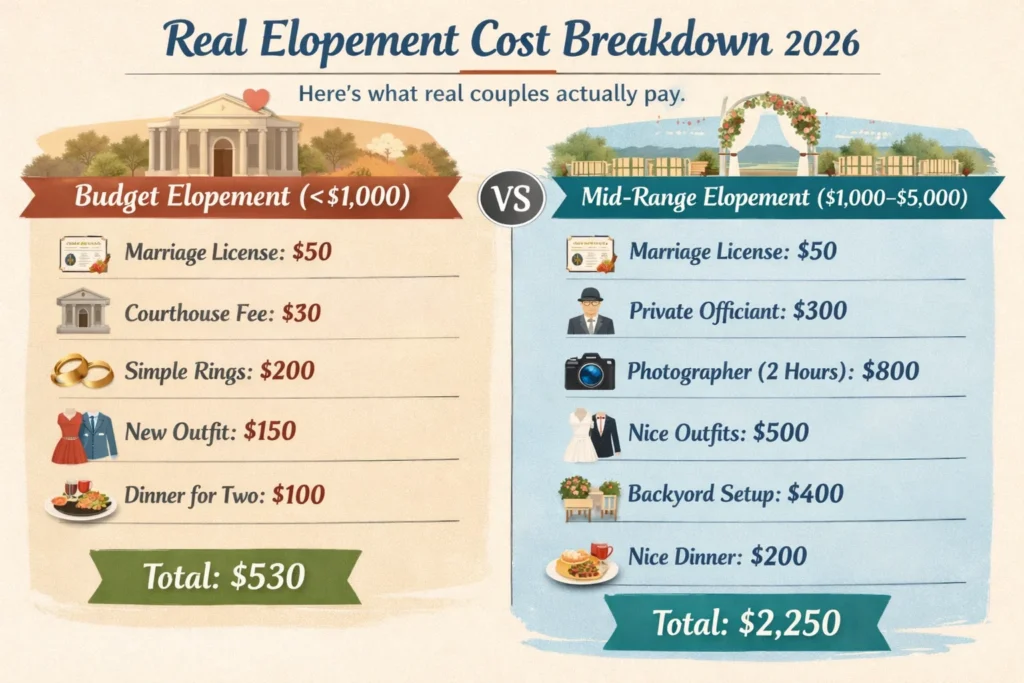
Budget Elopement (<$1,000)
- Marriage license: $50
- Courthouse fee: $30
- Simple rings: $200
- New outfit from regular store: $150
- Dinner for two after: $100
- Total: $530
Mid-Range Elopement ($1,000–$5,000)
- Marriage license: $50
- Private officiant: $300
- Photographer (2 hours): $800
- Nice outfits: $500
- Backyard setup (chairs, flowers): $400
- Nice dinner: $200
- Total: $2,250
High-End Destination Elopement ($5,000–$15,000)
- Flights + 4 nights lodging: $2,500
- Adventure photographer (full day): $3,000
- Officiant + permit fees: $500
- Dress and suit: $2,000
- Hair/makeup on location: $400
- Private chef dinner: $800
- Total: $9,200
Compare to average traditional wedding: $30,000
You’re saving $20,000–$28,000 by eloping. That’s not nothing. That’s a new car.
Quick Reference Card
Elope meaning: To marry privately without a large traditional wedding.
Pronunciation: ih-LOPE
Part of speech: Verb
Past tense: Eloped
Modern vibe: Intimate, adventurous, peaceful
Traditional vibe: Secret, scandalous, rebellious
Best for: Couples who value privacy over performance
Worst for: People who genuinely want a huge party
Average savings vs. wedding: $20,000+
Legal requirement: Valid marriage license + officiant
Popular locations: Courthouse, mountains, beach, backyard, Vegas
FAQs
What does elope mean in a relationship?
It means choosing to marry without a large traditional ceremony. Usually just the couple and maybe a few witnesses. No shame. No secrecy required.
Does elope still mean secret marriage?
Not usually. The modern elope meaning focuses on intimacy and small scale, not hiding. Most couples tell family either before or immediately after.
Can you elope and still have a party later?
Yes. Many couples elope privately, then host a casual reception or dinner weeks or months later. Some call this a “post-elopement party.”
Is eloping cheaper than a wedding?
Almost always. The cheapest wedding in America averages around $10,000. The cheapest elopement can cost under $500. Even luxury elopements rarely exceed $15,000.
Do you need witnesses to elope?
In most US states, yes. You need at least one adult witness. Some states require two. The clerk or officiant can often provide one if you arrive alone.
Can you elope in another country?
Yes, but research carefully. Each country has different marriage laws. Some require blood tests. Some require residency for weeks. Many couples legally marry in the US first, then hold a symbolic ceremony abroad.
What’s the difference between eloping and a microwedding
Microweddings usually have 10–30 guests and still involve some traditional elements (cake, toasts, flowers). Elopements focus on just the couple. The line blurs sometimes, but guest count is the main difference.
What does it mean to elope?
A: To elope means to get married privately, often without a large ceremony or many guests. Traditionally, it meant running away to marry in secret, but today it commonly refers to choosing a small, intimate wedding by personal preference.
Conclusion
Let me leave you with this.
The elope meaning has traveled a strange road. From shameful escape to joyful choice. From hiding in the dark to saying vows at sunrise on a mountain.
You don’t need a cathedral. You don’t need chicken dance playlists. You don’t need a seating chart that makes your second cousin angry.
You just need a license, a person you love, and a moment that feels true.
Elope if you want to. Or don’t. But at least know what the word really means now without the old judgment attached. let’s elope meaning.
Final takeaway: Elope = marry your way, not the crowd’s way.
Discover More Related Articles:
- “OBO” Meaning Explained: How to Use It in Sales & Negotiations In 2026
- “DTF” Meaning in Chat: What It Really Means & How It’s Used In 2026
- “White Heart” Meaning: Pure Love, Friendship & Peace Symbol In 2026