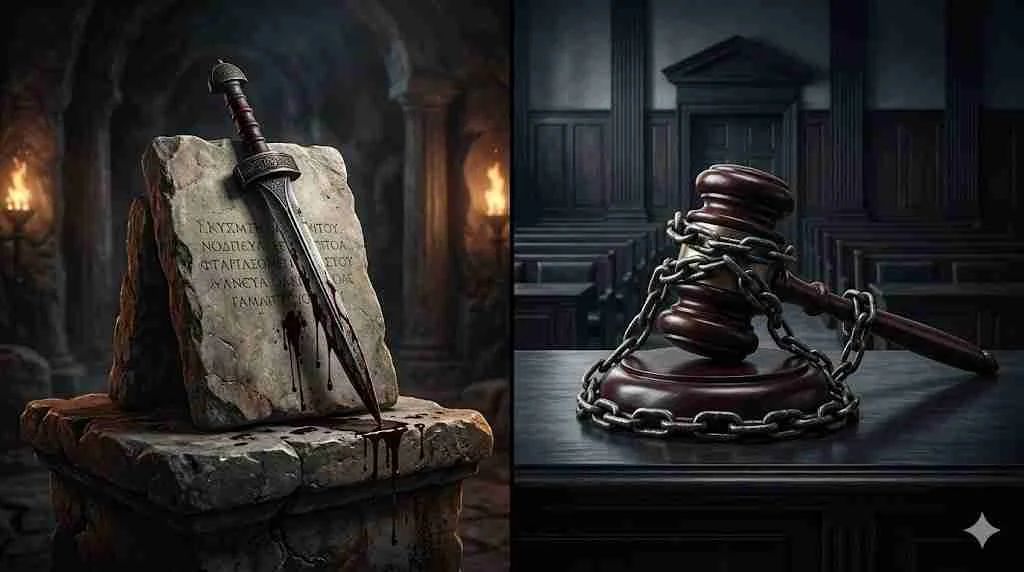

Draconian means excessively harsh and severe way beyond what’s reasonable or necessary. The word traces back to Draco, an ancient Athenian lawmaker who punished even minor crimes with death.
Draconian Meaning
You’ve heard the word before.
“That’s a draconian policy.”
“My landlord has draconian rules.”
“The new government passed draconian laws.”
But have you ever stopped to ask what draconian actually means?
Most people haven’t. They just know it sounds bad. Really bad.
Here’s the truth. The word carries a brutal history. We’re talking about blood, ancient Greece, and a lawmaker who thought death was a reasonable punishment for just about everything.
Let’s unpack the draconian meaning together. No boring dictionary dump. Just clear explanations, wild stories, and practical ways to use the word without messing it up.
The Simple Draconian Definition
Let’s start with the basics.
Draconian (adjective) means excessively harsh and severe. Way beyond what’s reasonable or necessary.
Think of it like this:
| Level of Strictness | Example | Draconian? |
|---|---|---|
| Lenient | No punishment for speeding | No |
| Reasonable | $50 fine for speeding | No |
| Strict | $200 fine + driving school | No |
| Draconian | Prison time for going 5 mph over the limit | Yes |
See the difference?
A strict rule still feels fair. A draconian rule feels cruel. It shocks your sense of justice.
Here’s a quick draconian definition you can actually remember:
Draconian = punishment that doesn’t fit the crime. On purpose.
The word almost always describes laws, policies, rules, regulations, or punishments. You wouldn’t call a spicy pepper draconian. You would call a lifetime ban for a late library book draconian.
Who Was Draco? The Man Behind the Word
Now for the good stuff.
The draconian meaning comes from a real person. His name was Draco.
He lived in Ancient Athens around 621 BCE.
Before Draco, Athens had a problem. A big one. Laws weren’t written down. Only rich aristocrats knew the rules. They changed them whenever they wanted. Regular people had no protection.
So the city leaders picked Draco to fix this. His job? Write the first formal legal code for Athens.
He did exactly that.
And then things got ugly.
Draco’s Laws: Written in Blood
Draco’s legal code covered everything from murder to theft to laziness.
Here’s the catch. Almost every crime carried the same penalty.
Death.
- Stealing a cabbage? Death.
- Lazing around when you should be working? Death.
- Killing someone in self-defense? Still death.
- Sacrilege against the gods? You guessed it. Death.
Only one crime had a lighter punishment. Manslaughter got you exile instead of execution. How generous.
The historian Plutarch described Draco’s laws perfectly. He said they were “written not in ink but in blood.”
That line stuck for over two thousand years. Because it’s true.
Why Did Draco Do This?
You might think Draco was a monster. But history suggests something else.
Draco believed harsh laws created order. He thought leniency led to chaos. In his mind, if people feared punishment enough, they wouldn’t commit crimes at all.
It’s extreme logic. But it’s still logic.
Also, keep the time period in mind. Ancient Greece wasn’t gentle. City-states fought constantly. Violence was normal. Draco’s approach fit the brutal era, even if it horrifies us today.
What Happened to Draco?
The Athenians didn’t love Draco. Shocking, right?
But they didn’t execute him either. They actually celebrated his written code. For the first time, everyone could see the laws. That was progress.
However, Draco fell out of favor politically. He lost power. Then he fled to the nearby island of Aegina.
The legend says he died in a theater. Crowds threw so many cloaks and shirts at him in appreciation that he suffocated. Yes, really. People basically loved him to death.
Historians debate if that actually happened. But it’s a great story.
Solon Replaces Draco
About thirty years later, another Athenian lawmaker named Solon took over. He erased almost all of Draco’s laws. Only the homicide rules stayed.
Solon called Draco’s code too harsh. And that’s coming from an ancient Greek politician.
Ever since, people have used Draco’s name to describe any excessively cruel legal system. That’s how we got the draconian meaning we use today.
Draconian Pronunciation
Let’s avoid embarrassment.
Pronunciation: druh-KOH-nee-uhn
Break it down:
- druh (like “drum” without the m)
- KOH (rhymes with “go”)
- nee (like the knee on your leg)
- uhn (like “fun” without the f)
Say it slowly: druh-KOH-nee-uhn
Common mistakes to avoid:
- Dray-coh-nee-an (wrong)
- Drack-oh-nee-an (wrong)
- Dra-cown-ian (very wrong)
The second syllable gets the stress. KOH is the loud part.
Think of “Draco” (dray-koh) plus “ian” (ee-uhn) smashed together. But the first vowel shifts from “ay” to “uh.” That’s the trick.
Draconian Synonyms
You can’t just swap any harsh word for draconian. Each synonym has its own flavor.
Here’s a practical table:
| Synonym | What It Emphasizes | Example Sentence |
|---|---|---|
| Harsh | General cruelty | “The harsh winter killed the crops.” |
| Severe | Seriousness, no leniency | “The judge gave a severe sentence.” |
| Strict | Rigid enforcement | “Her strict parents tracked her phone.” |
| Oppressive | Weighing down freedom | “The oppressive regime banned protests.” |
| Ruthless | No mercy, cold-blooded | “The ruthless CEO fired everyone.” |
| Authoritarian | Demanding total obedience | “Authoritarian leaders hate dissent.” |
| Stringent | Tight constraints, often financial | “Stringent loan rules hurt buyers.” |
| Unforgiving | No second chances | “The unforgiving terrain killed explorers.” |
Which synonym works best?
Use harsh for general situations. Use severe for formal writing. And use oppressive for political criticism. Use ruthless for people, not laws.
Save draconian for when you mean excessively harsh. Not just strict. Not just firm. Cruel and unreasonable.
Draconian Antonyms
Sometimes the best way to understand a word is to look at its opposite.
| Antonym | Meaning | Example Sentence |
|---|---|---|
| Lenient | Permissive, easygoing | “The lenient teacher gave extensions.” |
| Mild | Gentle, low intensity | “The court issued a mild warning.” |
| Tolerant | Accepting of differences | “A tolerant society allows protests.” |
| Permissive | Allowing much freedom | “Permissive parents set few rules.” |
| Flexible | Adaptable to situations | “Flexible work hours help families.” |
| Compassionate | Showing kindness | “The compassionate judge reduced bail.” |
A lenient policy gives second chances. A draconian policy doesn’t.
A flexible rule changes with context. A draconian rule never bends.
Remember this distinction. It’ll save you from misusing the word.
Draconian Meaning in Law
Let’s get specific. What does draconian mean in a legal context?
Draconian law = A statute or regulation that imposes penalties wildly disproportionate to the offense.
Legal scholars and judges use the term to criticize extreme legislation. It’s not an official legal term. But it carries weight in court opinions, law reviews, and political debates.
Real Examples of Draconian Laws
Three-strikes laws (United States)
California passed its three-strikes law in 1994. A third felony conviction meant 25 years to life in prison. Even if the third strike was nonviolent. Even if it was petty theft.
One man got life for stealing a slice of pizza. Another got 50 years for taking some children’s vitamins.
Critics called these sentences draconian. In 2012, California voters rolled back the law.
Mandatory minimum sentences (Various countries)
Judges once had flexibility. They could look at a defendant’s history, the crime’s context, and mitigating factors.
Mandatory minimums took that away. Commit the crime? Here’s your fixed sentence. No discussion.
For low-level drug offenses, mandatory minimums often produce draconian results. A first-time offender might serve five years for a nonviolent crime.
Historical blue laws (United States and Europe)
Blue laws banned Sunday shopping, sports, and entertainment. The punishment? Fines, jail time, or public shaming.
Connecticut once banned kissing on Sundays. Yes, really. A married couple could technically face punishment for showing affection on the Sabbath.
Most blue laws are gone now. But the draconian ones left a mark on legal history.
Draconian Legal Definition vs. Strict Enforcement
This matters.
Strict enforcement means applying every rule to the letter. No exceptions. But the rule itself might be reasonable.
Draconian law means the rule is unreasonable from the start. Even loose enforcement wouldn’t fix it.
Example:
- Strict enforcement of a 25 mph speed limit = fine for going 26 mph. Annoying but fair.
- Draconian law with that same speed limit = prison for going 26 mph. Absurd.
See the difference?
Draconian Government Policies
Governments love draconian measures. Especially authoritarian ones.
What is a draconian policy? A government rule that restricts basic freedoms without justification. Often used to silence dissent, control populations, or punish minor infractions severely.
Modern Examples
China’s social credit system (critics’ view)
The Chinese government tracks citizen behavior through a points system. Littering, late payments, or “untrustworthy” acts can lower your score. Low scores block you from flights, hotels, loans, and school admissions.
Supporters call it efficient. Critics call it draconian. The punishment (losing mobility and opportunity) far outweighs the crime (a late bill).
North Korea’s three-generation punishment rule
North Korea punishes not just the criminal but their entire family. Parents, children, even grandparents can go to prison camps for one person’s political crime.
That’s a textbook draconian policy. Collective punishment hasn’t been acceptable in most legal systems for centuries.
Hungary’s media laws (2010)
The Hungarian government passed a media law allowing massive fines for “unbalanced coverage.” A single article could cost a news outlet nearly $1 million.
International observers called the law draconian. The European Union launched legal action. Hungary eventually softened the rules.
Draconian Measures Meaning in Government
A draconian measure is any government action that uses extreme severity to solve a problem. Often a temporary measure. Often justified by crisis.
Examples:
- Curfews with prison penalties for first violations
- Internet shutdowns during protests
- Forced evictions for “urban renewal”
- Asset seizure without trial
The key word is proportionality. Draconian measures ignore it.
Draconian Rules in Daily Life
You don’t need a government to be draconian. Landlords, bosses, schools, and HOAs do it too.
Draconian rules = Organizational policies that punish minor infractions like major crimes.
Workplace Examples
Zero-tolerance policies
A factory worker forgets their safety glasses for 30 seconds. Automatic firing. No warning. No context. The worker had 12 years of perfect attendance. Doesn’t matter.
That’s draconian. The punishment (job loss) doesn’t fit the mistake (30 seconds without glasses).
Strict attendance policies
One tech company fined employees $100 for every minute late. Show up at 9:03? Lose $300. A flat tire cost someone $600.
The policy created fear, not productivity. People quit in droves.
School Examples
Expulsion for minor items
A 13-year-old brings a butter knife to cut an apple at lunch. The school expels her for a “weapon.” She misses three months of classes.
Another student shares ibuprofen with a friend who has a headache. That’s “drug distribution.” Expulsion recommended.
These cases make headlines because parents fight back. But thousands of similar draconian school rules go unchallenged every year.
HOA and Rental Examples
HOA fines
One homeowner’s association fined a resident $500 per day for having the wrong color curtains. Visible only from inside the house. Neighbors couldn’t even see them.
The fine accumulated to $15,000 before the homeowner sued. A judge called the rule “draconian on its face.”
Rental restrictions
A landlord banned guests entirely. No visitors. No family. And no deliveries. Just the tenant alone in the apartment.
Legal? Probably not. Draconian? Absolutely.
Draconian Punishment Meaning
Let’s get clear on punishment specifically.
Draconian punishment = Any penalty that causes suffering far beyond what the crime deserves.
Not just harsh. Excessively harsh.
Historical Examples
Cutting off hands for theft (various historical legal codes)
Many ancient and medieval societies punished thieves by amputation. Steal a loaf of bread? Lose a hand. That’s a draconian punishment by any standard.
Death for petty crimes (England, 18th century)
England’s “Bloody Code” listed over 200 capital offenses in the 1700s. You could hang for stealing a horse, cutting down a tree, or being out at night with a blackened face.
Judges often refused to enforce these laws. Jurors sometimes acquitted obviously guilty people to save them from the gallows. They knew the punishment was draconian.
Modern Examples
Life sentences for nonviolent drug offenses
A man in Louisiana received life without parole for selling $20 worth of cocaine. His third strike under state law. No violence. No weapons. Just a small sale.
The governor eventually commuted his sentence after 12 years. But the original punishment? Draconian.
Fines that destroy lives
A single mother receives a $10,000 fine for a first-time welfare fraud overpayment of $200. She can’t pay. She loses her driver’s license. Then she loses her job. Then her housing.
The punishment snowballs. The original crime didn’t justify the cascade of consequences.
The Proportionality Principle
Most legal systems have a simple rule: punishment should fit the crime.
- Minor crime = minor punishment
- Serious crime = serious punishment
- Horrific crime = horrific punishment
Draconian punishment breaks this rule. It applies serious or horrific penalties to minor crimes. That’s the heart of the draconian meaning.
Draconian Restrictions and Regulations
Restrictions limit what you can do. Regulations tell you how to do it. Both can be draconian.
Draconian restrictions prevent ordinary activities without good reason.
Draconian regulations impose impossible or absurd compliance costs.
Examples of Draconian Restrictions
Travel bans
A country bans all citizens from leaving without government permission. Even for medical treatment. Even for family emergencies. That’s a draconian restriction on movement.
Speech restrictions
A local government forbids any criticism of officials. Not just threats or lies. Any negative comment. Fine for a Facebook post. Jail for a protest sign.
That’s not normal regulation. That’s draconian.
Examples of Draconian Regulations
Business licensing
To open a small food cart, you need 14 permits. Each takes three months. Total cost: $8,000. The cart itself costs $2,000.
The regulation doesn’t protect public health. It just blocks competition. Draconian.
Building codes
A homeowner wants to replace a broken window. Same size. Same material. And same style. The city requires a $500 permit, an inspection, and a licensed contractor. Doing it yourself means a $2,000 fine.
That’s a draconian regulation. The requirement has no relationship to safety.
Draconian Sentence Examples
Let’s put everything together. Here are real sentences using draconian in different contexts.
Politics and Government
- “The new surveillance law gives police draconian powers to search phones without warrants.”
- “Refugees face draconian detention policies that lock up families for months.”
- “The president’s draconian executive order banned five common words from government websites.”
Business and Work
- “The company’s draconian non-compete clause banned the employee from any tech job for two years.”
- “Managers enforced a draconian bathroom break policy with a stopwatch.”
- “That severance agreement looks draconian. It takes away your right to unemployment benefits.”
School and Parenting
- “The school board reversed its draconian homework ban after parents complained.”
- “His draconian parenting style meant no screens, no sugar, no sleepovers, and no exceptions.”
- “A draconian dress code banned shorts even when the classroom hit 95 degrees.”
Law and Crime
- “The judge called the mandatory minimum sentence draconian but said his hands were tied.”
- “Civil rights groups say the city’s anti-camping ordinance is draconian against homeless residents.”
- “That’s a draconian fine for a first-time littering offense. Five thousand dollars is insane.”
Everyday Conversation
- “My landlord’s draconian pet policy bans hamsters. Hamsters!”
- “The HOA has a draconian rule about garage doors. Leave it open for ten minutes and they fine you.”
- “That’s a draconian way to run a meeting. You can’t silence people for asking questions.”
Draconian Origin and Etymology
Let’s geek out on word history for a minute.
Etymology: From Latin Dracon (stem of Draco) + English -ian
But the real story goes deeper.
The Greek Root
Draco’s name in ancient Greek is Δράκων (Drákōn). It means “dragon” or “serpent.”
Yes. The man who gave us a word for cruelty shares his name with mythical monsters.
Coincidence? Probably. But it’s a good one.
First Known Use in English
English speakers started using “draconian” in the mid-1700s.
The earliest written example appears around 1750. A British political writer compared a proposed tax to Draco’s laws. The comparison stuck.
By the 1800s, newspapers regularly called harsh sentences, strict military codes, and oppressive colonial policies “draconian.”
Evolution of Meaning
The draconian meaning has shifted slightly over time.
| Era | Primary Meaning | Example Context |
|---|---|---|
| 1700s | Literally like Draco’s laws (death for minor crimes) | Capital punishment debates |
| 1800s | Extremely harsh legal code | Colonial administration, military justice |
| 1900s | Excessively severe in any context | Labor laws, school rules, HOAs |
| 2000s | Unreasonably strict or punitive | Internet regulations, zero-tolerance policies |
Today, you can call almost any overly strict rule draconian. You don’t need death penalties anymore. Just disproportionate harshness.
Draconian Meaning in Simple Words
For kids or English learners:
Draconian = way too harsh. Much meaner than necessary.
If your teacher gives detention for forgetting a pencil, that’s not draconian. That’s a little strict.
If your teacher gives a week of detention and a 500-word essay for forgetting a pencil, that’s draconian.
The punishment doesn’t fit.
Think of it like this:
| Crime (small mistake) | Fair Punishment | Draconian Punishment |
|---|---|---|
| Late library book | 10-cent fine | $100 fine + ban from library |
| Running in the hall | Warning | One month of lunch detention |
| Forgetting homework | Stay after school for 15 minutes | Fail the class |
See the pattern? Draconian takes a tiny problem and makes it huge.
Is Draconian a Negative Word?
Yes. Completely negative.
No one uses draconian as a compliment. You can’t call something “pleasantly draconian” or “helpfully draconian.”
The word carries built-in criticism. When you call a policy draconian, you’re saying it’s wrong. Unjust. Cruel.
Can You Use Draconian Positively?
In theory? No.
In practice? Sometimes people misuse it to mean “very strict but effective.”
Example: “The coach’s draconian training schedule got us to the championship.”
That’s sloppy usage. The speaker means “demanding” or “rigorous.” Not “cruel and excessive.”
Good writers avoid this mistake. Save draconian for actual harshness.
Related Negative Words
Draconian belongs to a family of dark adjectives:
- Kafkaesque = bureaucratically nightmarish
- Orwellian = surveillance state, thought control
- Machiavellian = cunning, deceitful, power-hungry
- Draconian = cruelly harsh punishment
Each has a different flavor. Learn the distinctions. Your writing will improve.
Draconian vs. Strict | The Crucial Difference
This confuses people. Let’s fix it.
Strict = firm, consistent, high standards. Can be fair.
Draconian = unfair, excessive, cruel. Never fair.
| Situation | Strict Response | Draconian Response |
|---|---|---|
| Student cheats on a test | Failing grade on that test | Expulsion from school |
| Employee is late three times | Verbal warning then written warning | Immediate firing |
| Citizen litters | $50 fine | 30 days in jail |
| Tenant has a pet | Charge a pet deposit | Eviction notice |
Notice the pattern. The strict response addresses the problem. The draconian response destroys the person.
When Strict Crosses Into Draconian
It’s a spectrum.
Reasonable < Strict < Very Strict < Excessive < Draconian
The line between “very strict” and “draconian” depends on context.
A $200 fine for speeding is strict. A $2,000 fine for the same speed is draconian.
A three-day suspension for fighting is strict. A one-year expulsion for shoving is draconian.
Use your judgment. If you feel shocked by a punishment’s severity, “draconian” probably fits.
Quick Reference Table | Draconian Meaning at a Glance
| Category | Answer |
|---|---|
| Part of speech | Adjective |
| Simple definition | Excessively harsh and cruel |
| Origin | Draco (ancient Athenian lawmaker) |
| Pronunciation | druh-KOH-nee-uhn |
| Primary context | Laws, policies, punishments, rules |
| Common synonym | Ruthless, oppressive, severe |
| Common antonym | Lenient, mild, flexible |
| Emotional tone | Highly negative, critical |
| First English use | Mid-1700s |
| Related word family | Kafkaesque, Orwellian, Machiavellian |
FAQs
What does draconian mean in one sentence?
It means excessively harsh and cruel, especially for laws or punishments that don’t fit the crime.
Why is it called draconian?
The word comes from Draco, an ancient Athenian lawmaker who made death the penalty for almost every crime.
What is an example of a draconian law today?
A mandatory life sentence for stealing a slice of pizza. That actually happened under California’s three-strikes law.
Is draconian always negative?
Yes. Always. You can’t use it as a compliment.
What’s the difference between draconian and strict?
Strict can be fair. Draconian is never fair. Draconian means excessively strict to the point of cruelty.
What is a draconian punishment?
Any punishment far worse than the crime deserves. Historical examples include death for stealing cabbage. Modern examples include life in prison for a small drug sale.
Can a person be draconian?
Yes. A draconian parent or boss uses extreme, inflexible punishments for minor mistakes.
What is the opposite of draconian?
Lenient, mild, tolerant, or permissive.
How do you pronounce draconian?
druh-KOH-nee-uhn. Stress the second syllable.
What does draconian mean in politics?
A draconian government policy uses severe restrictions or punishments to control citizens, often without proportionality.
Conclusion
Words carry history.
When you call something draconian, you’re reaching back 2,600 years. You’re invoking a harsh Athenian lawgiver who thought death solved everything. You’re tapping into centuries of legal philosophy about proportionality and justice.
That’s powerful.
But with power comes responsibility. Don’t water down the word. Reserve it for truly excessive harshness. Not every strict policy deserves the label.
Use draconian when you mean it. Use it accurately. And now you know exactly how.
Next time you see a headline about “draconian measures” or hear a friend complain about “draconian HOA rules,” you’ll understand the full weight behind those words. You might even smile thinking about Draco suffocating under a pile of cloaks in an ancient Greek theater.
Discover More Related Articles:
- “PTSO” Meaning: What No One Tells You About This Slang In 2026
- “FWB” Meaning: What It Really Means in Modern Conversations In 2026
- “GNG” Meaning: What It Stands For, How to Use It & When It’s Appropriate In 2026