
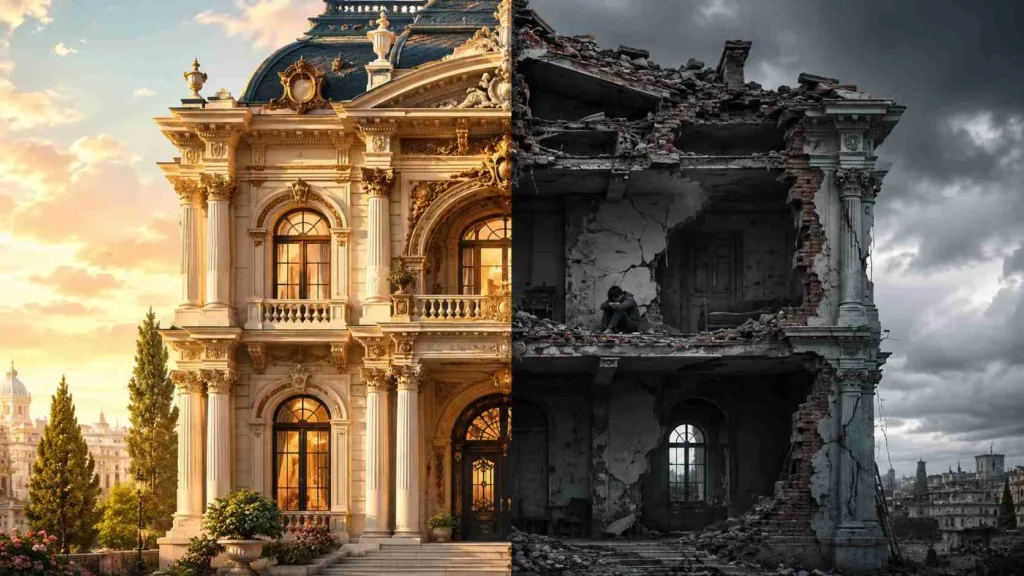

A facade is a false front either the face of a building or a deceptive appearance someone puts up to hide true feelings or reality. In short, it’s what you show the world that doesn’t match what’s really underneath.
Ever told someone “I’m fine” when you were falling apart?
That’s a facade.
You smiled. You nodded. Maybe even laughed at a joke that didn’t land. Meanwhile, your brain screamed something else entirely.
We all do this. Not because we’re dishonest. Because we’re human.
But here’s the thing: understanding the facade meaning changes how you see people, buildings, movies, and even yourself. Let’s break it down. No textbook nonsense. Just real talk.
What Does Facade Mean?
Facade (pronounced fuh-SAHD) has two main meanings.
First meaning (original): The front face of a building. Think of a courthouse with giant white columns. That’s a facade.
Second meaning (metaphorical): A false appearance. A mask. A way you act that hides how you really feel.
Here’s a quick table to lock it in.
| Context | Facade Example | What’s Hidden |
|---|---|---|
| Architecture | A grand marble entrance | Ordinary concrete behind it |
| Social | Laughing at a bad date | Boredom or discomfort |
| Work | Acting excited about a new policy | Disagreement or frustration |
| Online | Perfect vacation photos | Credit card debt and loneliness |
The word connects buildings and behavior. Both can look great on the outside. Both can hide messy realities underneath.
So when someone asks, “What does facade mean?” you can tell them: It’s a front. Sometimes literal. Sometimes emotional. Always hiding something.
How to Pronounce Facade Without Embarrassing Yourself
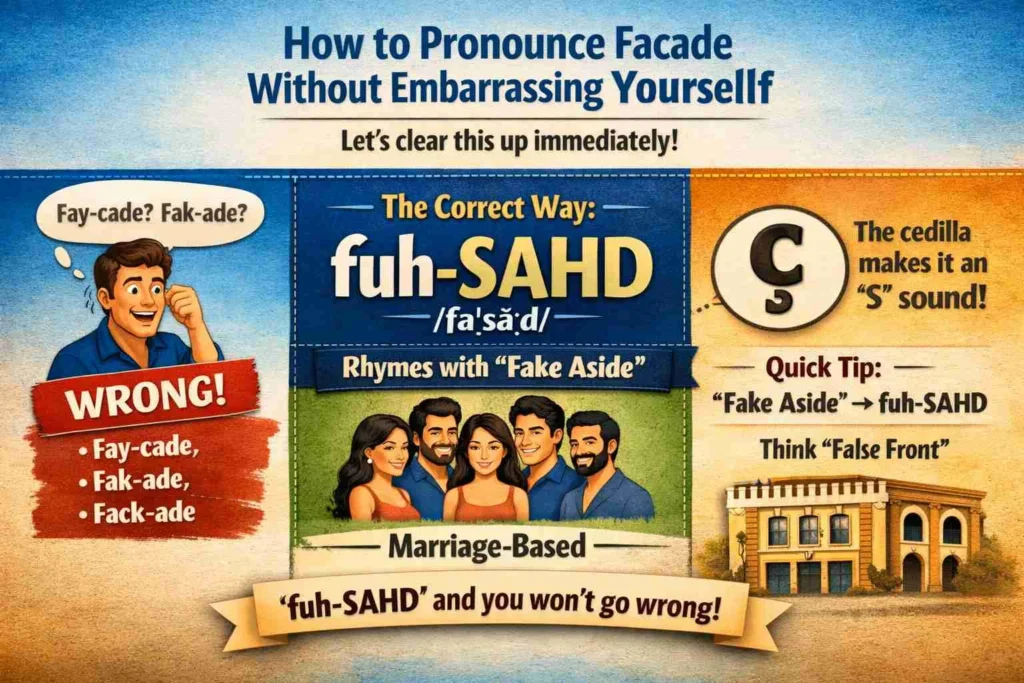
Let’s clear this up immediately.
Correct pronunciation: fuh-SAHD
Incorrect: fay-cade, fak-ade, or fack-ade
The little hook under the ‘c’ (ç) is called a cedilla. It tells you to pronounce the ‘c’ as an ‘s’ sound, not a ‘k’ sound.
Memory trick: Say “fake aside” fast. “Fake aside” → fuh-SAHD. Works every time.
If you’re ever unsure, just say “false front” instead. Same meaning. No awkwardness.
Facade Etymology | Where This Word Came From
Words have history. So does facade.
The word jumped from Italian to French to English.
- Italian: Facciata – meaning “face of a building”
- Root: Faccia – Italian for “face”
- French: Façade – same meaning, added the cedilla
- English: Borrowed it in the 16th century
At first, English speakers only used it for buildings. A theater had a nice facade. A church had an ornate facade.
But by the 1800s, writers started using it for people. “He put up a facade of cheerfulness.”
Why does this matter? Because language evolves the way people do. We borrow architectural words to describe emotional walls. That’s not random. That’s truth.
Facade Synonym and Antonym | The Right Words for the Right Situation
Knowing synonyms helps you avoid repeating the same word. Knowing antonyms helps you understand what facade isn’t.
Strong Synonyms for Facade
| Word | When to Use It |
|---|---|
| Mask | Emotional hiding, often intentional |
| Veneer | Thin attractive layer over something rough |
| Front | Often a business or criminal disguise |
| Pretense | Acting like something you’re not |
| Charade | Obvious, almost theatrical false act |
| Sham | Deliberate deception |
| Disguise | Hiding identity or true feelings |
Weak or Contextual Synonyms
- Appearance (too neutral)
- Exterior (too literal)
- Face (too vague)
Real Antonyms for Facade
These are the opposites. What facade isn’t.
| Antonym | Meaning |
|---|---|
| Authenticity | Being real, no mask |
| Transparency | What you see is what you get |
| Genuineness | Honest feelings and actions |
| Sincerity | No hidden agenda |
| Openness | Willing to show vulnerability |
Example sentence using both:
Her kindness wasn’t a facade. It was genuine transparency from start to finish.
Facade in Everyday Life | Examples You’ve Seen
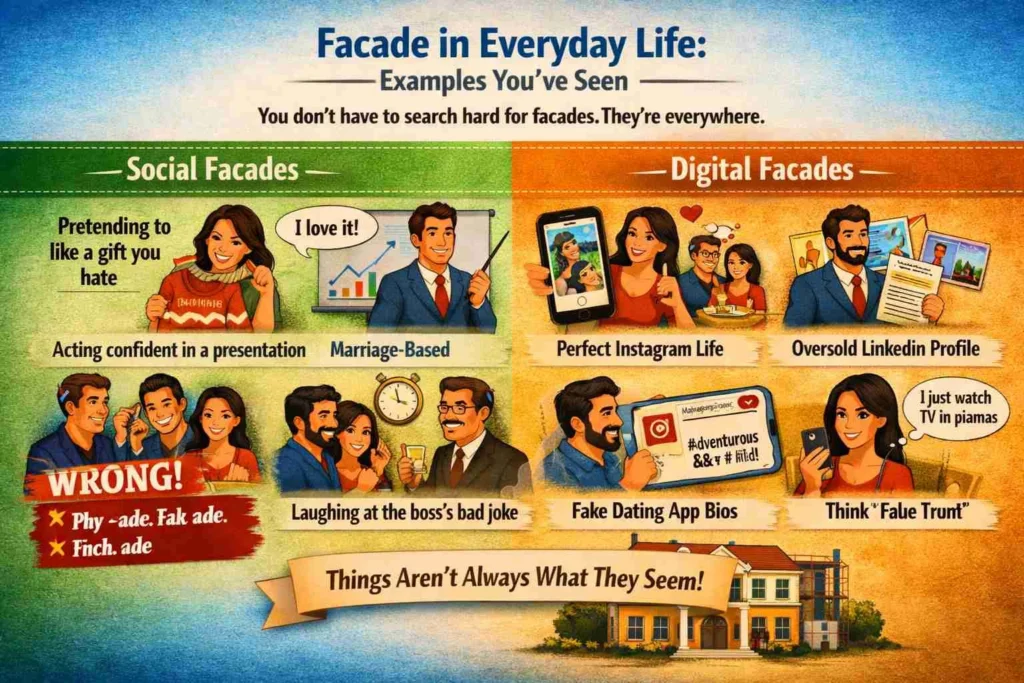
You don’t have to search hard for facades. They’re everywhere.
Social Facades
- Pretending to like a gift you hate
- Acting confident during a presentation when your hands shake
- Smiling through a family dinner after a huge argument
- Laughing at a boss’s bad joke to keep your job
Digital Facades
- Instagram feeds with zero bad days
- LinkedIn profiles that oversell every tiny achievement
- Dating app bios that say “adventurous” when you really love staying home
Professional Facades
- A startup’s sleek website hiding six months of unpaid rent
- A manager’s calm voice covering panic about layoffs
- Customer service reps saying “I’d be happy to help” when they’re exhausted
Bold truth: Facades aren’t always evil. Sometimes they’re survival tools. The problem starts when you forget you’re wearing one.
Facade Meaning in Psychology | Why Your Brain Builds Masks
Psychologists study facades seriously. They call it impression management or self-presentation.
Carl Jung, the famous psychiatrist, used the word persona. In Latin, “persona” meant an actor’s mask. Jung said we all wear one. It’s the version of ourselves we show the world.
Why Do People Create a Facade?
Here are the real psychological reasons.
- Fear of rejection – Show your true self, risk being disliked
- Social pressure – Families, cultures, or jobs demand certain behavior
- Trauma survival – Hiding pain used to keep you safe
- Low self-worth – Believing your real self isn’t good enough
- Professional necessity – Some jobs require emotional masking (nurses, flight attendants, retail workers)
When a Facade Helps
Short-term facades can be healthy.
- A first date (you don’t trauma-dump immediately)
- A job interview (you highlight strengths, not insecurities)
- A difficult conversation (you stay calm even when upset)
When a Facade Hurts
Long-term facades damage you.
- You forget who you really are
- Relationships stay shallow
- Anxiety rises because you’re always performing
- Exhaustion becomes normal
Key insight from psychology: The healthiest people know when they’re wearing a facade. They choose it consciously. And they take it off when they’re safe.
Facade Meaning in Literature | Classic and Modern Examples
Writers love facades. Why? Because facades create dramatic irony. The audience sees the mask. Other characters don’t. That tension drives stories.
Classic Literature
Iago in Othello (Shakespeare)
Iago says, “I am not what I am.” That’s the perfect definition of a facade. He acts loyal while plotting destruction.
Jay Gatsby in The Great Gatsby (Fitzgerald)
Gatsby’s mansion, parties, and “old sport” catchphrase are all a facade. Beneath them? A lonely boy who just wants Daisy.
The Inspector in A Doll’s House (Ibsen)
Nora’s happy marriage is a complete facade. She’s been hiding a loan and a secret identity for years.
Modern Literature and Film
Truman in The Truman Show
His entire town is a facade. Every person, every cloud, every “accidental” encounter is staged.
Patrick Bateman in American Psycho
He looks like the perfect businessman. He’s actually a murderer. The facade is terrifying because it works.
Amy in Gone Girl
She builds the “cool girl” facade perfectly. Then she destroys it on purpose.
Why do these stories resonate? Because everyone recognizes the gap between appearance and reality.
Facade in Architecture | The Original Meaning
Let’s go back to the literal meaning. Because buildings teach us about people.
Architectural definition: The principal front face of a building. Usually the side facing the street. Often the most decorated part.
Famous Architectural Facades
| Building | Facade Feature |
|---|---|
| Notre-Dame Cathedral | Two massive towers, rose window, flying buttresses |
| The White House | Neoclassical columns, balanced symmetry |
| Sydney Opera House | Overlapping shells (technically a facade from the water) |
| Colosseum (Rome) | Four stories of arches and columns |
Modern Glass Facades
Today, many buildings use glass facades. They look transparent. But they still hide things. Behind that glass could be open offices, sealed rooms, or empty floors.
Interesting fact: Some historic cities protect building facades by law. You can demolish the building behind it. But the front face must stay exactly the same.
Buildings and people aren’t so different after all.
How to Use Facade in a Sentence| 10 Real Examples
Stop memorizing definitions. Start using the word.
- Her cheerful voice was just a facade for crushing exhaustion.
- The dictator’s humanitarian speeches were a transparent facade.
- Beneath the startup’s cool facade lay zero profit and mounting debt.
- He dropped the facade and finally admitted he was scared of failing.
- That marble column facade? It’s painted concrete over cinder blocks.
- Their perfect Instagram feed felt like an unbreakable facade until the divorce announcement.
- Don’t confuse a professional facade with real confidence. They’re not the same.
- The castle’s eastern facade collapsed last winter. The rest still stands.
- She hated small talk but kept up the social facade anyway to avoid awkwardness.
- Politicians rarely drop their public facade entirely. The cost is too high.
Notice how “facade” works best when paired with a specific emotion or situation. General use is fine. Specific use is powerful.
Facade vs Mask vs Veneer vs Persona | What’s the Difference?
These words overlap. But they’re not identical.
| Term | Core Meaning | Best Used For |
|---|---|---|
| Facade | False front (building or person) | Long-term or structural hiding |
| Mask | Something you put on intentionally | Temporary hiding of emotions |
| Veneer | Thin attractive layer over something rough | Surface-level deception |
| Persona | Social role you play (can be authentic) | Professional or public identity |
| Front | Often illegal or business-related | Criminal enterprises or fake companies |
Example to clarify:
A politician has a public persona (not necessarily fake). But if they secretly take bribes, that persona becomes a facade. Their smiling mask covers a criminal veneer. And their charity might just be a front.
These distinctions matter for precise writing. But in casual conversation, “facade” covers most of it.
What Does Maintaining a Facade Mean?
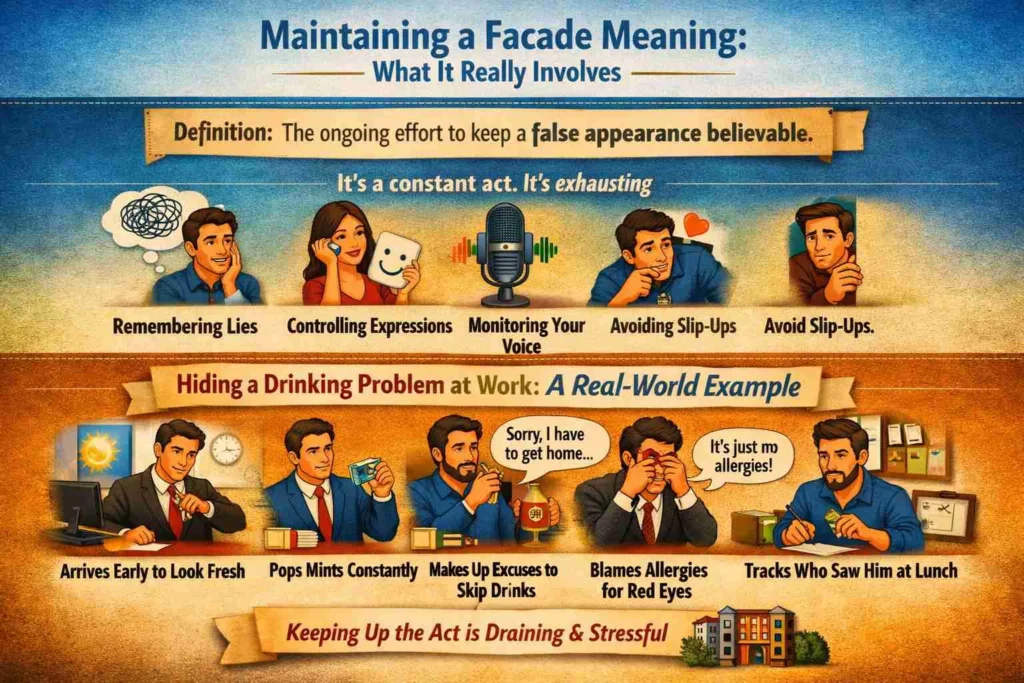
You’ve heard the phrase “maintaining a facade.” What does it actually mean?
Definition: The ongoing effort required to keep a false appearance believable.
It’s not a one-time act. Maintaining a facade is exhausting. You have to remember your lies. Control your expressions. Monitor your voice. Avoid slip-ups.
Real-World Example
Imagine someone hiding a drinking problem at work.
- They arrive early to look fresh
- They use mints constantly
- They avoid after-work drinks with excuses
- They blame allergies for red eyes
- They track who saw them at lunch
That’s not just a facade. That’s a full-time performance.
Short truth: The more elaborate the facade, the more energy it burns. Most people can’t maintain one forever. Eventually, something cracks.
Why Do People Put Up a Facade? The Deep Reasons
Let’s go deeper than “they’re fake.”
Survival-Based Facades
Children of abusive parents learn facades early. Smile to avoid anger. Stay quiet to avoid attention. Perform happiness to survive. That training doesn’t disappear in adulthood.
Career-Based Facades
Certain jobs demand emotional labor.
- Flight attendants smile during turbulence
- Debt collectors stay calm during anger
- Therapists hide their own reactions
These are professional facades. They’re not dishonest. They’re job requirements.
Culture-Based Facades
Some cultures value “saving face.” You avoid public shame at all costs. That means hiding failure, illness, divorce, or debt. The community facade protects everyone’s reputation.
Self-Deceptive Facades
This is the trickiest one. You build a facade and start believing it yourself.
- “I’m not lonely. I’m independent.”
- “I’m not broke. I’m minimalistic.”
- “I’m not unhappy. I’m just realistic.”
At that point, the facade becomes your identity. And that’s dangerous.
Facade Meaning in Relationships | The Silent Relationship Killer
Relationships die under facades.
Romantic Relationships
One partner pretends to be happy. The other believes it. Years pass. Resentment builds. Then one day, the facade cracks.
Common romantic facades:
- “I’m fine with less sex.”
- “I don’t mind your family.”
- “I’m over that fight from two years ago.”
- “I still find you attractive.”
Each lie feels kind in the moment. Each lie destroys intimacy over time.
Friendships
Platonic facades include pretending to share interests, hiding jealousy, or avoiding difficult conversations. The friendship feels smooth. But it’s also shallow.
Family Facades
The “perfect family” facade is classic. Holiday cards show smiling photos. Dinner conversations avoid politics, money, and health problems. Everyone performs. No one connects.
Relationship expert tip: The strongest relationships tolerate ugly honesty. The weakest ones require beautiful lies.
Facade Meaning in Business and Marketing
Businesses use facades constantly. Sometimes ethically. Sometimes not.
Ethical Business Facades
- A clean store entrance (hides the messy back room)
- Professional branding (hides internal chaos)
- Polished customer service (hides employee frustration)
These are normal. Every business has them.
Unethical Business Facades
- Fake reviews on product pages
- Inflated founder biographies
- “Transparent pricing” that hides junk fees
- Greenwashing (pretending to be eco-friendly)
These cross into deception.
The Startup Facade
Walk into most startups. You’ll see ping-pong tables, craft beer, and smiling faces. Behind the scenes? Crunch deadlines, unpaid overtime, and quiet layoffs.
The startup facade sells a dream. The reality is usually just work.
What Does Facade Mean in Slang?
Young people use “facade” less often than “fake” or “cap.” But it still appears.
In slang contexts:
- “His whole personality is a facade.”
- “Stop putting up a facade. Just be real.”
No special meaning. Just the standard definition delivered with more attitude.
Can Facade Be Positive?
Most people assume facade is always negative. That’s not quite right.
Positive or Neutral Facades
- Customer service voice – You’re not lying. You’re being professional.
- First date nerves – You hide anxiety to make the other person comfortable.
- Parental strength – You stay calm so your child feels safe.
- Job interview confidence – You exaggerate slightly because everyone does.
The difference: Positive facades are temporary and kind. Negative facades are long-term and selfish.
A nurse hiding exhaustion to comfort a patient? That’s a good facade.
A spouse hiding an affair behind “working late”? That’s a bad facade.
Context determines everything.
How to Recognize a Facade in Others
Spotting someone else’s facade isn’t about being cynical. It’s about being observant.
Behavioral Clues
- Inconsistent stories – Details change each time they tell them
- Overly perfect behavior – No one is that calm, happy, or put together all the time
- Defensive reactions – Simple questions get angry responses
- Long pauses before answers – They’re calculating, not responding
- Topic avoidance – Certain subjects always get deflected
Visual Clues
- Forced smiles (no eye wrinkles)
- Stiff body language
- Voice that doesn’t match facial expression
Warning: Don’t assume every awkward moment is a facade. Some people are just shy or tired. Look for patterns, not single incidents.
How to Recognize Your Own Facade
This is harder. Much harder.
Signs You’re Wearing a Facade
- You feel exhausted after basic social interactions
- You rehearse conversations in advance
- You hate being alone with your thoughts
- You feel like a fraud in your own life
- You can’t remember the last time you were truly spontaneous
The Journaling Test
Write down three answers without thinking:
- What do I actually feel right now?
- What would I say if someone asked me that?
- Are those two answers different?
If yes, you’re wearing a facade. Not necessarily bad. But worth noticing.
Dropping the Facade | What Happens When the Mask Comes Off
“Dropping the facade” means showing your true self. Flaws, fears, and all.
What Usually Happens
First? Relief. You stop performing.
Second? Fear. What will people think?
Third? Mixed reactions. Some people appreciate your honesty. Others get uncomfortable. A few walk away.
Is Dropping the Facade Always Good?
No. And anyone who says otherwise hasn’t lived much life.
Sometimes you should keep the facade up.
- During a work crisis (people need calm leadership)
- With a toxic person (your vulnerability becomes ammunition)
- In a cultural context where honesty is punished
Better rule: Know your facade. Choose when to use it. Drop it only when it’s safe and worth it.
Facade vs Reality | The Eternal Tension
This section could fill a whole book. We’ll keep it tight.
Every human lives in two worlds:
The outer world – What you show. Your job title. Your relationship status. And your filtered photos.
The inner world – What you actually think. Your secret fears. Your real opinions. And your 3 AM anxieties.
The gap between these two worlds is your facade.
Some people have a tiny gap. They say what they mean. They don’t posture. They’re almost painfully honest.
Others have a massive gap. They’re completely different in public versus private. Sometimes they don’t even know who they really are.
Most people fall somewhere in the middle. And that’s fine. The goal isn’t zero facade. The goal is awareness.
Facade in Popular Phrases and Idioms
Some common expressions use facade or related ideas.
| Phrase | Meaning |
|---|---|
| “Put up a facade” | Start pretending |
| “Maintain a facade” | Keep pretending over time |
| “Crack the facade” | Reveal the truth underneath |
| “Behind the facade” | The hidden reality |
| “Drop the facade” | Stop pretending |
You’ll hear these in movies, books, and serious conversations. Now you’ll recognize them instantly.
FAQs
Is facade always negative?
No. Temporary facades can protect you or others. Long-term deceptive facades cause problems.
What’s the difference between facade and mask?
Very little. Facade often implies a broader false front. Mask feels more intentional and removable.
What does “dropping the facade” mean?
Showing your true thoughts and feelings. Stopping the performance.
Can a building have a facade?
Yes. That’s the original meaning. Every building with a front face has a facade.
What is a social facade?
A false version of yourself that you show in social situations. Hiding true feelings to fit in or avoid conflict.
What does facade mean in psychology?
A persona or social mask. Often a defense mechanism to protect self-esteem or avoid vulnerability.
How do you pronounce facade correctly?
fuh-SAHD. Stress the second syllable.
What’s a good synonym for facade?
Mask, front, veneer, or pretense depending on context.
Conclusion
Understanding the facade meaning isn’t just vocabulary homework. It’s a mirror. You’ll start noticing false fronts everywhere from polished Instagram feeds to that coworker who’s always “fine.” But don’t let that make you cynical. Just let it make you curious.
The real question isn’t “Do I wear a facade?” Everyone does. The real question is “Do I know when I’m wearing one?” Awareness changes everything. Drop the mask when it’s safe. Keep it when you need it. But never forget it’s there. That’s the difference between performing your life and actually living it.
Discover More Related Articles:
- “PTSO” Meaning: What No One Tells You About This Slang In 2026
- “FWB” Meaning: What It Really Means in Modern Conversations In 2026
- “GNG” Meaning: What It Stands For, How to Use It & When It’s Appropriate In 2026