
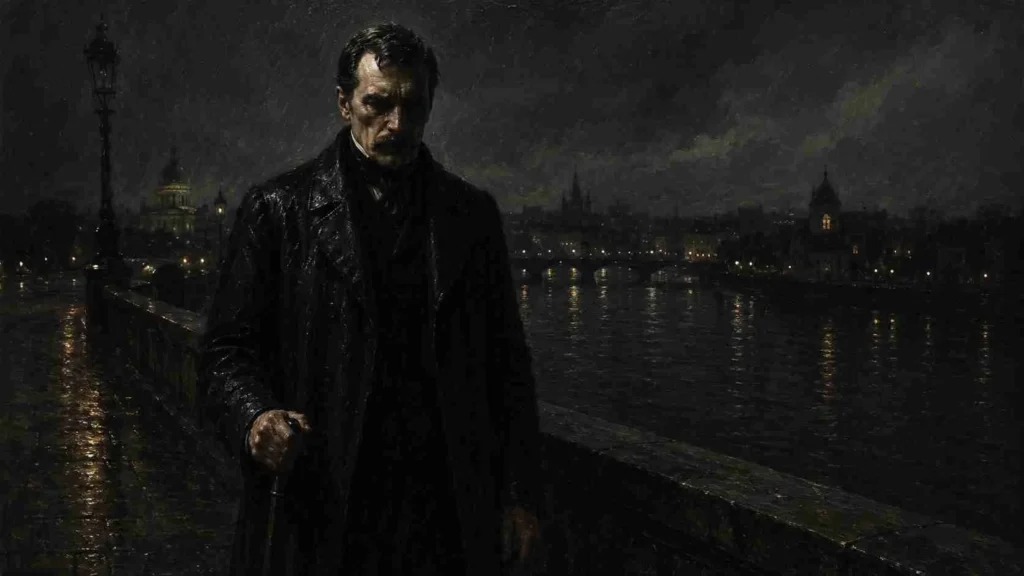

Javert is the obsessive police inspector from Victor Hugo’s Les Misérables who represents law without mercy a man so rigidly devoted to justice that he commits suicide when faced with kindness he cannot comprehend or accept.
Ever met someone who follows rules so strictly they break themselves?
You probably have. Maybe a teacher who failed a student over a single typo. A boss who enforced a pointless policy just because “it’s the rule.” Or a cop who gave you a ticket for jaywalking on an empty street at 2 AM.
Now multiply that by a thousand. You get Javert.
Javert isn’t just a villain. He’s a mirror. Look into him and you see the cost of justice without mercy. You see what happens when law becomes religion. And you see a man who would rather die than admit he was wrong.
This post breaks down the real javert meaning his personality, his symbolism, his suicide, and his clash with Jean Valjean. No fluff. Just the facts, the literary analysis, and why this 1862 character still haunts us today.
Who Is Javert?
One sentence says it all: Javert is the obsessive police inspector from Victor Hugo’s 1862 novel Les Misérables.
Born in a prison. Raised on hatred for criminals. He spends nearly two decades hunting one man Jean Valjean, a former convict who broke parole after stealing a loaf of bread.
But here’s the twist. Valjean becomes a mayor. A factory owner. A man who saves lives. Javert can’t accept that. Because Javert’s world has a simple rule: once a criminal, always a criminal.
Let’s get the basic facts down first.
| Attribute | Detail |
|---|---|
| Creator | Victor Hugo |
| First appearance | Les Misérables (1862) |
| Role | Police inspector / Primary antagonist |
| Age in the novel | Approximately 50–60 years old |
| Born | In a prison (his mother was a fortune teller; his father a galley slave) |
| Core obsession | Recapturing Jean Valjean |
| Core trait | Moral rigidity |
| Method | Surveillance, informants, relentless pursuit |
| End | Suicide by jumping into the Seine River |
| Adaptations | Over 30 films, 5 TV series, and the famous stage musical |
Javert definition is simple on the surface. But the deeper inspector javert meaning is where things get interesting.
He’s not a mustache-twirling bad guy. He never steals. Never lies. Never tortures for fun. He does his duty. Perfectly. And that perfection is exactly what destroys him.
Literal Meaning of the Name “Javert”
Here’s something most people miss. The name “Javert” has no direct translation. Victor Hugo likely invented it.
But scholars have theories. Good ones.
Theory one: The name comes from j’avertis French for “I warn” or “I inform.” That fits. Javert spends his entire life informing on others. He warns authority figures about threats. He warns Valjean that the law never sleeps.
Theory two: It connects to an old French verb javertir, meaning “to turn aside” or “to divert.” Again, perfect. Javert turns aside from mercy. He diverts every chance at compassion. He even turns the law sideways to fit his rigid worldview.
Theory three: Some linguists link it to Javart, an old veterinary term for a horse’s tumor. That’s darker. Hugo may have named his inspector after a disease something that grows inside a system and slowly kills it.
No one knows for sure. But the javert name meaning leans toward “the one who warns” or “the one who turns away.” Both describe him perfectly.
Symbolic Meaning | What Does Javert Represent?
Ask ten literature professors what Javert represents. You’ll get ten answers. But they all circle the same core idea.
Javert represents law without mercy and justice without humanity.
Let’s break that down into clear symbols.
- Legalism – He follows the letter of the law but murders its spirit. A man steals bread to feed a starving family? The law says guilty. Javert says prison.
- Obsession with order – Chaos terrifies him more than cruelty. He once says he would arrest his own mother if she broke the law. That’s not bravery. That’s sickness.
- Authority as identity – Javert doesn’t have a self outside his badge. Strip away the title “Inspector” and nothing remains. No hobbies. No friends. No love.
- Punishment as the only tool – He never learned another way. Mercy looks like corruption to him. Forgiveness looks like weakness.
- Conscience failure – He feels no internal conflict for most of the novel. Right is right. Wrong is wrong. End of discussion.
What does Javert represent in a single sentence? He represents every system that punishes without understanding, judges without listening, and breaks people in the name of order.
Victor Hugo wrote Les Misérables as a protest against France’s harsh justice system. Javert was his warning. Not a monster. A symptom.
Javert’s Personality | The Anatomy of a Rigid Mind
Let’s get specific. What does Javert actually act like?
Core personality traits (backed by the novel):
- Inflexible – He never changes his mind until the very end. And even then, the change kills him.
- Self-righteous – He believes God made him a policeman. Duty is divine.
- Duty-bound – He works 18-hour days. Sleeps in police barracks. Eats alone.
- Emotionally suppressed – The novel mentions he never laughs. Never cries. Never thanks anyone.
- Fearful of ambiguity – Gray areas terrify him. A good criminal? A kind thief? These ideas make him physically uncomfortable.
His moral code in one sentence: A former criminal is always a criminal.
Hugo writes that Javert saw Valjean’s goodness as a “threat to civilization itself.” Not a threat to safety. A threat to order.
Imagine that for a second. Someone saves a child from death. That person rebuilds a town. That person spares your life. And instead of gratitude, you feel threatened. That’s Javert.
The javert personality is obsessive, lonely, and profoundly sad. He never married. No children. No friends. The law was his wife. The prison his home.
Javert vs. Jean Valjean | The Real Conflict
This isn’t good versus evil. That’s too simple.
The real conflict is law versus grace.
| Javert | Jean Valjean |
|---|---|
| The law | Mercy |
| Punishment | Redemption |
| Rigid past defines you | Transformation is possible |
| Hunts others | Helps others |
| Dies by his own hand | Dies at peace, surrounded by love |
| Sees crime as permanent stain | Sees crime as a symptom of poverty |
| Never forgives himself or anyone | Forgives everyone, including Javert |
Here’s the genius of Hugo’s writing. Both men were born in prisons. Both suffered terrible childhoods. Both lived outside society’s rules.
But they chose different paths.
Valjean chooses change after a bishop shows him mercy. Javert never gets that moment. No one ever showed him kindness. No one ever broke his rigid frame. So he stayed frozen.
The javert vs valjean dynamic isn’t a chase scene. It’s a philosophical war. Valjean proves that people can change. Javert proves that some systems refuse to see it.
Hugo wasn’t attacking police. He was attacking a system with no room for transformation. Javert is the victim of that system. And also its most loyal soldier.
Why Does Javert Kill Himself? The Real Literary Answer
This is the scene everyone remembers. Javert stands on the Seine River. He lets Valjean go free. Then he jumps.
Why?
Direct answer: Javert commits suicide because he can’t hold two truths in his head at the same time.
Truth one: Valjean is a former convict. The law says he belongs in prison for life. Javert has spent 19 years hunting him.
Truth two: Valjean just saved Javert’s life. At the barricade. Javert was tied up. The revolutionaries were about to execute him. Valjean cut him free and let him escape.
Now Javert faces an impossible choice.
If he arrests Valjean, he betrays his own conscience. The man saved his life. That matters even to Javert.
If he lets Valjean go, he betrays the law. Everything he stood for. Every arrest. Every punishment. And every belief.
So he chooses a third option. He removes himself.
Victor Hugo writes that Javert felt “the earth giving way beneath him.” His mental foundation cracked. No framework allowed both justice and mercy. So he walked into the river.
The deeper meaning: Absolute rigidity leads to self-destruction. The Seine isn’t just a river. It’s a symbol of washing away an outdated system. Javert doesn’t die as a punishment. He dies because his worldview had no exits.
Why does javert kill himself in the musical? Same reason. The songs “Stars” and “Javert’s Suicide” make it even clearer. He sings about being “in the dark” for the first time. Uncertainty destroys him.
No mental illness. No sudden cowardice. Just a logical mind reaching a dead end. And jumping.
Javert as a Tragic Figure
We call Javert an antagonist. But is he a villain?
No. A villain enjoys cruelty. Javert never does.
He is a tragic figure someone destroyed by their own strengths.
Three reasons Javert fits the tragic label:
- He genuinely believes he’s doing good. He doesn’t hunt Valjean out of hatred. He does it because he thinks that’s what God and France demand.
- He never breaks his own code. He is consistent from start to finish. Even his suicide follows his logic. He punishes himself for the crime of mercy.
- His destruction comes from seeing mercy, not from failing at justice. That’s the tragedy. If Valjean had been evil, Javert would have won. But Valjean was good. And goodness broke Javert.
Literary label: Lawful antagonist. Some call him a tragic hero because he dies for his beliefs. Others say he’s a black mirror a warning about what happens when duty consumes humanity.
The javert character analysis is richer than most people realize. He’s not the Joker. He’s not Darth Vader. And he’s a civil servant with no off switch. And that’s somehow more frightening.
Javert’s Obsession with Valjean | More Than a Chase
At first, it’s just a job. Valjean broke parole. Javert wants him back in chains.
But something shifts over the years.
Javert starts dreaming about Valjean. He keeps files on him. He moves towns to stay close. When Valjean becomes Mayor Madeleine, Javert takes a job in the same town just to watch him.
That’s not police work. That’s obsession.
What drives it?
- Jealousy? Possibly. Valjean transformed himself. Javert never could.
- Fear? Definitely. A good criminal breaks Javert’s entire belief system. If Valjean can change, then anyone can. And if anyone can change, then Javert’s lifelong cruelty was unnecessary.
- Self-hatred? Hugo hints at this. Javert was born in a prison. He grew up surrounded by criminals. His obsession with catching them might be his way of proving he’s different.
The obsession has a name in psychology: reaction formation. He fights so hard against what he fears becoming.
The javert obsession with valjean isn’t personal. It’s existential. Valjean represents a universe where Javert could have been different. And that thought terrifies him.
Real-World Impact | Why Javert Still Matters Today
Let’s leave the 19th century. Why should you care about Javert in 2026?
Because Javert lives inside every system that refuses to forgive.
Modern parallels (real and current):
- Zero-tolerance school policies – A child brings a butter knife to cut an apple. Expelled for a year. No exceptions. That’s Javert logic.
- Three-strikes laws – A man steals a slice of pizza (third petty offense). Gets 25 years to life. That happened in California. Javert would have applauded.
- Bureaucratic cruelty – Welfare offices that cut benefits over a single missed form. Landlords who evict over a late payment. Hospitals that refuse care because of unpaid bills.
The question Hugo asks: At what point does protecting order become cruelty?
Javert never asks himself that. That’s his crime.
We see Javert in comment sections. In bosses who refuse second chances. In relatives who cut off contact over old grudges. The javert literary significance isn’t historical. It’s personal.
What does Javert represent today? He represents the part of us that prefers punishment over understanding. Because understanding is hard. Punishment is easy.
Famous Javert Quotes and Their Meaning
Hugo gave Javert some of the most memorable lines in literature. Let’s break down three of the best.
“I am a police inspector. I do my duty.”
Meaning: Duty as identity. Javert has no self outside the job. When the duty ends, so does he.
“I’ll tear you from your hiding place, you villain!”
Meaning: Obsession framed as righteousness. He doesn’t say “I’ll arrest you.” He says “I’ll tear you out.” That’s violence dressed as justice.
“Who is this man who can pardon?”
Meaning: Mercy terrifies the rigid mind. Javert says this after Valjean spares him. He can’t process it. Pardoning someone who wronged you? That breaks every rule Javert knows.
One more from the musical (not the novel, but still powerful):
“And I am Javert! Do not forget my name. Do not forget me, 24601!”
Meaning: He wants Valjean to remember him the way he remembers Valjean. An eternal dance. Two men who can’t forget each other.
The javert quotes and meaning all point to the same truth: he needed the chase more than the capture.
Common Misconceptions About Javert
Let’s clear up some myths. You see these all over forums and bad essays.
Misconception 1: Javert is pure evil.
Truth: He never acts out of cruelty for its own sake. He acts out of certainty. Evil enjoys suffering. Javert simply doesn’t care about suffering. Different thing.
Misconception 2: Javert hates Valjean personally.
Truth: He hates what Valjean represents a universe where a thief becomes a mayor. Where the law can be wrong. Where a convict shows more grace than an inspector.
Misconception 3: His suicide is weakness.
Truth: It’s a logical conclusion to a broken philosophy. Hugo called it a “suicide of the soul.” He didn’t die because he was sad. He died because his mental architecture collapsed.
Misconception 4: Javert is the novel’s main villain.
Truth: The real villains are the Thenardiers (greedy innkeepers who abuse children). Javert is an antagonist, not a villain. There’s a difference.
Misconception 5: Javert has no redeeming qualities.
Truth: He’s honest. He’s brave. He never takes a bribe. He works harder than anyone. Those are virtues. They just got pointed in the wrong direction.
The javert interpretation suffers from black-and-white thinking. Funny, because that’s exactly his problem.
Javert’s Psychological Profile
Let’s get clinical for a moment. What would a psychologist say about Javert?
- Obsessive-compulsive personality disorder (not OCD) – He’s rigid, perfectionistic, and obsessed with order. But he doesn’t have intrusive thoughts or rituals. OCPD fits better.
- Alexithymia – Difficulty identifying or describing emotions. Javert never says “I feel angry” or “I feel sad.” He only describes actions and duties.
- Moral scrupulosity – A form of religious or ethical obsession where a person fears being immoral. Javert’s entire life is a performance of “goodness” by the law’s standards.
- Reactive attachment disorder (possible) – Born in a prison. No stable caregiver. No early affection. That leaves marks.
Does Javert have narcissism? No. Narcissists crave admiration. Javert craves nothing except order. He doesn’t want praise. He wants compliance.
The javert psychological conflict is real. His mind simply couldn’t bend. And in Hugo’s world, bending is survival.
How Adaptations Changed Javert
The novel Javert and the musical Javert aren’t the same person. Let’s compare.
Novel Javert (1862):
- Older. Colder. More bureaucratic.
- Rarely raises his voice.
- His violence is quiet surveillance, files, warrants.
- The suicide scene is internal. We hear his thoughts as he drowns.
Musical Javert (1980, English 1985):
- Younger. More theatrical.
- Sings “Stars” about order as divine purpose.
- His suicide is a dramatic jump with orchestral swells.
- More sympathetic because we see his anguish in real time.
Film versions vary wildly:
- 1998 (Geoffrey Rush): Cold, reptilian, almost inhuman.
- 2012 (Russell Crowe): More vulnerable. Singing voice aside, Crowe plays Javert as a man already broken inside.
- 1935 (Charles Laughton): The most sympathetic. You almost cry for him.
No adaptation gets everything right. But the best ones capture his tragedy. He’s not a monster. He’s a system wearing a face.
The Philosophy Behind Javert | Hugo’s Big Argument
Victor Hugo wasn’t just writing a story. He was making an argument.
Hugo’s thesis: Society creates criminals by punishing poverty. Then it punishes those criminals again and again until they have no way out.
Javert is the machine that runs that punishment.
Hugo believed in redemption. He believed a person could change completely. He proved it with Valjean’s arc. From thief to mayor to saint.
But he also knew that some people and some systems resist redemption. That’s Javert.
The big question Hugo asks: Can a system that never forgives ever be just?
No, says Hugo. Justice without mercy is just revenge with a uniform.
The javert worldview is the opposite of Hugo’s. Javert believes people don’t change. Hugo believed they must. That tension drives the entire novel.
Bonus: Quick Reference Table | Javert at a Glance
| Category | Summary |
|---|---|
| Literal meaning | Invented name; possibly “the one who warns” or “turns aside” |
| Symbolic meaning | Law without mercy; justice without humanity |
| Core personality | Rigid, self-righteous, duty-obsessed, emotionally cold |
| Moral code | A former criminal is always a criminal |
| Primary conflict | Law (Javert) vs. Grace (Valjean) |
| Reason for suicide | Could not reconcile Valjean’s goodness with the law’s demands |
| Tragic label | Lawful antagonist / tragic hero |
| Modern relevance | Zero-tolerance policies, three-strikes laws, bureaucratic cruelty |
| Author’s intent | Warning against rigid systems that refuse redemption |
FAQs
1. What does Javert mean in simple terms?
Javert means law without mercy. He represents a person who follows rules so strictly that he loses his humanity. Think of someone who would arrest their own mother for a minor offense that’s Javert’s mindset.
2. Why does Javert kill himself at the end of Les Misérables?
Javert kills himself because he can’t hold two opposing truths at once. Truth one: Valjean is a criminal who belongs in prison. Truth two: Valjean just saved Javert’s life. His rigid mind has no room for both, so he jumps into the Seine River rather than live with uncertainty.
3. Is Javert a villain or a hero?
Neither. Javert is a tragic antagonist. He’s not evil he never lies, steals, or enjoys cruelty. But he’s not heroic either. He hunts a good man for nearly two decades. Hugo wrote him as a warning about systems that refuse to forgive.
4. What is the conflict between Javert and Jean Valjean?
The conflict is law versus grace. Javert believes a criminal stays a criminal forever. Valjean proves that people can change. Javert chases Valjean for 19 years, but Valjean keeps showing mercy. That mercy eventually destroys Javert’s entire worldview.
5. What does the name Javert mean?
Victor Hugo invented the name, but scholars have two main theories. One says it comes from j’avertis (French for “I warn”). Another traces it to javertir (an old verb meaning “to turn aside”). Both fit: Javert warns society about threats, and he turns aside from mercy at every opportunity.
Conclusion
The core javert meaning in one sentence: Javert is the cost of justice without mercy.
He’s not your enemy. He’s not your hero. And he’s a warning.
Every time you choose punishment over understanding, you become a little bit like him. Every time you refuse to forgive a past mistake, you echo his rigidity.
You don’t have to like him. But you should understand him. Because he lives in all of us. That part that wants easy answers. That part that fears change. And that part that would rather be right than kind.
Next time you read Les Misérables or watch the musical, watch Javert closely. Don’t boo him. Pity him. He’s not the monster.
Discover More Related Articles:
- “ISO” Meaning Slang: From Online Posts to Marketplace Use In 2026
- “PTSO” Meaning Slang: How to Use It & Real-Life Examples In 2026
- “JOI” Meaning Slang: How It’s Used in Online Conversations In 2026