
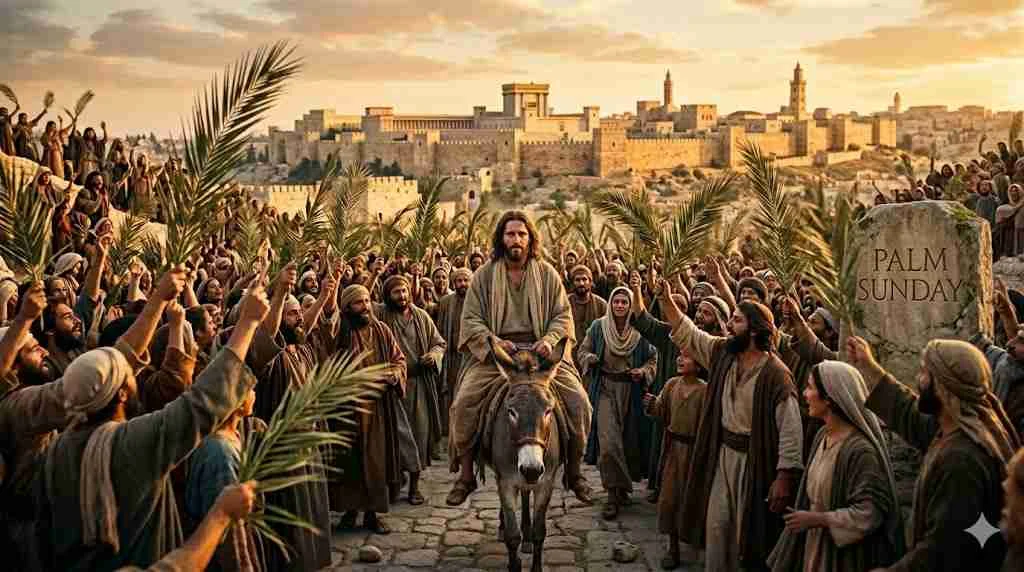

Hosanna is a Hebrew cry meaning “Save now!” or “Save us, we pray!” originally a desperate plea for deliverance from Psalm 118:25. Over time, it became a shout of praise and messianic acclamation, most famously shouted by the crowd welcoming Jesus into Jerusalem on Palm Sunday.
You know that moment when a single word carries more weight than an entire sentence? That’s the hosanna meaning in a nutshell. But here’s the thing most people get it completely backwards. They think it means “praise” or “hooray.” Nothing could be further from the truth.
Picture this. A massive crowd gathers in Jerusalem. Passover is days away. The streets are packed with pilgrims. Then a man rides in on a donkey, and thousands of people lose their minds. They tear branches from palm trees. They throw their cloaks on the ground. And they start shouting one word over and over: Hosanna!
But here’s the kicker. Those same people would scream for his execution just five days later. How does a crowd go from “Hosanna!” to “Crucify Him!” that fast?
Understanding the true hosanna meaning in the Bible unlocks this mystery. It changes how you read the Gospels. It transforms how you worship. And it might just change how you see your own desperate need for rescue.
The Hebrew Roots of Hosanna | A Cry You’ve Misunderstood
Let’s start at the beginning. The hosanna meaning traces back to the Hebrew phrase Hoshia Na. Two simple words that pack a punch.
Hoshia comes from the root yasha, which means “to save” or “to deliver.” You’ve seen this root before. It shows up in names like Joshua (Yehoshua) and Isaiah (Yeshayahu). Both names carry the idea of salvation.
Na is a particle of entreaty. Think of it like saying “please” or “now” with urgent emphasis. It’s not casual. It’s desperate.
Put them together, and you get “Save now!” or “Save us, we pray!”
This isn’t a praise song. It’s a 911 call.
Psalm 118:25-26 gives us the exact phrase: “Lord, save us! Lord, grant us success! Blessed is he who comes in the name of the Lord.”
The crowd at Palm Sunday wasn’t just cheering for Jesus. They were quoting scripture. They were applying an ancient prayer to the man on the donkey. And they were saying, “You are our only hope. Save us!”
Why Psalm 118 Matters for Understanding Hosanna
You can’t grasp the hosanna meaning without understanding Psalm 118. This psalm was the soundtrack of Jewish festivals. Every major feast featured the Hallel (Psalms 113-118). Worshipers sang these words during Passover, Pentecost, and the Feast of Tabernacles.
Here’s what makes Psalm 118 special for the hosanna meaning:
| Element | Significance |
|---|---|
| The phrase “Hoshia Na” | Appears as a desperate prayer for deliverance |
| “Blessed is he who comes” | A blessing for pilgrims entering the Temple |
| The context of victory | Written as a thanksgiving for God’s deliverance |
| Festival usage | Sung during processions with palm branches |
The crowd at Jerusalem knew exactly what they were saying. They weren’t improvising. They were singing their liturgy. And they were applying it to Jesus in real time.
Imagine the scene. Thousands of voices, raised in unison, crying out the words they’d sung since childhood. But this time, they directed those words at a specific person. This wasn’t abstract worship. This was declaration.
The Triumphal Entry| Where Hosanna Became History
Now let’s walk through the actual event. The Gospels give us four accounts of the triumphal entry, and each one includes the shout of hosanna.
Matthew 21:9 records the crowd shouting: “Hosanna to the Son of David! Blessed is he who comes in the name of the Lord! Hosanna in the highest!”
Mark 11:9-10 adds: “Blessed is the coming kingdom of our father David! Hosanna in the highest!”
John 12:13 gives us: “Blessed is the King of Israel!”
Luke 19:38 paraphrases: “Blessed is the king who comes in the name of the Lord!”
Notice something interesting? Luke paraphrases while the others transliterate. The early church understood that the original Hebrew carried weight. Translating it flattened the meaning. Leaving it untranscribed preserved its power.
Now here’s what makes this moment so significant. The crowd wasn’t just being polite. They were making a claim. They were declaring Jesus as the Messiah. And they were doing it with a word that meant “Save us!”
The Political Context You Can’t Ignore
Let’s get real about the historical setting. Rome occupied Israel. The people were oppressed. They wanted freedom. They wanted a king who would throw off Roman rule.
When the crowd shouted “Hosanna,” they weren’t thinking about spiritual salvation. They were thinking about political liberation. They wanted Jesus to be the warrior king who would crush their enemies.
This explains the whiplash. When Jesus didn’t deliver what they expected, their enthusiasm turned to anger. He came to save them from sin, not from Rome. And that wasn’t the salvation they wanted.
The Jewish Festival Traditions Behind the Word
To fully understand the hosanna meaning, you need to see how it functioned in ancient Jewish worship. The Feast of Tabernacles (Sukkot) provides the key.
The Daily Procession
During Sukkot, the priests led a daily procession around the altar. They carried palm branches (lulav) and citrons (etrog). The crowd recited Psalm 118, repeating verse 25: “Please, Lord, save us! Please, Lord, grant us success!”
This became known as the Hosanna cry. The word shifted from a prayer to an exclamation associated with the feast itself.
The Great Hosanna
The seventh day of Sukkot received a special name Hoshana Rabbah, meaning “the Great Hosanna.” The procession circled the altar seven times. The community cried out with even greater intensity.
This tradition survived the destruction of the Temple. Jewish communities continue to observe Hoshana Rabbah to this day. The word became intertwined with hope for deliverance.
How the Meaning Evolved
Here’s where it gets interesting. Over time, the cry for help transformed into a shout of praise. The very word that started as “Save us!” became “Praise the Lord!”
| Period | Usage |
|---|---|
| Original Hebrew | Desperate prayer for deliverance |
| Festival worship | Repeated cry during Sukkot processions |
| Time of Jesus | Familiar acclamation, still carrying salvation meaning |
| Early church | Transcribed in Greek, began to evolve toward praise |
| Modern usage | Often used as synonym for praise or “hooray” |
The hosanna meaning today still carries echoes of both. It’s praise born from desperation. It’s celebration that recognizes need.
Hosanna in the Bible| The Six Appearances
The word “hosanna” appears exactly six times in the New Testament. All of them are in accounts of Jesus’s entry into Jerusalem or in the Temple cleansing that followed.
Matthew 21:9
“The crowds that went ahead of him and those that followed shouted, ‘Hosanna to the Son of David! Blessed is he who comes in the name of the Lord! Hosanna in the highest!'”
Matthew 21:15
“But when the chief priests and the teachers of the law saw the wonderful things he did and the children shouting in the temple courts, ‘Hosanna to the Son of David,’ they were indignant.”
Mark 11:9
“Those who went ahead and those who followed shouted, ‘Hosanna! Blessed is he who comes in the name of the Lord!'”
Mark 11:10
“‘Blessed is the coming kingdom of our father David! Hosanna in the highest!'”
John 12:13
“They took palm branches and went out to meet him, shouting, ‘Hosanna! Blessed is he who comes in the name of the Lord! Blessed is the king of Israel!'”
That’s it. Six verses. Every single one connected to Palm Sunday.
Why So Few Appearances?
This raises a good question. If “hosanna” was so important, why does it only appear six times?
The answer lies in the nature of the New Testament. The Gospels were written for Greek-speaking audiences. Transliterating Hebrew words was unusual. The writers reserved it for moments of particular significance.
Think about other Hebrew words that appear in the New Testament:
- Hallelujah (Praise the Lord) appears only in Revelation
- Amen (So be it) appears throughout
- Abba (Father) appears only a few times
- Hosanna appears exclusively in the Palm Sunday accounts
Each transliteration marks something important. The writers wanted to preserve the original sound and weight. They wanted readers to feel the emotion behind the word.
The Difference Between Hosanna and Hallelujah
People often confuse these two words. They’re both exclamations. They’re both used in worship. But they’re completely different.
| Aspect | Hosanna | Hallelujah |
|---|---|---|
| Hebrew origin | Hoshia Na | Hallal Yah |
| Literal meaning | “Save now!” | “Praise the Lord!” |
| Type | Petition | Declaration |
| First appears | Psalm 118:25 | Psalm 104:35 |
| New Testament usage | Six times (Gospels) | Four times (Revelation) |
| Direction | Prayer toward God | Call to praise God |
| Emotion | Desperate plea | Triumphant declaration |
Hallelujah is a call to worship. Hosanna is a cry for help. They serve different purposes in worship.
Here’s the beautiful irony. The hosanna meaning is a plea for salvation. The hallelujah meaning is praise for salvation given. One asks. The other celebrates the answer.
When you understand both, you see a complete picture of worship. You cry out in need. You celebrate in response. Both are necessary. Both honor God.
Why Jesus Wept Over Jerusalem
Now let’s add another layer to the hosanna meaning. The Gospel of Luke records that Jesus wept as he approached Jerusalem. He saw the city and said:
“If you, even you, had only known on this day what would bring you peace but now it is hidden from your eyes.” (Luke 19:42)
The crowd shouted “Save us!” But they didn’t understand what they were asking. They wanted a political savior. Jesus came as a spiritual savior. They sought temporary relief. He offered eternal redemption.
Jesus wept because he knew what was coming. He knew the crowd would turn on him. He knew the destruction coming to Jerusalem. And he knew the people would reject their only hope.
The very word on their lips carried a weight they couldn’t fathom. They asked for salvation, and God gave it. Just not in the way they expected.
How the Early Church Understood Hosanna
The early church inherited the word from Jewish tradition. They understood its original meaning. But they also experienced its fulfillment.
The Progression of Understanding
| Stage | Understanding |
|---|---|
| Jewish tradition | A cry for deliverance, repeated at festivals |
| Palm Sunday crowd | A messianic declaration, expecting political freedom |
| After resurrection | Recognition of spiritual salvation |
| Early church | Both a prayer for rescue and a praise for rescue given |
The early Christians didn’t abandon the word. They used it in worship, but with a new understanding. They knew Jesus had saved them. The hosanna meaning for them became a memorial of what Christ had done.
The Didache Connection
The Didache, an early Christian document from the first century, includes a eucharistic prayer. It ends with:
“Hosanna to the God of David! If anyone is holy, let him come; if anyone is not, let him repent. Maranatha! Amen.”
This shows the word in liturgical use, still carrying its original weight but now connected to the Eucharist and the expectation of Christ’s return. The cry for salvation became a celebration of salvation present and future.
The Paradox of Hosanna| Desperation and Celebration
Here’s where the hosanna meaning gets truly profound. The word contains a paradox. It’s both a cry of desperation and a shout of victory.
The Desperation
Hosanna acknowledges need. It says, “I can’t save myself. I need deliverance. Please rescue me.”
This is honest worship. Not pretending you have it all together. Not hiding your brokenness. But laying it before God and asking for help.
The Celebration
Hosanna also celebrates that help has come. It says, “God, you’ve heard my cry. You’ve answered. And you’re faithful to save.”
This is confident worship. Knowing that God is a savior. Trusting that he hears and acts.
Living in the Tension
The Christian life lives in this tension. We’ve been saved. We’re being saved. We will be saved.
The hosanna meaning encompasses all three. We look back to Christ’s work on the cross. We look forward to his return. And in the present, we live as people who have been rescued and are still being rescued.
When you sing “Hosanna” in church, you’re doing all of this. You’re crying out for help. You’re celebrating the rescue you’ve received. And you’re hoping for the complete salvation yet to come.
Hosanna in Christian Worship Today
The word hasn’t disappeared. It’s alive in Christian worship worldwide. But do we understand what we’re saying?
In Catholic and Liturgical Worship
The Sanctus includes “Hosanna in the highest.” It’s part of the Mass. Worshippers repeat it every Sunday. But many don’t know the meaning.
| Worship Element | Occurrence of Hosanna |
|---|---|
| The Sanctus | “Hosanna in the highest” |
| Palm Sunday liturgy | Procession with palms, chanting of hosanna |
| Holy Week | Continued usage in the Triduum |
The Catholic Church preserves the word in its liturgy. But the connection to the original Hebrew is often lost. The phrase becomes familiar without being understood.
In Protestant Worship
Protestant hymns frequently use “hosanna.” Contemporary worship music includes it as well. But the usage varies.
Some songs maintain the original cry for help. Others use it purely as praise. Most contemporary worshipers don’t distinguish between hosanna and hallelujah.
What Happens When You Understand?
Imagine singing the song again with full knowledge. You know you’re crying out for salvation. You know you’re applying Psalm 118 to Jesus. And you know you’re asking him to save you.
Know the meaning.
Feel the weight.
Sing with intention.
This is what it means to worship “in spirit and in truth.” Not mindless repetition. But conscious engagement with the words.
The Spiritual Significance for Your Life
So what does the hosanna meaning have to do with you? How does an ancient Hebrew phrase affect your daily life?
Your Own Need for Salvation
Hosanna reminds you that you need saving. You can’t rescue yourself. No amount of self-improvement fixes your deepest problems. You need a savior.
This isn’t bad news. It’s reality. And reality is where grace meets us.
The Right Kind of Salvation
The crowd wanted freedom from Rome. Jesus offered freedom from sin. What are you asking for? Are you praying for comfort, success, and ease? Or are you asking for the salvation that truly matters?
Hosanna is the prayer of a person who understands what they really need.
Waiting on God’s Timing
The crowd wanted immediate deliverance. Jesus delivered in his time and his way. The same is true for you. God’s timing isn’t yours. But his ways are higher. Trust the process.
Praise Through Pain
Hosanna lets you cry out in desperation and still worship. It acknowledges that life is hard. It recognizes that God is good. And it holds both truths together.
Here are a few ways to bring hosanna into your daily walk:
- Pray the word when you feel overwhelmed
- Sing it when you celebrate answered prayer
- Meditate on Psalm 118 and its fulfillment in Christ
- Remember your own need and God’s faithful deliverance
Hosanna Across Christian Traditions
Let’s see how different traditions use the word today.
Catholicism
The word appears in the Sanctus, which is part of the Eucharistic Prayer at every Mass. The assembly says or sings:
“Holy, Holy, Holy Lord God of hosts. Heaven and earth are full of your glory. Hosanna in the highest. Blessed is he who comes in the name of the Lord. Hosanna in the highest.”
The word functions as a doxology, praising God for his glory and Christ’s coming. The connection to the original meaning is less emphasized, but the context preserves the word’s liturgical importance.
Eastern Orthodoxy
The Divine Liturgy of St. John Chrysostom includes the Sanctus with “Hosanna in the highest.” The phrase appears in the context of the consecration. The Eastern tradition also uses the word extensively during Holy Week services.
Protestantism
Protestant traditions vary. Many hymns and contemporary praise songs use hosanna. Some churches on Palm Sunday process with palms and sing hosanna. Others use the word infrequently or primarily through music.
Latter-day Saints
The Church of Jesus Christ of Latter-day Saints uses the hosanna shout in temple dedication services. The congregation shouts “Hosanna! Hosanna! Hosanna! to God and the Lamb!” three times, accompanied by waving white handkerchiefs. This practice echoes Old Testament festival traditions and New Testament accounts.
| Tradition | Usage |
|---|---|
| Catholic | Sanctus at Mass, Palm Sunday processions |
| Eastern Orthodox | Divine Liturgy, Holy Week services |
| Protestant | Hymns, contemporary worship, Palm Sunday |
| Latter-day Saints | Temple dedications, hosanna shout |
Practical Ways to Use Hosanna in Your Life
You don’t need to be a theologian to benefit from understanding the hosanna meaning. Here’s how to apply it.
In Prayer
When you’re desperate, pray it. When you’re overwhelmed, cry it. And when you don’t have words, let this word carry your plea.
“Lord, hosanna. Save me from this situation. Rescue me from this struggle. Help me when I can’t help myself.”
In Worship
When you sing “Hosanna,” mean it. Don’t just sing words. Sing the meaning. Make it your prayer. Make it your praise.
- Before singing, think about the meaning
- Visualize the crowd’s desperation and Jesus’s response
- Apply the word to your own need
- Celebrate the rescue Jesus provides
In Meditation
Psalm 118 is rich ground for reflection. Spend time in this psalm. See how the cry for salvation becomes the foundation for praise.
Read these verses slowly:
“The Lord is my strength and my defense; he has become my salvation.” (Psalm 118:14)
“I will not die but live, and will proclaim what the Lord has done.” (Psalm 118:17)
“The Lord has done it this very day; let us rejoice today and be glad.” (Psalm 118:24)
Notice the progression. Desperate prayer leads to confident praise. Salvation brings joy. The Lord’s steadfast love endures forever.
In Community
Use hosanna as a prayer for others. When you pray for someone in crisis, pray the word. When you worship together, sing it with understanding. Share the meaning with others who may not know.
Practical steps:
- Teach children the true hosanna meaning during Palm Sunday
- Discuss the word in your small group
- Read the Gospel accounts aloud and notice the weight of “Hosanna”
- Pray the word corporately during times of crisis
The Deeper Theological Meaning
Let’s go deeper. The hosanna meaning isn’t just about a word. It’s about salvation itself. And salvation has layers.
Salvation in the Old Testament
The Old Testament uses yasha (save) in multiple ways. It means rescue from enemies, deliverance from danger, and preservation of life. God saves his people physically and spiritually.
Psalm 118:25 uses this root: “Save us, Lord!” The psalmist asks for deliverance. The context suggests victory over enemies.
Salvation in the New Testament
The New Testament expands the meaning. Salvation is rescue from sin and death. It’s not just physical deliverance but eternal redemption. Jesus embodies this salvation.
The irony: When the crowd shouted “Save us!” they thought they meant political rescue. But God heard “Save us from sin!” and answered accordingly.
Salvation in Your Life
Your salvation has three tenses:
| Tense | Meaning | Status |
|---|---|---|
| Past | Justification | Completed once for all |
| Present | Sanctification | Ongoing process |
| Future | Glorification | Yet to be fulfilled |
Your hosanna covers all three. You’ve been saved from sin’s penalty. You’re being saved from sin’s power. You will be saved from sin’s presence.
The Emotional Impact of Hosanna
Words carry emotion. Hosanna carries a full spectrum.
Desperation
The crowd was desperate. They’d been waiting for generations. A savior was in their midst. They couldn’t hold back.
Hope
When they saw Jesus, they believed. He was the one. The prophecies were coming true. Hope flooded their hearts.
Fear
Rome was watching. The religious leaders were watching. Shouting “Hosanna” was dangerous. It was a political statement.
Joy
Despite the fear, joy broke out. Here was their king. Their deliverer. Their salvation. Joy overflowed.
Disappointment
Five days later, the same crowd stood silent or shouted “Crucify!” Jesus didn’t fit their expectations. Their hope turned to anger.
Vindication
The resurrection vindicated Jesus. He was the savior. Just not the kind they expected. His salvation was greater, deeper, and more lasting.
Summary| The Complete Hosanna Meaning
Let’s bring it all together. This table summarizes the key points:
| Aspect | Detail |
|---|---|
| Hebrew origin | Hoshia Na |
| Literal meaning | Save now! Save us, we pray! |
| Old Testament source | Psalm 118:25-26 |
| Festival context | Sung during Sukkot and other feasts |
| New Testament usage | Six verses in the Gospels |
| Associated event | Jesus’s triumphal entry |
| Modern pronunciation | hoh-ZAN-uh |
| Common misconception | Thought to mean “praise” or “hooray” |
| Actual significance | Cry for salvation that became praise |
| Contemporary usage | Worship songs, liturgy, Palm Sunday |
| Distinction from Hallelujah | Hosanna is petition; Hallelujah is declaration |
| Spiritual application | Recognizing need for salvation |
FAQs
What does hosanna mean in the Bible?
The biblical meaning of hosanna is “Save now!” It’s a cry for deliverance derived from Psalm 118:25-26. The New Testament records it during Jesus’s triumphal entry into Jerusalem.
What does hosanna in the highest mean?
The phrase “hosanna in the highest” is a praise exclamation that means “Salvation to our God!” or “Save us, O Highest One!” It ascribes salvation to God in the highest heavens. It’s not a location but a doxology.
Why did people shout hosanna to Jesus?
The crowd recognized Jesus as the promised Messiah. They quoted Psalm 118, applying the prayer for salvation to Jesus. They expected him to deliver them from Roman oppression and restore Israel’s kingdom.
Is hosanna a prayer or praise?
It’s both. Originally a prayer for salvation, hosanna became a shout of praise when the crowds saw their salvation arriving. The word carries both meanings in its usage. You can pray it as a plea and praise it as a celebration.
Where is hosanna found in the Bible?
Hosanna appears only in six New Testament verses: Matthew 21:9, Matthew 21:15, Mark 11:9, Mark 11:10, John 12:13. All are connected to Jesus’s triumphal entry or the events immediately following. The Hebrew phrase Hoshia Na appears in Psalm 118:25 in the Old Testament.
What is the difference between hosanna and hallelujah?
Hallelujah means “Praise the Lord” and is a declaration of praise. Hosanna means “Save now!” and is a petition for salvation. Hallelujah celebrates what God has done, while hosanna asks for rescue. Over time, both became common exclamations in worship.
What does hosanna mean in Hebrew?
In Hebrew, hosanna comes from Hoshia Na (הוֹשִׁיעָה נָּא). Hoshia means “save,” and Na is an urgent particle meaning “now” or “please.” The literal meaning is “Save now!” or “Save us, we pray!”
How do you pronounce hosanna?
The standard English pronunciation is hoh-ZAN-uh. The stress falls on the second syllable. Avoid saying “hose-anna” or “ho-sahn-nah.” The “zan” syllable should sound like the beginning of the word “zany.”
What does the name Hosanna mean?
As a personal name, Hosanna means “Salvation” or “Praise.” It derives from the Hebrew phrase meaning “Save now!” In some cultures, it functions as a given name, usually for girls. The meaning carries hope and spiritual significance.
What is Hosanna Sunday?
Hosanna Sunday is another name for Palm Sunday. It marks Jesus’s triumphal entry into Jerusalem when the crowd shouted “Hosanna!” The day begins Holy Week in Christian tradition. It’s also called Passion Sunday in some traditions.
Conclusion
The hosanna meaning is richer than you probably realized. It’s not just a word from an ancient language. It’s a window into the human heart. Desperate. Hopeful. Confused. Faithful.
When you understand what the crowd was truly saying, you understand them better. You understand Jesus better. And you understand yourself better.
You need saving. We all do. The question is we’ll recognize our savior when he comes. The crowd saw Jesus and cried out. They were right to do so. Their cry was answered, even if not in the way they expected.
When you say “Hosanna,” you join a chorus of voices across thousands of years. You cry out with the psalmist. You whisper in desperation. And you sing in celebration.
Save us, Lord.
We mean it.
We need you.
And he hears. He always hears. He’s the one who came riding on a donkey. He’s the one who wept over Jerusalem. And he’s the one who died on a cross. And he’s the one who rose from the grave.
That’s the salvation we’re crying out for. That’s the hope we’re celebrating. And that’s the hosanna meaning in a single word.
Discover More Related Articles:
- “MK” Mean in Text: How It’s Used in Everyday Conversations In 2026
- “DW” Meaning in Texting: Everything You Need to Know In 2026
- “GNG” Meaning in Slang: What It Really Means & How to Use It In 2026