
Definition
POV stands for “Point of View.” It refers to the perspective from which a story, situation, or experience is presented especially in social media, texting, and storytelling. Online, “POV” is often used to place the viewer or reader directly into a specific scenario, making them feel like they’re part of the moment.
If you’ve spent any time scrolling through TikTok, Instagram, or YouTube Shorts, you’ve probably seen captions starting with “POV:” followed by a scenario. But what exactly does that mean?
What is meaning of pov.
In simple terms, POV (Point of View) describes who is experiencing or narrating a situation. It’s widely used in:
- Social media captions
- Text messages and chats
- Storytelling and filmmaking
- Memes and short-form videos
In modern internet culture, POV is less about formal storytelling and more about immersive experiences. It invites the audience to step into a role that’s romantic, funny, awkward, or even dramatic. What is pov.
Origin of POV Meaning
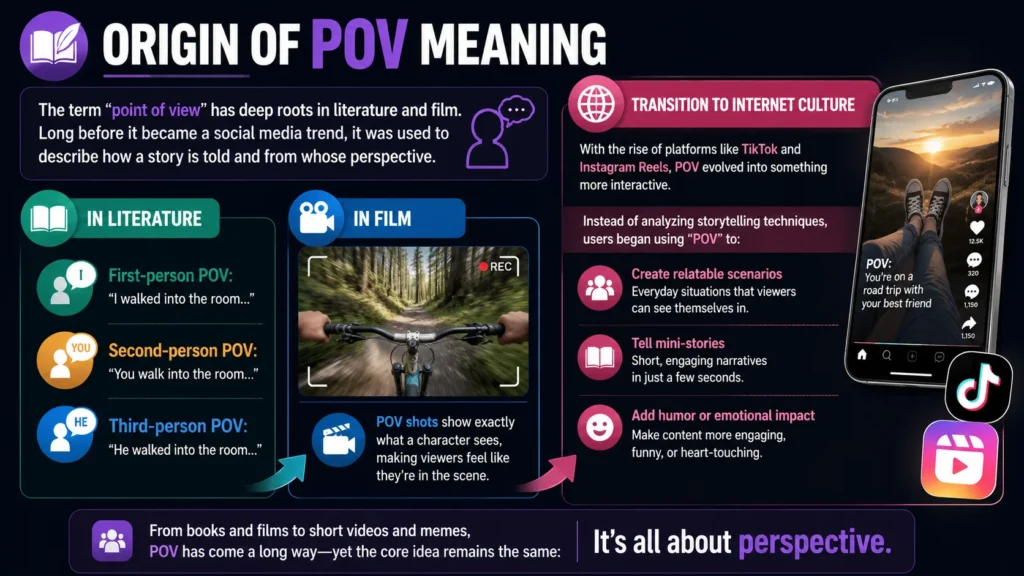
The term “point of view” has deep roots in literature and film. Long before it became a social media trend, it was used to describe how a story is told and from whose perspective.
In Literature:
- First-person POV: “I walked into the room…”
- Second-person POV: “You walk into the room…”
- Third-person POV: “He walked into the room…”
In Film:
- POV shots show exactly what a character sees, making viewers feel like they’re in the scene.
Transition to Internet Culture:
With the rise of platforms like TikTok and Instagram Reels, POV evolved into something more interactive. Instead of analyzing storytelling techniques, users began using “POV” to:
- Create relatable scenarios
- Tell mini-stories
- Add humor or emotional impact
Why POV Became So Popular
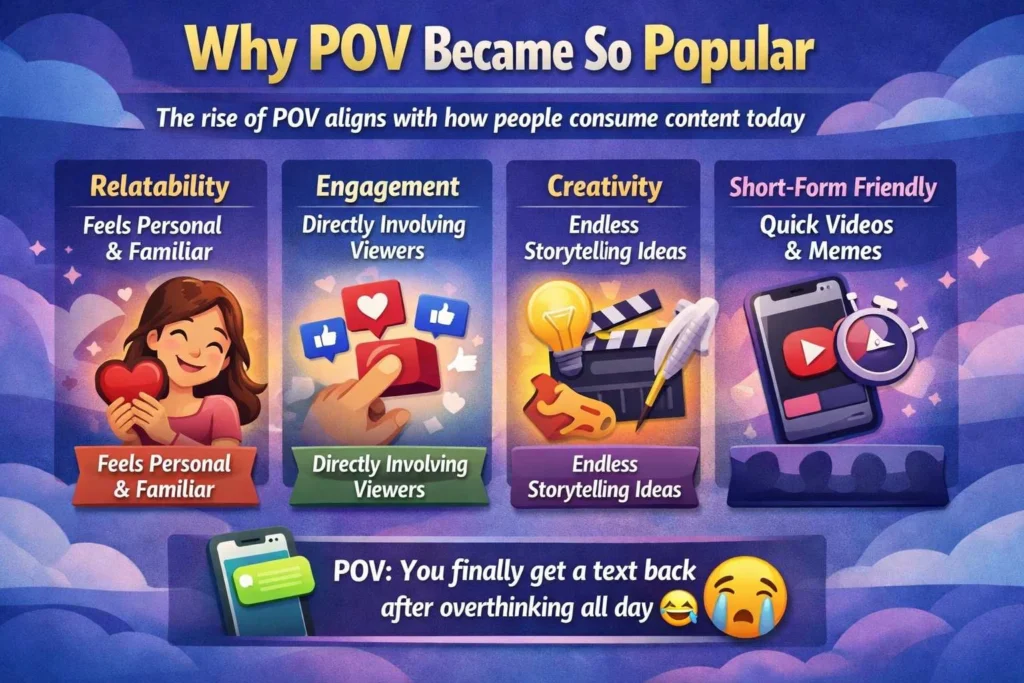
The explosion of POV content didn’t happen by accident. It aligns perfectly with how people consume content today.
Key Reasons for Its Popularity:
- Relatability: POV scenarios feel personal and familiar
- Engagement: Viewers feel directly involved
- Creativity: Endless possibilities for storytelling
- Short-form friendly: Perfect for quick videos and memes
For example:
“POV: You finally get a text back after overthinking all day 😭”
This instantly connects with anyone who’s experienced that feeling.
How POV Is Used Today
1. Social Media (Most Common Usage)
POV is used to create immersive scenarios where the viewer becomes part of the story.
Examples:
- “POV: You walk into your favorite café and your crush is there ☕💛”
- “POV: You forgot your lines in front of the whole class 😬”
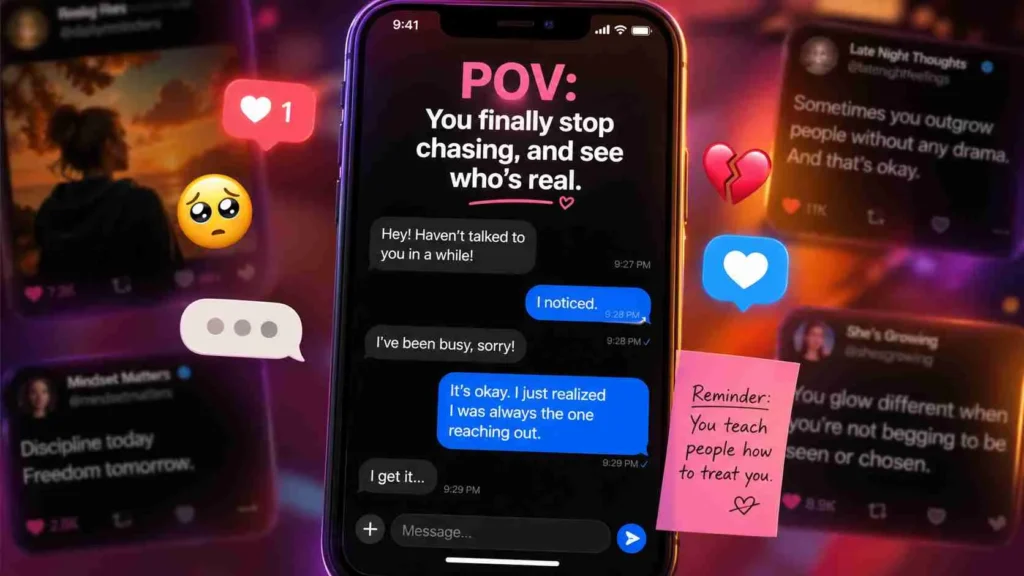
2. Texting and Chat Conversations
People use POV to describe situations in a playful or dramatic way.
Examples:
- “POV: me waiting for your reply 👀”
- “POV: you said you wouldn’t catch feelings… but here we are”
3. Memes and Humor
POV is widely used in memes to exaggerate relatable experiences.
Example:
- “POV: it’s 2 AM and you suddenly remember something embarrassing from 5 years ago”
4. Storytelling Content
Creators use POV to tell short stories where the viewer is the main character.
Example:
- “POV: You’re the new student and everyone is staring at you”
Types of POV Content (With Examples)
Here’s a breakdown of how POV is used across different tones and contexts:
| Type of POV | Description | Example |
|---|---|---|
| Friendly POV | Lighthearted, relatable | “POV: Your friend brings snacks without asking 🥺” |
| Romantic POV | Flirty or emotional | “POV: I look at you like you’re my whole world ❤️” |
| Funny POV | Humorous situations | “POV: You said ‘just one episode’ 😂” |
| Awkward POV | Cringe or relatable discomfort | “POV: You wave back at someone who wasn’t waving at you 😅” |
| Dramatic POV | Emotional or intense | “POV: You realize everything just changed” |
| Negative POV | Slightly dismissive or sarcastic | “POV: You thought this was a good idea… it wasn’t” |
POV Meaning in Different Contexts
1. In Writing and Literature
POV defines how a story is narrated.
- First-person: personal and intimate
- Third-person: broader perspective
2. In Photography and Film
POV refers to camera perspective what the viewer sees through the lens.
3. In Gaming
POV describes the player’s perspective:
- First-person POV (FPS games)
- Third-person POV
4. In Social Media
POV is more about creating an experience rather than just describing perspective.
POV vs Similar Terms
It’s easy to confuse POV with other internet slang or storytelling terms. Here’s how it compares:
| Term | Meaning | Difference from POV |
|---|---|---|
| POV | Point of View | Focuses on perspective |
| Scenario | A situation or scene | Less immersive than POV |
| Roleplay | Acting out roles | POV is more passive for the viewer |
| Context | Background information | POV creates the experience itself |
| Perspective | General viewpoint | POV is more specific and interactive |
Alternate Meanings of POV
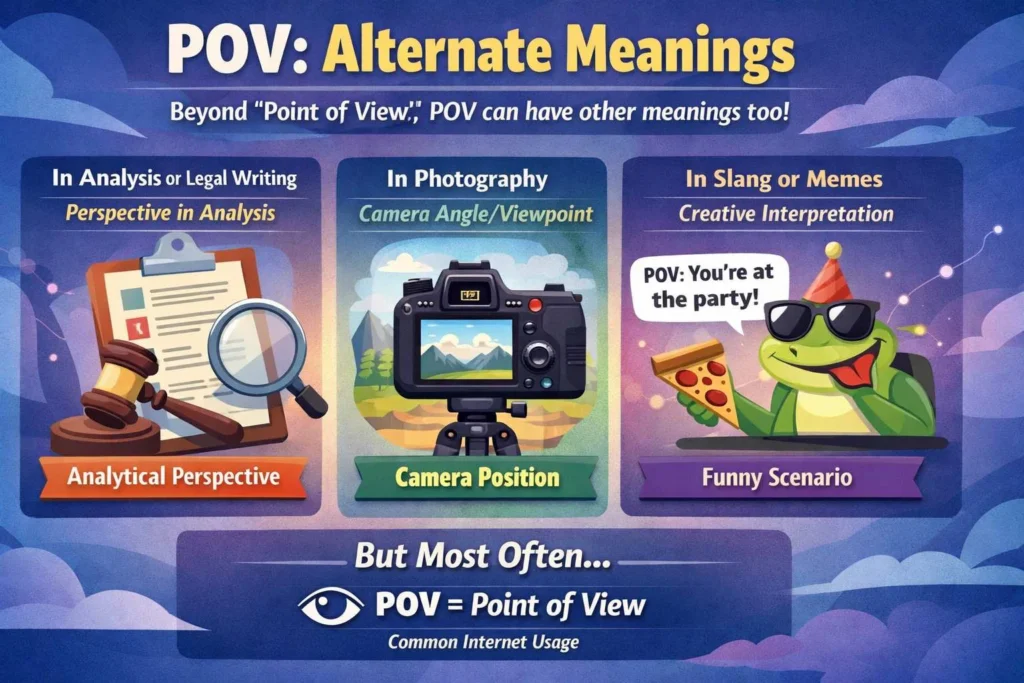
While “Point of View” is the most common meaning, POV can occasionally have other interpretations depending on context:
- In legal or professional writing: Perspective in analysis
- In photography discussions: Camera angle or viewpoint
- Rare slang usage: Some communities may use POV creatively beyond its original meaning
However, in everyday online use, POV almost always means “Point of View.”
How to Use POV Correctly
Using POV effectively is all about clarity and relatability.
Tips for Using POV:
- Keep it simple and clear
- Make the scenario relatable
- Use emotional triggers (humor, romance, nostalgia)
- Match tone with audience
Good Examples:
- “POV: You finally understand the assignment 😌”
- “POV: It starts raining right after you wash your car ☔”
Less Effective Examples:
- “POV: something happens” (too vague)
Polite or Professional Alternatives to POV
In formal or professional writing, “POV” may feel too casual. Here are better alternatives:
- From this perspective
- From my viewpoint
- From the user’s perspective
- Based on this scenario
- In this context
Example:
Instead of:
“POV: The customer is unhappy”
Use:
“From the customer’s perspective, the experience may feel unsatisfactory.”
Real-Life Examples of POV Usage
Casual Conversation:
“POV: You see your food coming after waiting 30 minutes 😍”
Romantic Tone:
“POV: I look at you and forget everything else 💖”
Sarcastic Tone:
“POV: You thought it would be easy… it wasn’t 🙃”
Motivational Tone:
“POV: You didn’t give up and now you made it 💪”
Common Mistakes When Using POV
Even though POV is simple, people sometimes misuse it.
Mistakes to Avoid:
- Using POV without a clear perspective
- Making it too vague
- Confusing it with general statements
- Overusing it in professional contexts
FAQs
What does POV mean in texting?
POV in texting means “point of view.” It’s used to describe a situation as if the reader is experiencing it themselves. For example, someone might say “POV: you finally get a reply after hours of waiting,” which creates a relatable emotional scenario.
What does POV mean on TikTok?
On TikTok, POV is used to create immersive videos where the viewer becomes part of the story. Creators use it to simulate experiences like romantic moments, awkward situations, or funny everyday scenarios.
Is POV always first-person?
Not always. While POV often feels like first-person, especially online, it can also represent second-person or third-person perspectives depending on how the scenario is framed.
Why do people use POV in memes?
People use POV in memes because it makes content more relatable and engaging. It allows viewers to instantly connect with the situation being described.
Can POV be used professionally?
POV is generally informal and best suited for casual or creative contexts. In professional settings, it’s better to use alternatives like “from this perspective” or “based on this viewpoint.”
What is the difference between POV and perspective?
POV is a specific type of perspective that focuses on how a scenario is experienced. Perspective is a broader term that refers to a general way of thinking or viewing something.
How do you write a good POV caption?
A good POV caption should be clear, relatable, and emotionally engaging. It should place the reader directly into a situation they recognize or feel connected to.
Is POV slang or formal language?
POV is considered internet slang in modern usage, although its original form “point of view” is a formal term used in literature and media studies.
Conclusion
POV meaning has evolved far beyond its traditional roots in literature and film. Today, it’s a powerful tool for storytelling, especially in social media where connection and relatability matter most.
You’re creating content, texting friends, or just trying to understand internet culture, knowing how POV works can make communication more engaging and expressive. At its core, POV is about perspective and experience. It allows you to step into someone else’s shoes even if just for a few seconds.
The key to using it effectively is clarity, relatability, and tone. Keep your scenarios simple, emotionally engaging, and easy to understand. Funny, romantic, or dramatic, POV content works best when it feels real and instantly recognizable. Meaning of pov.
Discover More Related Articles:
- “SMH” Meaning: What It Stands For, How to Use It & When It Fits In 2026
- “Skibidi” Meaning: What It Really Means in Internet Culture In 2026
- “Ennui” Meaning: The Feeling of Boredom & Emptiness Explained In 2026