
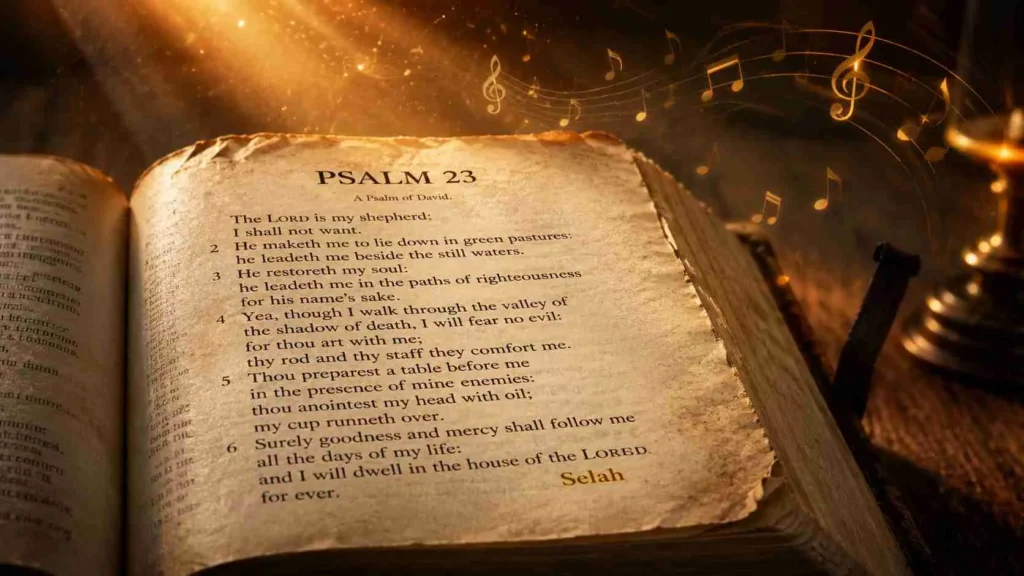

Selah (סֶלָה) is a Hebrew word found 74 times in the Bible that means “to lift up” or “pause and loudly praise.” It’s a musical and liturgical marker telling worshipers to stop, reflect, and respond often by raising their voices or hands toward God.
You’re reading Psalm 23. Everything flows smoothly. “The Lord is my shepherd. I shall not want.” Then boom. That weird little word jumps off the page. Selah.
Nobody explained it during Sunday school. Your study Bible shrugs with a tiny footnote. Google gives you six different answers – pause, lift up, forever, rock, interlude, shout. Which one is true?
Let’s settle this right now.
The real selah meaning comes from ancient Hebrew. It’s not mysterious. It’s not untranslatable and it’s a practical instruction for worship. Think of it as a musical road sign. It tells singers when to stop. When to breathe. When to shout. And when to let a hard truth sink in.
This post gives you everything you need. You’ll learn the Hebrew root. You’ll see exactly how selah works in the Psalms and you’ll debunk common myths and you’ll even learn how to pronounce it without sounding unsure.
No academic fluff. No vague “some scholars say.” Just clear facts. Real tables. And a fresh way to read your Bible starting today.
Let’s begin with the short answer then we’ll dig deep.
The Short Answer | What Selah Means in One Sentence
Here’s the selah meaning you can take to the bank.
Selah means “to lift up” or “to pause and loudly praise.” It’s a musical and liturgical marker. A holy intermission where you stop, reflect, and raise your voice or instruments toward God.
That’s it. Not complicated. But powerful.
Think of it as a stage direction for ancient worship leaders. The Psalmist writes a heavy line. Then he writes “Selah.” That means the music swells. The congregation breathes together. Maybe someone shouts “Amen!” or “Hallelujah!” Then the next verse begins.
You’ll see this pattern again and again in the book of Psalms. Seventy-one times, to be exact. Plus three more in Habakkuk chapter three.
| Feature | Detail |
|---|---|
| Part of speech | Interjection / musical notation |
| Language of origin | Biblical Hebrew |
| Total Bible occurrences | 74 (71 in Psalms + 3 in Habakkuk 3) |
| Most accepted interpretation | “Pause and praise” or “Lift up” |
| Is it a prayer instruction? | Yes – it cues worship leaders and congregations |
| First appearance in Psalms | Psalm 3:2 |
Key takeaway: Selah isn’t a secret code. It’s a tool. And once you understand it, the Psalms sound different. Richer. More alive.
The Hebrew Root | Where the Word Selah Actually Comes From
Most articles skip this part because it’s hard. We won’t.
Hebrew is a concrete language. Words connect to physical actions lifting, throwing, planting, walking. Selah follows that rule.
The word סֶלָה (Selah) connects to the Hebrew verb סָלָה (calah). That verb means:
- To lift up
- To exalt
- To weigh or balance (like on a scale)
Some scholars also link it to סָלַל (salal) “to lift a highway” or “cast up a road.” Same idea. You’re raising something high. Building a path upward.
Here’s the beautiful part. When you see Selah in a Psalm, you’re not just stopping. You’re stopping to lift something up. Your voice. Your hands and your attention and your praise toward God.
| Hebrew Word | Transliteration | Primary Meaning | Connection to Selah |
|---|---|---|---|
| סָלָה | Calah | To lift up, to exalt | Direct root – Selah as “lift up praise” |
| סָלַל | Salal | To cast up, raise a highway | Secondary – building a path toward God |
| שָׁלָה | Shalah | To be at rest | Possible later influence – pause connotation |
A smaller group of scholars suggests a connection to שָׁלָה (shalah), which means “to be at rest.” That’s where the “pause only” idea comes from. But most Hebrew linguists today say the primary meaning is “lift up.” The pause is a result of lifting up praise – not the main point.
Why this matters: You don’t need a PhD in Hebrew to get this. Just remember the word calah. Lift up. Every time you see Selah, imagine a worship leader raising both hands. Then do the same.
How Selah Works in the Psalms | More Than a Pause Button
Here’s where most writers get lazy. They say “Selah means pause.” Period. End of story.
But that’s like saying a red light only means “stop.” No – it also means “look around, check for danger, then get ready to go.” Context changes everything.
Selah does three things at once in the Psalms:
1. A musical rest – Instruments stop or shift to a different key. The drummer holds. The harpist lifts her fingers.
2. A lyrical break – The singer breathes. The words hang in the air. The congregation feels the weight of what was just sung.
3. A congregational response – This is the big one. Ancient Jewish worship wasn’t quiet. When the leader said “Selah,” the people shouted “Amen!” or “Hallelujah!” They raised their hands. Some fell silent. Some cried out.
Let’s see this in action.
Real example – Psalm 3:2–4 (NIV)
“Many are saying of me, ‘God will not deliver him.’ Selah
But you, LORD, are a shield around me, my glory, the One who lifts my head high. Selah”
See the pattern? First Selah follows a hard statement. Enemies are mocking David. They’re saying God abandoned him. Heavy stuff. Then Selah hits. Pause. Let that sting sink in.
Then David answers with confidence. “But you, LORD, are my shield.” Second Selah. Now pause and let that sink in. Let the shift happen. From fear to faith. From whisper to shout.
That’s the genius of Selah. It creates emotional punctuation. It gives you room to feel the Psalm instead of just reading it fast.
| Psalm | Selah Count | Context Right Before Selah |
|---|---|---|
| Psalm 3 | 2 | Enemies threatening David’s life |
| Psalm 4 | 2 | Trusting God despite anxiety and sleeplessness |
| Psalm 7 | 1 | A plea for justice against a liar |
| Psalm 20 | 1 | Prayer for victory before battle |
| Psalm 21 | 1 | Thanksgiving after victory |
| Psalm 24 | 1 | “Lift up your heads, you gates” – fittingly paired with Selah |
| Psalm 32 | 1 | Confession of hidden sin |
| Psalm 39 | 1 | Silence in the face of evil |
| Psalm 46 | 3 | “Be still and know that I am God” |
| Psalm 49 | 2 | Wealth can’t save you from death |
| Psalm 52 | 1 | The fate of the boastful wicked |
| Psalm 54 | 1 | God is my helper |
| Psalm 55 | 1 | Betrayal by a close friend |
| Psalm 57 | 2 | Refuge in the shadow of God’s wings |
| Psalm 59 | 2 | Deliverance from bloodthirsty enemies |
| Psalm 60 | 1 | God has rejected us – but also given a banner |
| Psalm 61 | 1 | Lead me to the rock that is higher than I |
| Psalm 62 | 2 | God alone is my rock and salvation |
| Psalm 66 | 3 | Come and see what God has done |
| Psalm 67 | 2 | Let the peoples praise you |
| Psalm 68 | 7 | Highest count – a processional Psalm full of military imagery |
| Psalm 75 | 1 | God judges – He puts down one and exalts another |
| Psalm 76 | 1 | God is feared in the council of the holy ones |
| Psalm 77 | 1 | Will the Lord reject forever? |
| Psalm 81 | 1 | Open your mouth wide – I will fill it |
| Psalm 82 | 1 | You are gods – but you will die like humans |
| Psalm 83 | 3 | Let them know that you alone are the Most High |
| Psalm 84 | 3 | Better is one day in your courts |
| Psalm 85 | 2 | Righteousness and peace kiss each other |
| Psalm 87 | 2 | This one was born in Zion |
| Psalm 88 | 1 | Darkness is my closest friend (bleakest Psalm) |
| Psalm 89 | 3 | You have renounced the covenant with your servant |
| Psalm 140 | 1 | Do not grant the desires of the wicked |
| Psalm 141 | 1 | Let a righteous man strike me – it’s kindness |
| Psalm 143 | 1 | I spread out my hands to you |
Why this pattern matters: Selah never appears in boring places. It always follows a high-stakes moment. Danger. Deliverance. Doubt. Declaration. The Psalmist wants you to stop right there. Don’t scroll past. Don’t skim. Feel this.
What Selah Does NOT Mean | Debunking Four Common Myths
People invent meanings for ancient words. It happens all the time. Let’s clean up the mess.
Myth 1: “Selah means forever”
You’ll see this in bad blog posts and meme Bibles. It’s wrong. The Hebrew word for “forever” is עוֹלָם (olam). Completely different word. Different letters. Different sound.
How did this myth start? Someone confused Selah with a similar-sounding Aramaic word. Or they wanted Selah to sound more mystical than it is. Don’t fall for it.
Myth 2: “Selah is untranslatable”
You hear this from people who gave up too soon. Sure, Selah doesn’t have a perfect one-word English equivalent. But many biblical words don’t. “Lift up praise” works fine. “Pause and worship” works fine. “Musical interlude with congregational response” works fine – though that’s a mouthful.
Untranslatable means zero words in another language can capture the meaning. That’s not true here. We just need two or three words instead of one.
Myth 3: “Selah only means silence”
This one sounds spiritual, so it stuck. But ancient Hebrew worship was loud. Check Psalm 47:1 – “Clap your hands, all you nations. Shout to God with cries of joy.” Check Psalm 150 – trumpets, harps, tambourines, dancing, cymbals.
Selah often cues a crescendo, not a whisper. The instruments swell. The singers raise their volume. The congregation shouts “Hallelujah.” Silence happens sometimes, yes. But not every time. And not as the main point.
Myth 4: “Selah is the same as ‘Amen’”
Related? Yes. Identical? No.
| Term | Meaning | Function | Found in Psalms? |
|---|---|---|---|
| Selah | Lift up / pause and praise | Musical-liturgical marker – cues response | Yes (71 times) |
| Amen | Truly / so be it / let it be confirmed | Affirmation of truth – ends a prayer or blessing | Yes (less frequent – Psalm 41:13, 72:19, 89:52) |
| Higgaion | Meditation / murmur / quiet music | Musical or meditative pause – softer than Selah | Yes (Psalm 9:16, 19:14, 92:3) |
| Tsela | Rib / side | Anatomical term – no relation to Selah despite similar spelling | No – different root entirely |
The bottom line: Don’t mix them up. Use Selah when you want to lift praise. Use Amen when you want to agree with truth and use Higgaion when you want quiet reflection. Your Bible study will thank you.
How to Pronounce Selah | Without Overthinking It
People stress about this. Don’t.
Two pronunciations are perfectly acceptable in English:
- SEE-luh (most common in American English)
- SAY-luh (closer to the original Hebrew, popular in worship music circles)
Not correct: Suh-LAH (stress on second syllable). Sell-ah (short e like “sell”). See-LAH (long second syllable sounds unnatural).
Quick tip: Say it like “see” + “luh.” Rhymes with “knee-duh.” That’s it. You’re done.
If you’re leading worship or teaching a Bible study, pick one pronunciation and stick with it. Consistency matters more than perfection. Hebrew itself had regional accents. The ancient Galileans probably said it differently than the Judeans. You get the same grace.
The Spiritual Meaning of Selah | Why It Matters for You Today
Here’s the practical part. The part you can actually use tomorrow morning.
Selah turns Bible reading into a conversation instead of a speed-run. Most of us read the Psalms like we’re trying to finish a chore. Ten chapters before coffee. Check the box. Move on.
But the Psalmists didn’t write for speed-readers. They wrote for worshipers. People who stopped. People who felt the weight of words and people who shouted back.
Three ways to practice Selah right now:
1. Read a Psalm aloud. When you see Selah, stop talking for five full seconds. Breathe. Then say one sentence of thanks out loud. Not in your head. Out loud. Your ears need to hear your own voice.
2. Write your own “Selah moments.” Grab a journal. Draw a small upward arrow (↑) next to any verse that hits you hard. That arrow means “lift up.” Pause before moving to the next verse. Write one word – thanks, help, wow, ouch – whatever you feel.
3. In worship music, treat Selah as a cue to raise your hands or voice. Even at home. Even alone and even if you feel silly. The physical act of lifting your hands changes your posture. And posture changes your heart.
Analogy time
You know that moment in a live concert when the band stops playing? The singer holds the microphone out toward the crowd. The drums cut. The lights dim. For three seconds, nothing happens. Then the crowd roars. They sing the next line without any help.
That’s Selah. A silence full of sound. A pause that isn’t empty. It’s the opposite of awkward silence. It’s anticipation and it’s shared breath and it’s worship waiting to explode.
| Without Selah | With Selah |
|---|---|
| Skim Psalm 23 in 30 seconds | Read verse 1. Pause. Say “The Lord is my shepherd – I lack nothing.” Feel the weight of those seven words. Then continue. |
| Pray a fast list of requests | Pray one sentence. Stop. Lift one praise for something God already did. Then continue. |
| Rush through a worship chorus | Sing the line before Selah twice. Let it land. Repeat it until it moves from your head to your chest. |
| Study Bible verses like a textbook | Read a verse with Selah. Close your eyes. Ask “What just happened here?” Then answer honestly. |
This isn’t mystical. It’s not about hearing voices or seeing visions. It’s about intentionality. Selah forces you to slow down. And slowing down is the first step toward actually listening.
Selah in Habakkuk | The Only Non-Psalm Selah You Need to Know
Most people forget this. Selah appears outside Psalms. Three times. All in one chapter – Habakkuk 3.
Habakkuk was a prophet who argued with God. “Why do you tolerate wrongdoing? Why do you let the wicked swallow the righteous?” Heavy questions. God answered – but the answer was scary. God said “I’m sending the Babylonians to judge everyone. Including you.”
Habakkuk freaked out. Then he composed a prayer. A Psalm-like poem. And in that poem, he wrote Selah three times.
Habakkuk 3:3 – “God came from Teman, the Holy One from Mount Paran. Selah”
Habakkuk 3:9 – “You uncovered your bow. You called for many arrows. Selah”
Habakkuk 3:13 – “You came out to save your people, to save your anointed one. Selah”
Same function as the Psalms. A musical and liturgical marker. Habakkuk wrote a song for worship leaders. He wanted congregations to stop and respond to God’s terrifying, beautiful power.
Key takeaway: Selah isn’t only for happy Psalms. It’s for the hard ones too. Habakkuk 3 is a song of trembling faith. The prophet says “I hear God’s judgment and my body trembles. But I will rejoice anyway. Selah.” That’s real worship. Not pretend happiness. Honest fear that still trusts.
Selah and the Structure of Ancient Hebrew Worship
Let’s go deeper. Because context changes everything.
Ancient Israelite worship followed a pattern. The Levites led music. The congregation responded. Priests offered sacrifices. Everyone ate a meal together. Selah fit into this rhythm.
Here’s what likely happened during a Psalm with Selah:
Step one: A worship leader (often a Levite) sings a line of the Psalm. The congregation listens. Maybe they hum along.
Step two: The leader reaches a key moment – a confession, a cry for help, a declaration of praise. He sings the line with extra emotion.
Step three: He says or signals “Selah.” The instruments stop or shift. The singers pause.
Step four: The congregation responds. Some shout “Amen.” Others raise their hands. Some fall to their knees. The leader waits.
Step five: After the response fades, the leader sings the next line. The music resumes. The worship continues.
This isn’t speculation. We have evidence from Jewish liturgical traditions, the Dead Sea Scrolls, and early Christian writings. Selah functioned as a cue. A baton flick from the conductor.
Why this matters for you: When you read a Psalm with Selah, imagine a room full of people responding. You’re not alone. You’re part of a chorus. Your pause is their pause. Your shout is their shout.
Ten Little Known Facts About Selah
Let’s close the deep dive with some rapid-fire truths. These aren’t fluff. They’re real observations from biblical scholarship.
1. Selah appears 74 times in the Hebrew Bible. Zero times in the New Testament. Zero times in the Torah (first five books). Almost all in Psalms.
2. The longest gap between Selah appearances in Psalms is 50 chapters. Psalm 89 has Selah. Psalm 140 has Selah. Everything between? No Selah at all.
3. Psalm 68 uses Selah seven times. That’s the most of any chapter. It’s a victory march. Selah marks each new scene of God’s triumph.
4. The Septuagint (Greek Old Testament, 200–100 BC) translates Selah as διάψαλμα (diapsalma) – “musical interlude.” That’s the earliest external evidence for Selah’s function.
5. Jerome’s Latin Vulgate (AD 400) translated Selah as semper – “always” or “forever.” That’s where the “forever” myth started. Jerome made an educated guess. Later scholars proved him wrong.
6. The Dead Sea Scrolls (100 BC – AD 100) preserve Psalms with Selah marked in the margins. Scribes added musical notations. This confirms Selah was a performance instruction, not a theological statement.
7. No ancient Jewish commentary (Talmud, Midrash, Targum) gives a single definitive meaning for Selah. They all say “we think it means X” with varying confidence. Honest humility from the rabbis.
8. Some Psalms have Selah in the middle of a verse. Not at the end. Check Psalm 55:19 (Hebrew numbering). Selah splits the sentence. That’s a dramatic breath right in the middle of a thought.
9. The Greek word diapsalma appears in the Septuagint for Selah. Early Christian hymn writers borrowed the same word for their own musical notations. Selah influenced Christian worship for centuries.
10. Modern Hebrew (the language spoken in Israel today) doesn’t use Selah conversationally. It’s purely biblical and liturgical. Ask for directions in Tel Aviv using Selah and they’ll look confused.
How to Teach Selah to Someone Else
You know the selah meaning now. Don’t keep it to yourself.
Here’s a 5-minute explanation you can give a friend, a small group, or your kids:
Step one: Open to Psalm 3. Read verses 1–2. Stop. Say “That’s rough. David’s enemies are mocking him.”
Step two: Point to the word Selah. Say “The Bible puts this little word here on purpose. It means ‘pause and praise’ or ‘lift up.’”
Step three: Read verse 3. Stop again. Say “Now David shifts. He’s not afraid anymore. He says God is his shield.”
Step four: Ask “What changed between verse 2 and verse 3?” Let them answer. Then say “Selah gave David room to shift. It gives us room too.”
Step five: Practice together. Read any Psalm with Selah. Every time you see it, stop for three seconds. Raise your hands. Then keep reading.
That’s it. No theology degree required. Just honesty and a willingness to slow down.
FAQs
Why isn’t Selah translated in most Bibles?
Translators weren’t 100% sure of its exact function. So they left it untranslated – like “Hosanna,” “Hallelujah,” or “Maranatha.” Better to keep the original word than guess wrong. Modern scholarship has clarified a lot, but older translations (KJV, NKJV, NASB) kept Selah as is.
Does Selah appear in the New Testament?
No. Not once. But some scholars see echoes of Selah in New Testament doxologies. Passages like Ephesians 3:20–21 – “Now to him who is able to do immeasurably more than all we ask or imagine… to him be glory.” That surge of praise at the end of a theological argument? That’s the spirit of Selah. Even without the word.
Is Selah a name?
Yes – but it’s rare. Some modern Christians name their daughters Selah. It’s a beautiful name. The biblical term inspires it. Just don’t tell people it means “forever” or “pause.” Correct them gently. “Actually, it means lift up praise.”
What’s the difference between Selah and “Be still” in Psalm 46:10?
Psalm 46 has both. Verse 10 says “Be still and know that I am God.” The Hebrew word for “be still” is רָפָה (raphah). It means “drop your hands, stop striving, let go.”
Selah appears three times in Psalm 46. It likely followed verses 3, 7, and 11. So the pattern is: declare God’s power → Selah (pause and praise) → command to be still → trust.
They work together. Raphah tells you to stop fighting. Selah tells you to start praising. One without the other is incomplete.
How do worship leaders use Selah today?
Some write Selah into chord charts as a rest symbol. Four beats of silence. Others use “Selah” as a song title popular examples include “Selah” by Lauryn Hill, “Selah” by Kanye West, and countless worship albums.
Conclusion
You came here for a definition. Now you have more.
You know the Hebrew root calah to lift up. You know Selah cues a musical break, a lyrical pause, and a congregational response and you know it appears 74 times in the Bible.
Next time you see Selah in Psalm 4, Psalm 46, or Psalm 89, don’t skip it. Don’t treat it like a typo. Stop. Breathe. Lift something up. Your voice. Your hands or your attention. And your honest praise or honest pain.
Try it today. Open any Psalm with Selah. Read the verse before it. Pause five seconds. Say one sentence out loud. “God, you see me.” Or “God, I’m tired.” Or “God, you’re good.” Then keep reading.
That little pause changes everything. It turns reading into praying. And praying into living. That’s the selah meaning. Not a mystery. A method. Not ancient trivia. A tool you can hold right now.
Discover More Related Articles:
- “Glaze” Meaning Slang: What It Really Means in Internet Conversations In 2026
- “67” Meaning Slang: How It’s Used in Online Conversations In 2026
- “Cap” Slang Meaning: From Street Language to Social Media in 2026