
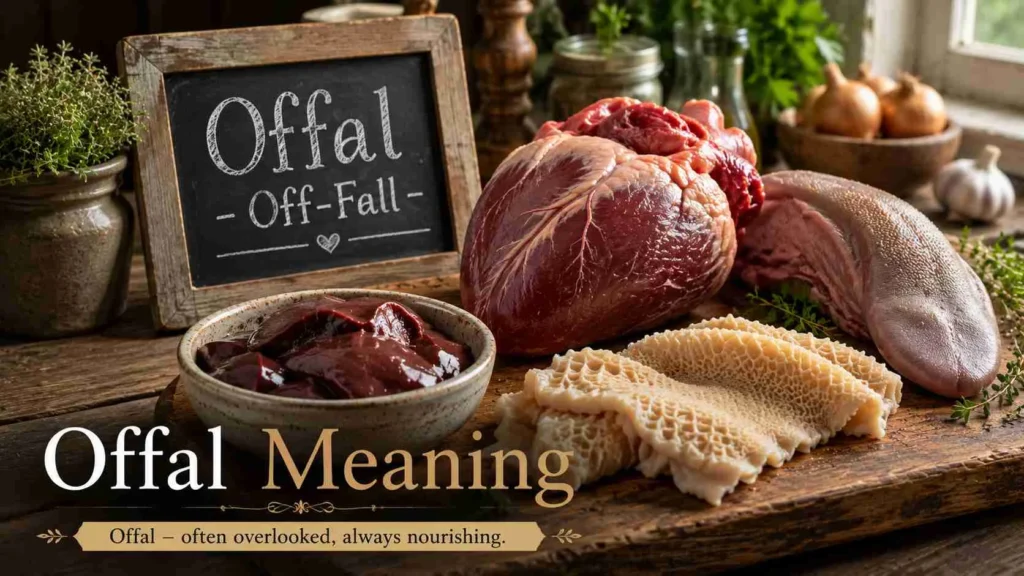

Offal (pronounced OFF-ul) refers to the edible internal organs and entrails of butchered animals think liver, kidneys, heart, tongue, tripe, and intestines. These nutrient-dense parts often get tossed aside in modern supermarkets.
Most people hear the word “offal” and cringe. I get it. It sounds like something you’d scrape off your boot.
But here’s the truth: you’ve probably already eaten offal. That rich, silky pâté on a cracker? That’s chicken liver. The deep, savory bite in a traditional British pie? Beef kidney. The tender strips in your phở? Cow tripe.
Offal isn’t gross. It’s just misunderstood.
This guide walks you through the offal meaning from every angle. You’ll learn the definition, pronunciation, types, safety facts, nutritional power, and how different cultures turn these “leftover” parts into world-famous dishes. No fluff. No judgment. Just real, useful information.
Let’s dig in.
What Does Offal Actually Mean?
The offal meaning is simpler than you think. Offal refers to the internal organs and entrails of a butchered animal. These are the parts that aren’t skeletal muscle – no steaks, no chops, no chicken breasts.
Think liver, kidneys, heart, tongue, tripe, brains, and intestines.
The word itself comes from Middle English. It’s a combination of “off” (away from) and “fall” (to drop). So offal meaning literally translates to “the parts that fall off” during butchering. That’s not an insult. That’s history.
In the 14th century, wasting food wasn’t an option. If you slaughtered an animal, you used everything. The “fallen” parts became stews, sausages, and spreads. Over time, wealthier classes preferred muscle meat. Offal became poor people’s food. But today? Chefs call it “nose-to-tail eating.” And it’s making a comeback.
So when someone asks for the offal definition, here’s your one-sentence answer: Edible organs and entrails of livestock, typically including liver, kidney, heart, tongue, tripe, sweetbreads, and intestines.
How to Pronounce Offal
Let’s clear this up fast. You pronounce offal as OFF-ul.
Rhymes with “chocolate” if you drop the “cho.” Or rhymes with “golf” but with a soft “ul” at the end.
Not “oh-fall.”
Not “uh-fall.”
Not “off-all.”
OFF-ul. Two quick syllables. First syllable gets the stress.
Say it out loud: OFF-ul. Good. Now you’ll never stumble over it in a butcher shop or fancy restaurant.
Offal vs. Organ Meat vs. Variety Meats: Same or Different?
People use these terms interchangeably. But there are small differences. Let’s break them down.
- Offal – The broadest term. Includes all internal organs and entrails. Liver, kidneys, tripe, intestines, heart, tongue, lungs, spleen, brain, feet, and head meat all count.
- Organ meat – A subset of offal. Refers specifically to compact organs like liver, kidneys, heart, and brain. Does not usually include intestines or tripe.
- Variety meats – A butcher’s polite word. Covers offal plus feet, tail, and sometimes head meat. Used on restaurant menus to sound less scary.
- Giblets – A narrow term. Only refers to the heart, liver, gizzard, and neck of poultry (chicken, turkey, duck).
So if you want to sound precise: all organ meats are offal, but not all offal is organ meat. Tripe is offal but not an organ. Intestines are offal but not organs.
For everyday conversation? Just say “offal” or “organ meat.” People will know what you mean.
The Complete List of Offal Types
Let’s name the parts without dancing around. Here is every major type of offal you’ll encounter in a butcher shop, market, or traditional recipe.
Liver
The most common offal worldwide. Chicken liver is mild and creamy. Beef liver is stronger and minerally. Pork liver sits in the middle. You’ve eaten it in pâté, liverwurst, and the classic American dish “liver and onions.”
Kidney
Lamb kidney is tender and delicate. Beef kidney is larger and more intense. Both appear in British steak and kidney pie. The key is removing the hard white core in the center before cooking.
Heart
Heart is a dense, lean muscle. Don’t confuse it with “organ” in the soft sense. It has a beefy flavor similar to steak but cheaper. Peruvians grill beef heart as anticuchos. Chicken hearts are skewered whole in Brazilian churrasco.
Tongue
Tongue is pure, tender muscle once you peel off the rough outer skin. Mexican lengua tacos are the best introduction. Jewish delis serve pickled tongue on rye bread.
Tripe
Tripe is the stomach lining of cows (or sometimes sheep or goats). It has a honeycomb pattern on one side. Raw tripe smells barnyard-strong. But after thorough cleaning and long simmering, it turns soft and mild. You’ve had it in menudo (Mexico) or phở (Vietnam).
Sweetbreads
This is the worst name in food. Sweetbreads aren’t sweet and aren’t bread. They’re the thymus gland (young animals) or pancreas (older animals). They taste creamy, rich, and slightly nutty. French chefs pan-sear them until crispy outside and custard-soft inside.
Intestines
Pork and beef intestines get used as sausage casings. Fried pig intestines appear as chitterlings (or “chitlins”) in the American South. In China, grilled lamb intestines are a street food favorite.
Brain
Brain has a silky, custard-like texture. It’s mild in flavor. In the US Midwest, you’ll find breaded and fried pork brain sandwiches. In Mexico, tacos de sesos (brain tacos) are common. Safety note: Avoid brain from regions with mad cow disease risk.
Other Notable Offal
- Lungs – Used in Scottish haggis (mixed with oats and spices).
- Spleen – Called milza in Italy; often fried or added to sauces.
- Feet – Pig trotters and chicken feet are rich in collagen. Simmered in stews or pickled.
- Head meat – The cheeks and jowls. Slow-cooked to tender perfection.
- Blood – Whisked into black pudding (UK) or morcilla (Spain).
Table 1: Offal Types at a Glance
| Offal Type | Animal Source | Texture | Typical Dish |
|---|---|---|---|
| Liver | Chicken, beef, pork | Soft, creamy | Pâté, liverwurst |
| Kidney | Lamb, beef | Tender, mild | Steak & kidney pie |
| Heart | Beef, chicken | Dense, meaty | Anticuchos, skewers |
| Tongue | Beef, pork | Tender, fatty | Lengua tacos |
| Tripe | Cow | Chewy, mild | Menudo, phở |
| Sweetbreads | Calf, lamb | Creamy, crispy | Pan-seared with sauce |
| Intestines | Pig, cow | Chewy, snappy | Chitterlings, sausage casings |
| Brain | Pork, lamb | Silky, custard-like | Tacos de sesos |
Is Offal Safe to Eat? Let’s Talk Straight.
Yes – offal is generally safe to eat. But you need common sense.
The safety of offal depends on three things: the animal’s health, how the butcher handles it, and how you cook it.
The Good News
Cooking offal thoroughly kills bacteria, parasites, and viruses. Most offal dishes involve long simmering (tripe, intestines) or high-heat searing (liver, heart). Either method works fine.
The Caveats
Some offal types concentrate toxins. The liver filters blood. The kidneys filter urine. If an animal lived in polluted conditions or received veterinary drugs, those chemicals can end up in the organs.
Vitamin A is another concern. Beef liver contains so much Vitamin A that eating it every day could cause toxicity. Pregnant people should limit liver intake to once a week or less. The same goes for children.
Brain carries a unique risk: prions. These are misfolded proteins that cause mad cow disease (bovine spongiform encephalopathy). In countries with strict livestock monitoring – like the US, UK, Canada, and Australia – the risk is extremely low. But in regions with less oversight, avoid brain entirely.
Practical Safety Rules
- Buy offal from a trusted butcher or grocery store. Avoid roadside or unregulated markets.
- Smell it before cooking. Fresh offal smells mild, not sour or ammonia-like.
- Rinse tripe and intestines thoroughly. Scrub if needed.
- Cook liver until no pink remains inside. Same for kidney and heart.
- Eat liver no more than once per week. A single serving of beef liver is about 3–4 ounces (85–115 grams).
- If you have gout or high uric acid, limit offal. Organs are high in purines, which trigger flare-ups.
Bottom line: offal is not dangerous. But it demands more respect than a chicken breast.
Table 2: Offal Safety – What to Watch For
| Offal Type | Main Risk | Safer If… |
|---|---|---|
| Liver | High Vitamin A, toxin storage | Eaten once weekly; organic or grass-fed |
| Kidney | Heavy metals, drug residues | Sourced from pasture-raised animals |
| Brain | Prions (mad cow disease) | Avoided in high-risk regions; cooked well |
| Intestines | Bacterial contamination | Thoroughly cleaned + boiled or fried |
| Heart, tongue | Very low risk | Standard cooking to 145°F (63°C) |
The Nutritional Power of Offal
Here’s where offal shines. These parts are nutrient bombs.
Muscle meat – steak, chicken breast, pork chops is fine. But offal packs more vitamins and minerals per ounce than almost any other food.
Let’s compare beef liver to kale, the so-called “superfood.”
- Iron: Beef liver has about 6.2 mg per 100g. Kale has 1.6 mg.
- Vitamin A: Beef liver has over 7,700 mcg RAE. Kale has 500 mcg.
- Vitamin B12: Beef liver has 83 mcg. Kale has 0 mcg (plants don’t make B12).
- Protein: Beef liver has 29g. Kale has 4g.
Liver wins across the board.
Heart is another standout. It’s as lean as chicken breast but contains CoQ10 – a compound that supports heart health and energy production. You won’t find CoQ10 in muscle meat at the same levels.
Kidney delivers selenium and B12. Selenium supports thyroid function. B12 keeps your nerves and blood cells healthy.
Tongue gives you collagen and fatty acids. Good for skin, joints, and gut lining. But it’s higher in calories than other offal, so portion control matters.
The Downsides (Realistic, Not Alarmist)
- Cholesterol: Liver and kidney are higher in cholesterol than muscle meat. For most people, dietary cholesterol isn’t a big deal. But if you have familial hypercholesterolemia, talk to your doctor.
- Purines: Offal raises uric acid levels. If you have gout or kidney stones, limit intake.
- Vitamin A toxicity: Happens only with extreme daily consumption. One serving per week is safe for healthy adults.
So eat offal like you eat oysters or tuna. Enjoy it. Don’t live on it.
Table 3: Nutritional Snapshot – Per 100g Cooked
| Offal Type | Protein (g) | Iron (mg) | Vitamin B12 (mcg) | Vitamin A (mcg RAE) | Calories |
|---|---|---|---|---|---|
| Beef liver | 29 | 6.2 | 83 | 7,700 | 191 |
| Beef heart | 28 | 6.0 | 10 | 0 | 179 |
| Beef kidney | 27 | 6.0 | 28 | 140 | 158 |
| Pork tongue | 21 | 3.5 | 2.5 | 0 | 242 |
| Chicken liver | 25 | 9.0 | 21 | 3,300 | 167 |
| Lamb brain | 11 | 2.0 | 10 | 0 | 150 |
Note: Vitamin A values vary by animal diet and cooking method.
Why Do People Eat Offal?
Good question. If offal is so nutritious, why don’t we see it in every grocery store?
History, economics, and culture all play a role.
Thrift and Tradition
For most of human history, wasting food was unthinkable. When a family slaughtered a pig or a cow, they used every part. Muscle meat fed the adults. Organs and scraps went into sausages, pâtés, and stews. Nothing hit the trash.
That changed in the 20th century. Industrialized farming made muscle meat cheap. Supermarkets trained consumers to prefer clean, familiar cuts. Offal became associated with poverty and “peasant food.”
The Nose-to-Tail Movement
In the 2000s, chefs like Fergus Henderson (London’s St. John restaurant) revived offal. His philosophy: if you kill the animal, you respect the whole animal. That means eating the heart, liver, and tongue – not just the tenderloin.
Today, nose-to-tail eating aligns with sustainability. Livestock farming has a heavy environmental footprint. Using more of each animal reduces waste and spreads that footprint across more meals. It’s not just ethical. It’s efficient.
Flavor – The Real Reason
People don’t eat offal just because it’s cheap or sustainable. They eat it because it tastes incredible.
- Liver adds deep, savory richness to pâtés and terrines.
- Heart has a clean, beefy flavor with no fat.
- Tongue turns buttery-soft after slow cooking.
- Tripe soaks up broth like a sponge, giving texture to soups.
- Brain melts in your mouth like nothing else.
Once you get past the idea of offal, the flavor wins you over.
Offal Dishes Around the World
Offal isn’t weird. It’s global. Here’s where you’ll find it.
United Kingdom
- Steak and kidney pie – Diced beef and lamb kidney in a rich gravy, baked under pastry.
- Black pudding – Pork blood mixed with oats, fat, and spices. Sliced and fried for breakfast.
- Haggis (Scotland) – Sheep’s heart, liver, and lungs mixed with suet, onions, and oatmeal. Stuffed into a stomach casing. Served with “neeps and tatties” (turnips and potatoes).
France
- Pâté de foie gras – Duck or goose liver. Rich, silky, and controversial (force-feeding).
- Andouillette – Sausage made from pig intestines. It smells barnyard-like. True fans love it.
- Rognons de veau – Veal kidneys pan-seared with mustard or cream sauce.
Mexico
- Tacos de lengua – Beef tongue slow-cooked until tender, chopped, and served in corn tortillas with onion, cilantro, and salsa.
- Menudo – Tripe soup with hominy, chili, and lime. A famous hangover cure.
- Tacos de sesos – Beef brain tacos. Soft, creamy, and mild.
Vietnam
- Phở bò – Beef noodle soup. Common offal toppings include tripe (sách), tendon (gân), and raw beef liver (bò tái).
- Bún bò Huế – Spicy beef noodle soup from central Vietnam. Uses pork blood cubes (huyết) and beef shank.
United States (Regional)
- Chitterlings (“chitlins”) – Boiled and fried pig intestines. A tradition in Southern Black cuisine.
- Fried chicken livers – Coated in seasoned flour and deep-fried. Served with hot sauce.
- Liver mush – Ground pork liver mixed with cornmeal, formed into loaves, sliced, and pan-fried. Popular in Appalachia.
Peru
- Anticuchos de corazón – Beef heart marinated in vinegar, cumin, and garlic. Skewered and grilled over charcoal. Served with boiled potatoes and corn.
Philippines
- Crispy dinuguan – Pork blood stew with offal (heart, intestines, ears). Often eaten with rice cakes (puto).
- Isaw – Grilled chicken or pig intestines. Sold as street food. Skewered, seasoned, and charred.
Ghana
- Chofi – Fried goat or sheep liver. Served with spicy pepper sauce and fried plantains (kelewele).
If you add it up, offal appears in nearly every cuisine on Earth. The exceptions are modern Western diets where meat comes neatly packaged in plastic.
Table 4: Global Offal Dishes by Continent
| Continent | Dish Name | Offal Used | Country |
|---|---|---|---|
| Europe | Steak & kidney pie | Lamb kidney | UK |
| Europe | Andouillette | Pig intestines | France |
| North America | Menudo | Tripe | Mexico |
| Asia | Phở bò | Tripe, tendon, liver | Vietnam |
| South America | Anticuchos | Beef heart | Peru |
| Africa | Chofi | Goat liver | Ghana |
| Oceania | Lamb’s fry | Lamb liver | Australia |
Offal Synonyms and Antonyms
Sometimes you need a softer word. Sometimes you need the exact term for SEO or writing. Here’s your cheat sheet.
Synonyms for Offal
- Organ meat – Most common alternative. Less scary than “offal.”
- Variety meats – Butcher’s term. Includes offal plus feet and tail.
- Innards – Informal. Friendly but accurate.
- Giblets – Only for poultry (heart, liver, gizzard, neck).
- Viscera – Medical term for internal organs. Sounds clinical.
- Entrails – Dramatic. Use for horror or historical writing.
Antonyms (What Offal Is NOT)
- Muscle meat – Steak, chops, breast, thigh.
- Fillet – A boneless cut of muscle.
- Prime cuts – Ribeye, tenderloin, strip loin.
- Skeletal meat – The anatomical term.
If you’re writing for a general audience, stick with “organ meat” in the headline. Use “offal” once you’ve defined it. Avoid “entrails” unless you want people to click away.
Offal Etymology: A Quick Dive for Language Lovers
The offal meaning in English hasn’t changed much in 700 years. But the word’s journey is interesting.
- 14th century: Middle English “offal” appears in butchery records.
- Literal meaning: “off” (away from) + “fall” (to drop).
- Original use: The parts that fall when a carcass is cut.
- Shift in meaning: By the 1500s, “offal” meant waste or refuse. That’s when the stigma started.
- Modern usage: Culinary writers and chefs reclaimed the word. Now it means “edible organs and entrails” without shame.
Compare “offal” to similar words:
- “Offcut” – A piece cut off from a larger object (wood, fabric, meat).
- “Offscouring” – Something rejected as worthless (very negative).
- “Offal” sits in the middle. Historically negative. Now neutral to positive in food writing.
If you want to impress a foodie, say: “Offal comes from the Old English ‘off’ and ‘feallan.’ It literally means what falls away.” They’ll nod. Then order the sweetbreads.
Where to Buy Offal And What to Look For
You won’t find offal in every supermarket. But it’s not hard to track down.
Best Places to Buy Offal
- Local butcher shops – Ask for “organ meat” or “variety meats.” Butchers often have liver and kidney in the back. They may need to order tongue or tripe.
- Asian supermarkets – Large Chinese, Vietnamese, or Korean markets carry fresh offal. Look in the meat section near the whole birds and pig feet.
- Mexican carnicerías – These meat markets always have tripe (menudo mix) and tongue (lengua).
- Farmers markets – Pasture-raised meat sellers often sell offal at lower prices than muscle cuts. Some give it away free if you ask.
- Online specialty meat retailers – Several US and UK companies ship frozen offal overnight. Search for “grass-fed beef liver delivery.”
What Fresh Offal Looks and Smells Like
- Liver: Deep red or purplish. Smooth surface. Smells mild, slightly metallic.
- Kidney: Reddish-brown. Bean-shaped. No strong odor.
- Heart: Dark red. Dense and firm. Smells like beef.
- Tongue: Pinkish-gray. Rough surface. No smell.
- Tripe: White or off-white. Honeycomb pattern. Raw tripe smells barnyard-like. That’s normal. Wash it well.
- Intestines: Pale pink. Smooth and slippery. Smell should be faint. Strong ammonia smell means it’s old.
Red Flags to Avoid
- Slimy or sticky surface.
- Yellow or green discoloration (liver only – that’s bile staining).
- Sour or rotten egg smell.
- Mold spots.
If you see any of those, walk away.
Table 5: Where to Buy Offal – Quick Reference
| Source | Best For | Price Range | Fresh or Frozen |
|---|---|---|---|
| Local butcher | Liver, kidney, heart | $ | Fresh |
| Asian supermarket | Tripe, intestines, tongue | $$ | Fresh |
| Mexican carnicería | Tripe, tongue, head meat | $ | Fresh |
| Farmers market | All offal (pasture-raised) | $$$ | Fresh or frozen |
| Online retailer | Grass-fed liver, specialty cuts | $$$ | Frozen |
*$ = cheap (under $5/lb), $$ = moderate ($5-10/lb), $$$ = premium ($10+/lb)*
How to Cook Offal Without Ruining It
Let’s keep this practical. Here are the basic rules for common offal types.
Liver (Chicken, Beef, Pork)
- Soak in milk for 30 minutes. Milk neutralizes bitter compounds.
- Pat completely dry before searing. Wet liver steams instead of browning.
- Hot pan, high heat. Use butter or oil.
- Don’t overcook. Chicken liver: 2 minutes per side. Beef liver: 3-4 minutes per side.
- Serve pink inside – not raw, but not gray. Overcooked liver turns grainy and bitter.
Kidney (Lamb, Beef)
- Cut in half lengthwise. Trim out the hard white core. That’s the ureter. It’s tough and bitter.
- Soak in salted water for 1 hour to remove strong flavors.
- Sear fast. Lamb kidney needs 2 minutes total. Beef kidney needs 4-5 minutes.
- Finish with cream or mustard sauce. The richness balances the minerality.
Heart (Beef, Chicken)
- Trim away fat and connective tissue. Heart has a tough outer layer.
- Cut into thin strips against the grain. Thick pieces get chewy.
- Marinate for 2 hours (vinegar, garlic, cumin for anticuchos).
- Grill or sear hot and fast. Chicken heart: 3 minutes. Beef heart: 5-7 minutes.
- Serve medium-rare to medium. Overcooked heart turns rubbery.
Tongue (Beef, Pork)
- Simmer whole in salted water for 3 hours (beef) or 1.5 hours (pork).
- Peel off the thick outer skin while still warm. Use your fingers or a paring knife.
- Slice into rounds or dice.
- Pan-sear or grill to crisp the outside.
- Tongue is already cooked after simmering. Searing just adds texture.
Tripe
- Buy pre-cleaned and parboiled if possible. Raw tripe is a pain to clean.
- Rinse thoroughly under cold water. Scrub with salt if needed.
- Simmer for 2-3 hours in broth. Tripe stays chewy even when cooked. That’s correct.
- Add to soups or stews at the end. It soaks up surrounding flavors.
Sweetbreads
- Soak in cold water for 2 hours (changes the water every 30 minutes). Removes blood.
- Poach in salted water with lemon juice for 10 minutes.
- Drain and press between two plates with a weight for 4 hours. This firms them up.
- Slice into medallions. Season with salt and pepper.
- Pan-sear in butter until golden brown and crispy on both sides (about 3-4 minutes total).
Common Offal Myths
Let’s clear up some nonsense you might have heard.
Myth 1: “Offal is dirty because it filters waste.”
The liver filters blood. The kidneys filter urine. Neither stores waste. They process it and pass it along. A healthy animal’s liver is clean and nutrient-dense. You don’t eat the bladder or colon (usually). So stop worrying.
Myth 2: “Offal is full of toxins.”
Partially true but exaggerated. Liver and kidney can accumulate certain fat-soluble toxins and heavy metals. That’s why you buy from clean sources and eat offal in moderation (once a week). But the toxin levels are still far below what would harm a healthy adult.
Myth 3: “Offal tastes disgusting.”
Have you ever tried it? Most people who say this have never eaten a single bite. Pâté is offal. So are fancy sausages. So is crispy fried chicken liver. Offal doesn’t have one flavor. It has dozens. And many of them are delicious.
Myth 4: “Only poor people eat offal.”
Tell that to the French chef serving $45 sweetbreads. Or the Tokyo sushi master offering grilled tuna heart for $30 a skewer. Offal appears on Michelin-starred menus worldwide. Class has nothing to do with it.
Myth 5: “You can’t cook offal safely at home.”
Yes, you can. Follow the same rules as chicken: cook until no pink remains for liver, kidney, and tripe. Use a meat thermometer. 145°F (63°C) for heart and tongue. 165°F (74°C) for liver. That’s it.
Offal and Sustainability: Why It Matters
Here’s a fact most meat-eaters ignore. We raise about 1.5 billion cows, 1.2 billion pigs, and 25 billion chickens each year globally. That’s a lot of animals.
When we only eat the muscle meat, we waste the other 30-40% of each animal. That’s inefficient. It’s also disrespectful to the animal.
Nose-to-tail eating changes that. If you eat offal alongside muscle meat, one animal feeds more people. Less waste. Lower environmental impact per meal.
The numbers tell the story:
- A 1,200-pound beef carcass yields about 490 pounds of muscle meat.
- The remaining offal adds another 150-200 pounds of edible food.
- That’s up to 40% more food from the same animal.
You don’t have to eat offal every day. But replacing one steak dinner per week with a liver or heart meal reduces overall meat demand without sacrificing nutrition.
Sustainable eating isn’t about going vegan (unless you want to). It’s about using more of what we already produce.
Quick Reference Card (Save This)
| What | Answer |
|---|---|
| Offal meaning | Edible animal organs and entrails |
| Pronunciation | OFF-ul |
| Also called | Organ meat, variety meats, innards |
| Examples | Liver, kidney, heart, tongue, tripe, sweetbreads, intestines |
| Is it safe? | Yes, in moderation from clean sources |
| Nutritional benefit | High in iron, B12, Vitamin A, protein |
| Main risk | Vitamin A toxicity (liver) + purines (gout) |
| Best for beginners | Chicken liver pâté or beef tongue tacos |
| Sustainability | Uses more of the animal, reduces waste |
FAQs
Is offal the same as organ meat?
Yes, in everyday cooking. Strictly speaking, offal is the broader term. It includes organs (liver, kidney) plus entrails (tripe, intestines). Organ meat is a subset of offal.
Why is it called offal?
From Middle English “off” (away) + “fall” (to drop). It means the parts that fall off the carcass during butchering.
Is offal healthy to eat?
Very healthy in moderation. Offal provides iron, B12, Vitamin A, and protein at higher levels than muscle meat. But it’s also high in cholesterol and purines. Once a week is fine. Daily is not.
What does offal mean in cooking?
In cooking, offal refers to any edible part of an animal that isn’t skeletal muscle. Chefs use it for pâtés, terrines, sausages, stews, and grilled skewers.
Which cultures commonly eat offal?
Most cultures outside of modern Western supermarkets. Mexico, France, the UK, Vietnam, Peru, China, Ghana, the Philippines, and many more all have offal traditions.
Is offal expensive or cheap?
Usually cheap. Liver, kidney, and tripe cost less than steak. But some offal – like sweetbreads and foie gras is expensive due to limited supply and high demand from restaurants.
How do I cook offal for the first time?
Start with chicken liver. Soak it in milk for 30 minutes (removes bitterness). Pat dry. Sear in hot butter for 2 minutes per side. Season with salt and black pepper. Serve on toast.
Can I freeze offal?
Yes. Wrap it tightly in plastic wrap or vacuum seal it. Freeze for up to 3 months. Thaw in the refrigerator overnight. Do not refreeze after thawing.
Conclusion
That depends on you.
If you’re curious, start small. Order chicken liver mousse at a restaurant. Buy a single beef heart and grill it like steak. Add tripe to your next bowl of phở. You won’t get sick. You won’t turn into a weirdo. You’ll just eat something different.
If you’re not curious, that’s fine too. Offal isn’t mandatory. But at least now you know the offal meaning without the stigma. You understand that liver isn’t gross. It’s just unfamiliar.
And unfamiliar doesn’t mean bad. It means you haven’t tried it yet.
Discover More Related Articles:
- “Glaze” Meaning Slang: What It Really Means in Internet Conversations In 2026
- “67” Meaning Slang: How It’s Used in Online Conversations In 2026
- “Cap” Slang Meaning: From Street Language to Social Media in 2026