
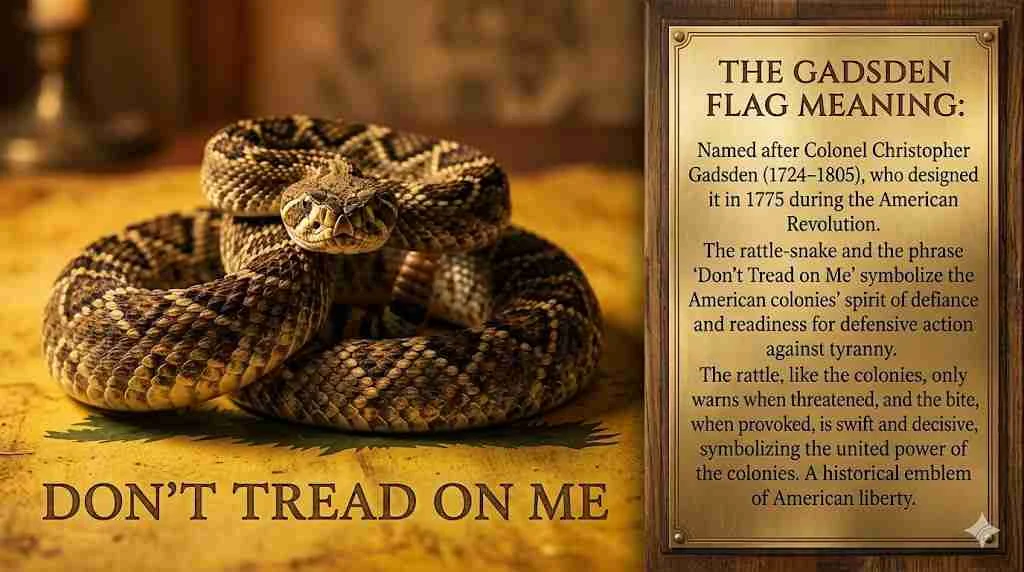

Don’t Tread on Me means “back off or face the consequences.” It’s a warning against oppression or rights violations, symbolized by the coiled rattlesnake on the yellow Gadsden Flag defensive, not aggressive and rooted in the American Revolution.
You’ve seen the flag. Bright yellow. Coiled rattlesnake. Those four sharp words: Don’t Tread on Me.
Maybe it hung on a veteran’s garage door. Maybe someone waved it at a rally. And maybe you just spotted it on a coffee mug and thought, What’s that about?
Here’s the short answer: It means back off.
But the long answer? That takes us from a colonial printing press to modern political brawls. It winds through Benjamin Franklin’s dark humor, a South Carolina colonel’s war flag, and a reptile that never closes its eyes.
Let’s unpack the don’t tread on me meaning layer by layer. No fluff. Just the real story.
What Does Don’t Tread on Me Mean?
Let’s start simple.
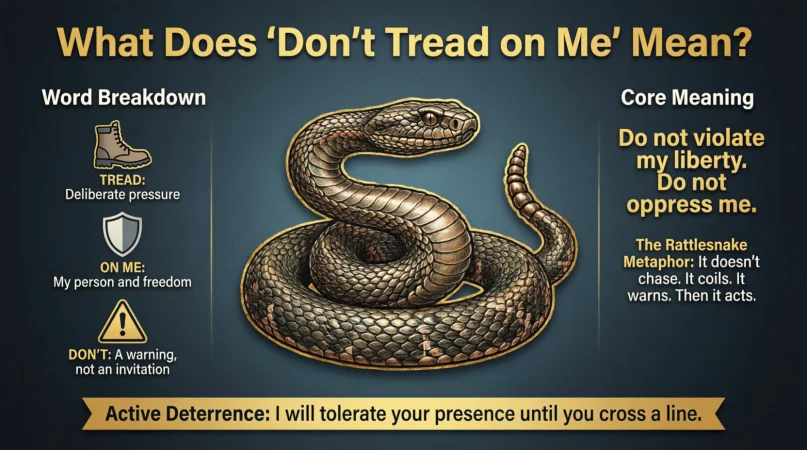
Don’t tread on me means: Do not violate my liberty. Do not oppress me. Do not step onto my rights expecting no consequences.
The phrase is an imperative sentence. It gives a direct command. Not a suggestion. Not a polite request.
Break down the words:
- Tread means to step heavily or walk with purpose. Think of a soldier’s boot. Think of a king’s decree pressing down.
- On me means onto my person, my property, or my freedom.
- Don’t is the contraction that makes it a warning, not an invitation.
So the don’t tread on me definition boils down to this: I will tolerate your presence until you cross a line. Cross it, and I strike.
This isn’t passive aggression. It’s active deterrence. The rattlesnake doesn’t chase. It coils. It warns. Then it acts.
You’ll hear people say don’t step on me as a modern version. Same idea. Less formal. But tread carries more weight. It implies deliberate pressure. Someone isn’t accidentally stepping on you. They’re treading with intent.
The Gadsden Flag Meaning| Where the Phrase Lives
You can’t separate the don’t tread on me meaning from its most famous home: the Gadsden Flag.
Here’s what the flag looks like and what each piece means.
| Flag Element | What It Represents |
|---|---|
| Bright yellow background | Danger. Caution. High visibility from a distance. |
| Coiled rattlesnake | Readiness. Defensive posture. Lethal if provoked. |
| 13 rattles on the snake’s tail | The 13 original American colonies. Unity in resistance. |
| “Don’t Tread on Me” below the snake | The warning. The boundary line. The final word. |
The flag does not show a snake attacking. The snake coils. It waits. That’s critical. The message isn’t go pick a fight. It’s don’t start one with me.
Who created it?
A man named Christopher Gadsden. Colonel in the Continental Army. Politician from South Carolina. Also a slave trader a fact historians don’t hide but also don’t let define the flag’s entire legacy.
In late 1775, Gadsden served on a naval committee with Commodore Esek Hopkins. Hopkins needed a personal standard for his flagship, the Alfred. Gadsden gave him a yellow flag with a rattlesnake and those four words.
The Alfred flew it in December 1775. That’s the first recorded use.
But the don’t tread on me origin goes back further than a flagpole. It starts with a cartoon snake.
Don’t Tread on Me Origin| Benjamin Franklin’s Snake
Most people credit the Gadsden Flag to Christopher Gadsden. Fair enough. He designed the flag itself.
But the rattlesnake as an American symbol? That belongs to Benjamin Franklin.
1754: Join or Die
Twenty-one years before the Revolutionary War, Franklin published a woodcut in the Pennsylvania Gazette. It showed a snake cut into eight pieces. Each piece represented a colony. New England counted as one piece. South Carolina stood alone. Georgia didn’t even make the cut.
The caption read: Join, or Die.
Franklin wasn’t talking about independence from Britain yet. He wanted colonies to unite against the French and Native American tribes during the French and Indian War. The message was practical: We’re weak separately. Strong together.
That snake wasn’t coiled. It was dead. Cut into pieces. A warning, not a threat.
1775: The Rattlesnake as America’s Spirit
Fast forward to December 27, 1775. Franklin published an anonymous letter in the Pennsylvania Journal. He signed it “An American Guesser.” In it, he argued that the rattlesnake made a perfect symbol for the American people.
Why? He gave several reasons.
First: The rattlesnake has no eyelids. Franklin wrote that its eyes are “more piercing” than any other animal’s. It never sleeps. It never stops watching. That represented colonial vigilance.
Second: The rattlesnake never attacks without warning. It rattles first. That’s generosity. Franklin saw this as a reflection of the American character slow to anger but deadly when pushed.
Third: The rattlesnake doesn’t retreat. It fights to the death. Franklin admired that stubborn courage.
Fourth: The 13 rattles on its tail perfectly matched the 13 colonies. One rattle for each. And rattles don’t function in isolation. They work together to produce a single sound. Unity.
Franklin even joked about the snake’s eye placement. He said the rattlesnake was the only animal whose eye “has no eye-lids” and therefore “may be esteemed an emblem of vigilance.” He also pointed out that the snake “never begins an attack, nor, when once engaged, ever surrenders.”
That letter didn’t create the Gadsden Flag. But it gave Gadsden and everyone else a ready-made symbol. The snake already meant American defiance before the first shot at Lexington.
Don’t Tread on Me History Meaning| 1775 to 2025
The don’t tread on me history meaning shifts across centuries. But one thread stays constant: resistance to overreach.
Let’s walk through each era.
1775–1783: Revolutionary Weapon
The Continental Marines carried the Gadsden Flag during the early days of the war. Marine commanders wanted a flag that frightened British sailors. A yellow field said plague ship. A rattlesnake said we bite.
In 1776, the Continental Navy established the Grand Union Flag as its official standard. But the Gadsden Flag remained a popular jack (a small flag flown on a ship’s bow). Sailors liked its bluntness. No stars. No stripes. Just a snake and a threat.
The British didn’t laugh. They knew what it meant. Every coiled snake in colonial propaganda stood for the same thing: we’re done taking orders.
1790s–1860s: Quiet Decades
After the Revolutionary War, the Gadsden Flag faded from public view. Americans adopted the Stars and Stripes. The rattlesnake symbol stuck around on a few military drums and currency designs. But Don’t Tread on Me became a historical footnote.
You’ll find almost no recorded use of the phrase from 1800 to 1940. That surprises most people. We think of it as an eternal American slogan. It wasn’t. It slept for over a century.
1970s: Libertarian Revival
The phrase came roaring back in the 1970s. Why? Two reasons.
First, the Libertarian Party formed in 1971. Members hunted for a symbol that said leave us alone without aligning with Democrats or Republicans. The Gadsden Flag fit perfectly. It had no party loyalty. Just pure anti-authoritarianism.
Second, the Bicentennial celebration (1976) made everything from 1776 trendy again. Flag makers reproduced the Gadsden Flag for collectors. Veterans bought them. Gun owners bought them. Soon, the flag meant small government and Second Amendment rights.
Key fact: The Libertarian Party never officially adopted the Gadsden Flag as its logo. But thousands of members fly it at conventions and rallies. It remains the party’s unofficial battle standard.
2000s–2010s: Tea Party Explosion
The don’t tread on me meaning exploded into mainstream politics during the Tea Party movement (2009–2014).
Tea Party protesters carried Gadsden Flags at rallies against the Affordable Care Act, the bank bailouts, and federal spending. For many Americans, this was their first time seeing the flag in person. News cameras broadcast it nightly.
Critics called the flag a symbol of right-wing extremism. Supporters called it a restoration of original American values.
Who was right? Both oversimplified. The flag isn’t inherently left or right. But the Tea Party’s heavy use tied it to modern conservatism in the public’s mind. That connection persists today.
2020s: Fragmented Symbolism
Today, the Gadsden Flag flies in wildly different spaces.
| Group | How They Use the Flag |
|---|---|
| Gun rights advocates | At rallies. On holsters. On rifle cases. Means: No new laws. |
| Military units | U.S. Army’s 3rd Infantry Regiment. Marine Recon Battalions. Means: Unit pride. |
| NASCAR fans | In infields. On campers. Means: Don’t mess with my Sunday. |
| Anti-police brutality activists | Rarely, but it happens. Means: Don’t tread on my body. |
| Militia groups | At training exercises. Means: We’re armed and watching. |
No single political party owns the phrase. The flag means different things to different people. That’s not confusion. That’s flexibility.
Don’t Tread on Me Political Meaning| Left, Right and the Messy Middle
Let’s get specific about the don’t tread on me political meaning today.
Conservatives
Most conservatives use the phrase to defend constitutional rights especially the Second Amendment. You’ll see the Gadsden Flag at gun shows, 2A rallies, and conservative protests against federal mandates.
Example: During the 2020 lockdowns, protesters flew Gadsden Flags outside state capitols. Their message: You can’t close my business. You can’t keep me home. Don’t tread.
Libertarians
Libertarians use the phrase for everything. Taxes? Don’t tread. Vaccine mandates? Don’t tread. Seatbelt laws? Don’t tread.
The Libertarian Party’s platform includes phrases like “individual sovereignty.” The Gadsden Flag visualizes that idea better than any paragraph of policy text.
Progressives (Yes, Really)
A small but real number of progressives and left-leaning activists also use the phrase. They apply it to:
- Police brutality (“Don’t tread on my neck”)
- Corporate power (“Don’t tread on my wages”)
- Surveillance (“Don’t tread on my privacy”)
You won’t see these folks at a Tea Party rally. But you might spot a Gadsden Flag patch on a leftist’s backpack in Portland or Austin. The flag predates the left-right divide. Some leftists want to reclaim it.
Extremists
Here’s the uncomfortable part. White nationalist and militia groups have also used the Gadsden Flag. The most famous example: the Oath Keepers (a far-right anti-government militia) adopted the flag as one of their symbols.
But and this matters the U.S. government does not classify the Gadsden Flag as a hate symbol. The Equal Employment Opportunity Commission (EEOC) ruled in 2015 that the flag is not “racially derogatory” on its own. Context determines meaning.
That ruling came from a complaint where an employee wore a Gadsden Flag hat. Another employee found it offensive. The EEOC said: The flag doesn’t inherently target any race. So it’s protected speech.
That legal distinction matters. It separates the Gadsden Flag from actual hate symbols like the Confederate battle flag or Nazi swastika.
Don’t Tread on Me Symbol Meaning| Why a Snake?
Let’s go deeper into the don’t tread on me symbol meaning. Why did Franklin and Gadsden choose a rattlesnake instead of, say, an eagle or a bear?
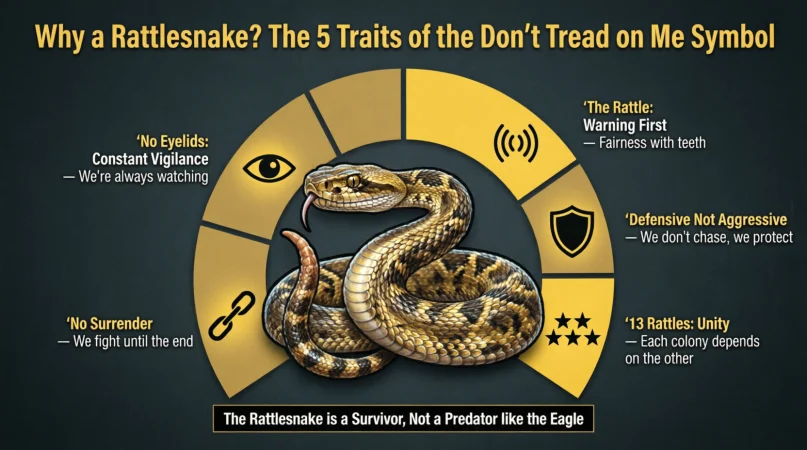
Here are the five traits that made the rattlesnake perfect.
1. No Eyelids
Rattlesnakes don’t close their eyes. They literally sleep with their eyes open. Franklin called this “vigilance.” An enemy can never catch America sleeping. In a political sense, it means we’re always watching.
2. The Rattle as a Warning
The rattle exists for one reason: to say back off before you regret it. Franklin loved this. He argued that America would never strike first. But it would always warn first. Fairness with teeth.
3. Defensive, Not Aggressive
A rattlesnake won’t chase a human. It doesn’t hunt us. It only bites when someone steps on it or corners it. That matched the colonial position perfectly. The colonies didn’t want war with Britain. They wanted to be left alone.
4. 13 Rattles
Franklin noted that the number of rattles varies. But a mature rattlesnake often has around 13. That matched the 13 colonies. And each rattle depends on the others to make sound. Break one rattle off, and the warning gets quieter. Unity.
5. No Surrender
Rattlesnakes don’t play dead. They don’t run. They fight until they can’t. Franklin saw this as the American spirit. We don’t surrender. We don’t retreat. We just fight.
Combine these five traits, and you get a symbol that says: We’re peaceful but prepared. We warn before we strike. And we never give up.
That’s richer than any eagle. Eagles attack from above. They’re predators. The rattlesnake is a survivor. It minds its own business until you cross a line. Then it ends you.
Don’t Tread on Me Slogan Meaning vs. Other Revolutionary Phrases
How does Don’t Tread on Me compare to other famous American slogans? Let’s line them up.
| Slogan | Tone | Target | Meaning |
|---|---|---|---|
| Don’t Tread on Me | Defensive warning | Any oppressor | Back off or else. |
| Join or Die | Urgent plea | Colonists | Unite now or perish. |
| No Taxation Without Representation | Political complaint | British Parliament | Give us a voice or keep your hand off our money. |
| Give Me Liberty or Give Me Death | Dramatic ultimatum | British Crown | I’ll die fighting before I live kneeling. |
| Live Free or Die | Stubborn declaration | Anyone | Freedom isn’t negotiable. |
Don’t Tread on Me is the shortest and most visual. You don’t need a history lesson to get it. A snake. A warning. A promise. That’s why it survived when other slogans faded.
Don’t Tread on Me Flag Meaning| Misconceptions and Mistakes
People get the don’t tread on me flag meaning wrong all the time. Let’s clear up the biggest myths.
Myth 1: The Flag Is Anti-Government
False. The flag is anti-tyranny, not anti-government. The original colonists wanted good government. They wanted representation, fair taxes, and protection of rights. They didn’t want anarchy.
The Gadsden Flag warns against abusive government. It doesn’t reject the idea of government entirely.
Myth 2: It’s a White Nationalist Symbol
Mostly false. Some white nationalist groups have used the flag. But so have Black gun owners, Latino veterans, and Asian-American libertarians. The EEOC explicitly ruled it’s not a hate symbol.
Context matters. A Gadsden Flag at a militia training camp is different from one at a family barbecue.
Myth 3: Franklin Designed the Flag
False. Franklin inspired the snake symbol. He never designed a yellow flag with Don’t Tread on Me on it. Christopher Gadsden did.
Myth 4: The Snake Represents Aggression
False. The snake coils. It doesn’t strike. The flag shows a defensive posture, not an offensive one. That’s the whole point.
Myth 5: The Phrase Is About Physical Stepping
False. Nobody thinks the British were literally stepping on American colonists. “Tread” is metaphorical. It means to exert power, impose will, or violate rights.
Don’t Tread on Me Phrase Explained| How to Use It Correctly
Want to use the phrase yourself? Here’s how it works in real sentences.
Correct uses:
- “The new surveillance law crosses a line. Don’t tread on my privacy.”
- “Our community doesn’t want your factory. Don’t tread on our land.”
- “I’ll follow every law except the one that takes my gun. Don’t tread on me.”
Incorrect uses:
- “Don’t tread on my sandwich” (trivializes the phrase)
- “Don’t tread on me helping you” (the phrase is defensive, not passive)
- “I’ll tread on you if you tread on me” (that’s aggression, not defense)
The phrase works best when you’re responding to a specific overreach. It loses power when you use it for minor inconveniences or everyday annoyances.
Think of it as a fire extinguisher. You don’t break the glass for a burnt toast alarm. You save it for a real fire.
Don’t Tread on Me Definition in Pop Culture
The phrase appears everywhere now. Music. Movies. Video games. Fashion.
Music:
- Metal band Metallica used Gadsden Flag imagery on tour merchandise.
- Country singer Aaron Lewis sells Gadsden Flag shirts at concerts.
- Punk band Against Me! referenced the phrase in lyrics about resisting authority.
Movies:
- In The Patriot (2000), Mel Gibson’s character doesn’t say the phrase, but the rattlesnake symbol appears on colonial flags in the background.
- In Captain America: The Winter Soldier, a character wears a Gadsden Flag patch. The filmmakers used it to signal anti-government sentiment.
Video Games:
- Fallout: New Vegas features the flag in post-apocalyptic settings. Fans love it.
- Call of Duty: Modern Warfare includes Gadsden Flag skins for weapons and characters.
Fashion:
- Streetwear brands sell Gadsden Flag hoodies.
- Boot companies stamp the snake on leather patches.
- Skateboard decks feature the coiled rattlesnake with “Don’t Tread” underneath.
The phrase has become aesthetic. People wear it without knowing the full history. That bothers some purists. But it also proves the symbol’s power. You don’t need a PhD in colonial history to feel what it means.
Don’t Tread on Me Meaning| Global Comparisons
Other countries have similar phrases and symbols. Let’s compare.
| Country | Phrase | Symbol | Meaning |
|---|---|---|---|
| United States | Don’t Tread on Me | Rattlesnake | Defensive liberty |
| Scotland | Nemo me impune lacessit | Thistle | No one provokes me with impunity |
| France | Liberté, Égalité, Fraternité | Marianne (woman symbol) | Abstract ideals, not defensive |
| Ireland | Éirinn go Brách | Harp | Ireland forever (less combative) |
| Gadsden Flag knockoffs worldwide | “Don’t Tread on Me” (in local languages) | Local animals | Borrowed from U.S. |
Scotland’s thistle motto is the closest match. The thistle is a spiky plant. Step on it barefoot, and you’ll regret it. Same logic as the rattlesnake. Different package.
Why the Don’t Tread on Me Meaning Still Matters in 2026
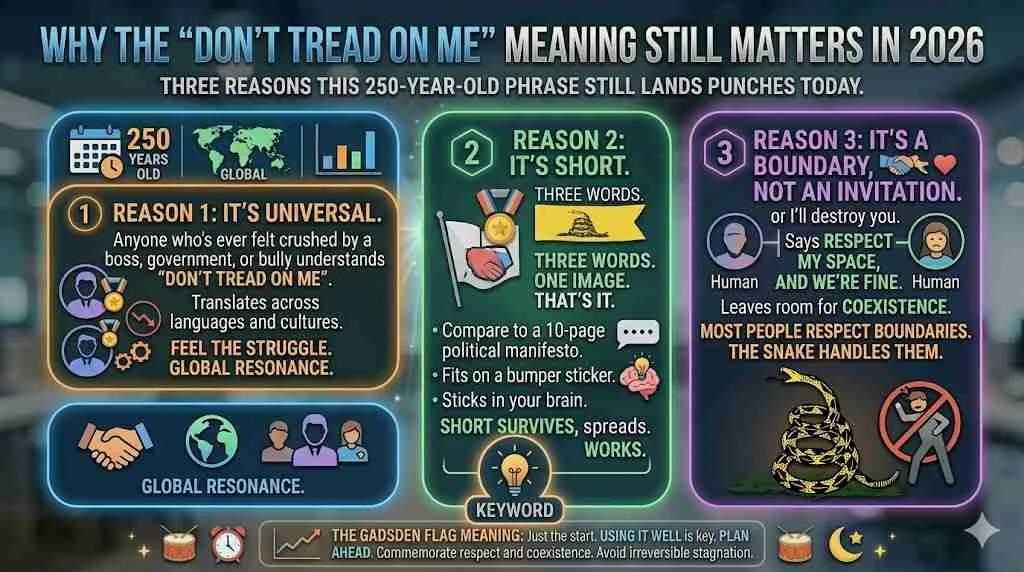
Three reasons this 250-year-old phrase still lands punches today.
Reason 1: It’s Universal
You don’t have to be American to get it. Anyone who’s ever felt crushed by a boss, a government, or a bully understands don’t tread on me. The phrase translates across languages and cultures.
Reason 2: It’s Short
Three words. One image. That’s it. Compare that to a 10-page political manifesto. Which one fits on a bumper sticker? Which one sticks in your brain?
Short works. Short spreads. And short survives.
Reason 3: It’s a Boundary, Not an Invitation
The phrase doesn’t say I hate you or I’ll destroy you. It says respect my space, and we’re fine. That leaves room for coexistence. Most people respect a clear boundary. The ones who don’t? The snake handles them.
Quick Reference Table| Don’t Tread on Me at a Glance
| Aspect | Summary |
|---|---|
| Core meaning | Warning against oppression or rights violation |
| Primary symbol | Gadsden Flag (yellow, coiled rattlesnake, phrase below) |
| Origin year | 1775 (flag); 1754 (snake symbol) |
| Creator | Christopher Gadsden (flag); Benjamin Franklin (snake symbol) |
| Original use | Continental Navy and Marines |
| Modern associations | Libertarianism, gun rights, military pride, Tea Party movement |
| Not a hate symbol | Confirmed by EEOC (2015 ruling) |
| Key trait | Defensive, not aggressive |
| Global equivalent | Scotland’s “Nemo me impune lacessit” (thistle) |
FAQs
1. Is the Don’t Tread on Me flag racist?
No. The EEOC ruled in 2015 that the Gadsden Flag is not a hate symbol. Some extremist groups have used it, but so have Black gun owners, Latino veterans, Asian-American libertarians, and countless average Americans. Context matters.
2. What does the rattlesnake on the Gadsden Flag represent?
The rattlesnake represents defensive vigilance. It has no eyelids (always watching), rattles before it strikes (fair warning), and never retreats. Benjamin Franklin loved these traits.
3. Who created the Don’t Tread on Me flag?
Christopher Gadsden, a South Carolina colonel and politician, designed the flag in 1775. He gave it to Commodore Esek Hopkins for the Continental Navy flagship Alfred. But Benjamin Franklin popularized the rattlesnake as an American symbol 21 years earlier with his “Join or Die” cartoon.
4. Is Don’t Tread on Me the same as the Tea Party movement?
No. The Tea Party (2009–2014) heavily used the flag, which tied it to modern conservatism in the public eye. But the phrase predates the Tea Party by 234 years.
5. What’s the difference between “Don’t Tread on Me” and “Don’t Step on Me”?
“Tread” implies deliberate, heavy pressure like a boot grinding down. “Step” sounds lighter, almost accidental. The original phrase uses “tread” for a reason. It means someone is intentionally violating your rights, not just clumsily bumping into you.
6. Can anyone fly the Gadsden Flag?
Yes. No law, group, or government controls the flag. It’s a public domain symbol from the American Revolution. Fly it on your porch, your truck, or your boat.
7. What does “Don’t Tread on Me” mean?
“Don’t Tread on Me” is a political slogan that means “don’t violate my rights” or “don’t interfere with my freedom.” It originally comes from the American Revolutionary War era and is associated with the Gadsden Flag, which shows a coiled rattlesnake and the phrase underneath it.
8. What does “Don’t Tread on Me” mean?
“Don’t Tread on Me” is a slogan that means “do not violate my rights” or “do not interfere with my freedom.” It comes from the American Revolutionary era and is strongly associated with the Gadsden Flag, which features a coiled rattlesnake and the phrase itself.
Conclusion
The don’t tread on me meaning boils down to a simple, sharp boundary: respect my liberty, or I’ll make you regret crossing the line. That message hasn’t changed in 250 years. The coiled rattlesnake still warns before it strikes. The yellow flag still signals danger. You see it on a veteran’s truck, a libertarian’s porch, or a protest sign, the core idea stays the same oppression gets an answer, not an invitation.
So don’t overcomplicate it. The phrase isn’t a call to violence or a secret handshake for extremists. It’s a universal human line in the sand. Everyone, everywhere, knows what it feels like to be stepped on. Don’t Tread on Me just says it out loud with a snake at its back and 250 years of defiance in its teeth.
Discover More Related Articles:
- “OTW” Meaning in Chat Apps: What People Really Mean In 2026
- “IG” Mean in Text: Common Uses in Texting & Online Chat In 2026
- “WYO” Mean: Hidden Meaning You Should Know In 2026