
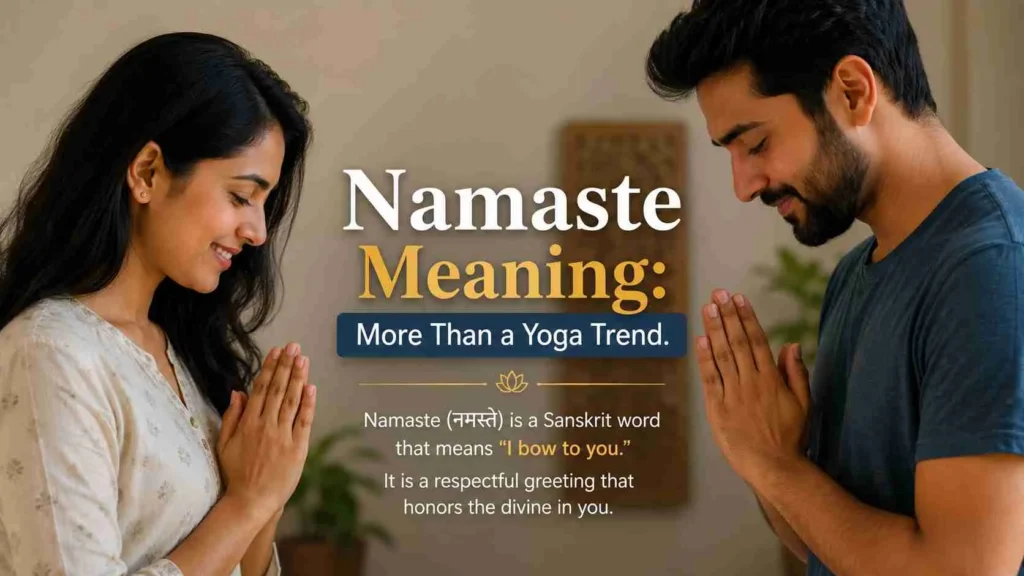

Namaste is a Sanskrit word that literally means “I bow to you.” In daily Indian life, it’s a respectful, everyday greeting said with hands folded at the chest not a mystical or exclusively spiritual phrase.
You’ve probably folded your hands at the end of a yoga class. You whispered “namaste” along with the teacher. It felt peaceful, maybe even a little sacred.
But here’s something that might surprise you.
Walk into a small tea shop in Delhi or a vegetable market in Lucknow. The shopkeeper won’t close his eyes or take a deep breath. He’ll just look at you, fold his hands briefly, and say “Namaste, kya chahiye?” (What do you need?)
Same word. Completely different vibe.
So which one is real? Both are. But the Instagram version leaves out most of the story. Let’s fix that. No fluff. No made-up “ancient secrets.” Just the real namaste meaning, how real people use it, and how you can too without accidentally sounding silly.
The Literal Translation from Sanskrit
Let’s start with the actual words. Namaste comes from ancient Sanskrit. It breaks down cleanly into two parts.
Namaḥ means “bow” or “obeisance.” Think of it like lowering your head or bending forward. It carries a sense of humility. You’re not puffing out your chest. You’re shrinking your ego just a little.
Te means “to you.”
Put them together: I bow to you.
That’s it. No hidden “divine in me” layers. No cosmic energy exchange. Just a respectful human acknowledging another human.
Here’s a useful comparison. Imagine tipping your hat to someone on the street. You’re not declaring their sainthood. You’re just showing basic respect. Namaste works the same way.
Many online sources overcomplicate this. They’ll say namaste means “the God in me honors the God in you.” That’s a beautiful sentiment. But it’s a modern spiritual reinterpretation, not the original definition. The Sanskrit grammar simply doesn’t support that longer phrase.
So when someone asks you for the namaste meaning in English, give them the honest answer: I bow to you. Short. Real. Respectful.
How to Pronounce Namaste Without Sounding Awkward
Let’s clear up the audio mess. You’ve heard people say it three different ways. Some make it sound heavy and dramatic. Others rush through it like an afterthought.
Here’s the correct pronunciation.
nuh-muh-stay
Three syllables. Soft and quick.
- First syllable: “nuh” – like the first part of “numb” but without the b sound.
- Second syllable: “muh” – short, almost swallowed.
- Third syllable: “stay” – rhymes with “day” or “play.”
Don’t say “nah-mah-stay” with a heavy first syllable. That stretches the word out and makes it sound forced. Native Hindi speakers keep it light.
Try this trick. Say “numb” then “uh” then “stay.” Say it faster each time. Numb-uh-stay. Numbuhstay. Nuh-muh-stay. There you go.
The stress falls on the second syllable. So it’s nuh-MUH-stay, not NAH-muh-stay. Feel the difference? The first version bounces. The second version thuds.
Practice in front of a mirror. Hands folded or not. Just get the sound right first. Once you have the pronunciation down, the gesture feels more natural too.
The Gesture: Añjali Mudra
You can say namaste without moving your hands. But the gesture makes it stronger. In fact, many Indians will silently bow with folded hands and say nothing at all. The gesture alone carries the full namaste meaning.
This hand position has its own name: Añjali Mudra.
Añj in Sanskrit means “to honor” or “to celebrate.” Mudra means “seal” or “gesture.” So you’re literally performing a seal of honor.
Here’s how to do it correctly.
Step-by-step:
- Bring both palms together.
- Press them lightly but evenly.
- Keep your fingers pointing up, not forward.
- Place your hands near your chest. Your thumbs should rest lightly against your sternum.
- Bow your head slightly. A small nod works. You don’t need to bend at the waist.
That’s it. No need to raise your hands to your forehead or third eye. That variation comes from specific meditation schools and isn’t standard for everyday namaste.
Your fingers should stay together. Don’t splay them out like a jazz hand pose. Keep it tight and tidy. The gesture looks like a lotus bud about to open.
One important note. Añjali Mudra isn’t exclusive to India or Hinduism. You’ll see similar hand positions across Thailand (wai), Cambodia (sampeah), and even in some Christian prayer practices. But the name and the specific cultural context remain uniquely South Asian.
What Namaste Means in Hindi And Daily Indian Life
Now we get to the real-world stuff. Forget yoga studios for a minute. Let’s look at how a normal person in northern India uses namaste.
In Hindi-speaking regions, namaste is an everyday greeting. Nothing special. Nothing mystical. You use it the way you’d use “hello” or “hi” in English, but with a bit more warmth.
Common situations for namaste in India:
- Walking into a small grocery shop
- Greeting a neighbor you pass on the street
- Meeting your friend’s parents for the first time
- Starting a phone call with an elder relative
- Thanking a bus driver or auto rickshaw driver
Notice something? None of these require a spiritual ceremony. You’re just being polite.
Here’s a real example.
You enter a tailor shop in Jaipur. The tailor looks up from his sewing machine. He folds his hands and says “Namaste, bhaiya” (brother). You reply “Namaste” and nod. That’s the whole exchange. No deep breathing. No closing eyes. Just two humans acknowledging each other.
Time of day doesn’t matter. Namaste works at 7 AM, 2 PM, and 11 PM. There’s no “good morning” or “good evening” version. It’s universal.
Formality level? Medium. Not as casual as “hey” between close friends. Not as intense as touching someone’s feet (a higher honor). It sits right in the middle respectful enough for strangers, warm enough for acquaintances.
One more fact. You’ll hear namaskar used in similar situations. Namaskar is slightly more formal. Use namaskar for elders, gurus, or government officials. Use namaste for everyone else.
Namaste Meaning in Yoga
Here’s where things get messy.
Western yoga classes adopted namaste as a closing ritual. The teacher says it. The class repeats it. Everyone folds their hands, bows, and feels a sense of completion.
That’s fine. Rituals hold meaning. But the meaning attached to namaste in Western yoga is mostly new.
Walk into a yoga studio in California. The teacher might say, “Namaste means the divine light in me honors the divine light in you.” That’s not a translation. That’s an interpretation layered on top of the original word.
Where did this come from?
Scholars trace it back to late 20th-century spiritual teachers who wanted to give namaste a more universal, mystical feel. It caught on. Then yoga influencers spread it. Now millions believe that’s the actual definition.
But here’s the honest truth.
Most Indian yoga practitioners don’t say namaste during practice at all. They might use it before or after class casually, like saying “see you later.” They don’t treat it as a sacred closing seal.
So should you stop using namaste in yoga? No. But know what you’re actually saying. You’re saying “I bow to you” to your teacher and fellow students. That’s a nice sentiment. Just don’t tack on extra divine-light baggage unless you understand you’re adding it yourself.
Quick comparison:
| Context | What namaste means | Tone |
|---|---|---|
| Daily life in North India | I bow to you / Hello | Casual respect |
| Formal ceremony in India | Deep reverence | Very respectful |
| Western yoga class | The divine in me bows to the divine in you | Spiritual / ritual |
| Between friends in Mumbai | Hey, what’s up? (with folded hands) | Friendly |
See the range? Same word. Different flavors.
Namaste vs. Other Indian Greetings
India doesn’t have just one greeting. It has dozens. Each language and region brings its own flavor. Let’s compare namaste to a few others so you don’t mix them up.
| Greeting | Language / Region | When to use | Formality level |
|---|---|---|---|
| Namaste | Hindi (North India) | Any time, most people | Neutral / Respectful |
| Namaskar | Hindi (formal) | Elders, gurus, ceremonies | High respect |
| Vanakkam | Tamil (Tamil Nadu) | Daily use, Tamil speakers | Standard |
| Namaskara | Kannada (Karnataka) | Everyday greeting | Standard |
| Pranam | Hindi / Sanskrit | Very deep respect (grandparents, saints) | Very formal |
| Sat Sri Akal | Punjabi (Sikh community) | Punjab region, Sikh settings | Respectful |
| Nomoshkar | Bengali (West Bengal, Bangladesh) | Daily greeting in Bengali | Standard |
| Salaam | Urdu / Muslim communities | South Asian Muslims | Respectful / Warm |
Notice something interesting? Namaste isn’t universal across India. A person in Tamil Nadu might understand it but will likely say Vanakkam instead. A Sikh farmer in Punjab might greet you with Sat Sri Akal.
So don’t assume namaste works everywhere. It’s widespread but not absolute.
If you’re traveling, learn the local greeting. It shows deeper respect than defaulting to namaste.
When to Say Namaste And When Not To
Let’s get practical. You want to use this word correctly. Here’s your cheat sheet.
Say namaste when:
- You meet an elder or someone you want to show respect.
- You enter a small family-run shop in India or Nepal.
- You start a conversation with a stranger in a traditional setting.
- You’re in a yoga class and the teacher uses it (follow their lead).
- You want to say thank you without sounding overly formal.
- You’re greeting a neighbor in a North Indian neighborhood.
Don’t say namaste when:
- You’re in a corporate business meeting in Mumbai or Delhi. Use “Hello” or “Hi.”
- You’re talking to close friends your own age. It’s too formal. Use their name or a casual “hey.”
- You want to sound “deep” without understanding the culture. That’s performative.
- You’re in South India and the person clearly uses Vanakkam or Namaskara.
- You’re angry or frustrated. Namaste carries goodwill. Don’t weaponize it.
One more tip. You can use the gesture alone. No words needed. If you’re in a loud market or don’t speak Hindi, just fold your hands and bow slightly. That communicates the full namaste meaning without a single sound.
Common Myths About Namaste
Let’s kill some myths. These floating around online drive linguists and South Asian culture experts crazy.
Myth 1: Namaste means “I bow to the god in you.”
Fact: No. The Sanskrit simply doesn’t say that. Namaḥ means “bow.” Te means “to you.” No “god” in the original. That’s a later addition by modern spiritual teachers.
Myth 2: You must say namaste only at sunrise.
Fact: Absolutely false. Say it at breakfast, lunch, or midnight. No time restrictions exist.
Myth 3: Namaste is purely Hindu.
Fact: Hindus use it widely. So do Indian Muslims, Christians, Sikhs, and Jains. It’s a cultural greeting, not a religious test.
Myth 4: You have to close your eyes when saying namaste.
Fact: Watch people in India. Most keep their eyes open. Eye contact during namaste shows sincerity. Closing your eyes is a meditation practice, not a requirement.
Myth 5: Namaste is always spiritual.
Fact: A vegetable seller saying namaste to a customer isn’t having a spiritual moment. He’s being polite. Context matters more than intention.
Myth 6: The hands must go to the third eye (forehead).
Fact: Standard Añjali Mudra places hands at the chest. Forehead placement is a modern variation used by some yogis. It’s not wrong, but it’s not the default.
Real-Life Examples of Namaste in Conversation
Let’s make this concrete. Here are five real situations where namaste appears naturally.
Example 1: Shopkeeper and customer
Shopkeeper folds hands. “Namaste, kya chahiye?” (What do you need?)
Customer nods. “Namaste. Do kilo aam.” (Two kilos of mangoes.)
No ceremony. Just commerce with respect.
Example 2: Child greeting grandparent
Child walks into room. Folds hands. Bows head slightly. “Namaste, Dadi.”
Grandmother smiles. “Namaste, beta. Aao.” (Come.)
The bow shows age-based respect.
Example 3: Two strangers on a rural path
A farmer walking home sees another farmer. They make eye contact. Both silently fold hands and nod. Neither speaks. The gesture alone works perfectly.
Example 4: Yoga studio in the U.S.
Teacher ends class. Hands at heart. “Namaste.”
Students repeat. Some cry. Some smile. One person quietly thinks about lunch. All valid.
Example 5: Phone call with an elder
You call your aunt in Lucknow. She picks up. You say “Namaste, Masi.” She replies “Namaste, beta.” You chat about weather and food. Greeting done.
Notice the range? From silent nods to tearful studio closings. Same word. Wildly different energy.
Namaste Pronunciation & Usage Cheat Sheet
Here’s your quick reference. Bookmark this mentally.
Say: nuh-muh-stay
Don’t say: nah-mah-stay (first syllable too heavy)
Gesture: Hands together at chest. Fingers up. Thumbs near sternum. Bow head slightly.
Context: Everyday respect in North India and Nepal. Formal respect in ceremonies. Closing ritual in Western yoga.
In yoga: Fine to use. Just know you’re adding a Western layer. That’s not bad just be aware.
When silent: The folded-hands gesture alone works without the word.
Translation: I bow to you. (Not “divine light.” Not “god in me.”)
The Cultural Weight of Namaste
Words carry history. Namaste carries thousands of years of South Asian etiquette.
In traditional Indian culture, you greet based on hierarchy. You show more respect to elders, teachers, and guests. You use casual speech with close friends. Namaste fits into this system perfectly. It’s not too stiff but not too loose.
Compare it to bowing in Japan or handshakes in the West. Each culture finds its own balance between respect and friendliness. Namaste is India’s balance point.
One important fact. Namaste also implies you don’t need to touch the other person. In traditional contexts, physical touch between opposite genders or different social groups wasn’t always appropriate. Namaste solved that. You can show deep respect without shaking hands or hugging.
That’s why namaste became so useful during the COVID-19 pandemic. Many news outlets called it the “perfect no-contact greeting.” It always was.
So when you use namaste, you’re not just saying a word. You’re participating in a centuries-old system of respectful distance. That’s pretty cool.
Why the Modern Yoga Interpretation Isn’t “Wrong”
Let me be fair here.
I’ve pushed back on the “divine light” translation. But I’m not saying it’s evil or stupid. Here’s the nuance.
Languages evolve. Words pick up new meanings in new contexts. The English word “nice” used to mean “foolish.” Now it means “pleasant.” That change happened because people used it differently over time.
Something similar happened to namaste in Western yoga. Teachers needed a closing ritual. They found namaste. They attached a spiritual meaning that felt right for their students. That meaning didn’t exist in Sanskrit, but it exists now in yoga studios from New York to London.
So is that meaning “fake”? Not exactly. It’s emergent. It grew from real use by real people.
Here’s the respectful take. Know the original meaning. Use it when you’re in traditional contexts. But also accept that namaste now has two lives: one in Indian marketplaces and one on yoga mats. Both are valid for their own settings.
The problem starts when people claim the yoga meaning is the only meaning or the original meaning. That’s just historically wrong.
So be the person who knows the difference. Say namaste in yoga class. Smile. Bow. Enjoy the ritual. Just don’t correct an Indian person who uses it casually. They’ve been using it longer than any yoga influencer has been alive.
A Simple Table of Namaste Meanings by Context
| Context | Primary Meaning | Gesture Used? | Eye Contact? |
|---|---|---|---|
| North Indian daily life | Hello / I bow to you | Often yes | Usually yes |
| Formal ceremony | Deep respect / reverence | Always yes | Sometimes no (looking down) |
| Yoga studio (West) | Divine light honors divine light | Yes | Often closed eyes |
| Greeting an elder | Respectful acknowledgment | Yes | Brief then down |
| Silent greeting | I acknowledge you respectfully | Only gesture | Brief |
| Phone call | Warm hello | No | N/A |
Use this as your mental map. Context drives meaning.
FAQs
Q: Is namaste religious?
A: Not exclusively. Hindus use it. So do Indian Muslims, Christians, Sikhs, and Jains. It’s primarily a cultural greeting.
Q: Can I say namaste if I’m not Indian?
A: Yes, respectfully. Use it in appropriate contexts like greeting an Indian elder or in a yoga class. Don’t force it into every conversation.
Q: What’s the difference between namaste and namaskar?
A: Namaskar is more formal. Use namaskar for elders, gurus, or ceremonies. Namaste works for everyday situations.
Q: Do people in South India say namaste?
A: Less common. They understand it but prefer regional greetings like Vanakkam (Tamil) or Namaskara (Kannada).
Q: Why do some yoga teachers put hands at the third eye?
A: That’s a modern variation. Traditional namaste keeps hands at chest level. Neither is wrong just different.
Q: Can children say namaste to adults?
A: Yes. In fact, children are often taught to say namaste to elders as a sign of respect.
Q: Is it rude to not say namaste back?
A: A little. If someone greets you with namaste, return the greeting or at least nod and smile.
Q: Does namaste mean goodbye?
A: Not exactly. It means “I bow to you.” People use it when meeting and when parting. So it works like “hello” and “farewell” in one word.
Q: What’s the female version of namaste?
A: There isn’t one. Namaste works for all genders.
Q: Can I text “namaste”?
A: Yes. Many Indians text “Namaste” or “Namaste ji” as a warm opening or closing. It’s common and friendly.
Conclusion
Namaste means “I bow to you.” Nothing more. Nothing less. That’s enough.
You can use it to greet a shopkeeper in Delhi. You can use it to close a yoga class.
What doesn’t work? Using namaste to sound exotic or deep without understanding its cultural roots. That turns a respectful greeting into a costume.
So here’s my advice. Learn the real namaste meaning. Practice the pronunciation. Use the gesture naturally. And when you’re in a yoga class and the teacher talks about divine light, appreciate the poetry but smile knowing the real story.
Respect the word. Respect the culture. And don’t overthink it. Now go ahead. Fold your hands. Bow your head. Say “nuh-muh-stay” to someone today. You’ll both feel a little more human.
Discover More Related Articles:
- “OTW” Meaning in Chat Apps: What People Really Mean In 2026
- “IG” Mean in Text: Common Uses in Texting & Online Chat In 2026
- “WYO” Mean: Hidden Meaning You Should Know In 2026