
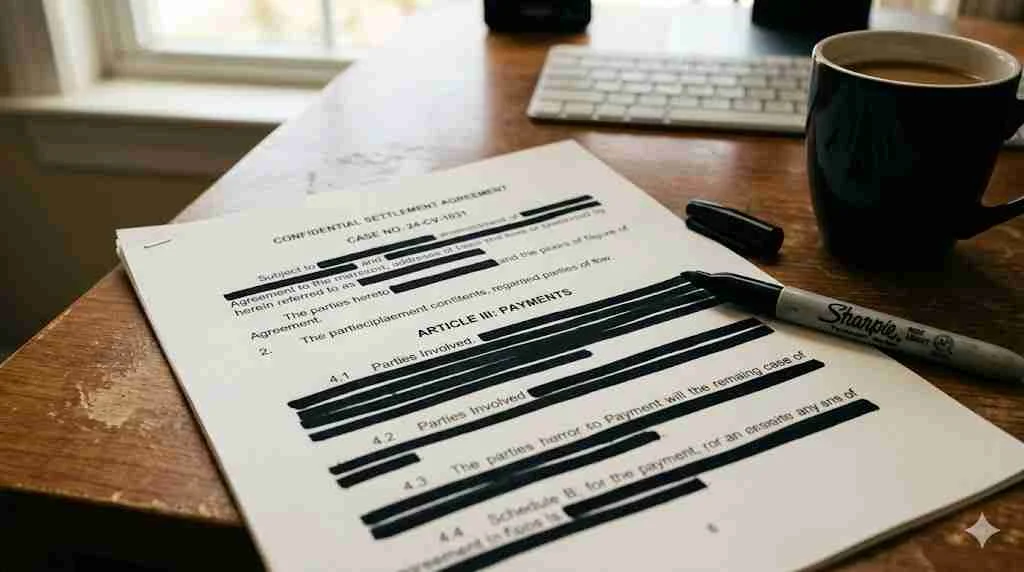

Redacted means information removed or hidden from a document before public release to protect privacy, security, or legal interests. When you see [REDACTED] or a black box, someone has deliberately concealed that specific content while leaving the rest of the document intact.
You open a government report. Something catches your eye. A thick black box covers half a paragraph. Or maybe you see the word [REDACTED] staring back at you in all caps. Your brain starts wondering. What’s hiding underneath? A secret agent’s name? A failed missile test? A billionaire’s tax loophole?
Relax. Most of the time, it’s just someone’s home address.
But the redacted meaning runs deeper than privacy. It touches national security, corporate lawsuits, medical records, and even your favorite true crime podcast. Understanding what does redacted mean helps you read documents like a pro. You will spot bad redactions. You will recognize censorship versus lawful removal. And you will never look at a black box the same way again.
This guide explains the redacted definition in plain English. No legalese. No fluff. Just real examples, hard facts, and everything you need to know.
The Simple Redacted Definition
Let us start with the basics. Redacted meaning boils down to one idea: information removed from a document before public release.
Think of it like editing a photo. You crop out the messy background so people only see what matters. Redaction does the same thing but with words. A person or software hides specific sentences, names, numbers, or whole paragraphs. The original document stays intact somewhere else. The public gets a cleaned version.
The word comes from Latin redactus. That means “to bring back” or “to collect.” Strange, right? Because today we use it for removal. Language shifts over time. Now redacted in English almost always means “edited for confidentiality.
You will see redacted text meaning show up in three main ways:
- Black boxes over printed text (old school, but still common)
- The word [REDACTED] in brackets (digital standard)
- Asterisks like [*]** (rare, mostly in legal filings)
What does redacted mean in practice? Imagine you request police records about a neighborhood crime. The report includes a witness name. Publishing that name could get someone hurt. So the department replaces the name with [REDACTED]. You still see the rest of the report. The witness stays safe. Everyone wins.
That is the redacted word meaning in a nutshell. Removal for protection. Not deletion. Not destruction. Just hiding.
What Does Redacted Look Like? Real Examples
You cannot understand what does redacted mean without seeing it. Words alone don’t do justice. Let me paint you some pictures.
The Classic Black Bar
Take a printed court transcript. Someone takes a thick black marker. They draw a heavy line over a Social Security number. You try to hold it up to the light. Nothing shows through. That is a physical redaction. Old, simple, and surprisingly effective if done right.
The Digital [REDACTED]
Open a PDF from the FBI. You see normal sentences. Then suddenly: “The informant met with agent [REDACTED] on March 12.” The bracket text replaces the original name. You cannot highlight it. You cannot copy it. It is baked into the file permanently.
The Fully Redacted Nightmare
Some documents go extreme. You request a file under the Freedom of Information Act (FOIA). They send you 50 pages. Page one has a title. Pages two through forty-nine? [REDACTED] repeated line after line. Page fifty says “End of document.” That is a fully redacted document. It signals either extreme sensitivity or a weak attempt to avoid sharing anything useful.
Real-World Example You Can Find Online
Pull up the Mueller Report (released 2019). Hundreds of pages show [REDACTED] in four colors. Each color meant a different reason for hiding:
- Red for grand jury information
- Yellow for personal privacy
- Green for ongoing investigations
- Purple for national security
That is redacted information meaning done with surgical precision. They told you why they hid something without revealing the secret itself.
What does redacted mean in documents like that? It means transparency with limits. You get most of the story. Just not the dangerous parts.
Why People Redact Information
Now we get practical. Why is information redacted? You have five main drivers. Each one comes from law, ethics, or common sense.
National Security
Classified documents top the list. The CIA, NSA, FBI, and military all redact before releasing anything to the public. They hide troop movements, spy identities, encryption methods, and intelligence sources.
Fact: The US government declassified over 200 million pages between 2015 and 2020. Almost every single one had redactions.
Personal Privacy
Social Security numbers. Home addresses. Phone numbers. Medical diagnoses. Bank account details. These never belong in public documents. Laws like HIPAA (medical privacy) and GDPR (European data protection) require redaction for any personal data.
Example: A hospital releases a research study. They must redact patient names and birth dates. The science stays. The identity goes.
Legal Privilege
Attorney-client conversations are sacred. So are discussions between a doctor and patient or a priest and parishioner. When those communications appear in court evidence, lawyers redact them before public filing.
What does redacted mean in legal terms? It means privileged information stays privileged. The judge sees everything. The public sees only what the law allows.
Trade Secrets
Coca-Cola’s recipe. Google’s search algorithm. KFC’s eleven herbs and spices. Companies fight hard to keep secrets. When lawsuits involve internal documents, they redact proprietary information.
Real case: In 2021, Waymo sued Uber over self-driving car secrets. Hundreds of pages of technical diagrams came out redacted. Competitors could not steal the exact designs.
Public Safety
Witness names in gang trials. Undercover officer identities. Juvenile offender records. These get redacted to prevent retaliation or harm.
Simple truth: No one wants their name in a public document if a drug cartel reads court filings.
Redacted vs Censored: They Are Not The Same
People confuse these two constantly. Redacted vs censored seems like splitting hairs. But the difference matters. A lot.
Here is a table that makes it crystal clear.
| Aspect | Redacted | Censored |
|---|---|---|
| Purpose | Protect privacy, security, or legal rights | Suppress ideas, dissent, or embarrassing facts |
| Who does it | Courts, agencies, hospitals, corporations | Governments, social media platforms, authoritarian regimes |
| Transparency | Usually labeled as redacted with a legal reason | Often hidden without notice or explanation |
| Legality | Required or permitted by law (FOIA, HIPAA) | Sometimes illegal in free countries |
| Appeal process | You can sue to unredact (often successfully) | Rarely appealable |
One sentence summary: Redaction follows rules. Censorship makes its own.
What does redacted mean in a free society? It means you have a right to know most things but not everything when safety or privacy hangs in the balance. Censorship says you have no right to know at all.
Where You Will See Redacted Information Most Often
Redacted documents appear everywhere once you start looking. Here are the most common places.
Government Documents (FOIA Responses)
The Freedom of Information Act lets anyone request federal records. Agencies must respond within 20 days. But they also redact heavily. The CIA redacts more than 90% of some requested files.
Keyword covered: redacted meaning in government documents often means “we followed the law by hiding nine out of ten lines.”
Court Records
Criminal cases. Civil lawsuits. Divorce proceedings. All generate public records. But judges redact juror names, minor victims, and trade secrets before releasing files online.
Example: The Johnny Depp vs Amber Heard trial (2022) released thousands of pages of exhibits. Witness phone numbers and addresses came redacted. The juicy details stayed visible.
Corporate Emails
Leaked internal emails always show redactions. Companies protect strategy, pending deals, and employee performance reviews.
What does redacted mean in reports from leaked documents? It means the leaker or publisher tried to avoid causing unnecessary harm.
Medical Records (HIPAA)
Hospitals release data for research or legal cases. But HIPAA requires redaction of 18 specific identifiers: names, dates (except year), addresses, phone numbers, email, Social Security numbers, medical record numbers, and more.
Fact: Violating HIPAA redaction rules costs up to $1.5 million per year per violation.
News Articles
When journalists obtain leaked documents, they often redact before publishing. They hide innocent bystanders’ names or sources who could face danger.
Social Media Screenshots
Look at any viral tweet showing a private conversation. The poster usually blacks out names and profile pictures. That is redaction. Just done with phone editing tools instead of software.
How Redaction Actually Works
You cannot understand redacted meaning without knowing the mechanics. Redaction is not magic. It is not just scribbling. It follows a specific process.
The Old Way
Take a printed document. Use a black marker. Cover the sensitive text. Scan the page. Publish the scan.
The problem: People can sometimes see through the marker. Or the scanner picks up indentations. Or someone finds the original file on a hard drive.
Famous failure: In 2019, the Department of Justice released a court filing about an FBI informant. They used markers. But someone forgot to delete the underlying text layer. Journalists copied the hidden text and revealed the informant’s name. Bad redaction. Huge consequences.
The Modern Way
Use redaction software. Adobe Acrobat Pro. Nuance Power PDF. Foxit PhantomPDF. These tools do two things:
- They visually black out the text
- They permanently delete the underlying text from the file
You cannot undo a proper digital redaction. No recovery. No hidden layer. The original words vanish.
The process step by step:
- Open the PDF
- Select the redaction tool
- Draw boxes over sensitive text
- Apply redactions
- Save as a new file
The software warns you: “This action cannot be undone.”
The Best Practice
Government redaction teams follow strict rules:
- Redact in the original file, not a copy
- Use software with certification (not just markers)
- Double-check every page
- Run automated scans for unredacted metadata
- Keep the original secret version in a secure location
What does redacted mean for professionals? It means a legal duty to protect. Screw it up and you face lawsuits, fines, or worse.
What “Fully Redacted” Means
Sometimes you hit the extreme. A fully redacted document hides almost everything.
Imagine a ten-page CIA file. You request it under FOIA. They send it back. Page one shows the title: “Operation Nightfall.” Pages two through nine show [REDACTED] on every line. Page ten says “End of report.”
That is fully redacted.
Why would anyone do this? Three reasons:
- Extreme sensitivity – The content would reveal sources and methods that active intelligence officers still use.
- Legal loophole – Some agencies redact everything rather than admit the document has no public value.
- Bad faith – Rare, but yes, some bureaucrats over-redact to avoid work.
Courts frown on fully redacted responses. The law requires agencies to release reasonably segregable information. If they black out everything, judges demand an explanation.
What does fully redacted mean for you as a requester? It means you probably need to sue. And sometimes that works. The ACLU and National Security Archive have won countless cases forcing agencies to unredact portions.
The Difference Between Redacted and Deleted
This confuses people. Redacted vs deleted sounds similar but changes everything.
Deleted means gone forever. You erase a file. You shred a paper. No one anywhere ever sees it again.
Redacted means hidden from public view but still exists in the original. The agency keeps the full version. You just cannot see it.
Think of it like a classified map. The public sees a version with military bases blacked out. The original sits in a vault. If someone deletes the original, history disappears. Redaction preserves history while protecting secrets.
Why does this matter? Because courts and historians often fight to unredact old documents. If the original got deleted, no fight is possible. Redaction leaves the door open. Future generations might see what we cannot today.
Bad Redactions That Made Headlines
Redaction fails happen more often than you think. Here are real examples.
The NSA Memo Disaster (2014)
The NSA released a surveillance memo. They used black bars to redact a code name. But someone copied the text into Word. The black bars disappeared. The code name “PRISM” appeared for all to see.
Lesson: Pixel-based redaction fails. Real software is required.
The Michael Cohen Case (2018)
Lawyers for Michael Cohen (Trump’s former fixer) filed court documents. They redacted bank account numbers with black boxes. But they used PDF comments instead of permanent redaction. Anyone could delete the boxes and see the numbers.
Lesson: Know your tools. Comments are not redaction.
The Epstein Flight Logs (2021)
A court released flight logs from Jeffrey Epstein’s private jets. The clerk redacted victim names. But she used white highlighter over black text. One “select all” command revealed every name underneath.
Lesson: White highlighter does nothing. You need permanent removal.
What does redacted mean when done wrong? It means a lawsuit, a scandal, and a very angry judge.
Redacted Meaning in Pop Culture
The word [REDACTED] escaped legal documents. Now it lives everywhere.
News Headlines
You see it constantly:
- “Trump financial records released with redacted SSNs”
- “FBI searched Mar-a-Lago. Affidavit heavily redacted.”
- “Epstein documents unsealed. Some names redacted.”
News uses redacted meaning to signal “we have the document but cannot show everything.”
TV and Movies
The West Wing characters say “We’ll redact that line.” Homeland shows agents redacting files. Snowden depicts the NSA redaction process. Hollywood loves the word because it sounds official and secretive at once.
Internet Memes and Slang
Reddit and Twitter users write things like:
- “My ex said [REDACTED] to me and I walked out.”
- “The CEO’s bonus was [REDACTED] million dollars.”
It replaces names or curse words for humorous effect. The audience fills in the blank.
True Crime Podcasts
Listen to Serial or Crime Junkie. You will hear hosts say “The police report redacted the witness name.” Podcasts use redacted term meaning to explain why certain details are missing.
Redacted vs Confidential vs Classified
Three words. Different meanings. Let us sort them out.
Redacted – The action of removing information from a document before release.
Confidential – The status of information that should not be shared broadly. A company’s sales data is confidential but not classified.
Classified – A formal government designation (Confidential, Secret, Top Secret). Only certain people with clearances can see classified information at all.
Here is the relationship:
| Term | Who uses it | Can it be redacted? |
|---|---|---|
| Redacted | Anyone | N/A (it is the action itself) |
| Confidential | Companies, lawyers, doctors | Yes, frequently |
| Classified | Military, intelligence agencies | Yes, almost always |
Example: A Top Secret document must be classified AND redacted before public release. A hospital’s patient list is confidential AND redacted before research publication.
The Legal Side of Redaction
Laws require redaction in specific situations. Here are the big ones.
FOIA (Freedom of Information Act) – Allows public requests for federal records. Has nine exemptions allowing redaction, including national security, personal privacy, and trade secrets.
HIPAA (Health Insurance Portability and Accountability Act) – Requires redaction of 18 specific patient identifiers before releasing medical records for research or legal cases.
GDPR (General Data Protection Regulation) – European law. Requires redaction or anonymization of personal data before public disclosure. Fines reach €20 million or 4% of global revenue.
State public records laws – Every state has its own version of FOIA. Most require similar redaction rules for police reports, court filings, and government emails.
What does redacted meaning have to do with law? Everything. Without these laws, agencies would either share nothing (bad for transparency) or share everything (bad for privacy). Redaction balances both.
How to Spot a Bad Redaction
You do not need to be a forensic expert. Simple tricks reveal bad redactions.
Copy and paste – Highlight the redacted area. Paste into Notepad. If text appears, the redaction failed.
Change the background color – Some bad redactions use white boxes over black text. Change the PDF background to gray. The black text reappears.
Check metadata – Use PDF metadata viewers. Sometimes the original text hides in file properties.
Zoom way in – Pixel-based black bars sometimes show tiny gaps where original text peeks through.
What does redacted mean when you spot a failure? It means you just found a scoop. Journalists love this. Agencies dread it.
FAQs
Is redacted the same as censored?
No. Redaction follows laws protecting privacy or security. Censorship suppresses ideas. One is regulated. The other is often arbitrary.
Can you ever see what is redacted?
Usually no. A proper redaction is permanent. However, bad redactions fail. And courts sometimes order agencies to unredact old documents for historical research.
Who decides what to redact?
A designated official: FOIA officer, compliance lawyer, records manager, or judge. They follow specific laws and guidelines. They cannot just redact anything they want.
What does redacted mean on a PDF?
It means someone used software to permanently remove or hide sensitive content before sharing that PDF with you. The original full PDF still exists elsewhere.
Why do police reports have redacted names?
To protect victims, witnesses, juveniles, undercover officers, and innocent people not charged with any crime. Publishing their names could cause harassment or danger.
Can I request something and ask them NOT to redact it?
You can try. But agencies follow the law. If the law requires redaction (like HIPAA for medical data), they have no choice. Your request does not override federal statutes.
What does redacted mean in court documents specifically?
It means the judge or clerk removed juror names, confidential informants, trade secrets, or embarrassing personal information before adding the file to the public docket.
Conclusion
You now know redacted meaning inside and out. Let me leave you with one simple rule.
Redacted means removed for a reason. That reason is almost always safety, privacy, or law. Not conspiracy. Not cover-up. Just control.
Next time you see [REDACTED] in a document, do not assume something sinister. Assume someone followed the rules. Assume a lawyer or records manager did their job.
But also stay curious. Ask why something got redacted. File a FOIA request for the unredacted version. Read court opinions about why judges allowed certain redactions.
The more you understand what does redacted mean, the better you read between those black lines. And who knows? Maybe one day you will catch a bad redaction yourself. Then you will have quite a story to tell.
Discover More Related Articles:
- “RS” Mean in Text: You’ve Seen It Everywhere In 2026
- “ION” Mean in Text: Don’t Misunderstand This Slang In 2026
- “Chuzz” Meaning in Social Media: Why People Are Using It In 2026