
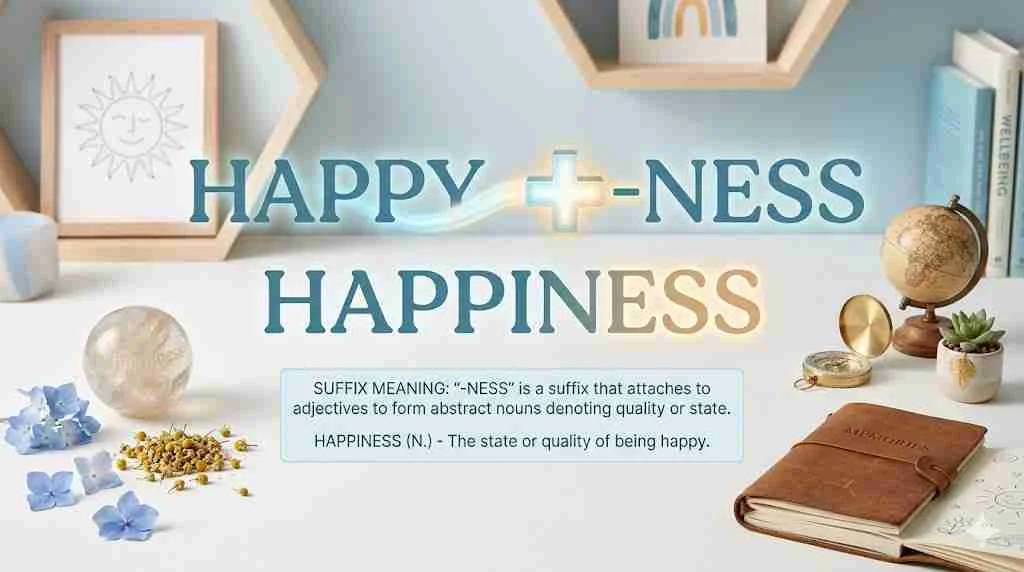

A suffix is a letter or group of letters added to the end of a base word to change its meaning or grammatical function.
For example, adding “-less” to “hope” gives “hopeless” (changes meaning), while adding “-ed” to “walk” gives “walked” (changes tense).
You add a few letters to the end of a word. Suddenly that word means something different. That’s a suffix.
A suffix is a letter or group of letters you attach to the end of a base word. It changes the word’s meaning or its grammatical function. Think of it like a tail. The tail doesn’t replace the animal. But it sure changes how you see it.
For example, take the word “help.” Add “-ful” and you get “helpful.” Now it means full of help. Add “-less” and you get “helpless.” Now it means without help. Same base. Different tails. Totally different meanings.
Suffixes are not the same as prefixes. A prefix goes at the front. A suffix goes at the back. Here’s a quick look:
| Term | Position | Example |
|---|---|---|
| Prefix | Beginning of word | unhappy |
| Suffix | End of word | happiness |
English has hundreds of suffixes. But you don’t need to learn all of them. You just need to understand how they work. Once you get the pattern, you can decode thousands of words without a dictionary.
The suffix meaning is simple: it’s the job that ending performs. Does it turn a verb into a noun? Does it show past tense? That’s the suffix’s meaning.
Let’s dig deeper.
How to Spot a Suffix in Any Word
You don’t need a linguistics degree to find a suffix. You just need a simple trick.
Look at the last few letters of a word. Ask yourself: if I remove these letters, does the remaining part still make sense as a word on its own?
Take “quickly.” Remove “-ly.” You get “quick.” That’s a real word. So “-ly” is a suffix.
Try “teacher.” Remove “-er.” You get “teach.” That’s a real word. So “-er” is a suffix.
Now try “window.” Remove “-ow.” You get “wind.” That’s a different word with a different meaning. That doesn’t work. So “-ow” is not a suffix here.
Three steps to spot a suffix:
- Look at the end of the word.
- Remove the last two to four letters.
- Check if the base word still exists in English.
Be careful. Some words look like they have suffixes but don’t. “Brother” ends in “-er.” But “broth” is a word. Does “broth” mean the same family member? No. So “-er” in “brother” is not a suffix. It’s just part of the original word.
A true suffix always attaches to a base word that stands alone with a related meaning.
Quick test: Change the suffix. Does the word’s part of speech change?
- Quick (adjective) → quickly (adverb) = suffix “-ly” works.
- Happy (adjective) → happiness (noun) = suffix “-ness” works.
- Run (verb) → runner (noun) = suffix “-er” works.
If the base word and the new word share a clear connection, you found a suffix.
The Two Main Types of Suffixes
Not all suffixes do the same job. Some create entirely new words. Others just tweak grammar rules. Linguists split suffixes into two buckets.
Derivational Suffixes
These change the meaning or the word class. Sometimes both.
Add “-ness” to “dark” and you get “darkness.” You changed an adjective into a noun. You also kept the core idea (absence of light) but turned it into a thing you can name.
Add “-less” to “hope” and you get “hopeless.” You changed the meaning from positive to negative. The word class stayed the same (adjective). But the meaning flipped.
Derivational suffixes often change the part of speech. Here’s how:
| Base Word | Part of Speech | Suffix | New Word | New Part of Speech |
|---|---|---|---|---|
| teach | verb | -er | teacher | noun |
| modern | adjective | -ize | modernize | verb |
| quick | adjective | -ly | quickly | adverb |
| friend | noun | -ship | friendship | noun (abstract) |
Derivational suffixes can stack. You can add more than one. For example:
- Care (noun/verb)
- Careless (adjective) — added “-less”
- Carelessness (noun) — added “-ness”
That’s two derivational suffixes on one base. English lets you do that.
Inflectional Suffixes
These don’t create new words. They just adjust a word for grammar. Think of them as the polite rules of English.
Inflectional suffixes never change the part of speech. A verb stays a verb. A noun stays a noun. They just add information like tense, number, or comparison.
Here’s the complete list. English has only eight inflectional suffixes. That’s it.
| Suffix | Job | Example |
|---|---|---|
| -s | plural noun | cat → cats |
| -es | plural noun (after s, sh, ch, x, z) | box → boxes |
| -ed | past tense verb | walk → walked |
| -ing | progressive verb | eat → eating |
| -en | past participle (irregular) | eat → eaten |
| -er | comparative adjective | fast → faster |
| -est | superlative adjective | fast → fastest |
| -s | third person singular verb | run → runs |
Notice “-s” appears twice. Same spelling. Different jobs. One makes nouns plural. One matches verbs with he/she/it.
Inflectional suffixes always go at the very end. If a word has both derivational and inflectional suffixes, the inflectional one comes last.
Example: “quickly” has “-ly” (derivational). No inflectional suffix.
Example: “runners” has “-er” (derivational) and “-s” (inflectional plural). The “-s” goes last.
Big difference in one sentence:
- Derivational: happy → unhappy (new word, opposite meaning)
- Inflectional: happy → happier (same word, just comparing)
Understanding both types unlocks the full meaning of suffix in English grammar.
Common Suffix Lists by Part of Speech
Memorizing raw lists is boring. Seeing suffixes change real words? That sticks. Below are the most common suffixes grouped by what they create.
Noun Suffixes
Nouns name people, places, things, or ideas. These suffixes turn verbs, adjectives, and other nouns into nouns.
| Suffix | Base Word | New Word | In a Sentence |
|---|---|---|---|
| -tion | educate | education | Education changes lives. |
| -er | teach | teacher | The teacher gave a quiz. |
| -or | act | actor | That actor won an award. |
| -ness | dark | darkness | Darkness filled the room. |
| -ity | active | activity | Swimming is my favorite activity. |
| -ment | enjoy | enjoyment | She reads for enjoyment. |
| -ship | friend | friendship | Their friendship lasted decades. |
| -hood | child | childhood | My childhood was happy. |
| -ance | appear | appearance | His appearance shocked everyone. |
| -ence | differ | difference | One small difference matters. |
Deep fact: The suffix “-er” is the most common agentive suffix in English. It turns actions into people who do those actions. Run → runner. Sing → singer. Dance → dancer. Almost any verb can take “-er.”
Verb Suffixes
Verbs show actions or states. These suffixes turn nouns and adjectives into verbs.
| Suffix | Base Word | New Word | In a Sentence |
|---|---|---|---|
| -ize | modern | modernize | They plan to modernize the kitchen. |
| -en | wide | widen | The road will widen next year. |
| -ify | simple | simplify | Can you simplify that explanation? |
| -ate | active | activate | Press this button to activate the alarm. |
Deep fact: The suffix “-ize” is surprisingly productive. English speakers create new “-ize” verbs all the time. “Randomize,” “visualize,” “prioritize.” Even informal ones like “adultize” appear in casual speech.
Adjective Suffixes
Adjectives describe nouns. These suffixes turn other parts of speech into describing words.
| Suffix | Base Word | New Word | In a Sentence |
|---|---|---|---|
| -ful | hope | hopeful | She felt hopeful about the interview. |
| -less | hope | hopeless | The situation looked hopeless. |
| -able | drink | drinkable | Is this water drinkable? |
| -ible | access | accessible | The building is accessible now. |
| -ive | act | active | Stay active every day. |
| -ous | danger | dangerous | That road is dangerous at night. |
| -al | nature | natural | Her reaction was natural. |
| -y | mess | messy | His desk is always messy. |
| -ic | hero | heroic | That was a heroic effort. |
Deep fact: “-ful” and “-less” are opposites. “Hopeful” means full of hope. “Hopeless” means without hope. English uses this pair constantly. But careful: “helpful” exists. “Helpless” exists. But “helpless” does not mean “without help.” It means unable to help oneself. Not all opposites are perfect mirrors.
Adverb Suffixes
Adverbs modify verbs, adjectives, or other adverbs. They often tell how, when, or where.
| Suffix | Base Word | New Word | In a Sentence |
|---|---|---|---|
| -ly | quick | quickly | He ran quickly to the door. |
| -ward | back | backward | She stepped backward without looking. |
| -wise | clock | clockwise | Turn the knob clockwise. |
Deep fact: The suffix “-ly” comes from an Old English word “lic” meaning “body” or “form.” Over time, it became the standard way to make adverbs. Almost any adjective can take “-ly.” Quick → quickly. Slow → slowly. Happy → happily (change y to i). But some common words like “fast” and “hard” don’t need “-ly.” They work as both adjectives and adverbs.
Do Suffixes Change Pronunciation?
Yes. Adding a suffix can shift stress. It can change vowel sounds. It can even make you drop or double letters.
Stress Shifts
Some suffixes pull the stress to a different syllable. This happens a lot with academic and technical words.
- PHOtograph (stress on first syllable)
- phoTOGraphy (stress on second syllable because of “-graphy”)
- photoGRAPHic (stress on third syllable because of “-graphic”)
Same root. Different suffixes. Different stress patterns.
Vowel Changes
Sometimes the vowel sound inside the base word changes when you add a suffix.
- nation (long a sound: nay-shun)
- national (short a sound: nash-uh-nul)
The suffix “-al” changed the pronunciation of the first “a.” You didn’t change the spelling of “nation.” But you did change how you say it.
Silent E Rule
If a base word ends with a silent E, drop the E before adding a suffix that starts with a vowel.
- make + ing = making (drop the E)
- make + er = maker (drop the E)
But keep the E if the suffix starts with a consonant.
- make + less = makeless (keep the E)
This rule applies to most suffixes. There are exceptions. But this rule works over 90% of the time.
The Doubling Rule
If a one-syllable word ends with consonant-vowel-consonant, double the last letter before adding a vowel-starting suffix.
- big + er = bigger (double G)
- run + ing = running (double N)
- hot + est = hottest (double T)
Don’t double if the suffix starts with a consonant.
- big + ness = bigness (no double)
Don’t double if the word has two syllables and the stress is not on the last syllable.
- open + ing = opening (no double. Stress on O, not pen)
This rule feels tricky at first. But native speakers do it automatically. You can learn it the same way: practice seeing the pattern.
Can a Word Have More Than One Suffix?
Yes. English lets you stack suffixes. Each new suffix attaches to the result of the previous one. Like building with Lego bricks.
Two suffixes:
- Hope → hopeful → hopefully
- Hope (noun/verb) + ful (adjective suffix) = hopeful
- Hopeful (adjective) + ly (adverb suffix) = hopefully
That’s two suffixes: “-ful” then “-ly.”
- Care → careless → carelessness
- Care (noun/verb) + less (adjective suffix) = careless
- Careless (adjective) + ness (noun suffix) = carelessness
That’s two suffixes: “-less” then “-ness.”
Three suffixes:
- Nation → national → nationalize → nationalization
- Nation (noun) + al (adjective suffix) = national
- National (adjective) + ize (verb suffix) = nationalize
- Nationalize (verb) + ation (noun suffix) = nationalization
That’s three suffixes: “-al,” “-ize,” “-ation.”
The limit? Technically there is no hard limit. But in real English, you rarely see more than three or four. More than that becomes clumsy. Readers lose track of the base.
Example of four (rare but real):
- Industrial → industrialize → industrialization → postindustrialization
- That’s “-al,” “-ize,” “-ation,” and “post-” (prefix) plus the base.
Most native speakers would avoid stacking that many. It sounds academic and stiff. But it is grammatically possible.
Key rule: Inflectional suffixes always come last. If you have derivational suffixes and an inflectional suffix, the inflectional one goes at the very end.
- Runner + s = runners (“-er” derivational, “-s” inflectional)
- Quicker + est = quickest (“-er” inflectional comparative, “-est” inflectional superlative two inflectional suffixes? No. You don’t stack two inflectional suffixes. “Quickerest” is not a word. English forbids stacking inflectional suffixes.)
Only derivational suffixes stack. Inflectional suffixes stand alone at the end.
Common Mistakes with Suffixes And How to Avoid Them
Even advanced writers slip up. Here are the most frequent errors.
Mistake 1: Doubling letters when you shouldn’t
Wrong: “openning”
Right: “opening” (stress not on last syllable of “open”)
Wrong: “bigest”
Right: “biggest” (double G because one syllable, consonant-vowel-consonant)
Fix: Learn the doubling rule. One syllable. Ends CVC. Double before vowel suffix.
Mistake 2: Dropping the E when you shouldn’t
Wrong: “safely” (safe + ly)
Wait, that’s actually right. Bad example. Let’s try:
Wrong: “truly” from “true” + “ly” oh, that’s right too. English is messy.
Better: “noticeable” (notice + able). Keep the E? Yes. “Noticable” is wrong. Keep E after “c” and “g” to keep sound soft.
Fix: When a base ends in “ce” or “ge,” keep the E before “-able” or “-ous.” Noticeable, changeable, courageous.
Mistake 3: Adding “-ly” to words that already end in “ly”
Wrong: “friendlyly”
Right: “in a friendly way” (avoid the double -ly)
English has no rule against it, but it sounds terrible. Rewrite instead.
Mistake 4: Using the wrong noun suffix
Wrong: “informate” (from inform + ate? No.)
Right: “information”
Some verb-noun pairs just need memorization. Inform → information. Decide → decision. Describe → description. No single rule covers them all.
Mistake 5: Confusing “-able” and “-ible”
Wrong: “convertable”
Right: “convertible”
No perfect rule. But here’s a good one: if you can remove “-able” and still have a full English word, use “-able” (like “washable” from “wash”). If the base changes or isn’t a full word, use “-ible” (like “convertible” “convert” works but “convert” + “ible” is the historical spelling). When in doubt, check a dictionary.
A Quick Reference Table of High-Value Suffixes
Bookmark this table. These 20 suffixes cover most of what you’ll meet in everyday reading and writing.
| Suffix | Type | Meaning | Example |
|---|---|---|---|
| -s/-es | Inflectional | Plural | dog → dogs |
| -ed | Inflectional | Past tense | walk → walked |
| -ing | Inflectional | In progress | eat → eating |
| -er (comparative) | Inflectional | More | fast → faster |
| -est | Inflectional | Most | fast → fastest |
| -er (agent) | Derivational | Person who | teach → teacher |
| -or | Derivational | Person who | act → actor |
| -tion | Derivational | Act or state | inform → information |
| -ness | Derivational | State or quality | happy → happiness |
| -ity | Derivational | Condition | active → activity |
| -ment | Derivational | Result | enjoy → enjoyment |
| -ship | Derivational | Status | friend → friendship |
| -ful | Derivational | Full of | hope → hopeful |
| -less | Derivational | Without | hope → hopeless |
| -able | Derivational | Capable of | drink → drinkable |
| -ible | Derivational | Capable of | access → accessible |
| -ive | Derivational | Tending to | act → active |
| -ous | Derivational | Full of | danger → dangerous |
| -ly | Derivational | In that manner | quick → quickly |
| -ize | Derivational | To make | modern → modernize |
Putting It All Together
You don’t need to memorize every suffix in existence. You just need to recognize the pattern.
Look at a word’s tail. Ask what changed. Did the part of speech shift? Did the meaning flip positive to negative? That’s the suffix doing its job.
English has over 100 common suffixes. But 80% of what you’ll read uses only the 20 listed above. Learn those. Practice spotting them in the wild. Read a news article. Highlight every word ending in “-ly,” “-ness,” or “-tion.” See how often they appear.
Once you see the pattern, you stop sounding like a student memorizing rules. You start sounding like someone who just gets how English works.
And that’s the real power of understanding suffix meaning. It turns decoding into second natur
FAQs
What does suffix mean in simple words?
A letter or group of letters you add to the end of a word to change its meaning or grammar. “Run” becomes “runner.” The “-er” means “person who does.”
What’s the difference between a prefix and a suffix?
A prefix goes at the front. “Re” in “rewrite.” A suffix goes at the end. “Er” in “writer.” Prefixes change meaning. Suffixes change meaning or grammar.
Why are suffixes important in English?
They let you build vocabulary without memorizing new words from scratch. Learn “help.” Learn “-ful” and “-less.” Now you know “helpful” and “helpless” without a dictionary. That’s efficiency.
What is a suffix in linguistics?
A bound morpheme attached after a stem. “Bound morpheme” means it cannot stand alone. “-ness” has no meaning by itself. It only works attached to something like “happy.”
Can a word have more than one suffix?
Yes. “Carelessness” has “-less” and “-ness.” Three is possible (“nationalization”). Four is rare.
What are the most common English suffixes?
By frequency in written English: “-s/-es” (plural), “-ed” (past tense), “-ing” (progressive), “-ly” (adverb), “-er/-or” (agent noun), “-tion” (noun).
What is an example of a suffix changing a word completely?
“Child” + “-ish” = “childish” (acting like a child, but negatively). “Child” + “-like” = “childlike” (innocent, positively). Same base. Different suffixes. Opposite feelings.
How do you identify a suffix?
Remove the last two to four letters. See if a real base word remains with a related meaning. “Quickly” → “quick” = yes. “Brother” → “broth” = no.
Do all suffixes change the part of speech?
No. Inflectional suffixes never change part of speech. “Walk” (verb) → “walked” (still verb). Derivational suffixes often do change it. But not always. “King” (noun) → “kingdom” (still noun but different meaning).
Conclusion
You don’t need to memorize every suffix in the dictionary. Just learn to spot the pattern. Look at a word’s ending. Remove those last few letters. Does a real base word remain? If yes, you’ve found a suffix. That simple trick unlocks thousands of English words without flipping through a dictionary every five minutes.
It’s “-ness” turning “happy” into a noun or “-ed” showing something happened yesterday, suffixes do the heavy lifting so you don’t have to. So next time you hit an unfamiliar word, check its tail first. Ask yourself: what changed? Did the word shift from a verb to a noun? Did the meaning flip from positive to negative?
Or did it just add a little grammatical polish? Once you start seeing suffixes everywhere in articles, emails, even text messages you’ll wonder how you ever read without noticing them. That’s the real power of understanding suffix meaning. It turns confusing English into something you can actually take apart and figure out on your own.
Discover More Related Articles:
- “OTW” Meaning in Chat Apps: What People Really Mean In 2026
- “IG” Mean in Text: Common Uses in Texting & Online Chat In 2026
- “WYO” Mean: Hidden Meaning You Should Know In 2026