
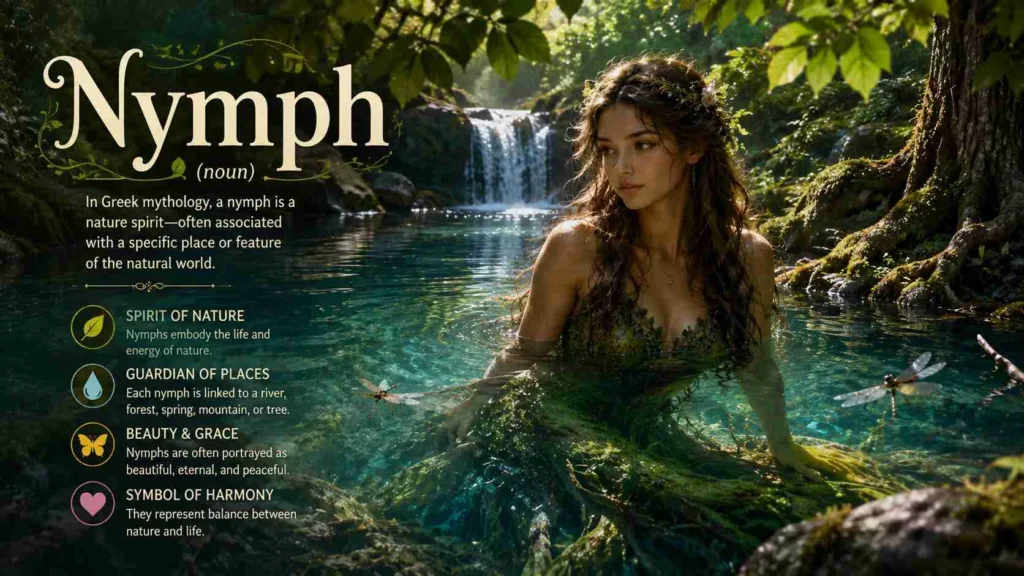

A nymph is a minor female nature spirit in Greek mythology, tied permanently to a specific place like a river, tree, or mountain. She’s not a goddess or a mortal just a beautiful, dangerous and deeply local force of the natural world.
You step into an old forest. The air smells wet and alive. A stream runs over smooth stones. Somewhere behind the leaves, you hear a quick laugh. Then nothing.
The ancient Greeks would have told you exactly what that was. Not a ghost. Not a hallucination. A nymph.
For centuries, people have thrown around the word nymph without really understanding it. Some think it means any beautiful nature fairy. Others confuse nymphs with goddesses. A few have no idea the word even has a mythological origin.
Let’s fix that.
This guide covers the complete nymph meaning from ancient Greek springs to modern spiritual symbolism. You’ll learn the different types, the real characteristics, and why these female nature spirits still show up in art, literature, and even biology.
No fluff. Just clear facts, useful examples, and a few surprises.
What Does Nymph Mean? Let’s Start Simple
Let’s nail down the basics first.
A nymph is a minor female nature deity in Greek mythology. Not a major god like Zeus or Athena. Not a mortal human. Something in between.
The nymph meaning always ties back to a specific natural feature. A river. A tree. A mountain. A spring. Each nymph lives inside that place. She can’t leave it for long without fading away.
Key traits at a glance:
- Always female
- Tied to one location
- Beautiful in a wild, untamed way
- Dangerous if disrespected
- Helpful if honored
Ancient Greeks didn’t worship nymphs like Olympian gods. But they left them offerings. Oil. Honey. Milk. Small cakes. You’d pour these out near a spring or an old oak tree to stay on the nymph’s good side.
Mess with her home? She could drown you, drive you mad, or turn you into a plant.
How to Say It and Where the Word Came From
Let’s clear up pronunciation first. You say it /nɪmf/. Rhymes with “blimp” but without the L sound. Not “nime.” Not “nymph-ee.” Just one quick syllable.
Now the origin story.
The English word nymph comes straight from ancient Greek νύμφη (nymphē). That Greek word had two overlapping meanings:
- A young woman of marriageable age
- A semi-divine nature spirit
Why the connection? Because ancient Greeks saw nymphs as eternal brides forever young, forever desirable, but never quite domestic. They attracted gods and mortals alike. Zeus chased them. Apollo chased them. Even satyrs chased them.
The Romans borrowed the word as nympha. It traveled through Latin into Old French as nimphe. By the time Middle English grabbed it, the spelling settled into nymph.
So the nymph origin of the word isn’t mysterious. It’s just an old word for “girl” that grew mythological muscles over time.
Nymph vs Fairy vs Goddess: Stop Mixing Them Up
People confuse these three all the time. Let’s kill that confusion with a clear table.
| Feature | Nymph | Fairy | Goddess |
|---|---|---|---|
| Culture of origin | Greek mythology | Celtic & European folklore | Multiple cultures (Greek, Norse, Hindu, etc.) |
| Power level | Minor and local | Minor, often trickster | Major, domain-wide |
| Lifespan | Very long but not truly immortal | Immortal in most traditions | Truly immortal |
| Tied to a place | Yes (one river, one tree, one mountain) | No (can move freely) | No (rules everywhere in their domain) |
| Examples | Dryads, Naiads, Oreads | Pixies, sprites, leprechauns | Athena, Aphrodite, Freya |
Why does this matter for the nymph meaning?
Because a nymph isn’t just a nature spirit. She’s a rooted nature spirit. Cut down her tree. Dry up her spring. Her existence ends. Fairies don’t work that way. Goddesses definitely don’t.
Think of it like this: A goddess rules the ocean. A nereid (sea nymph) lives in one small bay of that ocean. The goddess doesn’t need the bay. The nymph is the bay.
The Major Types of Nymphs
Ancient Greeks didn’t lump all nymphs together. They named them by where they lived. Each group had its own personality, its own myths, and its own dangers.
Let’s walk through the most important ones.
Water Nymphs
Water nymphs are the most famous kind. If someone says “nymph” without context, your brain probably pictures a woman rising from a lake. You’re not wrong.
Naiads (Freshwater Nymphs)
Naiads lived in rivers, springs, fountains, and lakes. Every freshwater source had its own naiad. No exceptions.
Some naiads were kind. They’d heal travelers or guide heroes. Others were vengeful. Cross them, and they’d flood your farm or poison your well.
Real example: Minthe. She was a naiad associated with the river Cocytus in the underworld. Hades fell for her. Persephone (his wife) got jealous and turned Minthe into the mint plant. That’s why mint grows so well near water.
Nereids (Saltwater Nymphs)
The nereids were fifty daughters of Nereus, the old man of the sea. They lived in the Mediterranean, not the deep ocean. Each one ruled a small stretch of coastline or a specific sea cave.
Real example: Thetis. She was a nereid and the mother of Achilles. When Achilles was born, Thetis tried to make him immortal by dipping him in the river Styx. She held him by his heel. You know the rest.
Oceanids (Open Ocean Nymphs)
Oceanids were daughters of Oceanus and Tethys (titans of the ocean). Ancient sources list over three thousand of them. They ruled the deep sea, far from shore.
Most oceanids have no surviving myths. But a few stand out.
Real example: Clymene. An oceanid who married the titan Iapetus and gave birth to Atlas and Prometheus.
Land and Forest Nymphs
Not all nymphs live in water. Some of the most famous ones live in trees and mountains.
Dryads and Hamadryads (Tree Nymphs)
Here’s where the nymph meaning gets very specific. A dryad is a tree spirit. A hamadryad is bonded to a single tree. If that tree dies, the hamadryad dies with it.
Most dryads lived in oak trees. The Greeks considered oaks sacred to Zeus. So dryads got extra respect.
Real example: Eurydice. Yes, the wife of Orpheus. She was a hamadryad. When a snake bit her, she died because her tree couldn’t survive the venom. Orpheus went to the underworld to bring her back. You know how that ended.
Oreads (Mountain Nymphs)
Oreads lived in mountains, grottoes, and rocky caves. They were tougher than other nymphs. Less delicate. More likely to throw a rock at you.
Real example: Echo. She was an oread who liked to talk. A little too much. She once distracted Hera with endless chatter so Zeus could chase other nymphs. Hera punished Echo by making her only able to repeat the last words she heard. When Echo fell in love with Narcissus, she couldn’t tell him. She wasted away until only her voice remained.
Less Common Nymph Types
These show up less often in myths but deserve a mention.
Asteriae (Star Nymphs)
Celestial nymphs tied to specific stars or constellations. They rarely interact with mortals.
Lampades (Underworld Nymphs)
Torch-bearing nymphs who served Hecate in the underworld. Their fire could drive people mad or reveal hidden ghost paths.
Characteristics of Nymphs | What Made Them Unique
Let’s move past simple nymph definition and dig into what actually made these creatures tick.
Female Only
Greek nymphs are always female. Later Roman writers played with male nature spirits, but that’s not real Greek mythology. Stick to the source material.
Beautiful but Dangerous
Art always shows nymphs as young and lovely. But beauty didn’t mean safe.
A nymph could:
- Drown a hunter who chased her
- Turn a rude traveler into a fish
- Send a madness that made men leap off cliffs
Ancient Greeks approached nymph caves carefully. You left an offering before you drank from a spring. Basic respect.
Tied to a Single Location
This is the most important nymph characteristic you’ll learn.
A nymph cannot leave her home. A naiad can’t walk ten miles inland. A dryad can’t move to a different forest. Her life force connects directly to that exact stream, that exact oak, that exact peak.
Leave the place? She weakens. Stay away too long? She dies.
This made nymphs incredibly vulnerable. It also made them fiercely protective.
Chased by Gods and Mortals
Read any collection of Greek myths. You’ll notice a pattern. A god sees a nymph. The god wants the nymph. The nymph runs.
Zeus did this constantly. So did Apollo, Hermes, and Pan. Even mortal heroes like Heracles chased nymphs.
Sometimes the nymph escaped by transforming. Daphne (a naiad) turned into a laurel tree to escape Apollo. Sometimes she didn’t escape at all.
Associated with Youth, Dance, and Song
Homer’s Odyssey describes nymph caves as places with stone looms and honey-sweet voices. They sing while they weave. They dance in circles on moonlit hills.
This isn’t random detail. The nymph meaning always includes youthful energy. Nymphs don’t age. They don’t get tired. They don’t grow wise or solemn. They stay forever young, forever playful, and forever slightly out of reach.
Spiritual Meaning of Nymphs
Search engines show thousands of people asking for the “nymph spiritual meaning.” Most results are vague New Age fluff. Let’s give you something real instead.
In Ancient Practice
Ancient Greeks didn’t “worship” nymphs the way they worshipped gods. But they did practice a form of local respect.
At a nymph spring, you might:
- Pour out a libation of oil or honey
- Tie a ribbon to a nearby tree
- Leave a small clay figurine
- Say a quiet request for healing or luck
This wasn’t organized religion. It was more like acknowledging a neighbor. You don’t worship your neighbor. But you stay on their good side.
Archaeologists have found hundreds of nymph shrines across Greece. The most famous is the Cave of the Nymphs on Ithaca. Odysseus supposedly rested there in the Odyssey.
In Modern Symbolism
When someone talks about “nymph energy” today, they usually mean three things:
- Untamed nature – A force that doesn’t obey human rules
- Feminine creativity – Wild, generative, unpredictable
- Genius loci – The soul of a specific place
Genius loci is a Latin phrase. It means “the spirit of a location.” Every forest has one. Every river. Every mountain. Nymphs are just the Greek version of that universal human feeling that some places feel alive.
In Dreams and Literature
Dream interpreters say a nymph figure usually represents:
- A fleeting desire you can’t catch
- Natural energy you’re ignoring
- A creative project tied to a specific time or place
In poetry and fiction, nymphs show up as symbols of lost youth, unattainable beauty, or nature’s indifference. You can’t possess a nymph. You can only witness her for a moment before she vanishes.
Where Does the Word Nymph Show Up Today?
The nymph word meaning didn’t stay in ancient Greece. It spread into biology, art, and everyday language.
Biology
Entomologists use nymph for the immature stage of certain insects.
Examples: Grasshoppers, dragonflies, mayflies, and cicadas.
A nymph in this sense looks like a small adult but lacks wings and working reproductive organs. It molts several times before reaching full adulthood.
Why this name? Early biologists saw these young insects emerging from water or soil and thought they looked like mythological spirits coming out of hiding. The name stuck.
Literature
Poets and novelists love nymphs as metaphors.
Alexander Pope’s The Rape of the Lock (1712) uses “nymphs” for the supernatural beings who guard a young woman’s beauty. It’s a mock epic so the nymphs are ridiculous and petty, not majestic.
Modern fantasy fiction uses real nymph types constantly. Rick Riordan’s Percy Jackson books feature dryads, naiads, and oreads as supporting characters. They follow the original Greek rules fairly closely.
Art
Renaissance painters couldn’t get enough of nymphs.
Botticelli’s Primavera (1482) shows the Three Graces beautiful young women often called nymph-like in art criticism. They dance in a orange grove, floating just above the ground.
French academic painters of the 1800s made nymphs their favorite subject. William-Adolphe Bouguereau painted Nymphs and Satyr (1873), which shows four nymphs dragging a satyr into a pond. It’s playful and slightly naughty. Very on-brand for nymphs.
Everyday Language
You’ll hear “nymph-like” in literary criticism and fashion writing. It means gracefully young and feminine, with a wild, untamed quality.
It’s not a compliment in every context. Calling someone “nymph-like” can imply they’re childish or flighty. Use with caution.
Nymph Mythology Facts | The Details Most Guides Skip
Let’s get deeper into nymph greek mythology with specific facts you won’t find in beginner guides.
Nymphs Could Marry Gods
Some nymphs became divine wives. Thetis (nereid) married Peleus, a mortal king. Their son was Achilles.
But most nymph marriages ended badly. Gods got bored. Nymphs got turned into plants or stars.
Some Nymphs Had Prophetic Powers
Certain springs gave prophetic abilities to the nymph who lived there. The most famous was the spring at Delphi before Apollo took over, a nymph named Daphnis gave prophecies there.
People would drink the spring water, then sleep in a cave. The nymph would visit their dreams with answers.
Nymphs Appear in Homer More Than Any God Except Zeus
Open the Iliad or Odyssey. Count the nymph mentions. They’re everywhere.
In the Odyssey, nymphs help Odysseus on multiple islands. Calypso (a nymph) holds him captive for seven years. Circe (a nymph with magic powers) turns his men into pigs.
Homer treated nymphs as major players, not minor side notes.
The Ancient Greeks Had a “Nymph Census”
A writer named Apollodorus tried to list every named nymph in Greek mythology. His Bibliotheca includes over 400 names. And he admits he probably missed hundreds more.
Every region of Greece had its own local nymphs. Travelers learned which ones lived near each spring and mountain pass. It was practical knowledge, not just poetry.
Why Nymphs Still Matter Today
Here’s the truth.
You don’t have to believe in Greek gods to feel what nymphs represent.
Walk through an old-growth forest. Stand beside a spring that never runs dry. Look out from a mountain peak before sunrise. Something in your chest says this place is alive.
That’s the nymph meaning. Not a literal spirit. But the human instinct to see personality in nature. To treat a river like it has moods. To leave a small offering even just a paused moment of respect before you drink from a wild spring.
The Greeks gave that feeling a name and a face. They built small shrines. They told stories. They didn’t overthink it.
Neither should you. Why Nymphs Still Matter Today
Here’s the truth.
You don’t have to believe in Greek gods to feel what nymphs represent.
Walk through an old-growth forest. Stand beside a spring that never runs dry. Look out from a mountain peak before sunrise. Something in your chest says this place is alive.
That’s the nymph meaning. Not a literal spirit. But the human instinct to see personality in nature. To treat a river like it has moods. To leave a small offering even just a paused moment of respect before you drink from a wild spring.
The Greeks gave that feeling a name and a face. They built small shrines. They told stories. They didn’t overthink it.
Neither should you. Why Nymphs Still Matter Today
Here’s the truth.
You don’t have to believe in Greek gods to feel what nymphs represent.
Walk through an old-growth forest. Stand beside a spring that never runs dry. Look out from a mountain peak before sunrise. Something in your chest says this place is alive.
FAQs
Q: Are nymphs immortal?
No. They live thousands of years but can die. Destroy their tree or spring. They die.
Q: What powers do nymphs have?
Shape-shifting (sometimes). Prophecy (rarely). Full control over their small natural domain. A naiad can flood one river valley. Nothing more.
Q: What’s the difference between a nymph and a goddess?
Goddesses rule concepts (love, war, wisdom). Nymphs are tied to places (this spring, that mountain). Also, goddesses are fully immortal. Nymphs aren’t.
Q: Did ancient people actually believe in nymphs?
Yes. They left offerings at nymph caves for over a thousand years. The Cave of the Nymphs on Ithaca was a real pilgrimage site. Even educated Greeks like Pausanias described nymph shrines as legitimate sacred places.
Q: How do you pronounce nymph correctly?
/nɪmf/. One syllable. Rhymes with “blimp” without the L.
Q: What is a nymph in the Bible?
Nothing. Nymphs don’t appear in the Bible. Some bad translations use “nymph” for certain Hebrew words, but that’s a mistake. Stick to Greek mythology for accurate nymph meaning.
Q: Can a nymph be male?
In Greek mythology? No. Later Roman poets invented male nature spirits called “fauns.” But that’s not nymph meaning. Those are different creatures.
Conclusion
A nymph isn’t some dusty myth you only find in old textbooks. She’s a wild, rooted, fiercely local force of nature. The Greeks didn’t invent nymphs to explain the world from a distance. They felt them right under their feet in the cold shock of a spring, the rustle of an ancient oak, the echo off a mountain wall. That instinct hasn’t disappeared. You’ve felt it too. That quiet pause when a forest feels a little too aware of you. That’s the nymph meaning still working.
Don’t overcomplicate it. Next time you walk past a stream or climb a rocky hill, don’t just see water and stone. See a personality. A mood. A spirit that doesn’t owe you anything but might just help you if you show a little respect. The Greeks left honey and oil. You can just leave a moment of attention. That’s enough. Nymphs don’t need worship. They just need you to notice they were always there.
Discover More Related Articles:
- “OTW” Meaning in Chat Apps: What People Really Mean In 2026
- “IG” Mean in Text: Common Uses in Texting & Online Chat In 2026
- “WYO” Mean: Hidden Meaning You Should Know In 2026