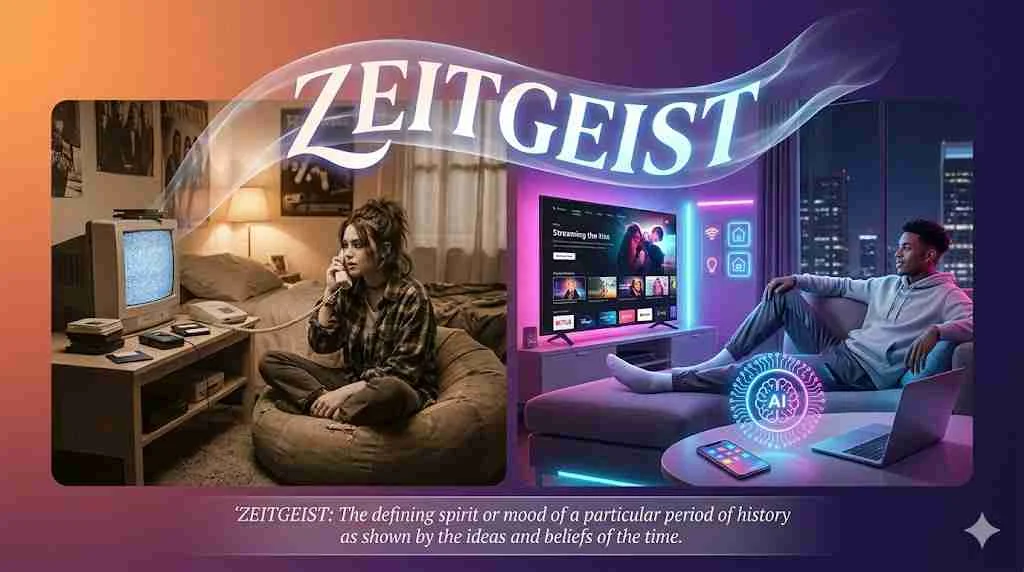

Zeitgeist is the invisible “spirit of the age” the dominant set of ideas, moods, beliefs, and cultural energy that defines a specific period in history. It’s the collective vibe everyone breathes without noticing, shaping what feels normal, cool, or embarrassing right now.
Picture a crowded city bus in 2003. Everyone’s flipping open flip phones. People burn CDs for their friends. A teenager reads a Harry Potter book while listening to a Linkin Park album on a silver iPod.
Now picture the same bus today. Every head tilts down toward bright rectangles. Nobody makes eye contact. Someone takes a selfie. Another person scrolls Reels about quiet quitting and AI replacing artists.
What changed? The people didn’t. The technology didn’t cause everything either. Something deeper shifted.
That invisible force? That’s the zeitgeist.
You’ve felt it. You just didn’t have a word for it. Now you do.
Zeitgeist Meaning | The Simple Definition
Let’s cut through the confusion right now.
Zeitgeist means “spirit of the time.” It’s the dominant set of ideas, beliefs, moods, and cultural energy that defines a specific era.
Think of it as the collective vibe of a generation. The unspoken rulebook telling everyone what feels normal, cool, scary, or embarrassing right now.
Not laws. Not trends. Something stickier.
A trend fades in two years. The zeitgeist lingers for twenty.
| Term | Lifespan | Example |
|---|---|---|
| Fad | Weeks | Fidget spinners, planking |
| Trend | 1–3 years | Cold brew coffee, skinny jeans |
| Zeitgeist | 20–30 years | Digital anxiety, work-life blend |
Here’s a faster way to get it. The zeitgeist is the cultural air you breathe without noticing. You only smell it when it changes.
How to Pronounce Zeitgeist
Let’s get this right from the start. Mispronouncing zeitgeist makes you sound like you just read it in a book last night.
Correct pronunciation: TSITE-guyst
Rhymes with “bright-sized” or “white-guysed” (but don’t say that second one out loud in public).
Break it down by syllable:
- First syllable: TSITE (like “cite” but with a T at the front)
- Second syllable: guyst (like “guised” without the D)
Common wrong versions:
- Zite-guest ❌
- Zee-guy-st ❌
- Zite-geest ❌
Say it three times fast: TSITE-guyst. TSITE-guyst. TSITE-guyst.
Now you own it.
Where the Word Comes From | Etymology and Origin
German gave English this gift because English didn’t have a word sharp enough for the job.
Zeit = time
Geist = spirit, ghost, or mind
Put them together: time-spirit.
Who invented it? A philosopher named Johann Gottfried Herder in the late 1700s. Herder noticed that different historical periods felt different. Not just in clothes or music but in how people thought and what they valued.
Another German giant, Georg Hegel, popularized the term. Hegel believed history moved forward when the zeitgeist clashed with old ideas. He called that clash “dialectic.” Fancy word, simple idea: the spirit of the age fights the spirit of the past. Out of that fight comes something new.
English speakers borrowed zeitgeist in the mid-1800s. Why? Because no single English phrase captured “the total intellectual and moral character of an entire era.”
You could say “spirit of the age.” But that’s three words. Zeitgeist does it in one.
Zeitgeist vs. Trend vs. Culture vs. Fad | Stop Confusing Them
People throw these words around like they mean the same thing. They don’t. Here’s the real difference.
Fad – Born fast. Dies faster. Low emotional investment. Example: Pokémon Go summer 2016. Fun for six weeks. Then gone.
Trend – Lasts a few years. Spreads through industries. Example: plant-based meat. Started in vegan circles. Now Burger King sells Impossible Whoppers.
Culture – Broader than zeitgeist. Culture includes food, language, art, rituals, traditions passed down for generations. Zeitgeist is the current mood inside that culture.
Zeitgeist – The dominant emotional and intellectual climate right now. It sits underneath trends. Trends float on top of it like leaves on a river.
| Concept | Scope | Duration | Example |
|---|---|---|---|
| Fad | Narrow | Weeks | Ice bucket challenge |
| Trend | Medium | 1–5 years | Remote work tools |
| Culture | Wide | Generations | Southern US hospitality |
| Zeitgeist | Wide | 20–30 years | Post-9/11 paranoia |
Simple analogy: A trend is a wave. The zeitgeist is the tide. Waves crash and disappear. The tide keeps pulling.
Real Examples of Zeitgeist | From the 1920s to Today
Examples make this real. Here’s how different decades felt from the inside.
1920s Zeitgeist | Jazz, Booze, and Rebellion
The “Roaring Twenties” had a specific spirit. Prohibition made drinking exciting. Jazz music felt dangerous to older generations. Women cut their hair short and raised their hemlines. Everyone felt like the old world Victorian rules, World War I trauma had ended.
F. Scott Fitzgerald’s The Great Gatsby captured this perfectly. The parties. The money. The emptiness underneath.
1950s Zeitgeist | Conformity and Hidden Fear
On the surface: suburbs, television, gray flannel suits, happy nuclear families. Underneath: cold war anxiety, nuclear bomb drills in schools, suspicion of anyone different. The zeitgeist said “fit in or get out.” But rock and roll was already cracking that shell.
1980s Zeitgeist | Greed Is Good
Wall Street ruled. Big hair, bigger shoulder pads, even bigger egos. Movies celebrated wealth and power. The cold war still scared people but now they drowned it in consumerism. “There is no society, only individuals,” Margaret Thatcher famously said. That was the 1980s zeitgeist in one line.
1990s Zeitgeist | Irony and Optimism
The cold war ended. The internet arrived. Gen X responded with sarcasm and flannel. Grunge music rejected 80s excess. Then late 90s brought dot-com mania. Everyone believed technology would fix everything. That naive hope died two years into the 2000s.
2000s Zeitgeist | Fear and Connection
9/11 shattered the 90s optimism. Suddenly everyone felt vulnerable. The zeitgeist swung toward surveillance, patriotism, and fear of outsiders. At the same time, social media arrived. MySpace. Facebook. YouTube. People craved connection and performance simultaneously.
2010s Zeitgeist | Curated Lives and Hidden Exhaustion
Instagram launched in 2010. The selfie became a verb. Everyone performed happiness online while feeling secretly depleted. Hustle culture glorified 80-hour workweeks. Wellness influencers sold green powders for burnout they helped cause.
2020s Zeitgeist | So Far
Current zeitgeist? Messy. Contradictory. That’s normal.
Dominant moods right now:
- AI will take my job (but I still use ChatGPT daily)
- Remote work ruined my social life (but I’ll never commute again)
- Main character energy (but also crushing loneliness)
- Climate doom (but also ironic climate humor memes)
- Therapy speak everywhere (gaslighting, trauma, boundaries)
Barbie (2023) became the biggest movie of the year not because of pink costumes. It captured the current zeitgeist perfectly: feminist nostalgia, existential dread, and laughing so you don’t cry.
How to Use “Zeitgeist” in a Sentence | Natural Examples
Don’t force this word into conversations. Use it when it fits better than “mood of the era.” Here’s how real people use it.
Talking about media:
“Succession nailed the late 2010s zeitgeist. Rich people being miserable while everyone else cheered.”
Talking about history:
“The civil rights movement succeeded partly because the national zeitgeist finally shifted toward justice.”
Talking about daily life:
“You can’t understand why Gen Z hates phone calls without looking at the zeitgeist they grew up in.”
Talking about work:
“The current zeitgeist says quiet quitting is self-care. A decade ago, that same behavior got you fired.”
And Talking about fashion:
“Y2K fashion came back because nostalgia for the early 2000s fits today’s anxious zeitgeist.”
What not to say:
“The zeitgeist of my breakfast this morning was oatmeal.” (No. Just no.)
Why the Zeitgeist Matters | Practical Significance
You might think: Okay, cool word. But why should I care?
Here’s why.
For Marketers and Business Owners
Miss the zeitgeist, and your brand looks clueless. Remember Kendall Jenner’s Pepsi ad? She handed a soda to a police officer during a protest. The ad ignored the real anger of the Black Lives Matter movement. The backlash was brutal. Pepsi pulled it in 24 hours.
Hit the zeitgeist, and you become a cultural hero. Dove’s “Real Beauty” campaign landed perfectly in the mid-2000s zeitgeist. Women were tired of airbrushed models. Dove spoke to that mood. The campaign ran for over a decade.
For Creators and Artists
The best art always taps into the zeitgeist or fights against it. The Hunger Games captured post-9/11 anxiety about surveillance and rebellion. Get Out spoke directly to the 2010s racial zeitgeist. Even Frozen worked because “Let It Go” matched the growing rejection of perfectionism.
For Understanding Your Own Life
Why do your parents not understand your job? Why do old jokes feel offensive now? Why do you feel guilty for taking a vacation?
The zeitgeist changed. You’re swimming in a different cultural river than your parents did. That’s not good or bad. It just is.
For Historians and Students
You can’t understand World War I without understanding the pre-war zeitgeist. Europe was drunk on nationalism and progress. That mood made the war possible. The post-war zeitgeist disillusionment, dark humor, hedonism made the Roaring Twenties happen.
Zeitgeist in Different Fields | A Quick Tour
This concept shows up everywhere once you know to look for it.
Zeitgeist in Literature
Each literary era has a dominant flavor. Victorian literature? Moral, restrained, socially conscious. Modernist literature (1920s–1940s)? Fragmented, cynical, experimental. Postmodern literature (1960s–1990s)? Ironic, playful, suspicious of truth.
A book that perfectly captures its literary zeitgeist: Slaughterhouse-Five by Kurt Vonnegut. The fragmented timeline and dark humor fit the post-WWII, Vietnam War era perfectly.
Zeitgeist in Philosophy
Philosophy doesn’t happen in a vacuum. Existentialism (Sartre, Camus) exploded after WWII. Why? Europe had just watched fascism rise, cities fall, and millions die. The old ideas about God, progress, and reason looked silly. Existentialism said: “No pre-written meaning. Create your own.” That was the post-war philosophical zeitgeist.
Zeitgeist in Sociology
Sociologists study how norms shift. In the 1950s US, the zeitgeist said a “good mother” stays home. By the 1990s, that same zeitgeist said a “good mother” works and provides. Neither is biologically truer. The collective mood changed.
Zeitgeist in Politics
The Overton Window that’s the range of ideas the public considers acceptable. The zeitgeist controls that window. In 2005, universal basic income sounded like science fiction. In 2023, politicians debate it seriously. The zeitgeist moved.
| Field | What Zeitgeist Reveals |
|---|---|
| Literature | Dominant themes and taboos of an era |
| Philosophy | Underlying assumptions about truth and morality |
| Sociology | Collective behaviors and social rules |
| Politics | Which policies feel reasonable vs. radical |
Common Misconceptions | What Zeitgeist Is NOT
Let’s kill these myths quickly.
“Zeitgeist just means popular culture”
No. Pop culture reflects the zeitgeist. But the zeitgeist also includes fears, political moods, economic anxieties, and moral shifts that never make it onto magazine covers.
“The zeitgeist is always progressive”
Wrong. The 1930s zeitgeist in Germany included rising nationalism and antisemitism. The 1950s US zeitgeist included intense conformity and suspicion of outsiders. The zeitgeist can be fearful, reactionary, or nostalgic.
“One person can change the zeitgeist”
Rarely. Leaders, artists, or inventors usually channel the zeitgeist more than they create it. Martin Luther King Jr. didn’t invent the desire for civil rights. He gave voice to a mood already rising. Same with Steve Jobs. He didn’t create the demand for personal computing. He surfed the wave at exactly the right moment.
“The zeitgeist is the same everywhere”
No. Different countries, regions, and subcultures have different zeitgeists running simultaneously. The 2020s zeitgeist in rural Alabama differs from coastal Brooklyn. The national zeitgeist averages them out.
How to Spot the Current Zeitgeist | A Practical Exercise
You don’t need a philosophy degree to see the zeitgeist. Just ask three questions.
Question 1: What are people ashamed of now that they weren’t 10 years ago?
Ten years ago, flying to a conference felt normal. Now people feel guilty. Ten years ago, not recycling felt fine. Now neighbors judge you. Ten years ago, saying “I’m tired” was small talk. Now saying “I’m burned out” signals moral failure.
Shame shifts = zeitgeist shifts.
Question 2: What jokes can’t you tell anymore?
Jokes reveal the moral center of an era. Jokes about certain groups, bodies, or tragedies fade when the zeitgeist changes. It’s not “cancel culture.” It’s the collective mood drawing a new line.
Try telling a “dumb blonde” joke at work. Feel the silence. That silence is the zeitgeist speaking.
Question 3: What job titles didn’t exist five years ago?
New jobs reveal new priorities. Social media manager (2010). AI prompt engineer (2022). Head of remote work (2021). Sustainability officer (2015). Each new title points to a new obsession.
Now try this exercise with a friend. Compare answers. You’ll both see the zeitgeist instantly.
Zeitgeist Synonyms and Antonyms | For Clarity
No perfect synonym exists. That’s why German gave us this word. But these come close.
| Synonym | Why It Works | Why It Falls Short |
|---|---|---|
| Spirit of the age | Direct translation | Three words, less punchy |
| Cultural climate | Good for metaphor | Feels meteorological, vague |
| Collective mindset | Accurate | Lacks the “time” element |
| Intellectual atmosphere | Good for academic use | Too narrow (ignores emotions) |
| Public mood | Everyday language | Sounds temporary, not generational |
Antonyms (opposites):
- Timelessness – ideas that don’t change
- Individual eccentricity – one person’s odd belief, not shared
- Cultural lag – when parts of society resist the new zeitgeist
- Static tradition – unchanging rituals
The Difference Between Zeitgeist and “Spirit of the Age”
You might see both phrases. They mean nearly the same thing. But zeitgeist carries more weight.
“Spirit of the age” sounds like a museum label. “Zeitgeist” sounds alive. German gives it mystery. English can’t replicate that fully.
Use “spirit of the age” in casual conversation if “zeitgeist” feels pretentious. Use “zeitgeist” in writing or when you want precision.
Zeitgeist in Popular Culture | Movies, Music, Memes
The zeitgeist lives in the art we consume. Here’s where to find it.
Movies That Captured Their Zeitgeist
- The Graduate (1967) – 1960s rebellion against parents and establishment
- Network (1976) – 1970s cynicism about TV and corporations
- Fight Club (1999) – Late 90s male alienation before 9/11 changed everything
- Parasite (2019) – Late 2010s class rage
Songs That Defined a Cultural Mood
- “Smells Like Teen Spirit” (Nirvana) – 1990s apathy and anger
- “Formation” (Beyoncé) – 2010s Black pride and feminism
- “Anti-Hero” (Taylor Swift) – 2020s self-awareness mixed with self-loathing
Memes as Zeitgeist Detectors
Memes spread faster than any other art form. They reveal the collective mood instantly.
- “Distracted Boyfriend” meme = the 2010s obsession with novelty and guilt
- “This Is Fine” dog in burning room = 2020s climate anxiety and dark humor
- “Main Character” TikTok trend = post-pandemic desire to feel special again
How the Zeitgeist Changes | Mechanics of Cultural Shifts
The zeitgeist doesn’t snap from one thing to another overnight. It bleeds.
Stage 1 | Old Zeitgeist Dominates
Everyone accepts the current mood as normal. People forget it was ever different. Example: 1950s conformity.
Stage 2 | Cracks Appear
Artists, outsiders, or events expose contradictions. People start whispering “doesn’t this feel wrong?” Example: early 1960s beatniks and civil rights protests.
Stage 3 | Accelerating Shift
A triggering event breaks the old mood. Example: 1963 JFK assassination, 1965 voting rights marches, 1968 Tet Offensive. Suddenly the old zeitgeist looks ridiculous.
Stage 4 | New Zeitgeist Solidifies
A new mood hardens into common sense. Example: by 1972, anti-war sentiment, hippie values, and distrust of authority felt normal.
This cycle takes 20–30 years. Then it repeats.
Zeitgeist vs. Collective Consciousness | A Fine Distinction
Sociologists love this one. Here’s the difference.
Collective consciousness (coined by Émile Durkheim) means the total set of beliefs and sentiments common to the average person in a society. It’s broader. More stable. Includes religion, language, deep values.
Zeitgeist is the current mood. More temporary. More emotional. The collective consciousness is the riverbed. The zeitgeist is the water flowing through it right now.
You can have a collective consciousness that’s religious for 200 years. The zeitgeist still swings between fear, hope, boredom, and excitement within that longer frame.
Why the Zeitgeist Matters for Students and Lifelong Learners
If you’re studying history, literature, or sociology, you need this concept.
A history test asks: “Why did the French Revolution happen?” A mediocre answer lists dates and taxes. A better answer says: “The pre-revolutionary zeitgeist shifted. Enlightenment ideas made people see monarchy as unnatural. The old spirit of obedience died before the Bastille fell.”
Same facts. Deeper insight.
When you read a novel from a different era, ask yourself: What zeitgeist did the author breathe? What felt normal to them that feels strange to me?
That question turns reading into time travel.
FAQ
Q: Can a single year have its own zeitgeist?
A: Usually not. 1968 felt radically different from 1967. But that’s a turning point inside a broader 1960s zeitgeist. Single years rarely have enough weight.
Q: Does social media control the zeitgeist now?
A: Social media reflects and accelerates it. But the deeper anxieties economic insecurity, loneliness, desire for status existed before Twitter.
Q: Is the current zeitgeist more negative than past ones?
A: Every generation thinks its own zeitgeist is uniquely terrible. The 1930s had the Great Depression and rising fascism. The 1970s had stagflation and terrorism. We just feel ours more because we see it every second on screens.
Q: Can businesses fight the zeitgeist?
A: Rarely. Blockbuster ignored the streaming zeitgeist. Kodak ignored digital photography. Both died. You can’t fight the tide. You can only swim with it or get pulled under.
Q: Does the zeitgeist ever reverse completely?
A: Sometimes. The 1920s zeitgeist (jazz, drinking, freedom) reversed into the 1930s (sober, scared, traditional). The 1980s greed zeitgeist reversed into the 1990s ironic detachment. Reversals usually follow a crisis.
Conclusion
The zeitgeist isn’t a vocabulary trophy. It’s a flashlight.
Once you know how to see it, you stop being a passive passenger. You start noticing why people act the way they do. You understand why your grandparents saw the world differently and you recognize that today’s “obvious truths” will look strange to your grandchildren.
That’s not depressing. It’s freeing.
Because if the zeitgeist changes, then nothing is permanent. Not the fears. Not the trends.
So next time something feels inevitable a fashion, a phrase, a fear that everyone seems to share pause. Ask yourself: Is this really me? Or is this the age I happen to live in?
That question alone changes everything.
Discover More Related Articles:
- “OTW” Meaning in Chat Apps: What People Really Mean In 2026
- “IG” Mean in Text: Common Uses in Texting & Online Chat In 2026
- “WYO” Mean: Hidden Meaning You Should Know In 2026