
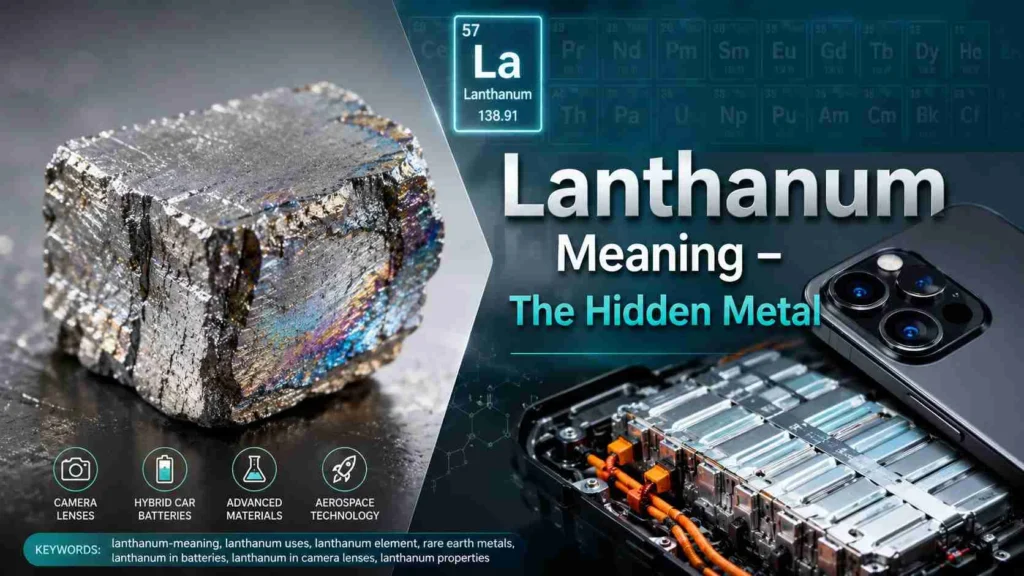

Lanthanum is a soft, silvery‑white rare earth metal (atomic number 57, symbol La) that reacts with air and stores hydrogen inside hybrid car batteries. It sharpens camera lenses and got its name from the Greek word lanthanein because it hid inside other minerals for centuries before anyone found it.
You have never held pure lanthanum. I can say that with confidence. It is not a metal you find at the hardware store or in a typical classroom collection. Yet you rely on it every single day. Every time you tap your phone screen, drive a hybrid car, or watch a bright television show, lanthanum is there. Quiet. Invisible. Essential.
So what does lanthanum actually mean? Let me walk you through it like a friendly chemist explaining things over coffee. No boring lectures. No fluff. Just real, useful knowledge.
What Is Lanthanum in One Simple Sentence
Lanthanum is a soft, silvery-white rare earth metal that reacts with air, conducts electricity, and makes your camera lenses sharper.
That is the core lanthanum meaning you need to remember. Everything else builds from here.
Let me break down the basics for you:
- Chemical symbol: La
- Atomic number: 57
- Element category: Rare earth metal and lanthanide
- Pronunciation: LAN-tha-num (rhymes with “plan than dumb” but much smarter)
The element sits right in the middle of the periodic table’s “f-block.” That is the row of elements that floats below the main chart. Most people skip over them. That is a mistake. These hidden metals run the modern world.
Table 1 | Lanthanum at a Glance
| Property | Value |
|---|---|
| Element name | Lanthanum |
| Chemical symbol | La |
| Atomic number | 57 |
| Atomic mass | 138.90547 u |
| Electron configuration | [Xe] 5d¹ 6s² |
| Most common oxidation state | +3 |
| Classification | Lanthanide / Rare earth metal |
| State at room temperature (20°C) | Solid |
| Color when fresh | Silvery white |
| Reactivity with air | High (tarnishes within hours) |
This table gives you the lanthanum definition in pure data form. Keep it bookmarked. You will come back to it.
The Hidden Origin of the Name Lanthanum
The word “lanthanum” comes from ancient Greek. Specifically from the word lanthanein. That Greek verb means “to lie hidden” or “to escape notice.”
Why such a secretive name? Because lanthanum hid inside other minerals for centuries. Chemists kept finding interesting rocks, but lanthanum refused to show its face.
Here is the real story.
In 1839, a Swedish chemist named Carl Gustaf Mosander studied a mineral called cerium nitrate. He noticed something strange. The cerium sample contained an impurity. Mosander could not see it directly. But he could measure its effects. The impurity changed how the material reacted with acids.
Mosander spent months isolating that impurity. He finally pulled out a new element. He named it lanthanum because it had hidden so well inside the cerium.
Think about that for a second. A grown man spent months hunting for a metal nobody knew existed. And he found it not by seeing it but by noticing what did not fit. That is real science.
Fun fact: Mosander later discovered two more elements hiding in similar rocks: erbium and terbium. The man had a nose for hidden metals.
Physical Properties | What Lanthanum Feels and Looks Like
Pure lanthanum is not dramatic. It will not shock you with bright colors or weird magnetic tricks. But its physical properties make it incredibly useful.
Let me describe it for you.
Freshly cut lanthanum looks like silver. Shiny. Bright. Almost pretty. But leave it on a lab bench for a few hours, and it changes. A dull grey film forms on the surface. That film is lanthanum oxide. The metal reacts with oxygen in the air. It is not angry about it. Just inevitable.
Here is what lanthanum feels like in your hand:
- Soft. You can cut it with a kitchen knife. Not a steak knife. A regular butter knife works.
- Malleable. You can hammer it into thin sheets without cracking.
- Ductile. You can pull it into a wire, though nobody does this commercially.
- Dense but not heavy. About the same density as zinc.
Table 2 | Physical Properties of Lanthanum
| Physical Property | Value |
|---|---|
| Melting point | 920°C (1688°F) |
| Boiling point | 3464°C (6267°F) |
| Density at room temperature | 6.146 g/cm³ |
| Hardness (Mohs scale) | 2.5 (similar to calcium) |
| Electrical resistivity | 615 nΩ·m (moderate conductor) |
| Thermal conductivity | 13.4 W/(m·K) |
| Magnetic ordering | Paramagnetic |
| Crystal structure at 25°C | Hexagonal |
| Crystal structure above 310°C | Face-centered cubic |
Notice the boiling point. Over 3400 degrees Celsius. That is higher than many steels. Lanthanum does not evaporate easily. That matters for certain high-temperature applications like carbon arc lamps.
The paramagnetic property is worth explaining. Paramagnetic means lanthanum responds very weakly to a magnet. It is not like iron. You cannot stick a lanthanum bar to your fridge. But if you put it inside a strong magnetic field, it aligns slightly. Remove the field, and it forgets instantly. No memory. No leftover magnetism.
Chemical Properties | How Lanthanum Behaves With Other Substances
Chemistry is about relationships. How does lanthanum treat its neighbors? Let me show you.
Lanthanum is a friendly metal. Too friendly sometimes. It reacts with almost everything except noble gases. That makes it tricky to store but fantastic for industrial chemistry.
The most important chemical fact about lanthanum: It almost always loses three electrons to become La³⁺. That +3 oxidation state is rock solid. You will never find natural lanthanum as La²⁺ or La⁴⁺ except in weird lab conditions.
Here is what happens when lanthanum meets common substances.
Air: The metal quickly forms a white oxide layer (La₂O₃). This layer flakes off. That exposes fresh metal underneath. So the reaction continues until the whole piece turns to powder. That is why labs store lanthanum under mineral oil or argon gas.
Water: Cold water reacts slowly. Hot water reacts fast. Both produce lanthanum hydroxide and hydrogen gas. The reaction is not violent like sodium or potassium. But it is steady.
Acids: Lanthanum dissolves eagerly in dilute sulfuric acid and hydrochloric acid. It releases hydrogen gas and leaves behind a clear solution of lanthanum salts.
Halogens: Lanthanum burns in chlorine gas. It forms lanthanum chloride. The reaction produces enough heat to melt the product.
Bases: Lanthanum metal does not react much with sodium hydroxide solutions. But lanthanum oxide does. It acts like a base and neutralizes acids.
Table 3 | Chemical Properties of Lanthanum
| Chemical Partner | Product Formed | Speed of Reaction | Special Notes |
|---|---|---|---|
| Oxygen (air) | Lanthanum oxide (La₂O₃) | Moderate | Tarnishes within hours |
| Water (cold) | Lanthanum hydroxide + H₂ | Slow | Bubbles form over minutes |
| Water (hot) | Lanthanum hydroxide + H₂ | Fast | Significant hydrogen release |
| Hydrochloric acid | Lanthanum chloride + H₂ | Very fast | Dissolves completely |
| Sulfuric acid | Lanthanum sulfate + H₂ | Fast | Forms soluble salt |
| Chlorine gas | Lanthanum chloride (LaCl₃) | Fast (burns) | Exothermic reaction |
| Nitrogen gas | Lanthanum nitride (LaN) | Slow at room temp | Faster when heated |
| Carbon dioxide | Lanthanum carbonate | Slow | Not a common reaction |
The +3 oxidation state governs everything lanthanum does. Once you understand that, you understand the whole element.
Where You Actually Find Lanthanum
You will never dig up pure lanthanum. It does not exist naturally as a metal. The Earth hides lanthanum inside minerals. Usually mixed with other rare earth elements.
Here are the main lanthanum-bearing minerals:
- Monazite sand – The most important commercial source. This reddish-brown sand contains 20-30% rare earth oxides. Lanthanum makes up about 25% of that mix.
- Bastnäsite – A yellow-brown mineral found in carbonatite rocks. Contains 40-50% rare earth oxides.
- Cerite – A rare silicate mineral. Historically important but not mined much today.
- Allanite – A dark brown to black mineral. Contains smaller percentages but is more widespread.
Where in the world does lanthanum come from?
China dominates. I mean really dominates. About 70% of global rare earth mining happens in China. The Bayan Obo mine in Inner Mongolia is the largest rare earth deposit on Earth.
Other producing countries include:
- United States (Mountain Pass mine in California)
- Australia (Mount Weld)
- Russia
- Brazil
- India
How abundant is lanthanum in the Earth’s crust?
About 39 milligrams per kilogram of crust. That number means nothing by itself. So let me give you context.
Lanthanum is three times more common than lead. It is ten times more common than tin. It is one hundred times more common than silver. So lanthanum is not rare in the ground. The “rare” in rare earth elements refers to how difficult they are to separate. Not how scarce they are.
One surprising fact: Lanthanum is more abundant than copper in some geological provinces. But we do not mine it like copper because it never forms concentrated veins. It always spreads out inside other minerals.
Table 4 | Top 5 Real-World Uses of Lanthanum
| Use | How Lanthanum Helps | Real Product Example |
|---|---|---|
| Camera and telescope lenses | Lanthanum oxide creates high-refractive-index glass. This bends light more sharply. Result: sharper images and less color distortion. | Most smartphone camera lenses contain lanthanum glass. So do high-end binoculars. |
| Hybrid car batteries (NiMH type) | Lanthanum-nickel hydride stores hydrogen atoms in the battery anode. The battery then releases those hydrogen atoms as electricity. | Toyota Prius, Honda Civic Hybrid, Ford Escape Hybrid |
| Projector and TV phosphors | Lanthanum oxysulfide glows bright red when electrons hit it. That red combines with green and blue to make full color. | Older plasma TVs. Some LED projectors. X-ray intensifying screens. |
| Petroleum refining | Fluid catalytic cracking (FCC) catalysts use lanthanum to break long crude oil molecules into gasoline. The catalyst lasts longer with lanthanum. | Every modern oil refinery on Earth |
| Carbon arc lamps | Lanthanum added to carbon rods makes the arc brighter and more stable. | Old movie projectors. Searchlights. Studio lighting (less common now). |
Let me expand on the battery use because it matters most to people.
The Toyota Prius uses a nickel-metal hydride (NiMH) battery. Each battery contains about 10 to 15 kilograms of lanthanum. Not as lanthanum metal. But as a lanthanum-nickel alloy called LaNi₅. This alloy forms a hydride. That means it soaks up hydrogen like a sponge soaks up water.
When you drive the Prius, the battery releases that hydrogen. The release produces electrons. Those electrons flow as electricity to the electric motor. When you brake, the motor reverses and pushes electrons back into the battery. That forces hydrogen back into the lanthanum-nickel alloy.
The system works for hundreds of thousands of miles. And it works because lanthanum forms that hydride better than almost any other metal.
How Do You Actually Pronounce Lanthanum?
I have heard people say “lan-THAY-num.” I have heard “LAN-tha-numb.” Both are wrong.
The correct pronunciation is LAN-tha-num.
Say it with me: LAN (like “land” without the D). THA (like “thaw” without the W). NUM (like “number” without the BER).
Three syllables. Stress the first one. LAN-tha-num.
Here is an example sentence you might actually say:
“My phone’s camera uses lanthanum glass, which is why the photos look sharper than my old phone.”
Dictionary meaning (short version):
A soft, ductile, silver-white metallic element of the lanthanide series. It tarnishes in air and is used in alloys, glass, and catalysts.
Dictionary meaning (technical version from IUPAC):
Lanthanum is a chemical element with symbol La and atomic number 57. It is the first element of the lanthanide series and exhibits the +3 oxidation state in all its stable compounds.
Table 5 | Lanthanum vs Other Lanthanides
| Element | Symbol | Atomic Number | Main Difference From Lanthanum | Real-World Difference |
|---|---|---|---|---|
| Lanthanum | La | 57 | The starting point. Sets the pattern for all lanthanides. | Best hydride former. Best for NiMH batteries. |
| Cerium | Ce | 58 | Oxidizes even faster than lanthanum. Changes color from silver to yellow to purple. | Used in self-cleaning ovens and catalytic converters. |
| Praseodymium | Pr | 59 | Creates intense yellow-green colors in glass. Lanthanum does not. | Welder’s goggles and high-end yellow glass. |
| Neodymium | Nd | 60 | Forms incredibly strong permanent magnets. Lanthanum magnets are weak. | Neodymium magnets in hard drives and headphones. |
| Samarium | Sm | 62 | Has stable +2 oxidation state. Lanthanum only does +3. | Samarium-cobalt magnets for high-temperature use. |
| Europium | Eu | 63 | Glows bright red in TV phosphors. Lanthanum glows much less. | Red in euro banknotes (anti-counterfeiting). |
| Gadolinium | Gd | 64 | Strongly magnetic at room temperature. Lanthanum is weakly paramagnetic. | MRI contrast agent (injectable). |
| Terbium | Tb | 65 | Produces green phosphors for fluorescent lamps. | Energy-saving light bulbs. |
What does this table tell you? Lanthanum is not the strongest, not the brightest, not the most magnetic. It is the most stable hydride former. That is its superpower.
Lanthanum in the Periodic Table | Where It Belongs
Open any periodic table. Look at the main grid. You will see two rows floating below. Those are the lanthanides (row one) and actinides (row two).
Lanthanum sits at the very start of the lanthanide row. But here is where it gets tricky.
Some periodic tables place lanthanum in the main grid at position 57. Others place lutetium (element 71) there. This is a real debate among chemists. I am not joking. Grown scientists argue about where to draw a box on a chart.
Here are the cold, hard facts:
- Period: 6 (meaning it has six electron shells)
- Group: 3 (same group as scandium and yttrium)
- Block: f-block (electrons fill the 4f subshell)
- Electron configuration: [Xe] 5d¹ 6s²
Notice something unusual. The 4f subshell is empty in neutral lanthanum. But the next element, cerium, starts filling 4f. That makes lanthanum the “template” for all lanthanides. Every other lanthanide copies its structure but adds f-electrons.
Think of lanthanum as the architectural blueprint. Every other lanthanide builds a slightly different house using the same blueprint.
Is Lanthanum Dangerous? The Honest Answer
You can hold a piece of lanthanum metal. Nothing bad will happen. Wash your hands after. Do not lick it. Do not grind it into powder and inhale it.
That is the short version. Here is the longer medical truth.
Lanthanum has low acute toxicity. That means one accidental exposure will not hurt you. Laboratories handle lanthanum salts with normal gloves and basic safety glasses.
But there are three specific risks:
Risk one: Powder inhalation
If you grind or sand lanthanum metal, the fine powder can irritate your lungs. It causes a condition called pneumoconiosis in severe, repeated exposures. That is a fancy word for “dusty lung.” Miners and refiners face this risk. You do not.
Risk two: Soluble salts
Lanthanum chloride and lanthanum nitrate dissolve in water. In very high doses (grams, not milligrams), these salts affect liver function in animal studies. No human has ever died from lanthanum poisoning in medical literature.
Risk three: The medical use is ironic
Doctors prescribe lanthanum carbonate (brand name Fosrenol) to kidney dialysis patients. The drug binds to phosphate in the gut. That prevents phosphate buildup in the blood. So lanthanum is both a potential irritant and a life-saving medicine. Chemistry is weird.
Safe handling rules for normal people:
- Wash hands after touching any lanthanum compound
- Do not eat or drink near lanthanum powders
- Keep lanthanum metal under oil or in a sealed container
- If you cut lanthanum metal, do it in a ventilated area
Bottom line: Lanthanum is not radioactive. It is not lead. It is not mercury. Treat it with normal respect, and it will not hurt you.
Lanthanum in Nature | The Extraction Story
Mining companies do not dig up pure lanthanum. They dig up monazite sand or bastnäsite ore. Then begins a long, expensive separation process.
Here is how it works in simple steps.
Step one – Crushing
The ore arrives at a processing plant. Machines crush it into fine powder.
Step two – Acid leaching
Hot sulfuric acid dissolves the crushed ore. Almost everything goes into solution. Lanthanum, cerium, neodymium, thorium, uranium, and iron all dissolve together.
Step three – Solvent extraction
This is the magic step. Chemists add an organic solvent that selectively grabs some rare earths but not others. They adjust the pH. They adjust the temperature and they run the mixture through dozens of mixing and settling tanks.
After 50 to 100 stages, the lanthanum separates from the other rare earths. The purity reaches 99% or higher.
Step four – Conversion to metal
Lanthanum oxide (La₂O₃) goes into a furnace. The furnace heats it to 1000°C. A current passes through. The oxygen leaves as carbon dioxide. Pure lanthanum metal collects at the bottom.
This process is called molten salt electrolysis. It is expensive. It uses huge amounts of electricity. That is why lanthanum costs more than steel or aluminum.
Current market price (as of 2024-2025):
- Lanthanum oxide: $2 to $5 per kilogram
- Pure lanthanum metal: $50 to $100 per kilogram
Compare that to copper at $9 per kilogram. Lanthanum is not crazy expensive. But it is not cheap either.
The Quiet Role of Lanthanum in Optics
Here is something most people never learn. Lanthanum oxide changes how glass bends light. Normal glass (soda-lime glass) has a refractive index around 1.5. Lanthanum glass reaches 1.8 or higher.
Why does that matter?
Because high-index glass lets you make thinner lenses with the same focusing power. A traditional camera lens needs several glass elements stacked together. Each element corrects the distortion from the previous one. That gets bulky.
Lanthanum glass does more bending per millimeter. So you need fewer elements. The lens becomes smaller, lighter, and sharper.
Where you find lanthanum glass right now:
- Every smartphone camera lens (especially the main wide camera)
- DSLR and mirrorless camera lenses (Canon, Nikon, Sony)
- High-end binoculars and spotting scopes
- Microscope objective lenses
- Telescope eyepieces
- Rifle scopes (military and hunting)
One specific example: The Canon 50mm f/1.8 lens (the “nifty fifty”) contains lanthanum glass elements. That lens costs around $125. It takes incredibly sharp photos. The lanthanum glass is why.
But there is a catch. Older lanthanum glass from the 1970s and 1980s sometimes contains thorium. Thorium is radioactive. Not dangerously so. But enough to make some vintage lenses slightly brown over decades. Modern lanthanum glass uses no thorium. Safe and clear.
Lanthanum in Batteries | The Technical Deep Dive
I promised deep knowledge. Here it is.
Nickel-metal hydride (NiMH) batteries work because of lanthanum. But not pure lanthanum. A specific alloy called LaNi₅ (one lanthanum atom for every five nickel atoms).
Why does LaNi₅ work so well?
Because it forms a reversible hydride. At room temperature and moderate pressure (about 2-3 atmospheres), hydrogen atoms slide into the gaps between lanthanum and nickel atoms. The alloy swells slightly. About 10% by volume.
Then, when you need electricity, you lower the pressure. The hydrogen atoms slide back out. That releases electrons. The electrons flow through your car’s wiring to the electric motor.
Here are the cold numbers for LaNi₅:
- Hydrogen storage capacity: 1.4% by weight
- Cycles before failure: Over 5000 charge-discharge cycles
- Operating temperature range: -20°C to 60°C
- Cost: About $30 per kilogram for the alloy
A Prius battery contains approximately 168 individual cells. Each cell uses lanthanum-nickel alloy in the negative electrode. The positive electrode uses nickel hydroxide. The electrolyte is potassium hydroxide solution.
The battery weighs about 40 kilograms. Lanthanum makes up roughly 10 kilograms of that weight.
Why not lithium-ion for hybrids? Lithium-ion stores more energy per kilogram. But NiMH handles cold weather better. It tolerates overcharging without catching fire. And it lasts longer in partial charge conditions (which happens constantly in a hybrid). Lanthanum makes all of that possible.
Lanthanum in Petroleum Refining | The Invisible Workhorse
You drive a gasoline car. That gasoline came from crude oil. Crude oil would not become gasoline without lanthanum.
Here is the chemistry.
Crude oil contains long hydrocarbon chains. Some chains have 20, 30, even 50 carbon atoms. Those long chains do not burn well in an engine. They gum up the works.
Refineries need to crack those long chains into shorter ones. Gasoline uses chains of 8 to 12 carbons.
Enter fluid catalytic cracking (FCC).
FCC units heat crude oil to 500°C. Then they spray it onto a hot, sand-like catalyst. That catalyst is a zeolite (a porous aluminosilicate mineral). But the zeolite needs help. On its own, it loses activity after a few hours.
Lanthanum solves the problem. Refineries exchange lanthanum ions into the zeolite structure. Those lanthanum ions stabilize the zeolite. They prevent the aluminum atoms from moving around at high temperatures.
The result: The catalyst lasts for years instead of days. Each refinery processes millions of barrels of crude oil. Each barrel of gasoline you buy passed through a lanthanum-containing catalyst.
How much lanthanum does a refinery use? About 100 to 200 tons per year for a large refinery. That sounds like a lot. But spread across all the gasoline produced, it is a tiny amount per gallon.
Without lanthanum, gasoline would cost much more. Refineries would shut down every week to replace dead catalyst. That is the hidden value of this element.
Lanthanum vs Other Rare Earths | A Friendly Comparison
People group all rare earths together. That is lazy. Each one has a unique personality. Let me compare them like musicians in a band.
Lanthanum (La) – The bass player
You do not notice it. But take it away, and the whole song falls apart. Reliable. Steady. Essential.
Cerium (Ce) – The guitarist who changes pedals constantly
Oxidizes eagerly. Changes color. Used in self-cleaning ovens and catalytic converters. Flashy and useful.
Praseodymium (Pr) – The keyboardist with yellow sunglasses
Creates intense yellow-green colors. Used in welder’s goggles. Rare in everyday life but irreplaceable in its niche.
Neodymium (Nd) – The lead singer
Everyone knows neodymium. Strongest permanent magnets. Used in hard drives, headphones, and wind turbines. Famous. Glamorous. Expensive.
Europium (Eu) – The lighting designer
Glows bright red in TV screens and euro banknotes. Not much else. But that one job is critical.
Lanthanum does not want to be famous. It wants to work quietly. And that is fine. Bass players rarely get the glory. They still get paid.
Lanthanum Meaning Across Three Levels of Understanding
Let me summarize the lanthanum meaning in three different depths. Pick the one you need.
Kid-friendly version:
Lanthanum is a shiny metal that hides inside rocks. It helps make TV colors bright and car batteries last a long time.
Student-friendly version:
Lanthanum (atomic number 57) is a soft, reactive rare earth metal. It forms stable +3 compounds and stores hydrogen in NiMH batteries. You also find it in camera lenses and oil refinery catalysts.
Chemistry professional version:
Lanthanum (La) is the first f-block element in the lanthanide series. It exhibits an exclusive +3 oxidation state with electron configuration [Xe] 5d¹ 6s². The oxide (La₂O₃) provides high refractive index for optical glass. The intermetallic compound LaNi₅ forms a reversible hydride used in NiMH battery anodes. In FCC catalysts, La³⁺ ions stabilize zeolite structures against hydrothermal degradation.
Pick your level. All are correct.
Interesting Lanthanum Facts You Can Drop at Parties
Here is a list of genuine, useful facts. No filler.
- Lanthanum was the first rare earth element discovered in pure form. Not the first found. The first isolated.
- A single Toyota Prius battery contains about 10 kilograms of lanthanum. That is roughly the weight of two bowling balls.
- Lanthanum carbonate is a prescription drug. Kidney patients take it to control phosphate levels. The brand name is Fosrenol.
- Lanthanum has no known biological role. Your body contains trace amounts. Those amounts do nothing useful or harmful.
- The monazite sands of India contain lanthanum. So do the beaches of Florida. You have walked on lanthanum and never known it.
- Lanthanum glass was a military secret during World War II. The US Army used it for tank periscopes and artillery sights.
- Lanthanum burns at about 800°C. That is hot enough to melt aluminum but not hot enough to melt steel.
- The deep sea contains lanthanum. Ferromanganese nodules on the ocean floor hold rare earths including lanthanum. No one mines them yet. Too expensive.
The Future of Lanthanum | What Comes Next
Lanthanum is not going anywhere. Demand will grow. Here is why.
Electric vehicles are switching to lanthanum-free batteries. That sounds bad for lanthanum. But hear me out. Lithium-ion now dominates EVs. NiMH survives in hybrids. Hybrids are not dying. Toyota still sells millions of Priuses and Corolla Hybrids each year. That steady demand continues.
Hydrogen storage is the real future. Lanthanum-nickel alloys store hydrogen at room temperature and modest pressure. Compressed hydrogen tanks need 700 atmospheres. Dangerous. Expensive. Lanthanum hydride needs 2 atmospheres. Much safer.
If hydrogen fuel cell cars ever become mainstream (big if), lanthanum demand explodes. Each hydrogen tank would contain dozens of kilograms of LaNi₅.
Optics keep growing. Smartphones now have three, four, even five cameras per phone. Each camera lens uses lanthanum glass. More cameras means more lanthanum.
Recycling will change everything. Right now, we mine lanthanum. We use it. We throw it away in dead batteries and old phones. That is stupid. Japan already recycles rare earths from electronic waste. The US and Europe will follow. Recycled lanthanum costs less and avoids Chinese dominance.
Bottom line on the future: Lanthanum will not become a celebrity metal like lithium or cobalt. But it will not fade away either. Steady demand. Steady price and Steady importance.
FAQs
1. What is lanthanum in simple words?
Lanthanum is a soft, silvery metal that hides inside rocks. You won’t find it pure in nature. It helps make your phone camera sharper and your hybrid car battery last longer.
2. Is lanthanum dangerous to touch or use?
No, solid lanthanum is safe to handle briefly. Just wash your hands after. The real risk comes from inhaling its powder or eating large amounts of its salts.
3. Where is lanthanum found on Earth?
Miners dig it up from monazite sand and bastnäsite ore. China produces about 70% of the world’s supply. You’ll also find deposits in the US, Australia, Brazil, and India.
4. Why is lanthanum called a “rare earth” metal?
The name is misleading because lanthanum isn’t actually rare. It’s three times more common than lead. The “rare” refers to how hard it is to separate from other similar metals.
5. Does lanthanum have any medical use?
Yes, doctors prescribe lanthanum carbonate (Fosrenol) to kidney dialysis patients. The drug binds to phosphate in your gut. This prevents dangerous phosphate buildup in your blood.
6. Can I recycle lanthanum from old electronics?
Yes, and Japan already does this on a large scale. Old hybrid batteries, smartphone cameras, and hard drives contain recoverable lanthanum. Recycling reduces the need for new mining.
Conclusion
You started this article asking for the lanthanum meaning. Now you have it. Not just a dictionary definition. A full picture.
Lanthanum is a soft, silvery metal that hides in plain sight. It sharpens your camera photos. Or it starts your hybrid car. It brightens your television and it refines your gasoline. And it does all of this without asking for credit.
The Greek name lanthanein means “to lie hidden.” That is perfect. Lanthanum hides in your phone. Hides in your car. Hides in the ground. But now you see it.
Next time someone asks you “what is lanthanum,” you have an answer. Not a boring one. A real, useful, interesting answer. You can tell them about the Prius battery. Or the camera lens. Or the Greek chemist who found a hidden metal inside a hidden rock.
That is the real lanthanum meaning. A quiet workhorse that makes modern life possible. And now you know its secret.
Discover More Related Articles:
- “Glaze” Meaning Slang: What It Really Means in Internet Conversations In 2026
- “67” Meaning Slang: How It’s Used in Online Conversations In 2026
- “Cap” Slang Meaning: From Street Language to Social Media in 2026